

Crestron’s latest push into networked audio—DM NAX Intelligent Audio, built around the new DM NAX AP-100 audio processor—is a clear bet on the next phase of hybrid meetings: not just clearer sound for humans, but crystal‑clear audio for machine listeners. The product family brings a network‑first approach to meeting‑room audio, combining AES67 compatibility, PoE endpoints, direction‑of‑arrival speaker tracking, and onboard DSP tuned for modern transcription and meeting‑AI workflows. For organizations rolling out Microsoft® Copilot, Zoom Companion, or other agentic assistants, Crestron is arguing that the basic infrastructure of a room—its microphones, speakers, and network—must be treated as the AI agent’s ears. This article synthesizes the technical details, deployment implications, and practical tradeoffs of that thesis, and offers guidance for IT, AV integrators, and procurement teams deciding whether to standardize on DM NAX for AI‑ready meeting rooms.
Hybrid meeting quality has long been limited by inconsistent audio capture: bad mic placement, consumer hardware, and unmanaged room acoustics all conspire to produce garbled transcripts, missed speaker attributions, and opaque meeting summaries. As AI moves from optional to integral—used for live transcription, multi‑language interpretation, automatic note generation, and even agentic meeting assistants—the audio layer becomes mission critical. Crestron’s DM NAX Intelligent Audio is positioned as a turnkey answer: a PoE, AES67‑based audio fabric that promises fast installs, validated room templates, and DSP tuned to make AI tools more reliable.
At its core:
Key practical benefits:
What AES67 means in practice:
Benefits:
That said, success is not plug‑and‑play in the organizational sense. AES67 and AoIP bring real network and security responsibilities; integrations with transcription and agentic AI require policy and model‑selection decisions; and the financial case must balance hardware and network upgrades against the productivity gains AI promises.
For AV managers and IT leaders, the sensible path is pragmatic:
Conclusion: DM NAX Intelligent Audio is a timely and technically mature platform that recognizes audio as the foundation of useful meeting AI. Its strengths lie in networked PoE simplicity, AES67 interoperability, and DSP tuned for transcription and agent workflows. But to realize the promises, organizations must invest in network readiness, security, and governance—the non‑sexy plumbing that ultimately determines whether AI will help people work smarter or simply generate noisier meeting records.
Source: avinteractive.com Intelligent Audio for AI — and More | AV Magazine
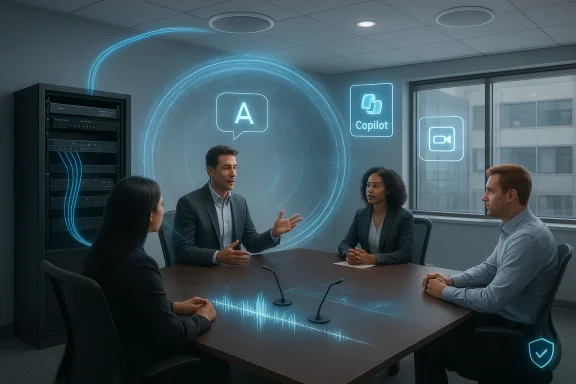 Background / Overview
Hybrid meeting quality has long been limited by inconsistent audio capture: bad mic placement, consumer hardware, and unmanaged room acoustics all conspire to produce garbled transcripts, missed speaker attributions, and opaque meeting summaries. As AI moves from optional to integral—used for live transcription, multi‑language interpretation, automatic note generation, and even agentic meeting assistants—the audio layer becomes mission critical. Crestron’s DM NAX Intelligent Audio is positioned as a turnkey answer: a PoE, AES67‑based audio fabric that promises fast installs, validated room templates, and DSP tuned to make AI tools more reliable.At its core:
- The DM NAX AP-100 audio processor orchestrates endpoints and provides the DSP necessary for echo cancellation, automatic gain control, noise reduction, and auto‑mixing.
- A lineup of PoE‑powered Saros speakers and upcoming Mic + Speaker (MIC‑SPK) Pods serve as endpoints; third‑party AES67 equipment is supported for interoperability.
- “Direction of Arrival” (DOA) audio and speaker‑tracking features enable the system to locate active talkers and improve speaker attribution for video systems and transcripts.
- The platform intentionally emphasizes pre‑validated configurations so integrators can deploy with predictable results rather than tuning each room from scratch.
What DM NAX Intelligent Audio actually brings to a room
Network‑first architecture and PoE simplicity
Crestron designed DM NAX as a networked audio platform where endpoints are powered and connected via Ethernet. That reduces cable complexity (one cable for data + power), lowers installation time, and aligns audio devices with standard IT provisioning and monitoring tools. PoE endpoints simplify retrofits: no dedicated speaker cabling or local power drops in many installations.Key practical benefits:
- Faster electrical and cabling work orders.
- Centralized device management and firmware rollout.
- Easier scaling: add a PoE mic array or speaker and the AP‑100 discovers and configures it.
AES67 interoperability
DM NAX uses AES67 as its audio‑over‑IP interoperability layer. That matters because AES67 is a broadly accepted professional standard for streaming audio between vendors; it enables mixing Crestron endpoints with Dante, RAVENNA, and other AoIP ecosystems where vendors implement the standard correctly.What AES67 means in practice:
- Integrators can use third‑party mics (e.g., Sennheiser TeamConnect ceiling arrays) where appropriate.
- Audio streams can be routed between devices and systems across properly configured LANs.
- There are network preconditions—PTP timing (IEEE‑1588), QoS, multicast handling—that must be implemented to meet AES67’s low‑latency and stability promises.
Onboard DSP tuned for AI workflows
Built‑in digital signal processing on the AP‑100 and endpoint arrays provides the audio hygiene modern tools rely on:- Acoustic Echo Cancellation (AEC) to remove playback leaks that confuse transcription and speaker recognition.
- Automatic Gain Control (AGC) and level‑compensation so speakers at varying distances are normalized.
- Noise reduction and automatic mic‑mixing to suppress ambient sounds and prioritize active talkers.
- Direction of Arrival and speaker tracking, so the system can inform cameras and meeting agents who is talking.
Pre‑validated room configurations and auto‑discovery
Rather than expecting integrators to design DSP from scratch for each room, Crestron provides validated designs for common room sizes and shapes. Devices use auto‑discovery so a DM NAX deployment can “come up” quickly, with less manual routing and fewer field adjustments.Benefits:
- Faster time‑to‑audio for large rollouts.
- Predictable, repeatable performance across multiple rooms.
- Reduced need for highly specialized acoustic tuning at every site.
Why audio matters to AI — and to business outcomes
AI tools are only as good as the data they receive. For meeting AI, the raw input is speech. Poor audio results in:- Mis‑transcriptions that change the meaning of decisions.
- Missed action items or incorrect speaker attribution.
- Lower trust in automated meeting summaries, which reduces usage and ROI.
- Failures of agentic assistants that rely on accurate, time‑aligned inputs to act on behalf of users.
Strengths: where DM NAX plays to Crestron’s advantages
- Networked, IT‑friendly architecture. DM NAX aligns AV endpoints with IT toolchains (PoE, SNMP, centralized firmware), reducing operational friction for enterprise rollouts.
- Interoperability via AES67. Because AES67 is a cross‑vendor standard, organizations aren’t entirely locked into a single microphone or amplifier vendor.
- Pre‑validated configurations and auto‑discovery. These lower the barrier for scaling to dozens or thousands of rooms with repeatable performance.
- DSP tuned for AI transcription and agents. End‑to‑end tuning—from capture to processor—improves the quality of downstream automated processes such as meeting summarization and language translation.
- Speaker tracking and DOA features. These improve camera selection and speaker attribution for video systems and meeting records.
- Single‑cable installs. For renovated spaces or office campuses, PoE reduces civil works and total install hours.
Risks and limitations integrators and IT must consider
The technical promise is real, but realistic deployments confront several non‑trivial risks:1) Network complexity and prerequisites
AES67 and stable AoIP operation require enterprise‑grade networking:- Precision Time Protocol (PTP) implementation across switches.
- Correct QoS prioritization for audio RTP streams.
- Managed multicast handling (IGMP snooping and queriers).
- Sufficient PoE budget and consideration of switch power classes.
2) Security and privacy surface area
Turning meeting audio into multicast streams on the corporate LAN increases the attack surface if not properly segmented and secured:- Audio streams must be isolated on VLANs with restricted access.
- Access controls and logging should be enforced so only authorized services (e.g., recording, transcription) can subscribe.
- Enterprises must consider policy and compliance: where are recordings stored, who can access AI‑generated transcripts, and how long are those artifacts retained?
3) AES67 caveats and vendor nuances
AES67 is an interoperability standard, but in the real world:- Implementation details (sample rates, payload IDs, PTP profiles) differ between vendors and sometimes require manual compatibility modes.
- Dante/AES67 interplay may impose sample rate limitations or configuration constraints when devices are switched into AES67 mode.
- Integrators need to run interoperability tests (plugfests) for mixed fleets.
4) Cost and lifecycle considerations
PoE endpoints and validated DSP hardware are not cheap. The total cost of ownership must include:- Managed switch upgrades and PoE capacity increases.
- Ongoing firmware management and support contracts.
- Replacement cycles for room endpoints as AI features evolve.
5) Overpromising on “AI‑readiness”
The narrative that better audio alone will solve downstream AI problems is optimistic. High‑quality audio reduces one major error source, but AI outputs still depend on:- The quality of the AI models used for transcription/summary.
- Privacy‑safe data handling and model fine‑tuning.
- Proper integration and testing between room audio streams and cloud or edge AI services.
Practical deployment checklist — from specs to steady state
If you’re evaluating DM NAX for an enterprise roll‑out, use this structured approach:- Network readiness audit
- Validate switch PTP (IEEE‑1588) support and configuration.
- Confirm PoE budget on edge switches; verify per‑port wattage for proposed endpoints.
- Configure VLANs, IGMP snooping, and QoS policies for RTP streams.
- Choose pre‑validated room templates
- Map each physical space (huddle, conference, boardroom) to a Crestron validated configuration to reduce tuning time.
- Endpoint and mic selection
- Decide between MIC‑SPK pods, Saros PoE speakers, or AES67 third‑party mics based on ceiling height and room usage.
- Security and compliance planning
- Segment audio streams; restrict subscription access.
- Define retention, access, and audit policies for recordings and transcriptions.
- Ensure legal review for multi‑jurisdictional recording and data‑protection rules.
- Install and verify
- Leverage auto‑discovery to bring devices online, then validate DSP settings using test recordings and live meetings.
- Verify AEC, AGC, noise reduction in typical meeting scenarios—loud participants, multi‑language speakers, and remote presentations.
- Integrate with AI services
- Test transcription quality with target services (Microsoft® Copilot, Zoom Companion).
- Verify speaker attribution when pairing with intelligent camera systems.
- Monitor and iterate
- Establish monitoring for stream health, switch CPU/PoE load, and firmware updates.
- Collect user feedback and adjust validated templates as necessary.
Deployment patterns: where DM NAX makes the most sense
- Large enterprises standardizing on Microsoft 365 and Copilot where consistent transcript quality is a requirement.
- Campuses (higher education, government) that need uniform experience across hundreds of rooms and centralized management.
- Hybrid workplaces where meeting summaries and AI agents are part of the knowledge workflow.
- Training and distance‑learning facilities where clear audio materially affects learning outcomes and automated captioning.
Integration with Microsoft® Copilot and meeting AI: practical considerations
Crestron has positioned DM NAX as tuned for Microsoft 365® Copilot and similar meeting assistants. That tuning manifests as:- DSP presets optimized for speech intelligibility and the audio bands most important to ASR (automatic speech recognition).
- DOA and speaker tracking data that help attribute audio to identified faces in intelligent video pipelines.
- Low latency audio paths that reduce desync between audio and the time‑aligned AI transcripts.
- Edge vs. cloud processing: Where does the transcription occur? On‑prem edge processing reduces privacy concerns and latency; cloud services may offer superior model quality but increase data movement.
- Credential flows and APIs: Ensure your meeting AI has the right access (with least privilege) to audio streams.
- Model performance: Different ASR models have varying tolerances for accents, overlapping speech, and background noise—confirm the combination of DM NAX capture + chosen ASR yields acceptable accuracy for your use cases.
Security, privacy, and governance — don’t treat them as afterthoughts
For organizations deploying AI‑enabled meeting rooms at scale, governance matters as much as technology:- Define who can enable recording and agent attendance in meetings.
- Make transcript access auditable and restrict long‑term storage of raw audio unless needed.
- Train staff and define policies around when AI agents may join meetings and what they are allowed to do (summarize, action, access company data).
- Ensure firmware and management interfaces use encrypted management channels and role‑based access control.
Final assessment: where this fits in the enterprise AV roadmap
Crestron’s DM NAX Intelligent Audio is a well‑executed realization of an obvious technical trend: meeting AI needs enterprise‑grade audio capture. The product plays to Crestron’s strengths—large integrator relationships, pre‑validated room designs, and deep experience in AV/IT convergence—and it addresses a genuine pain point for AI workflows: noisy, inconsistent audio.That said, success is not plug‑and‑play in the organizational sense. AES67 and AoIP bring real network and security responsibilities; integrations with transcription and agentic AI require policy and model‑selection decisions; and the financial case must balance hardware and network upgrades against the productivity gains AI promises.
For AV managers and IT leaders, the sensible path is pragmatic:
- Start with a pilot in a controlled environment (a few rooms and a managed set of meetings).
- Validate audio quality improvements with your chosen AI stack (Copilot, Zoom Companion, or other).
- Quantify improvements in transcript accuracy, time saved for meeting follow‑up, and user satisfaction before committing to estate‑wide rollouts.
Quick reference: recommended questions to ask your integrator before buying
- How will AES67 streams be secured and segmented on our LAN?
- Do our switches support PTP (IEEE‑1588) and the PoE budget required for the planned endpoints?
- Which validated room templates match our typical room sizes and use cases?
- How is speaker tracking exposed to our video systems and transcription services?
- What are the full lifecycle costs (hardware, network upgrades, support, licensing) for the rollout?
- Can we run a pilot where we measure ASR accuracy before and after deployment?
- What governance controls are available to manage agent attendance and transcript access?
Conclusion: DM NAX Intelligent Audio is a timely and technically mature platform that recognizes audio as the foundation of useful meeting AI. Its strengths lie in networked PoE simplicity, AES67 interoperability, and DSP tuned for transcription and agent workflows. But to realize the promises, organizations must invest in network readiness, security, and governance—the non‑sexy plumbing that ultimately determines whether AI will help people work smarter or simply generate noisier meeting records.
Source: avinteractive.com Intelligent Audio for AI — and More | AV Magazine
