

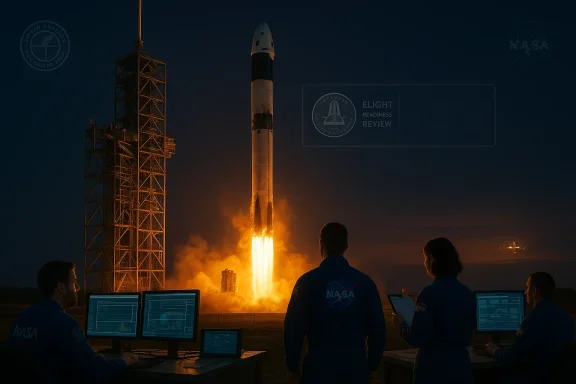
NASA and SpaceX are now targeting a pre-dawn liftoff on February 11, 2026, after the Federal Aviation Administration and NASA completed a rapid review of a recent Falcon 9 upper‑stage anomaly and cleared the vehicle and Crew Dragon for the next crew rotation to the International Space Station.
The upcoming Crew‑12 mission will lift off from Space Launch Complex 40 at Cape Canaveral, carrying four crewmembers aboard SpaceX’s Crew Dragon capsule to restore a full International Space Station (ISS) complement. The clearance to proceed follows an investigation into an “off‑nominal condition” experienced by a Falcon 9 second stage during preparation for a deorbit burn after a recent Starlink mission. That anomaly briefly grounded Falcon 9 flights while SpaceX and federal regulators evaluated root cause, mitigations, and the implications for human spaceflight.
This episode illustrates how tightly integrated modern space operations are with regulatory oversight and international station commitments: a single upper‑stage irregularity on an expendable portion of a launch vehicle can ripple through crew rotation plans, research schedules, and operational staffing aboard the ISS. The rapid investigative timeline and coordinated decision to resume crew launches offer a useful case study in risk management, technical troubleshooting, and the balance between operational tempo and safety.
The technical descriptions issued by SpaceX and summarized by independent press coverage indicate the anomaly was associated with behavior of the second‑stage Merlin vacuum engine and related propellant systems during post‑mission operations. Reported symptoms include an inability to complete the scheduled deorbit ignition, the use of passivation procedures (venting propellant and dissipating stored energy), and ultimately an uncontrolled or atypical reentry trajectory relative to expectations.
While the upper stage is not reused like the Falcon 9 first stage, its controlled disposal is essential to minimize orbital debris and public risk. That disposal depends on post‑mission engine firings and propellant management—systems that are outside the mission’s primary satellite delivery but still critical to overall flight safety.
Key elements of the review process included:
It’s important to stress that the failure mode—affecting a disposal burn after the primary payload was delivered—differs from an ascent or orbital insertion failure. Nonetheless, any anomaly in flight hardware prompts careful systems engineering reviews because latent issues in design, assembly, or operations could manifest in other mission phases if not properly constrained.
Why these are meaningful:
Typical corrective actions that meet FAA expectations include:
Key policy takeaways from this incident:
For policymakers, the episode shows the value of capable regulatory oversight that balances public safety with operational continuity. For the public, it reinforces that commercial providers are now central to human spaceflight, and that sustaining high access to low Earth orbit depends on both rapid innovation and disciplined safety governance.
That said, the incident is a reminder that maintaining a resilient human presence in low Earth orbit requires not only routine launches but continuous improvement in vehicle reliability, deeper telemetry insight, and unwavering regulatory attention. As Crew‑12 prepares to launch, engineers, mission managers, and international partners will be watching closely—not because they doubt the value of commercial crew operations, but because long‑term success depends on learning from events like this and turning those lessons into demonstrable, verifiable safety gains.
Source: perfscience.com NASA astronauts set for Feb 11 liftoff as SpaceX Falcon 9 and Crew Dragon gain FAA green light
 Background
The upcoming Crew‑12 mission will lift off from Space Launch Complex 40 at Cape Canaveral, carrying four crewmembers aboard SpaceX’s Crew Dragon capsule to restore a full International Space Station (ISS) complement. The clearance to proceed follows an investigation into an “off‑nominal condition” experienced by a Falcon 9 second stage during preparation for a deorbit burn after a recent Starlink mission. That anomaly briefly grounded Falcon 9 flights while SpaceX and federal regulators evaluated root cause, mitigations, and the implications for human spaceflight.This episode illustrates how tightly integrated modern space operations are with regulatory oversight and international station commitments: a single upper‑stage irregularity on an expendable portion of a launch vehicle can ripple through crew rotation plans, research schedules, and operational staffing aboard the ISS. The rapid investigative timeline and coordinated decision to resume crew launches offer a useful case study in risk management, technical troubleshooting, and the balance between operational tempo and safety.
What happened: the upper‑stage anomaly in plain language
On a recent Falcon 9 launch carrying a batch of Starlink satellites, SpaceX reported that the rocket’s upper stage experienced an off‑nominal condition while preparing for its planned deorbit burn. The primary mission objective—deploying the satellites—was completed successfully, but the second stage did not perform the disposal burn as intended. Instead of a controlled reentry into a designated remote ocean area, the stage required passivation measures to remove stored energy and reduce debris risk.The technical descriptions issued by SpaceX and summarized by independent press coverage indicate the anomaly was associated with behavior of the second‑stage Merlin vacuum engine and related propellant systems during post‑mission operations. Reported symptoms include an inability to complete the scheduled deorbit ignition, the use of passivation procedures (venting propellant and dissipating stored energy), and ultimately an uncontrolled or atypical reentry trajectory relative to expectations.
While the upper stage is not reused like the Falcon 9 first stage, its controlled disposal is essential to minimize orbital debris and public risk. That disposal depends on post‑mission engine firings and propellant management—systems that are outside the mission’s primary satellite delivery but still critical to overall flight safety.
The review: FAA, NASA, and SpaceX coordination
When an anomaly affects a U.S.‑licensed rocket, the Federal Aviation Administration (FAA) takes a lead regulatory role to evaluate public safety implications and to determine whether an investigation is required before launches can resume. In this case, FAA teams reviewed SpaceX’s anomaly data and corrective action proposals. NASA also reviewed SpaceX’s findings as part of its Flight Readiness Review process for Crew‑12, focusing specifically on any hazard cascade that could affect ascent or crew safety.Key elements of the review process included:
- Validation that the anomaly occurred during post‑mission disposal operations and did not compromise the ascent flight regime used for crewed launches.
- Root‑cause analysis of the upper‑stage behavior, including engine start sequencing, propellant management, thermal and pressure dynamics, and any evidence of leaks or hard‑start conditions.
- Evaluation of technical and organizational corrective actions from SpaceX, and a determination that those actions reduce the probability of recurrence to an acceptable level for the FAA.
- A NASA assessment that the specific flight profile used for crewed missions—particularly ascent and near‑orbital engine performance—was not measurably impacted by the identified issue.
Crew‑12 at a glance
- Vehicle: SpaceX Falcon 9 (first stage reusable, second stage expendable)
- Spacecraft: Crew Dragon, the capsule named Freedom for this flight
- Launch site: Space Launch Complex 40, Cape Canaveral Space Force Station, Florida
- Target launch: February 11, 2026 (with contingency windows)
- Crew complement: a mixed international team representing NASA, ESA and Roscosmos
- Mission duration: an extended long‑duration increment aboard the ISS, planned for multiple months to support science and operations
Technical anatomy of the anomaly (what engineers are watching)
Upper‑stage disposal burns are deceptively simple in concept but complex in execution. After payload deployment, the second stage must manage tank pressures, thermal states, and engine ignition sequences so that a small burn reorients and lowers the stage trajectory for safe reentry. Problems can arise from several sources:- Propellant leaks or vapor ingestion that change engine inlet conditions.
- Thermal effects (icing or unexpected cooling) that alter component tolerances.
- Faulty valves, sensors, or timing sequences that prevent a clean ignition.
- Hard starts or engine start transients caused by abnormal mixture ratios or residual cryogen behavior.
It’s important to stress that the failure mode—affecting a disposal burn after the primary payload was delivered—differs from an ascent or orbital insertion failure. Nonetheless, any anomaly in flight hardware prompts careful systems engineering reviews because latent issues in design, assembly, or operations could manifest in other mission phases if not properly constrained.
Precedent matters: why previous upper‑stage events raise concern
Over roughly the past year and a half, industry reporting has noted multiple Falcon 9 upper‑stage irregularities across different missions. Those incidents were not identical in cause or consequence, but the clustering of events focused attention on upper‑stage reliability and orbital debris policy.Why these are meaningful:
- Repeated off‑nominal upper‑stage behaviors can increase cumulative orbital debris risk and public safety exposure during unplanned reentries.
- Regulators must ensure that corrective actions are not just local fixes but address root causes across hardware batches and operational profiles.
- For crewed flights, even anomalies in non‑crew vehicle elements can drive programmatic pauses because confidence must be high across the entire ecosystem of launch provider processes, quality control, and anomaly response.
What SpaceX reportedly proposed and what regulators looked for
SpaceX’s investigative work after such anomalies typically includes telemetry reconstruction, hardware forensic checks for recovered components (where possible), and software/sequence review for guidance and engine startup logic. Regulators expect a clearly articulated problem statement, a reproducible root cause hypothesis, and specific mitigations with verification evidence.Typical corrective actions that meet FAA expectations include:
- Hardware modifications (e.g., valve or sensor replacements, redesigned fluid lines).
- Updated operational procedures and sequencing changes.
- Enhanced ground and inflight telemetry to detect precursor signatures earlier.
- Additional inspections and acceptance tests across vehicle lots.
- Organizational or procedural changes that tighten launch‑site or factory QA steps.
Immediate operational implications for the ISS
A delayed crew rotation can pressure station operations in several ways:- Reduced crew counts limit the volume of scientific experiments, especially time‑sensitive biological or human research that requires hands‑on work.
- Maintenance and logistics tasks accumulate, potentially increasing EVA or robotic work later in the increment.
- International partner commitments for experiments, technology demonstrations, and joint operations must be rescheduled, consuming integration bandwidth.
- A prolonged staffing shortfall raises contingency planning complexity for health, safety, and emergency response.
Risk assessment: what this clearance does — and does not — mean
What resuming launches means:- The FAA judged that the identified failure mode is confined to post‑mission disposal sequences and that SpaceX’s proposed mitigations reduce public risk below regulatory thresholds.
- NASA’s review concluded that ascent‑phase safety margins for Crew‑12 remain intact, enabling mission managers to move forward with launch processing.
- The review is not a blanket affirmation that all upper‑stage risks are eliminated forever. Ongoing engineering follow‑up, additional tests, and data collection will continue as flights resume.
- Resumption of flights doesn’t remove the obligation for SpaceX to complete any license modifications, post‑flight reporting, or additional inspections the FAA may impose.
- The presence of repeated, similar anomaly types across a program remains a concern that requires long‑term design or procedural changes—not only operational band‑aids.
Broader implications for commercial crew and launch policy
The commercial crew model relies on private companies to provide routine, safe access to low Earth orbit, under government oversight. This public‑private partnership depends on trust, transparency, and robust regulation.Key policy takeaways from this incident:
- Rapid, transparent anomaly investigation and regulator engagement strengthen public confidence in commercial crew operations.
- Agencies will continue to expect redundant safety checks and conservative engineering practices where crew safety is at stake.
- Recurrent anomalies can trigger incremental regulatory tightening or more stringent license conditions for particular mission modes (for example, additional second‑stage telemetry requirements or mandated hardware changes).
- International partners watch U.S. licensing decisions closely because delays or safety shortfalls affect cooperative ISS timelines and joint experiments.
Lessons for engineering and operations
From a systems engineering perspective, this event reinforces several durable lessons:- Design for failure modes beyond primary mission: expendable stages still must have robust passivation and disposal designs to minimize downstream risk.
- Telemetry fidelity matters: high‑resolution, high‑frequency data can reveal early signatures of atypical LOX or pressure behavior before they escalate.
- Operational discipline and cross‑program reviews: anomalies should trigger both hardware fixes and organizational checks to reduce human‑factor contributors.
- Transparent regulator coupling: close, proactive engagement with licensing authorities shortens pauses and builds confidence in return‑to‑flight decisions.
- Contingency preparedness: mission planners should always maintain multiple crew‑rotation scenarios to absorb short pauses without degrading station operations.
Risks and open questions to watch
Several items merit attention as flights resume:- Will telemetry and post‑flight data from upcoming missions confirm that corrective actions are effective across environmental and flight‑profile variations?
- Are the root‑cause fixes hardware‑limited to a specific production batch, or do they imply broader design changes?
- Could any latent issue in propellant management or engine start sequencing appear under different thermal or orbital conditions not yet experienced?
- How will regulators adapt license conditions if similar anomalies recur?
What the public and policymakers should take away
Spaceflight is inherently complex and occasionally defers to iterative engineering: problems are found, corrected, and validated. This recent event demonstrates functioning safety systems: an anomaly was detected, the operator paused flights, regulators performed a focused review, NASA evaluated crew safety, and a carefully considered clearance was issued to resume.For policymakers, the episode shows the value of capable regulatory oversight that balances public safety with operational continuity. For the public, it reinforces that commercial providers are now central to human spaceflight, and that sustaining high access to low Earth orbit depends on both rapid innovation and disciplined safety governance.
Conclusion
The February 11 target liftoff for Crew‑12 marks a momentary return to rhythm for NASA’s crew rotation schedule after a prudent, regulator‑led pause to examine a Falcon 9 upper‑stage anomaly. SpaceX and federal agencies reached a judgement that the specific post‑mission issue did not increase ascent risk for the crew and that corrective measures justified resuming crewed launches. The decision underscores the functioning mechanics of modern spaceflight oversight: fast‑moving technical inquiry, rigorous agency review, and a conservative posture toward crew safety.That said, the incident is a reminder that maintaining a resilient human presence in low Earth orbit requires not only routine launches but continuous improvement in vehicle reliability, deeper telemetry insight, and unwavering regulatory attention. As Crew‑12 prepares to launch, engineers, mission managers, and international partners will be watching closely—not because they doubt the value of commercial crew operations, but because long‑term success depends on learning from events like this and turning those lessons into demonstrable, verifiable safety gains.
Source: perfscience.com NASA astronauts set for Feb 11 liftoff as SpaceX Falcon 9 and Crew Dragon gain FAA green light