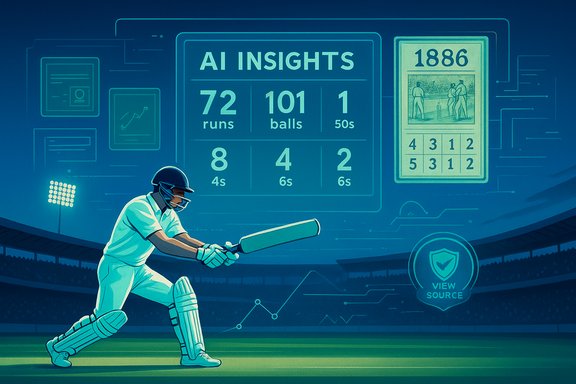
Insight Enterprises, working with Microsoft, HCLTech and a small integrator called Skewer, has rolled a major AI upgrade into the Cricket Australia Live App that promises on‑the‑fly, editorial‑style match insights, interactive follow‑up Q&A and access to official scorecards stretching back to 1886 — all delivered through a cloud‑hosted generative AI pipeline built on Microsoft’s stack. The release reframes a match‑day second screen: rather than only offering live scores and ball‑by‑ball commentary, the app now acts as a conversational, historical and contextual companion for fans, surfacing player milestones, record linkages and short analytic nuggets as games unfold.
Cricket Australia has progressively modernised its digital products over the last few seasons; the Live App is already a mainstream touchpoint for domestic and international audiences. The new AI Insights feature — launched in partnership with Insight Enterprises as the lead integrator, Microsoft as cloud and platform provider, and HCLTech and Skewer on development and integration — was promoted as a match‑day companion that combines more than a century of official scorecards with real‑time telemetry to produce context‑aware narratives and follow‑up answers fans can ask during play. Several Australian trade outlets reported the update and quoted Cricket Australia’s head of customer experience, Kieran McMillan, emphasising the product’s combination of history and technology. The technical framing given in partner material positions the feature as an agentic AI experience built on Microsoft Azure components — notably Azure OpenAI / Azure AI Foundry and conventional cloud data services such as Cosmos DB and SQL — paired with retrieval‑augmented generation (RAG) and an orchestration layer that coordinates stats lookups, archival retrieval and natural‑language generation. This is consistent with modern, enterprise‑grade interactive AI patterns used in several recent sports and media deployments.
At the same time, the deployment surfaces classic agentic AI challenges: hallucination risk, live‑latency SLAs, commercial governance and vendor lock‑in. The most sustainable outcomes will come from transparent provenance, conservative editorial gating on monetised outputs, and a public commitment to auditability and accuracy metrics. Procurement teams and product owners should insist on documented evidence of model governance, human‑in‑the‑loop processes and a realistic multi‑year TCO before expanding similar features.
Multiple independent trade outlets reported the rollout and partner claims, and Microsoft’s own coverage confirms the Azure OpenAI and data services foundation — though some media pieces name GPT‑5 specifically while Microsoft’s narrative focuses on Azure OpenAI and platform services. That model attribution should be read as partner and media reporting corroborated across outlets, with platform details verified in Microsoft’s customer narrative. The Cricket Australia example is a compelling case study for rights‑holders: the technology now exists to make history speak to the present, but the quality and trustworthiness of that conversation will be decided by engineering discipline, editorial control and a willingness to publish transparency metrics for fans and partners alike.
Conclusion
Cricket Australia’s new AI Insights in the Live App is a meaningful evolution in sports fan technology — an intersection of archival value, real‑time telemetry and conversational AI that changes how a match can be consumed. The technical approach mirrors contemporary enterprise architectures for interactive AI: retrieval‑grounded responses, agent orchestration and hyperscaler‑hosted inference. The feature’s potential to boost engagement and broaden audience understanding is real, but it will only be sustainable if the product enshrines provenance, editorial oversight and operational SLAs as first‑class requirements. The rollout is an instructive model for other sporting bodies: innovate fast, but govern faster.
Source: ARNnet Insight helps bring AI to Cricket Australia app - ARN
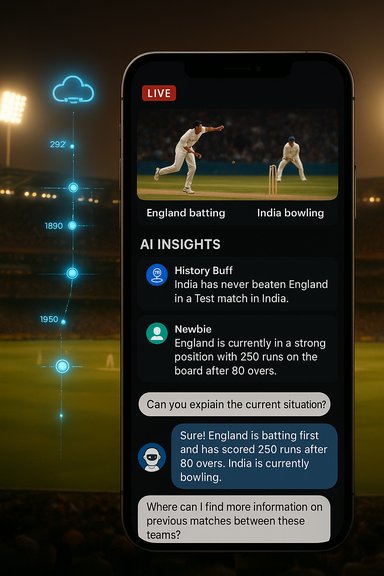 Background
Cricket Australia has progressively modernised its digital products over the last few seasons; the Live App is already a mainstream touchpoint for domestic and international audiences. The new AI Insights feature — launched in partnership with Insight Enterprises as the lead integrator, Microsoft as cloud and platform provider, and HCLTech and Skewer on development and integration — was promoted as a match‑day companion that combines more than a century of official scorecards with real‑time telemetry to produce context‑aware narratives and follow‑up answers fans can ask during play. Several Australian trade outlets reported the update and quoted Cricket Australia’s head of customer experience, Kieran McMillan, emphasising the product’s combination of history and technology. The technical framing given in partner material positions the feature as an agentic AI experience built on Microsoft Azure components — notably Azure OpenAI / Azure AI Foundry and conventional cloud data services such as Cosmos DB and SQL — paired with retrieval‑augmented generation (RAG) and an orchestration layer that coordinates stats lookups, archival retrieval and natural‑language generation. This is consistent with modern, enterprise‑grade interactive AI patterns used in several recent sports and media deployments. What’s new in the Cricket Australia Live App
Instant, editorial‑quality micro‑insights
The headline capability is a stream of short, analyst‑grade insights that appear during live matches. These are not raw stats dumps; instead they are framed narrative sentences linking current events (e.g., a fifty, a five‑wicket haul, a milestone over) to historical records or trends drawn from Cricket Australia’s archive. The product team describes these as “instant, editorial‑quality insights.”- The system surfaces player milestones, team records and contextual lines such as historical comparisons.
- Insights appear alongside traditional live data, providing a second, interpretive voice to the ball‑by‑ball feed.
Conversational follow‑ups and personas
Users can ask follow‑up questions about an insight — for example, “When was the last time this bowler took four wickets in a day at this ground?” — and receive a conversational response. Partner coverage indicates that responses are produced by an OpenAI model (reported as GPT‑5) hosted in Microsoft’s Azure AI Foundry, with the orchestration enabling multi‑turn follow‑up dialogue and persona selection (e.g., “History Buff” vs “Newbie”) in future versions. This affords personalised explanation depth based on fan expertise.Century‑spanning official scorecards
A visible differentiator is the deep historical archive: the app now exposes official Cricket Australia scorecards dating back to 1886. That historical corpus acts as the grounding dataset for comparisons and record retrieval, allowing the AI to link contemporary match moments with comparable events from cricket’s long past.Availability and rollout
The feature was rolled into the Live App on iOS and Android, with partners noting the update aims to boost time‑on‑platform, session depth and social sharing during matches. Several press pieces suggest the capability is available now and was demonstrated for recent fixtures.The technology stack — what’s explicit and what’s reported
Several public materials give a consistent, though not identical, account of the technology used. Microsoft’s own coverage of the Cricket Australia project highlights Azure OpenAI Service, Azure Cosmos DB, and standard Azure data services to power retrieval and low‑latency access to live and archival records, while partner press describes an agent orchestration layer and a retrieval‑augmented generation pipeline. Independent reporting — and trade coverage — additionally mentions Azure AI Foundry as the host for the generative model and explicitly names OpenAI’s GPT‑5 as the inference model producing conversational answers. Those model specifics appear in several media outlets and partner comments, but Microsoft’s official post focuses on Azure OpenAI and platform components without enumerating a specific model name in its customer narrative. That means the model selection claim is corroborated by multiple press sources, while some platform announcements emphasise the platform services rather than a named model. Treat those two descriptions as complementary: the platform (Azure OpenAI / Foundry) plus a high‑capability OpenAI model (reported as GPT‑5) comprise the inference surface. Technical themes observable across announcements and industry analyses:- Retrieval‑augmented generation (RAG) to ground outputs in archival scorecards and verified records.
- Agent orchestration to combine structured stats fetches, database queries and natural language composition into a single response pipeline.
- Use of globally distributed operational stores (e.g., Cosmos DB) and caching to meet stringent latency needs during live matches.
- Emphasis on provenance and traceability in partner messaging — though the public detail on how provenance is surfaced in the UI is limited.
Why this matters: strengths and practical benefits
1. Deeper engagement and retention
By combining bite‑sized editorial insights with historic context, the app transforms passive viewing into an exploratory experience. Fans get quick narratives they can share on social media or use to fuel in‑match debates. That kind of micro‑content increases session time and creates more moments to monetise or sponsor. Trade coverage projects measurable retention gains simply by increasing the number of meaningful interactions per match.2. Democratisation of cricket knowledge
Cricket has complex statistical traditions; the app’s personas and conversational layer help lower the barrier for new fans while enabling superfans to dig deeper. The move toward personalised “personas” and tailored answer depths is a clear UX play to broaden the audience.3. Productisation of archival assets
Cricket Australia’s scorecards are a latent asset. Structuring and indexing those records into searchable, AI‑friendly formats creates long‑term value: archival content that previously lived behind editors can now be surfaced programmatically and packaged as features, highlights or sponsored storytelling.4. Competitive and broadcast value
Real‑time, contextual overlays and second‑screen insights are valuable for rights‑holders and broadcasters. The same micro‑insights can be repurposed into graphics, broadcast overlays and social activations, offering new sponsorship and ad inventory options. Enterprise partner write‑ups emphasise this commercial angle.Real risks and technical limits — what the rollout must manage
The promise is compelling, but several important risks and limitations require explicit mitigation.Hallucinations and factual accuracy
Generative models can confidently produce incorrect facts, especially when asked to synthesise across structured stats and free‑text archives. Any fan‑facing answer that omits provenance or links to the official scorecard increases the risk of misinformation. Industry guidance from comparable sports AI projects highlights the need for provenance links, conservative prompting and human‑in‑the‑loop gates for high‑visibility outputs.Latency during live events
Delivering sub‑second or low‑interactivity experiences at peak match moments demands robust caching, precomputation and a fast operational store. The architecture must support sudden concurrent spikes (e.g., when a crowd reacts to a key wicket) or the feature will degrade precisely when users expect it to perform. Azure Cosmos DB and managed caching are suitable choices, but operational tuning and regionally distributed infrastructure remain critical.Data rights, licensing and archival provenance
Using official scorecards raises rights and licensing issues — who can quote, what can be republished, and how are rights‑holder relationships protected when AI composes derivative content from copyrighted archival text or images. The platform must include audit trails and clear policies on redisplay and repurposing. Partner and vendor materials often mention governance, but public detail is limited.Monetisation and sponsor alignment risks
While overlays and AI insights are new inventory opportunities, their commercialisation requires clear controls over sponsors, accuracy guarantees and editorial guardrails. Bad or misleading AI outputs could damage sponsor relationships or create regulatory exposure for gambling‑adjacent content. Vendor guidance recommends conservative editorial approval for any AI output that will be monetised.Vendor lock‑in and TCO
Building an agentic experience tightly coupled to Azure AI Foundry and a particular hosted model can accelerate time‑to‑market but increases migration costs. Procurement teams should evaluate TCO across hosting, model inference, storage and managed service support over a multi‑year horizon, and insist on exportable indexes and documented APIs where possible. This is routine vendor‑management advice for hyperscaler‑centric projects.Privacy and data governance
User interactions with AI (questions, prompts, histories) can contain personally identifiable information or behavioural signals. Clear retention policies, opt‑in disclosures and controls on training usage are essential to preserve trust and comply with privacy laws. Azure platform controls help, but responsibility rests with the developer and rights‑holder organizations.Verification and cross‑checks: what is confirmed and what should be treated cautiously
- Confirmed by multiple independent outlets: Insight Enterprises, Microsoft, HCLTech and Skewer are named partners in the update; the new AI Insights feature and access to official scorecards back to 1886 are widely reported.
- Confirmed technical components: Microsoft partner narratives and Microsoft’s own coverage identify Azure OpenAI Service, Azure Cosmos DB and a standard Azure data architecture underpinning the feature.
- Reported (by trade press and partner commentary) but not exhaustively confirmed in Microsoft’s official post: the explicit model reference to OpenAI’s GPT‑5 hosted in Azure AI Foundry appears across multiple media pieces and partner quotes; Microsoft’s customer coverage emphasises Azure OpenAI and Foundry but uses more general language about hosting and model services. Readers should treat the exact model citation as reported by partners and media; the platform components and the RAG approach are the higher‑confidence technical claims.
- Limited public detail: the small integrator Skewer appears in partner lists across press coverage, but independent public information on Skewer’s role and corporate footprint is sparse in standard searches — a common pattern for boutique agencies used on integration projects. Where partner roles matter contractually, procurement should request clear statements of scope, SLAs and references.
Best practices and a technical checklist for sports organisations building agentic fan features
For sports rights‑holders, broadcasters and product teams planning similar agentic AI features, the Cricket Australia rollout is instructive. Below is a recommended checklist of practical steps and governance measures.- Define provenance and citation UX
- Always surface the canonical source for fact‑based claims (e.g., “See official scorecard: [match, date]”) and link to the primary record when possible.
- Maintain a prompt and model version log
- Record the prompt templates, model name and model version for every production response to support audits and accuracy backtests.
- Precompute predictable insights and cache aggressively
- For common fact queries (e.g., “most runs at ground X”), precompute answers and store them with short TTLs to avoid repeated inference calls during spikes.
- Human‑in‑the‑loop for high‑impact outputs
- Route any monetised, quoted or legal‑sensitive outputs through editorial review before public display.
- Publicly publish accuracy metrics
- Run regular backtests comparing snippet outputs against ground‑truth and publish rolling accuracy stats for transparency.
- Build exportable indexes and APIs
- Avoid deep platform lock‑in by ensuring vector indexes, datasets and connectors are exportable in standard formats.
- Implement strict data‑use policies
- Require opt‑ins for collecting and using conversational prompts for model training and disclose data‑retention windows.
- Define SLAs and cost estimates for inference at scale
- Model inference costs are recurring; produce a three‑year TCO that includes peak‑match costing scenarios and contingency budgets.
Commercial and editorial implications
The Cricket Australia update illustrates a strategic shift: major sporting bodies no longer view digital products as simple scoreboards; they are becoming platforms for storytelling, second‑screen engagement and monetisation. That evolution has several corollaries:- Editorial teams must adapt: the role of human editors moves toward oversight, verification and packaging of AI‑generated signals rather than purely producing every nugget of content.
- Rights and sponsorship complexity increases: AI outputs that reference archival footage, quotes or clips raise entitlements questions and need explicit rights mapping.
- Procurement and risk management must be more rigorous: selecting partners with proven Azure‑native capabilities and demonstrable observability practices matters — and so do contractual guarantees on model governance and data handling.
Where Cricket Australia’s approach aligns with industry precedent
Comparable large‑scale sports AI initiatives have followed a similar pattern: consolidate data (scores, telemetry, video), index it for fast retrieval, place a retrieval layer in front of a high‑capability LLM, and orchestrate specialized agents for stats, editorial retrieval and summarisation. Public cases from football and other leagues illustrate the same engineering tradeoffs — the need for traceability, caching and a governance layer in front of agentic responses. The Cricket Australia update is therefore consistent with best practice, but success depends on rigorous operational execution.Final assessment — measured optimism
The Cricket Australia Live App update represents a well‑timed, product‑level application of agentic AI in sports. It leverages unique archival assets and the scale advantages of hyperscaler platforms to deliver experiences that will likely increase engagement among both casual and committed fans. The partnership model (Insight Enterprises as integrator with Microsoft, HCLTech and local integrators) is the right approach to reduce time‑to‑market while layering in governance capabilities.At the same time, the deployment surfaces classic agentic AI challenges: hallucination risk, live‑latency SLAs, commercial governance and vendor lock‑in. The most sustainable outcomes will come from transparent provenance, conservative editorial gating on monetised outputs, and a public commitment to auditability and accuracy metrics. Procurement teams and product owners should insist on documented evidence of model governance, human‑in‑the‑loop processes and a realistic multi‑year TCO before expanding similar features.
Multiple independent trade outlets reported the rollout and partner claims, and Microsoft’s own coverage confirms the Azure OpenAI and data services foundation — though some media pieces name GPT‑5 specifically while Microsoft’s narrative focuses on Azure OpenAI and platform services. That model attribution should be read as partner and media reporting corroborated across outlets, with platform details verified in Microsoft’s customer narrative. The Cricket Australia example is a compelling case study for rights‑holders: the technology now exists to make history speak to the present, but the quality and trustworthiness of that conversation will be decided by engineering discipline, editorial control and a willingness to publish transparency metrics for fans and partners alike.
Conclusion
Cricket Australia’s new AI Insights in the Live App is a meaningful evolution in sports fan technology — an intersection of archival value, real‑time telemetry and conversational AI that changes how a match can be consumed. The technical approach mirrors contemporary enterprise architectures for interactive AI: retrieval‑grounded responses, agent orchestration and hyperscaler‑hosted inference. The feature’s potential to boost engagement and broaden audience understanding is real, but it will only be sustainable if the product enshrines provenance, editorial oversight and operational SLAs as first‑class requirements. The rollout is an instructive model for other sporting bodies: innovate fast, but govern faster.
Source: ARNnet Insight helps bring AI to Cricket Australia app - ARN