

Crimson Desert finally arrives on March 19, 2026 — a global, simultaneous launch that will drop Pearl Abyss’ long-awaited open-world action-adventure onto PC (Windows/Steam and the Epic/Microsoft storefronts), Xbox Series X|S, PlayStation 5, and macOS. After years of trailers, delays, and “gone gold” milestones, the gates to Pywel open at the same moment everywhere: March 19, 2026, at 3:00 p.m. Pacific Time / 6:00 p.m. Eastern Time (10:00 p.m. UTC), with local rollouts pushing into the morning of March 20 for parts of Asia and Oceania. Preloads begin roughly 48 hours earlier for most regions — March 17 (or March 18 in regions where local launch falls on March 20) — and players should prepare for a very large install and a host of performance considerations before they try to jump in.
Pearl Abyss first revealed Crimson Desert as a high-ambition project tied to the Black Desert universe, but over six years it evolved into a standalone, single-player open-world epic built on the studio’s BlackSpace engine. The scope is deliberately maximalist: large biomes, varied activities (combat, crafting, fishing, piloting mechs, dragon riding), and a combat system that blends melee, ranged, and Abyss-powered mechanics. Pearl Abyss has repeatedly emphasized cinematic presentation and scale; the game has gone gold, meaning the launch master has been delivered to manufacturing and digital distribution is locked in.
Expect a narrative-led campaign focused on Kliff and the fractured Greymane mercenary band, plus dozens of environmental systems and set-piece boss fights. The studio has promised platform-specific features — notably DualSense haptics on PS5 — and native macOS support with Metal-backed upscaling for Apple Silicon. The big question between now and launch is whether Pearl Abyss’ engine and assets will run smoothly at scale on the broad range of hardware and consoles that the studio is targeting.
Key technical risk areas:
Before preload opens
Expectations for post‑launch
Strengths to watch
Crimson Desert’s long road ends on March 19, 2026; whether it arrives as the sprawling, technically impressive landmark many expect or as another beautiful but bumpy open‑world debut depends on the final weeks of polish and the first wave of player feedback. Prepare your hardware, set aside the space, and decide whether you’ll be there for the opening bell or letting the early adopters find the traps first — either way, Pywel is about to get very, very crowded.
Source: Windows Central Crimson Desert's release date is imminent — here's when you can play
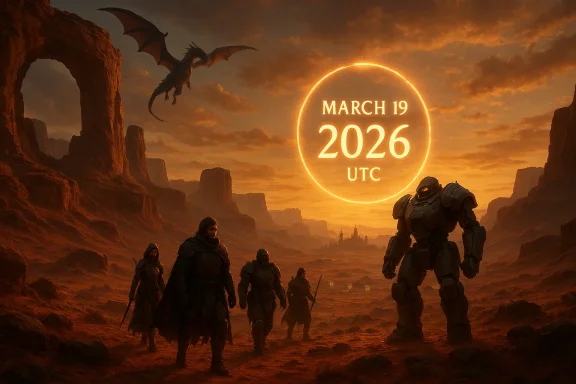 Background / Overview
Pearl Abyss first revealed Crimson Desert as a high-ambition project tied to the Black Desert universe, but over six years it evolved into a standalone, single-player open-world epic built on the studio’s BlackSpace engine. The scope is deliberately maximalist: large biomes, varied activities (combat, crafting, fishing, piloting mechs, dragon riding), and a combat system that blends melee, ranged, and Abyss-powered mechanics. Pearl Abyss has repeatedly emphasized cinematic presentation and scale; the game has gone gold, meaning the launch master has been delivered to manufacturing and digital distribution is locked in.Expect a narrative-led campaign focused on Kliff and the fractured Greymane mercenary band, plus dozens of environmental systems and set-piece boss fights. The studio has promised platform-specific features — notably DualSense haptics on PS5 — and native macOS support with Metal-backed upscaling for Apple Silicon. The big question between now and launch is whether Pearl Abyss’ engine and assets will run smoothly at scale on the broad range of hardware and consoles that the studio is targeting.
When you can play: global launch times and preload windows
Crimson Desert’s official launch schedule is a simultaneous worldwide release with a single unlock moment keyed to UTC. That means:- Global launch: March 19, 2026 — 10:00 p.m. UTC (which is 3:00 p.m. PT / 6:00 p.m. ET).
- For many players east of South Africa’s time zone, the in-region local time will be the morning of March 20 (for example, Japan and Korea see a March 20, 7:00 a.m. local unlock).
- Preload window (general): opens March 17, 2026 (10:00 p.m. UTC for PlayStation Store confirmation; other digital storefronts are expected to follow the same 48-hour pattern).
- If your region has a March 20 local unlock, preload opens one day later for your local prelaunch window (essentially March 18 local time).
- Physical-disc buyers generally do not get preload downloads; they will need to install from disc and then download any day‑one patches, so retail pickups will typically require an internet connection on first run.
- There is no early-play or time‑limited head start tied to deluxe editions: the Deluxe and Standard editions unlock at the same global moment.
Platforms, editions, and cost
Pearl Abyss is shipping Crimson Desert on a broad platform slate from day one:- PC (Windows via Steam and other PC storefronts), macOS (native Apple Silicon support), PlayStation 5, Xbox Series X|S.
- Xbox “Play Anywhere” compatibility means your purchase/on‑account ownership on PC and Xbox should interoperate via the Microsoft ecosystem where applicable.
- Standard Edition: $69.99 (street price may vary across regions and third‑party sellers).
- Deluxe Edition: $79.99 — a premium bundle with cosmetic sets for Kliff and mount extras; it does not include early access.
- Pre-order bonuses (platform specific): Pearl Abyss is offering the Khaled Shield and other platform pre-order items on PlayStation and other marketplaces as part of pre-order incentives.
How much space will you need? Storage and system requirements
One of the clearest technical messages from Pearl Abyss and multiple storefront summaries is this: Crimson Desert is a large, SSD-friendly game. The exact numbers fluctuate slightly between storefront entries and early review builds, but the practical guidance is consistent.- Official-ish storage requirement: expect somewhere in the 135–150 GB range for the base install on PC and macOS. Console installs have been reported by review builds in the ~121 GB zone, but storefronts tend to list 135 GB or 150 GB.
- RAM baseline: Pearl Abyss lists 16 GB of system memory as the minimum and recommended floor across PC presets.
- SSD required: the developers explicitly require installation on an SSD for acceptable streaming and load times.
- Minimum: GTX 1060 / RX 6500 XT class + Intel Core i5‑8500 or Ryzen 5 2600X, 16 GB RAM, SSD (target: upscaled 1080p, ~30 FPS in light scenes).
- Recommended: RTX 2080 / RX 6700 XT class + more modern 6‑core CPUs (target: 1080p/60 FPS or 4K/30 FPS depending on settings).
- High/Ultra tiers: GPUs in the RTX 4070 / RX 7700 XT or better range for high‑resolution 60 FPS with RT features enabled.
- Storefronts and early report builds show slight variations in the storage figure — some listings say 135 GB, others 150 GB. Day‑one patches commonly add several gigabytes. Plan for at least 200 GB of free SSD space if you want a comfortable margin for patches, save data, and temporary files.
- The consistent 16 GB RAM requirement across tiers is notable — it indicates that the engine expects a significant memory budget even at lower graphics presets. If you have 8 GB of RAM or swap-heavy setups, you should upgrade before launch.
Performance expectations and risks
Crimson Desert’s ambition is double‑edged. The BlackSpace engine scales across targets, and Pearl Abyss claims console optimizations (including ray-tracing support and higher framerate modes), but there are realistic fault lines for performance at launch.Key technical risk areas:
- Asset streaming and CPU overhead: open-world games of this size rely on aggressive streaming and CPU‑bound physics/AI tasks. Even consoles with fast SSDs can experience stutters if thread scheduling or I/O priorities aren’t tuned. Expect patching during the first week to tackle CPU- or streaming-related spikes.
- Ray‑tracing and upscaling options: the PC version supports vendor upscalers (DLSS / FSR) and ray‑tracing effects. These features can improve fidelity but also introduce performance unpredictability across GPU architectures — testing by players with mid‑range GPUs will be crucial.
- Variability in minimum spec experience: many outlets report relatively modest minimum GPU requirements (GTX 1060 / RX 6500 XT), which would be surprising for a 2026 AAA title of this visual ambition. Historically, official minimums sometimes under-promise how much tuning a playable 30+ FPS experience requires in dense city or battle scenes. Expect to tweak settings and rely on upscaling if you run older GPUs.
- PlayStation 5 / Xbox Series consoles: Pearl Abyss has touted PS5 haptic features and next‑gen optimizations, but there is limited public footage of final builds running on base consoles. That means we won’t know until launch whether the base PS5 and Series S hit stable performance targets at high fidelity or whether owners will need to accept a “quality vs. performance” tradeoff.
- macOS (Apple Silicon): macOS is supported at launch and Apple highlighted MetalFX upscaling and support for M3/M4 ray tracing. Performance on Apple Silicon will vary by chip generation — M1 may run lower settings, while M3/M4 chips are more likely to hit higher presets.
Preload and installation best practices — a checklist
If you plan to play at the exact unlock moment, preloading and technical prep will make the difference between sitting down to play immediately and waiting for a big day‑one patch to download.Before preload opens
- Free up space: clear at least 200 GB on your SSD to avoid installation hiccups and to accommodate day‑one updates.
- Update platform clients: make sure your Steam, Xbox App, Epic, PlayStation Store, or Mac App Store client is fully updated so it can accept the preload when it goes live.
- Verify pre-order: the preload will show only if the store recognizes your pre-order; confirm payment and ownership status ahead of time.
- Toggle auto-download: enable automatic downloads on consoles/PC clients so the preload begins immediately.
- Start the download and prioritize the queue: on congested networks, pause non-essential downloads and use wired connections where possible.
- Don’t launch immediately after install: many physical and digital preloads still require a day‑one patch; check the launcher for updated versions before attempting to play.
- Update GPU drivers: install the latest GPU drivers just before launch — GPU vendors often ship day‑one driver tweaks for big releases.
- Power settings: set your PC/console to a performance‑friendly power mode and configure Windows to avoid sleep during downloads.
- Bring a patience margin: disk installs plus large day‑one patches can easily add 30–100+ minutes to setup time depending on connection speed. If you want to play at the unlock, digital pre‑orders are safer.
Reviews, embargoes, and whether to wait
Pearl Abyss and media outlets have coordinated a review embargo window that puts professional coverage in the day immediately before launch. The practical implication:- Review embargo: reports indicate review copies and pre‑publishing windows allow critics to publish impressions roughly 24 hours before launch. That means the bulk of professional performance tests and final verdicts will be public by March 18, 2026.
- Performance benchmarking across consoles and GPU classes, including how stable framerates are in high-density scenes.
- Day‑one patch size and whether fixes change the experience materially.
- Stability and save reliability in a sweep of critical systems (quests, AI, streaming, cutscenes).
- Whether there are any hidden monetization hooks or DRM requirements — Pearl Abyss has publicly emphasized Crimson Desert is a premium, single‑purchase experience (no microtransaction store at launch), but the post-launch roadmap always bears watching.
Monetization, post‑launch plans, and developer promises
Pearl Abyss has repeatedly framed Crimson Desert as a premium, single‑purchase experience. The studio has stated that there will be no microtransactions or cosmetic shop at launch — “this is the premium experience; that is the transaction.” That commitment reduces one common modern risk (aggressive live‑ops monetization) but does not tell the whole story about future content.Expectations for post‑launch
- DLC and expansions: given the single‑player scope and publisher dynamics, paid expansions or season‑style content are plausible. Those would typically come later and are not the same as a loot-shop monetization model.
- Patches and balancing: the first weeks after launch will focus heavily on stability and performance fixes, with content patches likely to follow based on community feedback.
Practical recommendations for players
- If you play on PC: verify your GPU and CPU against the recommended tier if you want stable framerates at higher resolutions. Make sure you have an NVMe SSD and at least 16 GB RAM. Allocate 200 GB+ of free space before preloading. Update GPU drivers the morning of launch.
- If you play on console: prefer digital pre-orders if you want to join exactly at the unlock; physical copies will require disc install and likely a large day‑one patch. Consider whether your console’s storage is an internal SSD or an external drive with proper bandwidth — performance and install success hinge on SSD speed.
- If you play on Mac: check whether your Mac is M1 vs M3/M4 — performance with ray tracing and MetalFX will vary considerably across Apple Silicon chips. Expect the best results on recent M‑series hardware.
- If you stream or record: be aware that initial patches can change render timings and bitrates. Hold off on long-form streaming until a day‑one patch and early stability checks appear.
Final analysis: why this launch matters — and what could still go wrong
Crimson Desert is one of 2026’s most consequential single‑player launches because it represents Pearl Abyss’ pivot from MMO studio to single-player auteur with big ambitions. If the game meets its design goals — coherent systems, stable performance across platforms, and the evocative worldbuilding shown in trailers — it could stand as a major AAA single-player RPG in a year that also features other blockbusters.Strengths to watch
- Ambition at scale: an open world that mixes mechanical variety (mechs, dragons, party systems) with robust combat feels like a rare “big” single-player title in 2026.
- Cross‑platform native support at launch, including macOS, puts the title in a unique position to capture diverse player bases.
- Pearl Abyss’ experience tuning large live‑service engines could help them optimize streaming and asset pipelines better than many single‑player studios.
- Performance volatility: a huge world with complex interactions is the most likely place for stutters, frame dips, and memory pressure. The uniform 16 GB RAM floor is an early hint that the engine expects modern hardware.
- Inconsistent storefront details: small but meaningful differences in reported install size (135 GB vs 150 GB) mean players must plan for more space than some listings claim.
- Console parity unknowns: without broad footage of final builds running on base PS5 and Series S/X hardware, there’s uncertainty about what quality/perf tradeoffs console players will face.
Crimson Desert’s long road ends on March 19, 2026; whether it arrives as the sprawling, technically impressive landmark many expect or as another beautiful but bumpy open‑world debut depends on the final weeks of polish and the first wave of player feedback. Prepare your hardware, set aside the space, and decide whether you’ll be there for the opening bell or letting the early adopters find the traps first — either way, Pywel is about to get very, very crowded.
Source: Windows Central Crimson Desert's release date is imminent — here's when you can play
