

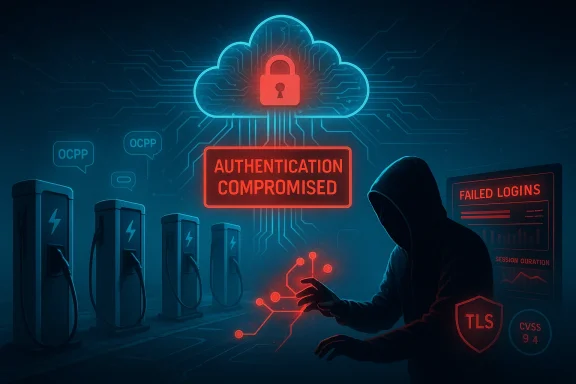
A cluster of high‑severity authentication and session‑management flaws in CloudCharge’s public platform — identified and cataloged by U.S. federal ICS authorities on February 26, 2026 — exposes EV charging infrastructure to real, immediate risks: attackers can impersonate charging stations, hijack user and operator sessions, suppress or misroute legitimate traffic to cause large‑scale denial of service, and manipulate data flowing to backend systems. The advisory lists four tracked CVEs (CVE‑2026‑20781, CVE‑2026‑25114, CVE‑2026‑27652, CVE‑2026‑20733) and assigns the cluster a CVSS v3 rating in the critical range (9.4), citing failures such as missing authentication for critical functions, insufficient session expiration, excessive authentication attempt handling weaknesses, and insufficiently protected credentials. For operators, integrators, and infrastructure owners who rely on CloudCharge services worldwide, this is not theoretical: the flaws strike at the trust model that underpins how charging stations, mobile apps, and management portals authenticate and exchange control and telemetry data.
CloudCharge is a Sweden‑headquartered EV charging management platform used by property owners, workplaces, and public operators across multiple countries. The company’s platform supports OCPP field devices, mobile apps and a cloud portal that mediates payments, access control, telemetry and load management. On February 26, 2026, a coordinated industrial control systems advisory documented that all versions of the public cloud instance (identified as cloudcharge.se) are affected by a cluster of authentication and session handling defects. The advisory credited two researchers, Khaled Sarieddine and Mohammad Ali Sayed, for reporting the issues to authorities.
The advisory’s core warning is straightforward and alarming: weaknesses in how the platform authenticates and maintains sessions allow an attacker to assume the identity of chargers or management users, disrupt communications, and change the state of charging operations. Because EV charging sits at the intersection of energy and transportation sectors, the impact surface includes grid load reliability, consumer mobility, safety perceptions, and revenue integrity.
This incident should accelerate three industry shifts:
But gaps remain. Authentication and session management are foundational. When they fail across a cloud instance that orchestrates thousands of edge devices, the consequences are disproportionately large. Operators must treat platform identity and credential hygiene as non‑negotiable, and vendors must commit to transparent, rapid remediation and support for mass credential re‑provisioning.
For defenders, the playbook is clear: inventory, isolate, rotate, monitor, and harden — in that order. For the industry, the lesson is deeper: secure digital trust is the backbone of an electric, connected transportation future. Until that trust is demonstrably robust, every EV charging transaction will carry an operational risk that deserves attention from C‑suite to field technicians.
Conclusion: If your organization relies on CloudCharge cloud services (cloudcharge.se) — or any centralized CSMS provider — treat this advisory as a high‑urgency incident. Implement the immediate steps above, demand vendor transparency and timelines, and harden identity and session controls before the next threat finds a way through.
Source: CISA CloudCharge cloudcharge.se | CISA
 Background
CloudCharge is a Sweden‑headquartered EV charging management platform used by property owners, workplaces, and public operators across multiple countries. The company’s platform supports OCPP field devices, mobile apps and a cloud portal that mediates payments, access control, telemetry and load management. On February 26, 2026, a coordinated industrial control systems advisory documented that all versions of the public cloud instance (identified as cloudcharge.se) are affected by a cluster of authentication and session handling defects. The advisory credited two researchers, Khaled Sarieddine and Mohammad Ali Sayed, for reporting the issues to authorities.The advisory’s core warning is straightforward and alarming: weaknesses in how the platform authenticates and maintains sessions allow an attacker to assume the identity of chargers or management users, disrupt communications, and change the state of charging operations. Because EV charging sits at the intersection of energy and transportation sectors, the impact surface includes grid load reliability, consumer mobility, safety perceptions, and revenue integrity.
Why this matters: the operational risk picture
The trust model of modern charging systems
EV charging infrastructure depends on a chain of trust:- Charge point (EVSE) authenticates to a management backend (CSMS).
- User and operator sessions authenticate to portals and apps.
- Messages carrying start/stop commands, meter readings, and diagnostics traverse the CSMS and often rely on session tokens and TLS to protect integrity and confidentiality.
Realistic attack goals
Successful exploitation enables several high‑impact operations:- Station impersonation — an attacker pretends to be a legitimate charger and injects false telemetry (e.g., fake meter values), causing billing errors or erroneous grid load reports.
- Session hijacking — compromise of management or user sessions to issue remote start/stop or pricing changes.
- Denial of service at scale — by abusing authentication endpoints or session mechanics attackers can block legitimate user operations or cause mass‑disconnection of chargers.
- Credential harvesting and lateral movement — extracted or reused credentials can be leveraged to move into corporate networks or other charger management systems.
- Data manipulation — altering telemetry and logs can hide malicious activity and undermine forensic efforts.
Technical summary of the failures (what was found)
Categories of weakness
The advisory groups the defects into four principal issues:- Missing Authentication for Critical Function — endpoints that perform sensitive actions are reachable without adequate authentication checks.
- Improper Restriction of Excessive Authentication Attempts — lack of rate limits and lockout behavior enables brute‑force attacks on credentials or session tokens.
- Insufficient Session Expiration — session tokens remain valid far longer than necessary, increasing the window for replay or session theft.
- Insufficiently Protected Credentials — secrets and stored credentials (for devices or users) are not adequately protected at rest or in transit.
The CVE set
Four CVE identifiers were assigned to individual issues within the cluster. The vendor surface described in the advisory indicates the faults affect public cloud deployments (the cloudcharge.se instance). The advisory assigns a high combined severity score (CVSS v3 9.4), indicating exploitability by remote actors with little to no privileges and very severe potential impact.How defenders should prioritize action (practical steps)
If you operate or depend on CloudCharge-managed charging stations, you should treat this advisory as high priority. Below is a prioritized, pragmatic action plan designed for operators, facility owners, integrators, and infrastructure teams.Immediate (hours)
- Isolate internet‑exposed management interfaces.
- If your CloudCharge portal or any management endpoints are accessible from the public internet in ways that bypass your corporate/VPN controls, restrict access now.
- Block or tightly control administrative access.
- Enforce IP allow‑lists for admin users, or require access only through approved VPNs with strong multi‑factor authentication.
- Notify stakeholders and stand up an incident coordinator.
- Inform facility managers, payment processors, and any third‑party integrators. Prepare a rolling notification channel for updates.
Short term (24–72 hours)
- Inventory and map affected assets.
- Create a list of chargers connected to the affected cloud instance, their firmware versions, and their network paths into the CSMS.
- Rotate privileged credentials and session tokens.
- Invalidate all long‑lived sessions and force password resets for administrative and operator accounts. Where possible, revoke device tokens and re‑provision.
- Increase monitoring and hunt for anomalies.
- Enable and centralize logs for authentication endpoints, device registrations, and billing events. Hunt for repeated auth failures, unusual source IPs, or odd session patterns.
- Apply vendor guidance and patches if available.
- If CloudCharge releases hotfixes or mitigation steps, apply them according to your change‑control process after due diligence.
Medium term (weeks)
- Deploy compensating controls.
- Web Application Firewalls (WAF) in front of portals, stricter rate limiting, and CAPTCHA on login endpoints reduce attack windows.
- Segment OT from IT.
- Ensure chargers and their management interfaces are isolated from general business networks using firewalls and VLANs to limit lateral movement.
- Introduce multi‑factor authentication (MFA) for operator accounts.
- MFA reduces the value of stolen single‑factor credentials.
- Re‑evaluate vendor SLA and incident commitments.
- Confirm CloudCharge’s remediation timeline and their support for re‑provisioning device credentials at scale.
Longer term (months)
- Adopt a supply‑chain and vendor assurance program.
- Require vendors to meet secure development lifecycle (SDL) practices, publish patching cadence, and support vulnerability disclosure.
- Mandate secure OCPP and transport encryption for devices.
- Ensure OCPP channels are authenticated and use TLS with certificate pinning where possible.
- Periodic third‑party security testing and red‑team exercises.
- Simulate attacks on management planes to validate detection and response.
Detection and monitoring playbook (concrete signals to look for)
- Repeated failed login attempts against portal or device management endpoints (indicative of brute force).
- Multiple session creations from different geographic IP addresses for the same account.
- Unexpected device registration or firmware‑update requests originating from unknown hosts.
- Meter reading anomalies: sudden jumps or inconsistent meter values across neighboring stations.
- Sudden surge in authorization failures followed by widespread disconnects (could indicate an attempted mass‑denial operation).
Exploitation scenarios: how attackers might chain these weaknesses
Scenario 1 — Charger impersonation and billing fraud
An attacker probes public authentication endpoints and identifies an endpoint that executes critical functions without verifying caller identity. By spoofing a charger identity and sending fabricated telemetry, the attacker can create phantom charges, alter meter readings, or redirect billing records. Over time, this can be used to siphon payments or create billing disputes at scale.Scenario 2 — Session hijack to interrupt charging at peak demand
Because sessions expire slowly and lack robust binding to client characteristics, a stolen session token allows an attacker to issue stop commands to a set of chargers during peak hours. The result: a sudden drop in available charging capacity when many EVs are queued, causing both customer impact and potential demand management issues for grid operators.Scenario 3 — Credential harvesting leading to supply‑chain compromise
Improperly protected credentials stored by the platform or exposed through weak APIs can be harvested and reused against operator dashboards or other connected systems. Once inside, the attacker can pivot to corporate billing systems, invoice manipulations, or deploy ransomware across operator networks.Vendor and disclosure responsibilities: what we learned and what to expect
The advisory credits external researchers with reporting the issues and identifies the problem as affecting the cloud instance. For vendors and platform providers, coordinated disclosure and timely patching are essential. Responsible vendors should:- Provide a clear remediation timeline and affected‑customer list.
- Publish guidance for credential rotation and session invalidation.
- Offer detection scripts or SIEM rules to help operators hunt for indicators of compromise.
- Facilitate bulk token re‑provisioning for device fleets.
Strengths found in the ecosystem — and why they’re not enough
There are positive elements in the modern EV charging ecosystem that reduce risk if properly used:- Standardized protocols (OCPP) help centralize security hardening: once secure profiles and TLS requirements are enforced, many misconfigurations are eliminated.
- Cloud‑based CSMS platforms enable rapid patch deployment and centralized credential management.
- Active researcher engagement and coordinated disclosure mean flaws are being found and recorded responsibly.
Policy and critical‑infrastructure implications
EV charging straddles energy and transportation sectors, both of which are considered critical infrastructure in many jurisdictions. A vulnerability cluster of this type raises several regulatory and operational concerns:- Operators must consider mandatory incident reporting to national CERTs and regulators if consumer or grid impact occurs.
- Procurement processes should require evidence of secure development lifecycle practices, third‑party testing, and rapid patching commitments.
- Grid operators and regional balancing authorities should account for the risk that charging availability and reported load may be manipulated, and adjust contingency plans accordingly.
Practical hardening checklist for CSMS operators and site owners
- Enforce HTTPS/TLS on all management and device endpoints; require up‑to‑date ciphers and certificate validation.
- Implement MFA for all portal and admin access; prefer hardware or app‑based second factors.
- Apply strict rate‑limiting and account lockout policies to authentication endpoints.
- Invalidate and rotate long‑lived tokens upon detection of suspicious activity; prefer short‑lived tokens bound to device identities.
- Isolate charging management traffic from general IT networks; employ firewalls and DMZ architectures.
- Maintain an up‑to‑date inventory of device firmware and enable secure update channels with signed images.
- Require vendors to provide proof of code review, static analysis, and penetration testing results for product releases.
What to tell end users and stakeholders
- For end users (drivers): service interruptions and billing anomalies are possible during remediation windows; monitor your charging receipts and report unexpected charges immediately.
- For property or facility managers: implement interim access controls (IP allow‑listing, VPN‑only admin access) and plan for possible service disruptions during credential rotation or platform upgrades.
- For IT/security teams: accelerate hunts focused on authentication anomalies and consider placing the CSMS behind additional reverse proxies and WAFs during patching.
Where this leaves the industry
The CloudCharge advisory is a sobering reminder that maturity in EV charging is not just about hardware or network coverage — it’s about secure identity and session models at scale. As charging networks grow rapidly, a single cloud provider with systemic authentication failures can expose operators and drivers across regions.This incident should accelerate three industry shifts:
- Hardening identity and session controls as a first‑class requirement in CSMS procurement and development.
- Stronger third‑party assurance and transparency from cloud providers regarding their security posture and remediation commitments.
- Operational resilience planning by grid and transport authorities that treats charging availability as a critical, monitored utility.
Final analysis: strengths, gaps, and the road ahead
The advisory’s technical findings are stark: CVE‑listed flaws and a high CVSS score indicate an immediate, exploitable problem. The strengths in the broader ecosystem — standardized protocols, cloud patching ability, and active researcher engagement — will help limit the window of exposure if vendors and operators act decisively.But gaps remain. Authentication and session management are foundational. When they fail across a cloud instance that orchestrates thousands of edge devices, the consequences are disproportionately large. Operators must treat platform identity and credential hygiene as non‑negotiable, and vendors must commit to transparent, rapid remediation and support for mass credential re‑provisioning.
For defenders, the playbook is clear: inventory, isolate, rotate, monitor, and harden — in that order. For the industry, the lesson is deeper: secure digital trust is the backbone of an electric, connected transportation future. Until that trust is demonstrably robust, every EV charging transaction will carry an operational risk that deserves attention from C‑suite to field technicians.
Conclusion: If your organization relies on CloudCharge cloud services (cloudcharge.se) — or any centralized CSMS provider — treat this advisory as a high‑urgency incident. Implement the immediate steps above, demand vendor transparency and timelines, and harden identity and session controls before the next threat finds a way through.
Source: CISA CloudCharge cloudcharge.se | CISA
