

CrowdStrike’s recent string of alliances — from Qualtrics and Microsoft to NordVPN and Saudi Aramco — signals a deliberate shift: take Falcon beyond endpoints and cloud workloads and embed it into procurement channels, SaaS workflows, consumer protection and national-scale critical-infrastructure programs. Those moves are strategic and sensible, but they also push CrowdStrike into executional terrain that is as operationally complex as it is commercially promising.
CrowdStrike has spent the better part of the last decade building the Falcon platform as a cloud-native, AI-first security stack centered on a lightweight agent and a shared telemetry plane. The product story shifted from endpoint protection to a broader “platform” narrative — adding cloud workload security, identity protection, SaaS security modules and SIEM-like observability under the Falcon umbrella. That architecture is now the foundation for a partner-led growth play: embed Falcon protections where users and procurement already live, then convert those footholds into recurring subscriptions and expansion ARR.
Between January and February 2026, CrowdStrike announced a set of partnerships that illustrate this multi-pronged strategy:
Limitations: Typical SaaS integrations must balance scope (read-only monitoring vs active remediation), tenant isolation and customer control — rollouts can be slow where CX platforms have tightly governed API access.
Why it matters:
Why it matters:
Why it matters:
Valuation, however, is elevated. Multiple market-data snapshots show CrowdStrike trading at premiums on forward price-to-sales and price/sales metrics compared to the broader security industry. A premium is justified if the company can maintain growth, expand gross margins and convert partner-driven adoption into durable ARR. If growth decelerates, the premium compresses quickly — a classic risk for high-growth software franchises.
Investors should watch:
Those vectors point to a plausible path for faster scaling — but only if the company can reliably convert partner-led trials into recurring subscriptions, preserve margin while moving down‑market, and manage the geopolitical and privacy risks inherent in sovereign and consumer engagements. The headline numbers — strong ARR growth and analyst estimates forecasting low‑to‑mid‑20% revenue expansion — give the plan credibility. The valuation, however, leaves little margin for error.
In short: strategic partnerships can materially contribute to CrowdStrike’s next growth phase, but the payoff depends on measurable conversion outcomes and disciplined, low-cost delivery. The next 12 to 18 months will tell whether these alliances are the prelude to accelerated platform adoption — or a collection of promising market experiments that require more time to mature into durable ARR engines.
Source: The Globe and Mail Can Strategic Partnerships Drive CrowdStrike's Next Growth Phase?
 Background / Overview
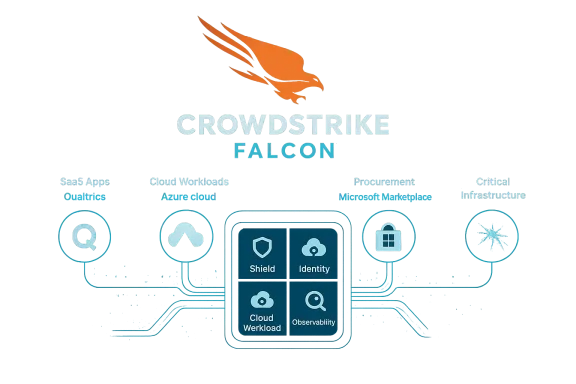
CrowdStrike has spent the better part of the last decade building the Falcon platform as a cloud-native, AI-first security stack centered on a lightweight agent and a shared telemetry plane. The product story shifted from endpoint protection to a broader “platform” narrative — adding cloud workload security, identity protection, SaaS security modules and SIEM-like observability under the Falcon umbrella. That architecture is now the foundation for a partner-led growth play: embed Falcon protections where users and procurement already live, then convert those footholds into recurring subscriptions and expansion ARR.Between January and February 2026, CrowdStrike announced a set of partnerships that illustrate this multi-pronged strategy:
- Falcon Shield integration with the Qualtrics XM platform (announced Feb 19, 2026) to extend SaaS security into customer and employee experience telemetry.
- Falcon being made available on Microsoft Marketplace with Azure Consumption Commitment eligibility (announced Feb 18, 2026) to simplify procurement for Azure customers.
- Strategic ties with Nord (Nord Security / NordVPN) to bring Falcon Go/Falcon Enterprise into NordLayer and to power NordVPN’s consumer Threat Protection Pro with CrowdStrike threat intelligence (announced Jan–Feb 2026).
- A memorandum of understanding (MoU) with Saudi Aramco (announced Feb 5, 2026) to explore national-scale cybersecurity collaboration, in‑country cloud capabilities and regional investment.
Why partnerships now? The strategic logic
1) Marketplace + procurement removes friction
Making Falcon available on Microsoft Marketplace and enabling customers to consume via existing Azure Consumption Commitment funds reduces procurement friction. For large organizations that allocate pre-committed cloud spend to hyperscalers, this is a pragmatic revenue lever: instead of moving budget from one line item to another and triggering lengthy procurement cycles, clients can apply existing cloud commitments to buy Falcon modules.- Benefit: shortened procurement timelines and potentially higher deal velocity.
- Also important: marketplaces don’t replace complex enterprise procurement entirely — they accelerate deal closure for standard configurations and make it easier for field teams and channel partners to transact quickly.
2) SaaS security is a high-opportunity adjacency
Qualtrics is a business-critical SaaS used in customer and employee experience workflows that often touches highly sensitive PII and research data. The Falcon Shield integration gives security teams the ability to monitor user activity, permissions, configurations and anomalous access patterns inside Qualtrics.- Benefit: access to a new SaaS workload tenancy where misuse or misconfiguration can create direct business impact.
- Opportunity: Falcon’s SaaS security modules (posture, visibility, detection, automated remediation) are a natural extension to the platform and have strong attach potential if teams treat this as a rightsizing and compliance play.
3) Consumer distribution expands telemetry and brand reach
NordVPN’s integration — powering Threat Protection Pro with CrowdStrike threat intelligence — puts enterprise-grade adversary telemetry into millions of consumer devices. That’s valuable for two reasons: first, broader data collection (anonymized telemetry and indicators) enriches threat models; second, it creates a consumer brand pathway that can feed SMB and enterprise pipelines when users move into corporate contexts.- Benefit: scale of telemetry and expanded threat-sensing surface.
- Caveat: consumer privacy, data protection constraints and differences in SLAs mean product integration must be tightly scoped.
4) National-scale MoUs scale reputation and potential contracts
The MoU with Saudi Aramco signals CrowdStrike’s intent to play at the country-level scale: in-country cloud deployment, joint threat intelligence for critical infrastructure, workforce development and the possibility of a regionally domiciled HQ.- Benefit: high-profile beachhead into a large market with sovereign-scale budgets and ambitions around AI and cyber resilience.
- Risk: MoUs are non-binding by design. Delivering a national-scale program requires regulatory alignment, long procurement cycles and careful management of geopolitical and export-control risk.
The mechanics: how partner-led adoption converts into ARR
Partnerships are distribution multipliers only if they generate recurring, contract-backed usage. The conversion path typically runs through these steps:- Awareness and product fit — demonstrate a minimal-control integration (e.g., Falcon Shield in Qualtrics) that provides immediate operational value for security and compliance teams.
- Low-friction procurement — advertise marketplace availability and payment using existing cloud commitments. This reduces transactional barriers and shortens proof-of-concept timelines.
- Small wins and expansion — a SaaS security module or consumer telemetry feed proves value; the customer expands with additional Falcon modules or subscription tiers.
- Consolidation and retention — high gross retention, effective module attach rates and upsell into Falcon Flex enterprise subscriptions drive net new ARR and expansion ARR.
What the recent announcements actually add — a closer look
Falcon Shield + Qualtrics (Feb 19, 2026)
The Qualtrics integration extends Falcon Shield into a SaaS application that is frequently used for surveys, customer feedback and employee engagement. Technically, the integration delivers:- Continuous monitoring of user and agent activity inside Qualtrics.
- Detection of misconfigurations, anomalous access and bot activity.
- Policy-based automated remediation through Falcon Shield APIs.
Limitations: Typical SaaS integrations must balance scope (read-only monitoring vs active remediation), tenant isolation and customer control — rollouts can be slow where CX platforms have tightly governed API access.
Microsoft Marketplace (Feb 18, 2026)
Falcon’s availability on Microsoft Marketplace with eligibility to draw down Azure Consumption Commitment funds is a classic procurement innovation.Why it matters:
- Customers with committed Azure spend can now apply those funds to purchase Falcon, simplifying internal approvals.
- Marketplace transacts at scale for modular purchases; it’s a particularly useful channel for mid-market and distributed procurement scenarios.
Nord partnerships (Jan–Feb 2026)
There are two related Nord tie-ins: Nord Security’s NordLayer will offer Falcon Go and Falcon Enterprise to SMBs (making enterprise-grade protection easier to buy through Nord’s platform), and NordVPN will use CrowdStrike threat intelligence to power its Threat Protection Pro consumer capability.Why it matters:
- SMB market expansion: SMBs often lack the budget and expertise to buy enterprise security. Embedding Falcon into NordLayer and Pax8 MSP channels targets this underserved segment.
- Consumer reach: integrating CrowdStrike intel into a consumer VPN product creates a potential telemetry feedback loop and increases brand awareness among end users.
- SMB economics differ from enterprise: lower price points and higher churn risk. Success depends on operationalizing low-cost, high-automation delivery and support.
- Consumer integrations must safeguard privacy and data retention rules; any misstep could cause reputational damage.
Saudi Aramco Memorandum of Understanding (Feb 5, 2026)
The MoU is the most strategically visible and politically sensitive announcement. It contemplates long-term collaboration around in‑country cloud, national-scale cybersecurity frameworks, workforce training and deploying Falcon across critical infrastructure.Why it matters:
- Country-scale contracts (if they materialize) can be material to ARR and brand prestige.
- Local cloud deployments and a regional HQ would give CrowdStrike lower-latency protections for in‑country customers and a competitive edge in the region.
- MoUs are exploratory by nature and not revenue guarantees.
- National-level programs introduce regulatory complexity, localization requirements and export-control scrutiny.
- Political risk and public scrutiny (human-rights concerns, supply-chain policies) can ripple into commercial effects.
Competition and market context
CrowdStrike is not alone in pursuing platform expansion by partnerships and acquisitions.- Palo Alto Networks (Prisma AIRS + Google Cloud): Palo Alto’s expanded integration with Google Cloud (covering Vertex AI, Agent Engine, and broader AI workload protection) pushes a direct data-and-AI security narrative into cloud-native AI pipelines. This is competition at the AI-workload protection layer.
- Zscaler (SquareX acquisition): Zscaler’s acquisition of SquareX (Feb 5, 2026) strengthens browser-based Zero Trust protections, targeting a different — but adjacent — vector of enterprise attack surfaces. Browser-level protections complement endpoint and cloud protections but also represent a route to displace or limit Falcon’s visibility if a customer consolidates on a different vendor’s Zero Trust stack.
Financial and valuation context
CrowdStrike’s reported ARR of approximately $4.92 billion (as of Oct. 31, 2025) and robust subscription gross margins make the company a clear growth platform. Analysts (as aggregated by services such as Zacks) project top-line growth in the low‑to‑mid‑20% range for fiscal 2026 and fiscal 2027 — consistent with management guidance at the time of recent enterprise results.Valuation, however, is elevated. Multiple market-data snapshots show CrowdStrike trading at premiums on forward price-to-sales and price/sales metrics compared to the broader security industry. A premium is justified if the company can maintain growth, expand gross margins and convert partner-driven adoption into durable ARR. If growth decelerates, the premium compresses quickly — a classic risk for high-growth software franchises.
Investors should watch:
- Net new ARR growth rate and FY guidance cadence.
- Module attach per customer and take rate for new SaaS/consumer offerings.
- Gross retention and churn metrics.
- Contribution from partner channels and the velocity of marketplace-led wins.
Risks and unknowns — what to watch closely
- Execution timing and conversion
- Integrations and marketplace listings are necessary but not sufficient. The real question is conversion: how many Qualtrics tenants will enable Falcon Shield? How many Azure customers will reallocate committed spend to Falcon? Execution timelines matter.
- Channel economics and margin dilution
- Selling through partners, marketplaces and MSPs often carries different margin profiles than direct enterprise sales. CrowdStrike must maintain high operating leverage and efficient go-to-market execution to preserve unit economics.
- Sovereign and geopolitical risk
- Working with national oil companies and governments expands the addressable market but increases geopolitical complexity. Local data residency, sovereign cloud requirements and export-control constraints can complicate deployments and timelines.
- Consumer privacy and product fit
- Adding CrowdStrike threat intelligence to consumer VPNs is a double-edged sword: it increases reach but exposes the company to privacy expectations and potential scrutiny over data usage. Clear contractual and technical boundaries must protect telemetry and user privacy.
- Competitive responses
- Rivals are moving fast: hyperscaler-native security integrations, acquisitions targeting browser and identity protections, and bundled cloud security offerings could blunt or bifurcate demand for Falcon modules.
- Financial expectations vs. delivery
- The company’s valuation implies sustained high growth. Any slippage — slower ARR expansion, higher churn or lower attach rates — will be penalized.
Strengths and upside scenarios
- Platform breadth: Falcon’s architectural advantage (single lightweight agent + cloud-native telemetry) supports modular expansion into SaaS, identity and cloud workloads in a way that competitors with legacy agents or siloed stacks may struggle to match.
- Marketplace and procurement wins: enabling Azure consumption commits is pragmatically important for enterprise procurement and could accelerate deal velocity in environments where cloud spend is pre-committed.
- SMB and consumer pathways: Nord partnerships create lower-friction entry points into SMBs and consumers, which may broaden the funnel and feed enterprise pipelines over time.
- National-scale credibility: working with a company like Aramco, even at the MoU stage, signals trust and technical capability that can open doors elsewhere, particularly in regions prioritizing secure AI adoption.
Tactical recommendations — what CrowdStrike (and partners) should prioritize
- Measure and report partner-sourced ARR independently: public disclosure of ARR or bookings sourced through marketplaces and strategic partners would give investors a clearer picture of conversion success.
- Standardize low-cost deployment bundles for SMB via NordLayer and Pax8: low-touch onboarding with clear SLA tiers is critical to avoid costly one-off support engagements that erode margins.
- Harden privacy controls and transparent telemetry contracts for consumer integrations: publish clear data handling and anonymization controls to preempt regulatory scrutiny and customer concern.
- Use marketplace availability to accelerate proof-of-concept (PoC) completion SLAs: create a joint “marketplace-to-production” playbook with Microsoft to reduce the average time from procurement to meaningful detection coverage.
- Treat MoU-to-contract execution as a long lead item: assign a dedicated cross-functional team (policy, engineering, ops and legal) to scope localization, compliance and export-control hurdles early.
Conclusion
CrowdStrike’s recent partnership sweep is an ambitious and multi-dimensional play for platform expansion. By embedding Falcon into SaaS workflows (Qualtrics), simplifying procurement (Microsoft Marketplace), reaching consumers and SMBs (NordVPN / NordLayer), and positioning itself for national-scale cyber programs (Aramco MoU), CrowdStrike is deliberately widening its top-of-funnel and creating multiple acquisition vectors.Those vectors point to a plausible path for faster scaling — but only if the company can reliably convert partner-led trials into recurring subscriptions, preserve margin while moving down‑market, and manage the geopolitical and privacy risks inherent in sovereign and consumer engagements. The headline numbers — strong ARR growth and analyst estimates forecasting low‑to‑mid‑20% revenue expansion — give the plan credibility. The valuation, however, leaves little margin for error.
In short: strategic partnerships can materially contribute to CrowdStrike’s next growth phase, but the payoff depends on measurable conversion outcomes and disciplined, low-cost delivery. The next 12 to 18 months will tell whether these alliances are the prelude to accelerated platform adoption — or a collection of promising market experiments that require more time to mature into durable ARR engines.
Source: The Globe and Mail Can Strategic Partnerships Drive CrowdStrike's Next Growth Phase?
