

CrowdStrike is pushing deeper into the AI-era security problem set with a familiar playbook: broaden the Falcon platform, tighten visibility across more layers of the stack, and make it easier for customers to consolidate operations around one control plane. The company’s newest updates add AI security capabilities aimed at endpoints, browsers, SaaS and cloud workflows, while also extending Falcon Next-Gen SIEM support for Microsoft Defender for Endpoint telemetry. Together, the moves reflect a market where AI usage is spreading faster than governance, and where security vendors are racing to catch up with both the speed of agentic software and the economics of data-heavy SOC operations.
CrowdStrike has spent years framing its platform around the idea that modern security must be cloud-native, AI-assisted, and data-driven. That message has only become more relevant as generative AI moved from experimentation to production use, first as chat interfaces and copilots, and now as autonomous or semi-autonomous agents that can take actions on behalf of users. The company’s own recent messaging has repeatedly emphasized AI agents, SaaS identity, runtime protection and next-gen SIEM as pillars of the same broader strategy.
The latest announcement sits squarely inside that trajectory. CrowdStrike has already been expanding Falcon Shield for SaaS and agent visibility, while also deepening its next-gen SIEM and automation capabilities throughout 2025. Its April 2025 cloud-risk release introduced AI model scanning and shadow AI detection, showing that the company has been treating AI not as a separate market, but as an extension of endpoint, identity and cloud risk. The new endpoint and SIEM updates are a continuation of that line rather than a departure from it.
The timing matters because AI adoption inside enterprises has become messy in a way that looks very familiar to security teams. Workers are using desktop apps, browser-based assistants, embedded copilots, development tools, SaaS agents and cloud services that can all interact with sensitive data and privileged workflows. CrowdStrike says it now sees more than 1,800 distinct AI applications across customer environments, spanning nearly 160 million unique application instances, which underscores how quickly AI has become a production workload rather than a lab experiment. Those numbers are vendor-reported, but they fit the broader industry narrative that shadow AI is moving faster than policy.
On the SIEM side, the company is also trying to exploit a long-running pain point: organizations rarely want to rip and replace everything at once. Many enterprises already rely heavily on Microsoft Defender for Endpoint, and security teams often hesitate to deploy yet another sensor just to unify telemetry. Microsoft’s own documentation shows that Defender for Endpoint and Defender XDR already expose APIs and SIEM ingestion paths for incidents, alerts and streamed event data, which makes a telemetry-sharing integration technically and operationally plausible. CrowdStrike’s pitch is that Falcon Next-Gen SIEM can consume that data without a second endpoint agent.
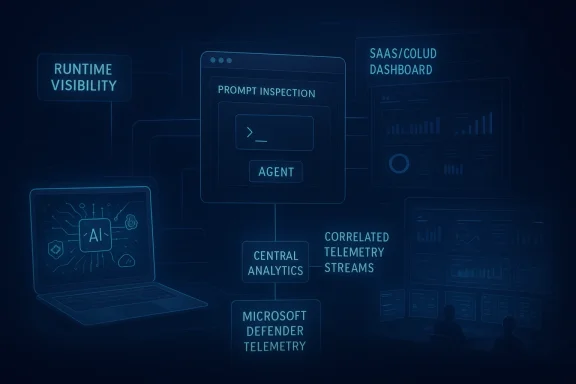
CrowdStrike’s response is to extend Falcon’s runtime visibility and discovery layers. The company says the platform can now identify AI applications, AI agents, large language model runtimes, MCP servers and development tools on endpoints, while also linking them to asset context and privilege exposure. It also says prompt-layer inspection now covers desktop AI applications such as ChatGPT, Gemini, Claude, DeepSeek, Microsoft Copilot, O365 Copilot, GitHub Copilot and Cursor. That is a broad sweep, and it signals a belief that the desktop is once again a major enforcement point for security.
The SIEM expansion is more conservative on the surface, but strategically just as important. Falcon Next-Gen SIEM can now ingest and correlate Microsoft Defender for Endpoint telemetry without requiring a Falcon endpoint sensor. That matters because it reduces adoption friction for Defender-centric enterprises and gives CrowdStrike a route into environments where it may not be the primary endpoint agent. In a market where vendors increasingly compete on openness and data economics, being able to analyze third-party telemetry without forcing immediate infrastructure changes is a strong sales argument.
CrowdStrike is clearly trying to position Falcon as the answer to all three problems. That is ambitious, but it is also a logical extension of the company’s identity, endpoint and cloud strategy.
Falcon’s new runtime visibility is meant to close that gap. By capturing commands, scripts, file activity and network connections from applications running on a device, security teams can trace suspicious actions back to the originating process and quarantine the device if needed. In practice, that makes the endpoint both an observation point and a containment point, which is exactly what modern EDR and XDR products are supposed to do. The difference here is that the target surface includes AI-native workflows as well as traditional malware and user activity.
CrowdStrike is also emphasizing discovery. The platform can identify AI applications, agents, large language model runtimes, MCP servers and development tools, then enrich those discoveries with asset and privilege context. That matters because AI risk is not just about what is installed; it is about what those tools can reach. A low-risk app on one device may become a serious governance problem on another if it has access to sensitive repositories, privileged SaaS accounts or production cloud workflows.
This is where the new features become more than a product story. They represent a shift in security posture from reviewing artifacts after the fact to observing autonomous behavior as it happens.
The company also says Falcon can identify AI agent activity and data access across Microsoft Copilot for Power Platform, Salesforce Agentforce, ChatGPT Enterprise, OpenAI Enterprise GPT and Nexos.ai, along with monitoring for Microsoft Copilot Studio agents. That list reads like a map of where enterprise AI is currently being operationalized: business apps, workflow automation, vendor-hosted AI platforms and custom agent builders. In other words, CrowdStrike is targeting the places where AI moves from chat to action.
Cloud-focused tools are another important piece. The company says it can identify ungoverned AI services, monitor AI data flows and detect prompt attacks, data leaks and policy violations. That matters because AI security is not just about model abuse; it is also about where prompts go, what they touch and what comes back. Once AI agents are allowed to access business data, the policy problem becomes as important as the malware problem.
Prompt inspection is important because the prompt itself can be the attack surface. It can contain confidential data, malicious instructions, or attempts to exfiltrate sensitive material through seemingly ordinary queries. If a security platform can observe, correlate and enforce policy at the prompt layer, it gets much closer to actual AI governance rather than simple app inventory. CrowdStrike’s messaging implies that this is now a first-class security requirement.
Shadow AI governance is the natural companion to prompt inspection. Organizations do not just need to know that an AI app exists; they need to know whether it is approved, whether it has access to regulated data, and whether its behavior violates internal policy. CrowdStrike’s discovery tools and runtime monitoring are designed to answer those questions continuously rather than via periodic audits, which is a better fit for fast-moving enterprise environments.
CrowdStrike appears to be betting that customers want enforcement embedded into the same platform they use for endpoint and identity operations. That is a smart assumption, because AI risk does not respect organizational silos.
From a technical standpoint, the integration makes sense. Microsoft Defender for Endpoint already exposes APIs for alerts, machines, investigations and advanced hunting, and Microsoft Defender XDR supports SIEM ingestion of incidents and streaming event data through supported integrations. CrowdStrike is effectively offering a new analytics and correlation layer on top of existing Microsoft telemetry, rather than asking customers to replace their current endpoint stack before they can modernize SIEM.
The strategic message is important too. CrowdStrike wants to be seen as open, data-agnostic and operationally pragmatic. By aligning with Microsoft rather than framing the relationship as zero-sum, it can present Falcon as a place where different security datasets can be normalized, searched and investigated. That is especially attractive for enterprises pursuing consolidation without the pain of a full forklift upgrade.
This integration gives buyers a transitional path.
This is the part of the announcement that speaks directly to operational migration. The hardest part of replacing an older SIEM is often not the dashboard or the detector; it is the data plumbing, the query rewrites and the analyst retraining. If CrowdStrike can reduce those costs, it improves the odds of winning new workloads from legacy tools.
Federated search is especially notable. Instead of forcing all data into one central repository, analysts can query data where it lives. That can improve performance, lower storage costs and reduce duplication. It also aligns with the broader industry shift toward data locality and more elastic analytics architectures, which is increasingly important as telemetry volumes continue to explode.
For legacy SIEM vendors, the message is even more direct. CrowdStrike is continuing to target the problems of cost, complexity and analyst efficiency that have historically slowed modernization. The addition of query translation from Splunk searches is a clear signal that the company wants to make migration feel less like a product switch and more like a translation exercise. That is a subtle but powerful framing.
Against endpoint rivals, the AI security features are designed to reinforce CrowdStrike’s identity as an AI-native platform rather than a point-product EDR vendor. If AI applications and agents are now part of the endpoint threat model, then any security vendor that cannot inspect or govern those interactions risks appearing behind the curve. CrowdStrike is clearly trying to define the category before competitors do.
That is a useful position if buyers are looking for a single platform story, but it also raises the bar. Once you promise to secure AI across endpoint, browser, SaaS and cloud while also modernizing SIEM, customers will expect the platform to be consistent and transparent across all those layers.
For consumers, the impact is less direct but still meaningful. Many of the AI applications named in the announcement are the same tools individuals use at work and home, which means enterprise policy is increasingly shaping how consumer-grade AI products are deployed in business settings. When a company governs ChatGPT, Gemini or Copilot use at the endpoint and browser layers, it is effectively deciding which consumer-style experiences can be trusted in the workplace.
The consumer angle also matters because the line between personal and corporate usage keeps blurring. Employees often experiment with AI tools on personal accounts before migrating them into work contexts. Security teams will see that as a governance risk, but vendors will see it as a distribution opportunity. That tension is one of the defining dynamics of the AI era.
The Microsoft integration is equally important to watch because it hints at how security platforms may evolve in a multi-vendor enterprise. Rather than replacing every component, the winning approach may be to ingest telemetry from whichever vendor is already deployed and then apply analytics, correlation and response in one place. That is a very different value proposition from the old “rip and replace” model, and it may prove more realistic in large organizations.
Source: SecurityBrief Australia https://securitybrief.com.au/story/crowdstrike-adds-ai-security-tools-microsoft-siem/
 Background
CrowdStrike has spent years framing its platform around the idea that modern security must be cloud-native, AI-assisted, and data-driven. That message has only become more relevant as generative AI moved from experimentation to production use, first as chat interfaces and copilots, and now as autonomous or semi-autonomous agents that can take actions on behalf of users. The company’s own recent messaging has repeatedly emphasized AI agents, SaaS identity, runtime protection and next-gen SIEM as pillars of the same broader strategy.The latest announcement sits squarely inside that trajectory. CrowdStrike has already been expanding Falcon Shield for SaaS and agent visibility, while also deepening its next-gen SIEM and automation capabilities throughout 2025. Its April 2025 cloud-risk release introduced AI model scanning and shadow AI detection, showing that the company has been treating AI not as a separate market, but as an extension of endpoint, identity and cloud risk. The new endpoint and SIEM updates are a continuation of that line rather than a departure from it.
The timing matters because AI adoption inside enterprises has become messy in a way that looks very familiar to security teams. Workers are using desktop apps, browser-based assistants, embedded copilots, development tools, SaaS agents and cloud services that can all interact with sensitive data and privileged workflows. CrowdStrike says it now sees more than 1,800 distinct AI applications across customer environments, spanning nearly 160 million unique application instances, which underscores how quickly AI has become a production workload rather than a lab experiment. Those numbers are vendor-reported, but they fit the broader industry narrative that shadow AI is moving faster than policy.
On the SIEM side, the company is also trying to exploit a long-running pain point: organizations rarely want to rip and replace everything at once. Many enterprises already rely heavily on Microsoft Defender for Endpoint, and security teams often hesitate to deploy yet another sensor just to unify telemetry. Microsoft’s own documentation shows that Defender for Endpoint and Defender XDR already expose APIs and SIEM ingestion paths for incidents, alerts and streamed event data, which makes a telemetry-sharing integration technically and operationally plausible. CrowdStrike’s pitch is that Falcon Next-Gen SIEM can consume that data without a second endpoint agent.
Overview
The AI security announcement is built around a simple but important claim: AI systems are no longer merely tools that humans use, but active participants in enterprise workflows. That changes the threat model. Instead of watching only for malicious user behavior, defenders now have to observe commands, scripts, file access, browser activity, network connections and prompt interactions triggered by software that may behave like a user while acting at machine speed.CrowdStrike’s response is to extend Falcon’s runtime visibility and discovery layers. The company says the platform can now identify AI applications, AI agents, large language model runtimes, MCP servers and development tools on endpoints, while also linking them to asset context and privilege exposure. It also says prompt-layer inspection now covers desktop AI applications such as ChatGPT, Gemini, Claude, DeepSeek, Microsoft Copilot, O365 Copilot, GitHub Copilot and Cursor. That is a broad sweep, and it signals a belief that the desktop is once again a major enforcement point for security.
The SIEM expansion is more conservative on the surface, but strategically just as important. Falcon Next-Gen SIEM can now ingest and correlate Microsoft Defender for Endpoint telemetry without requiring a Falcon endpoint sensor. That matters because it reduces adoption friction for Defender-centric enterprises and gives CrowdStrike a route into environments where it may not be the primary endpoint agent. In a market where vendors increasingly compete on openness and data economics, being able to analyze third-party telemetry without forcing immediate infrastructure changes is a strong sales argument.
Why this matters now
The broader security market is converging around a few truths. First, AI has multiplied the number of identity-like entities and machine-driven actions in the enterprise. Second, the browser has become a control plane for everything from SaaS to copilots to internal business systems. Third, SIEM customers are under relentless pressure to reduce storage, ingestion and query costs while improving response time.CrowdStrike is clearly trying to position Falcon as the answer to all three problems. That is ambitious, but it is also a logical extension of the company’s identity, endpoint and cloud strategy.
- AI is no longer a niche workload; it is becoming everywhere.
- The endpoint remains a critical place to observe AI behavior at runtime.
- Browser-level control is increasingly necessary because so much AI work happens there.
- SIEM customers want less duplication and lower data handling costs.
- Vendors that can unify telemetry across products gain a real advantage.
AI Security at the Endpoint
The endpoint announcement is the most direct response to the AI boom. CrowdStrike argues that AI agents now execute commands, access data and trigger actions that can resemble legitimate user activity, making them difficult to distinguish from normal work. That is a compelling threat model because it blurs the line between automation and misuse. If an AI assistant opens files, runs scripts, queries systems or posts data to external services, classic “user vs. malware” assumptions no longer hold cleanly.Falcon’s new runtime visibility is meant to close that gap. By capturing commands, scripts, file activity and network connections from applications running on a device, security teams can trace suspicious actions back to the originating process and quarantine the device if needed. In practice, that makes the endpoint both an observation point and a containment point, which is exactly what modern EDR and XDR products are supposed to do. The difference here is that the target surface includes AI-native workflows as well as traditional malware and user activity.
CrowdStrike is also emphasizing discovery. The platform can identify AI applications, agents, large language model runtimes, MCP servers and development tools, then enrich those discoveries with asset and privilege context. That matters because AI risk is not just about what is installed; it is about what those tools can reach. A low-risk app on one device may become a serious governance problem on another if it has access to sensitive repositories, privileged SaaS accounts or production cloud workflows.
The practical security problem
The core issue is decision speed. Human analysts can investigate a suspicious login or file transfer, but they cannot manually review every action taken by dozens of AI assistants operating across hundreds or thousands of endpoints. CrowdStrike’s strategy is therefore to make AI activity visible enough to correlate quickly, then actionable enough to isolate devices or block risky interactions.This is where the new features become more than a product story. They represent a shift in security posture from reviewing artifacts after the fact to observing autonomous behavior as it happens.
- Runtime telemetry can expose AI-driven commands in context.
- Discovery can reveal unauthorized AI tools before they become incidents.
- Privilege mapping helps distinguish harmless experimentation from dangerous access.
- Isolation and remediation remain critical when automation goes off the rails.
- Endpoint visibility remains valuable even as workloads become more distributed.
Browser, SaaS and Cloud Coverage
The endpoint is only part of the story because much of AI now runs through browsers and SaaS apps. CrowdStrike says the acquisition of Seraphic extends runtime protection into the browser, where many AI-driven tasks are executed. That is strategically sensible because the browser is fast becoming the universal front end for enterprise work, including copilots, SaaS agents and internal portals. If security tools ignore the browser, they leave a large portion of AI-enabled activity under-protected.The company also says Falcon can identify AI agent activity and data access across Microsoft Copilot for Power Platform, Salesforce Agentforce, ChatGPT Enterprise, OpenAI Enterprise GPT and Nexos.ai, along with monitoring for Microsoft Copilot Studio agents. That list reads like a map of where enterprise AI is currently being operationalized: business apps, workflow automation, vendor-hosted AI platforms and custom agent builders. In other words, CrowdStrike is targeting the places where AI moves from chat to action.
Cloud-focused tools are another important piece. The company says it can identify ungoverned AI services, monitor AI data flows and detect prompt attacks, data leaks and policy violations. That matters because AI security is not just about model abuse; it is also about where prompts go, what they touch and what comes back. Once AI agents are allowed to access business data, the policy problem becomes as important as the malware problem.
Why browser security is becoming central
Browsers increasingly serve as the place where AI, identity and SaaS intersect. Employees authenticate there, SaaS sessions persist there, and browser extensions often mediate access to web apps and copilots. If agents are acting through the browser, then browser-level inspection becomes a control point for governance, not merely a privacy consideration.- Browser activity is now part of the AI attack surface.
- SaaS agents can move data without traditional endpoint binaries.
- Prompt injection can exploit workflows that look benign to users.
- Data leakage often occurs through legitimate tools, not obvious malware.
- Runtime browser protection helps reduce blind spots in agentic workflows.
Prompt Inspection and Shadow AI Governance
One of the more telling additions is prompt-layer inspection for desktop AI applications. Support for ChatGPT, Gemini, Claude, DeepSeek, Microsoft Copilot, O365 Copilot, GitHub Copilot and Cursor suggests that CrowdStrike is treating prompts as security-relevant objects, not just user input. That is a major shift in how security vendors think about content and context.Prompt inspection is important because the prompt itself can be the attack surface. It can contain confidential data, malicious instructions, or attempts to exfiltrate sensitive material through seemingly ordinary queries. If a security platform can observe, correlate and enforce policy at the prompt layer, it gets much closer to actual AI governance rather than simple app inventory. CrowdStrike’s messaging implies that this is now a first-class security requirement.
Shadow AI governance is the natural companion to prompt inspection. Organizations do not just need to know that an AI app exists; they need to know whether it is approved, whether it has access to regulated data, and whether its behavior violates internal policy. CrowdStrike’s discovery tools and runtime monitoring are designed to answer those questions continuously rather than via periodic audits, which is a better fit for fast-moving enterprise environments.
Governance is becoming operational, not theoretical
The old compliance model of “discover, approve, document” is too slow for AI. By the time a quarterly review finds a problematic assistant, employees may already have embedded it into critical workflows. That is why continuous governance is more important than static policy language.CrowdStrike appears to be betting that customers want enforcement embedded into the same platform they use for endpoint and identity operations. That is a smart assumption, because AI risk does not respect organizational silos.
- Prompt-layer inspection can catch sensitive or malicious content early.
- Discovery tools help identify AI software before it spreads widely.
- Policy violations are easier to spot when context is unified.
- Governance has to operate continuously, not quarterly.
- Shadow AI is a security issue as much as a compliance issue.
SIEM Expansion with Microsoft Defender for Endpoint
The SIEM update is less flashy but possibly more commercially significant. Falcon Next-Gen SIEM can now ingest Microsoft Defender for Endpoint telemetry without requiring a Falcon sensor, which lowers friction for organizations that already standardized on Microsoft endpoint protection. That is a meaningful move in enterprise sales because it reduces one of the biggest objections to platform migration: the fear of introducing another agent just to get value from a second tool.From a technical standpoint, the integration makes sense. Microsoft Defender for Endpoint already exposes APIs for alerts, machines, investigations and advanced hunting, and Microsoft Defender XDR supports SIEM ingestion of incidents and streaming event data through supported integrations. CrowdStrike is effectively offering a new analytics and correlation layer on top of existing Microsoft telemetry, rather than asking customers to replace their current endpoint stack before they can modernize SIEM.
The strategic message is important too. CrowdStrike wants to be seen as open, data-agnostic and operationally pragmatic. By aligning with Microsoft rather than framing the relationship as zero-sum, it can present Falcon as a place where different security datasets can be normalized, searched and investigated. That is especially attractive for enterprises pursuing consolidation without the pain of a full forklift upgrade.
Why this matters for buyers
Many organizations are caught between two realities: they want the benefits of a modern SIEM, but they cannot afford to replace every security sensor overnight. Microsoft Defender for Endpoint is common in large enterprises, and CrowdStrike knows that replacing a mature Microsoft deployment is often a slow and politically difficult process.This integration gives buyers a transitional path.
- Keep Microsoft endpoint protection in place.
- Feed Defender telemetry into Falcon Next-Gen SIEM.
- Correlate that data with other sources and threat intelligence.
- Use the SIEM workflow before deciding whether to expand further.
- Avoid deploying another agent just for visibility.
Data Pipelines, Federated Search and Query Translation
CrowdStrike is also adding supporting SIEM features that are easy to overlook but very relevant to real-world adoption. The company says Falcon Next-Gen SIEM now includes native Falcon Onum real-time data pipelines, federated search across third-party data stores, integration of external indicators of compromise and a Query Translation Agent that converts legacy SIEM searches, including Splunk queries, into CrowdStrike Query Language.This is the part of the announcement that speaks directly to operational migration. The hardest part of replacing an older SIEM is often not the dashboard or the detector; it is the data plumbing, the query rewrites and the analyst retraining. If CrowdStrike can reduce those costs, it improves the odds of winning new workloads from legacy tools.
Federated search is especially notable. Instead of forcing all data into one central repository, analysts can query data where it lives. That can improve performance, lower storage costs and reduce duplication. It also aligns with the broader industry shift toward data locality and more elastic analytics architectures, which is increasingly important as telemetry volumes continue to explode.
Migration friction remains the real battleground
Most SIEM replacements fail or stall because of complexity, not because the product is unusable. Query migration, ingestion tuning and storage optimization all take time. CrowdStrike’s additions are designed to attack each of those barriers directly.- Real-time pipelines reduce latency and duplication.
- Federated search can lower data movement costs.
- External IoC integration improves investigation speed.
- Query translation helps analysts preserve muscle memory.
- Data-agnostic architecture supports mixed environments.
Competitive Implications
Competitively, this announcement puts pressure on several vendors at once. Microsoft is both collaborator and rival here, which is common in enterprise security but still strategically delicate. CrowdStrike benefits from the fact that many organizations want Microsoft telemetry normalized alongside other sources, yet it must also avoid overdependence on Microsoft integrations as a selling point. The balance is to use Microsoft compatibility to expand Falcon’s footprint without ceding platform control.For legacy SIEM vendors, the message is even more direct. CrowdStrike is continuing to target the problems of cost, complexity and analyst efficiency that have historically slowed modernization. The addition of query translation from Splunk searches is a clear signal that the company wants to make migration feel less like a product switch and more like a translation exercise. That is a subtle but powerful framing.
Against endpoint rivals, the AI security features are designed to reinforce CrowdStrike’s identity as an AI-native platform rather than a point-product EDR vendor. If AI applications and agents are now part of the endpoint threat model, then any security vendor that cannot inspect or govern those interactions risks appearing behind the curve. CrowdStrike is clearly trying to define the category before competitors do.
Market position and messaging
The company’s public language is also revealing. Terms like runtime visibility, shadow AI, prompt attacks and data economics are not accidental. They define the terms of competition around observability, governance and cost efficiency rather than just breach prevention.That is a useful position if buyers are looking for a single platform story, but it also raises the bar. Once you promise to secure AI across endpoint, browser, SaaS and cloud while also modernizing SIEM, customers will expect the platform to be consistent and transparent across all those layers.
Enterprise Impact vs Consumer Impact
For enterprises, the benefits are immediate and practical. They get better visibility into AI usage, more ways to govern shadow AI, and a lower-friction path to consume Microsoft Defender telemetry inside Falcon Next-Gen SIEM. Large organizations especially may value the ability to correlate disparate datasets without deploying another sensor or centralizing everything in one expensive repository. That could reduce both operational complexity and budget pressure.For consumers, the impact is less direct but still meaningful. Many of the AI applications named in the announcement are the same tools individuals use at work and home, which means enterprise policy is increasingly shaping how consumer-grade AI products are deployed in business settings. When a company governs ChatGPT, Gemini or Copilot use at the endpoint and browser layers, it is effectively deciding which consumer-style experiences can be trusted in the workplace.
The consumer angle also matters because the line between personal and corporate usage keeps blurring. Employees often experiment with AI tools on personal accounts before migrating them into work contexts. Security teams will see that as a governance risk, but vendors will see it as a distribution opportunity. That tension is one of the defining dynamics of the AI era.
Different expectations, different controls
Enterprises want policy, auditability and response. Consumers want convenience, speed and low friction. CrowdStrike’s challenge is to satisfy enterprise control requirements without making the experience feel oppressive or overly technical.- Enterprises need centralized governance and telemetry.
- Consumers care more about usability than enforcement.
- Workplace AI adoption often starts as shadow IT.
- Policy enforcement must be subtle enough to avoid friction.
- Security tooling now influences how AI products are adopted.
Strengths and Opportunities
CrowdStrike’s announcement has several clear strengths. It addresses a real and growing problem, it aligns with the company’s established platform narrative, and it gives customers a practical way to connect AI governance with endpoint and SIEM operations. The integration with Microsoft telemetry also broadens its appeal to enterprises that are not ready for a full endpoint replacement.- Broad AI visibility across endpoint, browser, SaaS and cloud.
- Runtime enforcement rather than static inventory alone.
- Microsoft Defender compatibility without a Falcon sensor requirement.
- Migration helpers such as query translation and federated search.
- Strong alignment with current enterprise AI governance priorities.
- Better analyst efficiency through unified telemetry and context.
- Commercial leverage in SIEM modernization deals.
Risks and Concerns
The same breadth that makes the announcement attractive also creates risk. CrowdStrike is extending Falcon into more places, but each new domain increases complexity, integration burden and the chance of overlap with existing security tooling. There is also a real possibility that customers will expect more depth in AI governance than current product surfaces can reliably deliver.- Feature sprawl could make the platform harder to operationalize.
- Vendor claims about AI app counts are difficult to independently verify.
- Prompt-layer inspection may raise privacy and policy questions.
- Browser-centric controls can be bypassed if users shift contexts.
- Microsoft interoperability is useful, but strategic dependence is a concern.
- SIEM migration promises may still face data-quality and tuning challenges.
- AI security category confusion could slow buyer understanding.
Looking Ahead
The next few quarters will likely determine whether these additions become a meaningful market shift or simply another expansion of CrowdStrike’s already broad platform story. The key test is whether customers can actually operationalize AI discovery, governance and response at scale without creating new workflow burdens. If Falcon can make AI security feel measurable and actionable, it will strengthen the company’s position in both endpoint and SIEM.The Microsoft integration is equally important to watch because it hints at how security platforms may evolve in a multi-vendor enterprise. Rather than replacing every component, the winning approach may be to ingest telemetry from whichever vendor is already deployed and then apply analytics, correlation and response in one place. That is a very different value proposition from the old “rip and replace” model, and it may prove more realistic in large organizations.
- Watch whether customers adopt AI discovery as a policy baseline.
- Watch if browser runtime protection becomes a standard requirement.
- Watch how much Defender telemetry flows into Falcon Next-Gen SIEM.
- Watch whether the query translation feature reduces migration friction.
- Watch for competitive responses from Microsoft, Palo Alto Networks and Splunk-era SIEM rivals.
Source: SecurityBrief Australia https://securitybrief.com.au/story/crowdstrike-adds-ai-security-tools-microsoft-siem/
Last edited:
