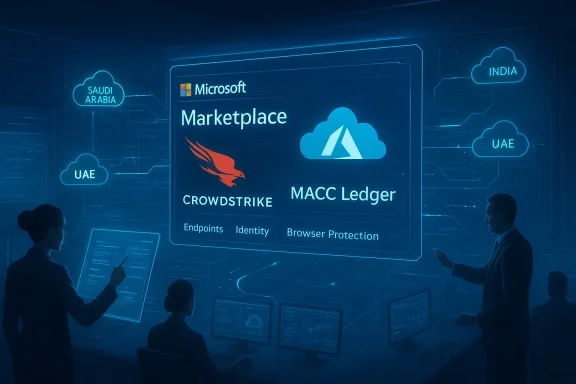
CrowdStrike and Microsoft have deepened a strategic tie that will let Azure customers buy the CrowdStrike Falcon platform directly through Microsoft Marketplace and apply those purchases against their existing Microsoft Azure Consumption Commitment, a move the vendors say will remove procurement friction and accelerate deployment of Falcon’s AI‑native protections across endpoints, cloud workloads, identity and data.
The new arrangement — announced by CrowdStrike and Microsoft on February 18, 2026 — makes the CrowdStrike Falcon platform available for purchase via Microsoft Marketplace with full eligibility to decrement Microsoft Azure Consumption Commitments. That means organizations that have committed cloud spend with Microsoft can now apply some of that committed budget toward buying CrowdStrike’s Falcon security subscriptions instead of routing those purchases through separate procurement and billing systems. (crowdstrike.com)
Cloud marketplaces have been steadily evolving from discovery catalogs into primary procurement channels for enterprise software. Analysts and vendors have pointed to marketplace availability plus commitment‑redemption programs as a way to speed time‑to‑value and simplify vendor billing workflows. Historically, vendors on other major clouds have pursued similar marketplace expansions to streamline buying and billing for customers.
Canalys chief analyst Jay McBain and joint customers quoted by the vendors described marketplaces as growing primary channels for enterprise software — a claim supported by growing industry evidence that marketplace transactions accelerate procurement and enable easier partner co‑sell motions. This market narrative is consistent with multiple marketplace expansions observed across Azure, AWS, and other clouds.
For enterprise customers, this dynamic raises strategic questions: do you prefer a single‑pane marketplace for procurement and billing, or a multi‑vendor procurement strategy that preserves negotiating leverage and reduces single‑cloud dependency? There’s no universal answer; the right approach depends on governance, compliance, and multi‑cloud strategy.
However, the long‑term commercial impact depends on adoption velocity, negotiated economics for large customers, and whether similar arrangements expand to other leading security vendors — competitive responses will shape whether this becomes a decisive advantage or a normalization of marketplace commerce. Readers should view near‑term commercial language as vendor positioning rather than a guarantee of long‑term market disruption.
Strategically, the move signals continued maturation of cloud marketplaces as central distribution channels for security software, and it places pressure on competing cloud vendors and security vendors to offer comparable commercial flexibility. Organizations should welcome the improved procurement model while preserving rigorous technical validation, contractual review, and governance controls to ensure the convenience of Marketplace procurement translates into durable security outcomes.
In every case, treat the Marketplace option as one procurement path among several: it’s a convenience that can reduce friction, but the ultimate measure of success remains whether Falcon—however purchased—improves detection, reduces dwell time, and helps your SOC stop breaches faster.
Source: Investing.com CrowdStrike and Microsoft expand alliance for Azure customers By Investing.com
 Background
The new arrangement — announced by CrowdStrike and Microsoft on February 18, 2026 — makes the CrowdStrike Falcon platform available for purchase via Microsoft Marketplace with full eligibility to decrement Microsoft Azure Consumption Commitments. That means organizations that have committed cloud spend with Microsoft can now apply some of that committed budget toward buying CrowdStrike’s Falcon security subscriptions instead of routing those purchases through separate procurement and billing systems. (crowdstrike.com)Cloud marketplaces have been steadily evolving from discovery catalogs into primary procurement channels for enterprise software. Analysts and vendors have pointed to marketplace availability plus commitment‑redemption programs as a way to speed time‑to‑value and simplify vendor billing workflows. Historically, vendors on other major clouds have pursued similar marketplace expansions to streamline buying and billing for customers.
What changed — the essentials
- What’s enabled now: Customers can purchase the CrowdStrike Falcon platform through Microsoft Marketplace and have that purchase counted against existing Microsoft Azure Consumption Commitments (MACC).
- Why it matters: The integration reduces procurement friction, consolidates billing, and — according to the vendors — accelerates deployment of Falcon protections across endpoints, cloud workloads, identity, AI and data.
- Who announced it: The move was announced jointly by CrowdStrike and Microsoft, with quotes from CrowdStrike CEO George Kurtz and Judson Althoff, CEO of Microsoft’s commercial business, framing the step as both a commercial simplification and a security enabler for AI transformation.
Why this matters to Azure customers
Faster procurement, less invoicing headache
Enterprise procurement cycles are often slowed by multi‑vendor billing models, purchase orders, and differing contracting terms. By enabling CrowdStrike purchases to be consumed through a customer’s Azure consumption commitment, Microsoft and CrowdStrike aim to eliminate one set of these hurdles and make it simpler for security teams to get Falcon deployed quickly. For organizations already highly invested in Azure, this can reduce the number of purchasing routes and align security spend with existing cloud budgets.Consolidated vendor relationship inside Azure
For IT leaders who prefer to centralize platform vendors inside a single cloud ecosystem, marketplace availability provides operational advantages: unified invoicing, simpler vendor management, and an auditable procurement trail inside Azure’s ecosystem. This can be particularly appealing for global organizations that standardize on Microsoft’s billing and subscription tooling. CrowdStrike and Microsoft highlight exactly these benefits in their joint messaging. (crowdstrike.com)Tangible impact on deployment and time-to-protection
From a security‑ops perspective, the most direct benefit is time‑to‑protection. The vendors say that Marketplace availability and simplified procurement will accelerate teams’ ability to deploy Falcon across endpoints and cloud workloads. Faster procurement often reduces administrative backlog for security teams and shortens the window in which gaps exist while teams negotiate separate contracts. That said, procurement acceleration is necessary but not sufficient — deployment, agent management, identity integrations and SOC tuning still require operational work.How this fits the broader marketplace trend
Cloud marketplaces have matured beyond discovery portals and are now battlegrounds for how enterprise software is sold, discounted, and bundled. Microsoft’s approach — letting purchases reduce a umption Commitment — is similar in flavor to previous moves by Microsoft to make third‑party software transactable and billable inside Azure, and it mirrors activity on competing clouds where vendors enable marketplace procurement and flexible consumption models. The CrowdStrike announcement follows other examples where vendors made sophisticated security and FinOps products transactable inside the principal cloud marketplaces to reduce friction for customers.Vendor and partner perspectives
Microsoft framed the move as part of a broader push to ensure security underpins enterprise AI transformation; Judson Althoff described security as “the foundation for AI Transformation” and emphasized the additional financial flexibility this change provides. CrowdStrike’s CEO George Kurtz emphasized the operational urgency of security and the need to remove procurement barriers so security teams can act faster. Both vendors presented the initiative as customer‑centric — combining commercial flexibility with security enablement.Canalys chief analyst Jay McBain and joint customers quoted by the vendors described marketplaces as growing primary channels for enterprise software — a claim supported by growing industry evidence that marketplace transactions accelerate procurement and enable easier partner co‑sell motions. This market narrative is consistent with multiple marketplace expansions observed across Azure, AWS, and other clouds.
Technical and operational implications for security teams
Integration scope — what Falcon delivers inside Azure
CrowdStrike’s Falcon is a unified security platform that combines endpoint detection and response, cloud workload protection, identity threat protection, and other modules under a cloud‑native architecture. The joint announcement highlights coverage for endpoints, cloud workloads, identity, AI and data — in other words, Falcon’s cross‑domain telemetry is meant to be consistent with hybrid cloud and SaaS environments. Because the marketplace transaction is commercial (procurement) rather than aation layer, existing technical integrations like Falcon connectors for cloud telemetry, Entra/Microsoft Entra ID integrations, or Sentinel integrations remain central to realizing runtime security gains.What to validate in your environment
When IT and security teams consider transacting Falcon through Azure Marketplace, weigh and verify:- Which specific Falcon modules (EDR, CWP/CNAPP, identity protection, XDR) are included or require separate SKUs.
- How licensing through MACC maps to CrowdStrike’s subscription and seat counts — confirm decrement rules and billingtion points with Microsoft Entra ID (identity), Azure AD logs, Microsoft Defender telemetry, and Microsoft Sentinel for correlation and SOC workflows.
- Agent deployment strategy (phased vs. big‑bang), patching expectations, and impact on endpoint resource usage.
- Contractual terms around support SLAs, data jurisdiction, and telemetry retention.
Deployment checklist (recommended steps)
- Inventory current endpoints, cloud workloads, and identity sources you plan to protect.
- Map which Falcon modules you need and confirm Marketplace SKUs correspond.
- Engage procurement to validate Azure Consumption Commitment decrementing rules and contractual changes.
- Pilot deployment on a representative subset of endpoints and cloud services.
- Validate telemetry flows into SIEM/SOAR and tune detections; confirm runbooks.
- Review vendor support, legal terms, and data residency policies before scaling.
Benefits, but also realistic limits
There are clear advantages:- Speed: Procurement friction is reduced and consolidated billing can speed purchases.
- Financial flexibility: Customers with committed Azure spend can better align security spend to existing budgets.
- Procurement simplicity: Centralized invoicing and Marketplace purchasing reduce cross‑vendor procurement complexity.
- Procurement simplification does not equal instant deployment. Technical integration, agent rollout, SOC tuning and change management still require time and skilled personnel.
- Not a free lunch on cost. Applying cecurity product simply shifts the budget; it does not necessarily lower overall spend unless organizations renegotiate or restructure commitments. Teams should model the economics carefully.
- Governance and vendor consolidation risks. Centralizing purchases inside Azure can simplify management, but increases reliance on a single cloud and its procurement constructs — a tradeoff that requires governance oversight.
Competitive context — why this matters strategically
Marketplace availability and commitment‑level procurement are competitive levers for both platform providers and security vendors. For Microsoft, making first‑class marketplace transactions possible for a high‑profile third‑party security vendor strengthens Azure’s position as a one‑stop procurement portal for enterprise stacks. For CrowdStrike, being transactable through Microsoft Marketplace lowers barriers for Azure‑centric customers to adopt Falcon and accelerates co‑sell motions with Microsoft’s field organization. Similar plays have happened on AWS and other marketplaces, where vendors shifted to marketplace billing models to lower procurement and accelerate adoption.For enterprise customers, this dynamic raises strategic questions: do you prefer a single‑pane marketplace for procurement and billing, or a multi‑vendor procurement strategy that preserves negotiating leverage and reduces single‑cloud dependency? There’s no universal answer; the right approach depends on governance, compliance, and multi‑cloud strategy.
Risks and areas to audit before buying in
- Contractual detail: Ensure the Marketplace SKU and price model mirror negotiated terms. Marketplace transacting can sometimes introduce differences in renewal mechanics, cancellation policies, or support channels. Verify with legal and procurement.
- Data flow and residency: Confirm how telemetry is stored, whether CrowdStrike or Microsoft handles data residency controls, and how that maps to your compliance obligations.
- Integration overlap and signal duplication: If you already run Microsoft Defender XDR, Sentinel, or other telemetry stacks, validate how Falcon’s signals will be integrated to avoid duplication, alert fatigue, or inconsistent response playbooks. Joint vendor statements highlight mers must test end‑to‑end workflows.
- Vendor lock‑in and multi‑cloud posture: Treat Marketplace convenience as a procurement tool — not a strategic constraint. If your organization pursues a multi‑cloud security architecture, plan how to purchase and operate across clouds without creating brittle dependencies.
What this could mean for CrowdStrike and Microsoft commercially
From a market standpoint, this is a win for both companies’ go‑to‑market strategies. CrowdStrike gains easier access to Azure customers through a frictionless procurement channel and co‑sell potential inside Microsoft’s commercial engine. Microsoft strengthens Marketplace attractiveness by broadening the set of enterprise‑grade security solutions customers can buy and consume inside Azure budgets. Industry commentary in the announcement frames this as part of a broader trend where cloud marketplaces are increasingly central to enterprise software distribution.However, the long‑term commercial impact depends on adoption velocity, negotiated economics for large customers, and whether similar arrangements expand to other leading security vendors — competitive responses will shape whether this becomes a decisive advantage or a normalization of marketplace commerce. Readers should view near‑term commercial language as vendor positioning rather than a guarantee of long‑term market disruption.
Practical advice for IT and security leaders
- Talk to procurement early. Confirm MACC decrement rules, which SKUs are eligible, and how billing will appear in Azure invoices. Procurement should align the legal contract with the Marketplace SKU.
- Pilot before broad roll‑out. Use a controlled pilot to validate agent behavior, telemetry routing to your SIEM, and response automation with existing SOAR processes.
- Map observability and detection overlap. If you run Microsoft Defender, Sentinel or third‑party SIEMs, design a single‑pane detection and response view to minimize duplicated alerts and unclear playbook ownership.
- Assess data sovereignty and compliance. Confirm where telemetry and logs live, who is the custodian, and whether contractual commitments meet regulatory requirements.
Bottom line — practical and strategic takeaways
This announcement is a concrete example of how cloud marketplaces continue to shift the mechanics of enterprise software procurement. For Azure‑centric customers, buying CrowdStrike Falcon through Microsoft Marketplace and applying it against Azure Consumption Commitments removes a practical barrier: the need to route security purchases outside a primary cloud budget. That simplification can shorten procurement timelines and help security teams deploy protective controls faster — but it does not replace the operational work of deploying, integrating, and tuning a security platform.Strategically, the move signals continued maturation of cloud marketplaces as central distribution channels for security software, and it places pressure on competing cloud vendors and security vendors to offer comparable commercial flexibility. Organizations should welcome the improved procurement model while preserving rigorous technical validation, contractual review, and governance controls to ensure the convenience of Marketplace procurement translates into durable security outcomes.
Final recommendation for WindowsForum readers
If your organization runs significant workloads on Azure and you’re evaluating endpoint, identity, and cloud workload protections:- Start discussion cycles between security, procurement, and cloud finance teams to assess whether applying MACC to CrowdStrike purchases makes financial sense.
- Run a short proof‑of‑value pilot that focuses on integrated telemetry into existing SOC tooling and evaluates detection efficacy.
- Update vendor governance playbooks to account for Marketplace procurement, ensuring renewal windows, SLAs and data handling terms meet your policy requirements.
In every case, treat the Marketplace option as one procurement path among several: it’s a convenience that can reduce friction, but the ultimate measure of success remains whether Falcon—however purchased—improves detection, reduces dwell time, and helps your SOC stop breaches faster.
Source: Investing.com CrowdStrike and Microsoft expand alliance for Azure customers By Investing.com