

A Senate inquiry will examine the rationale, timing and likely fallout of fresh cuts to Australia’s national science agency after the Commonwealth Scientific and Industrial Research Organisation (CSIRO) announced plans to cut up to 350 research roles on top of previous rounds that have already seen hundreds of jobs go; the move has intensified political scrutiny, union alarm and debate about the future of publicly funded science in Australia.
CSIRO’s leadership announced on 18 November that an 18‑month internal review had prompted a strategic realignment of the agency’s research portfolio and the need to reduce research staffing by between 300 and 350 full‑time equivalent (FTE) roles to achieve a “sharpened research focus” and long‑term financial sustainability. The agency said the refocus will concentrate resources into six priority areas including clean energy and critical minerals, climate adaptation and resilience, advanced technologies (AI, quantum and robotics), agricultural technology, biosecurity, and disruptive science and engineering. CSIRO’s public statement also said the organisation faces an infrastructure and capability bill that will require an additional $80–$135 million per year over the next decade to make sites, laboratories and technology fit for purpose — a cost the agency argues cannot be met under current funding arrangements. That framing underpins CSIRO’s public explanation for reducing workforce numbers and prioritising particular programs. The announcement followed an earlier period of major restructuring that CSIRO staff and external reporting estimate has already removed around 800–818 positions from across the organisation in the past 18 months, largely through cuts to science support, Data61 and other units. CSIRO management and staff associations present those prior reductions as context for the new restructuring step — a claim echoed in multiple independent media reports.
Source: psnews.com.au Senate inquiry to be held over CSIRO job cuts | PS News
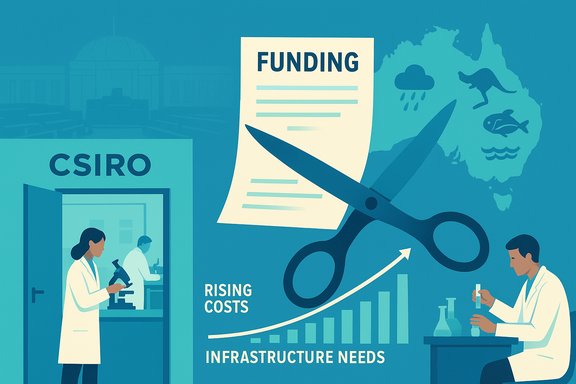 Background: what was announced and why it matters
CSIRO’s leadership announced on 18 November that an 18‑month internal review had prompted a strategic realignment of the agency’s research portfolio and the need to reduce research staffing by between 300 and 350 full‑time equivalent (FTE) roles to achieve a “sharpened research focus” and long‑term financial sustainability. The agency said the refocus will concentrate resources into six priority areas including clean energy and critical minerals, climate adaptation and resilience, advanced technologies (AI, quantum and robotics), agricultural technology, biosecurity, and disruptive science and engineering. CSIRO’s public statement also said the organisation faces an infrastructure and capability bill that will require an additional $80–$135 million per year over the next decade to make sites, laboratories and technology fit for purpose — a cost the agency argues cannot be met under current funding arrangements. That framing underpins CSIRO’s public explanation for reducing workforce numbers and prioritising particular programs. The announcement followed an earlier period of major restructuring that CSIRO staff and external reporting estimate has already removed around 800–818 positions from across the organisation in the past 18 months, largely through cuts to science support, Data61 and other units. CSIRO management and staff associations present those prior reductions as context for the new restructuring step — a claim echoed in multiple independent media reports. The Senate inquiry: scope, timing and what it will examine
In the Senate on 26 November, the Greens moved and succeeded in referring a formal inquiry to the Economics References Committee with a reporting deadline of 31 March 2026. The terms of reference are broad and include examination of: the nature of recent and proposed job and program cuts; the importance of public funding for public‑good science; sovereign scientific capability; recruitment and retention across career stages; CSIRO’s commercialisation activities; long‑term capability needs including workforce and infrastructure; leadership independence in resourcing decisions; and the specific impact of cuts on the Environment Research Unit and work on climate, ocean and biodiversity issues. The motion was carried in the Senate and will require the committee to receive submissions, hold hearings and produce a public report by the stated date. That referral formalises parliamentary scrutiny at a time when CSIRO’s leadership says it is moving to prioritise projects that deliver measurable national industrial and technological impact — and when critics argue that public‑good and long‑horizon research risks being squeezed out. The inquiry offers a forum to test both sets of claims, compel documentation from CSIRO and Cabinet, and evaluate whether funding models support the agency’s stated mission.Political reactions and stakeholder responses
Government and CSIRO leadership
CSIRO chief executive Dr Doug Hilton framed the changes as a painful but necessary repositioning to deliver long‑term impact at national scale. Hilton emphasised the agency had “reached a critical inflection point” where real‑term funding had not kept pace with rising costs and infrastructure needs, and that a concentrated research portfolio would deliver better outcomes within constrained finances. CSIRO’s public communications stress consultation with staff and stakeholders while seeking to minimise the immediate operational risks of change. Science Ministerial spokespeople have been careful to characterise the reprioritisation as independently decided by CSIRO leadership following the review, though the government has been urged by backbenchers and some ministers to find additional funding if the public interest requires it. Former science minister and Labor backbencher Ed Husic publicly called for stronger Treasury support to see the agency through, urging the government to “stop looking at science as a cost and see it as an investment.”Opposition, Greens and unions
The Greens and the Community and Public Sector Union (CPSU) — including the CSIRO Staff Association — have sharply criticised the cuts. Greens science spokesperson Senator Peter Whish‑Wilson called the planned cuts “reprehensible” and highlighted the disproportionate impact on the Environment Research Unit, saying that reducing capacity in biodiversity, climate intelligence and ocean science will undercut Australia’s ability to respond to an escalating environmental emergency. Greens finance and public sector spokesperson Barbara Pocock argued the agency needed more public funding, not structural contraction. Unions have framed the cuts as not only an institutional loss but a social and workforce problem: hundreds of skilled researchers may be forced out of the public research system, with knock‑on effects for regional centres, universities and private‑public research pipelines. The CSIRO Staff Association painted the cumulative losses as deeper than past large reductions to the agency, linking workforce erosion to declining institutional capacity.Science community and professional bodies
Peak science bodies and research advocates urge a different framing: public‑good research must be sustained through dedicated funding streams, long‑term institutional support and strategic investment, they say, rather than relying on reactive internal restructures that shrink capability. The concern is that a national agency like CSIRO plays roles — national monitoring, basic ecosystem science, early‑warning biosecurity work — that private funding models do not reliably support. This argument underpins several submissions expected in the Senate inquiry.Who stands to be affected: distribution of cuts and program risks
Multiple independent reports and union sources indicate the cuts are not evenly distributed across the agency. Media reporting and union statements point to the following approximate distribution of proposed reductions:- Environment Research Unit: estimated 130–150 FTE reductions (roughly one in five roles within the unit according to some reporting), with specific program closures or transfers under consideration.
- Health and Biosecurity: estimated 100–110 FTE reductions.
- Agriculture and Food: estimated 45–55 FTE reductions.
- Mineral Resources: estimated 25–35 FTE reductions.
Risks to public‑good science and national monitoring
The most immediate risk flagged by researchers, unions and critics is erosion of “public‑good” capabilities: long‑term biodiversity monitoring, foundational climate datasets, baseline ecosystem research and national biosecurity surveillance. These areas typically lack private‑sector sponsors because the benefits are widely shared rather than directly commercialisable. If capacity in these domains is reduced or shifted to other entities with different priorities, Australia could lose continuity in critical national datasets or reduce its ability to provide independent scientific advice in emergencies. The Senate inquiry explicitly lists these vulnerabilities in its terms of reference.Regional and talent impacts
CSIRO operates numerous regional laboratories and research centres. Job reductions can have disproportionate regional economic effects, reduce local science capability and prompt skilled researchers to move overseas or to private sector roles. Recruitment and retention problems — especially for mid‑career and early‑career researchers — were singled out in the Senate motion as areas for examination. Sustaining a pipeline of expertise requires predictable, multi‑year funding commitments; ad‑hoc cuts undermine that predictability.Financial logic and contested numbers: what’s verified and what’s uncertain
CSIRO management argues the combination of rising operational costs (including cybersecurity, laboratory maintenance and site upgrades) and static nominal funding has put the agency in a position where its existing footprint is not fiscally sustainable. The agency’s public materials state the need for an additional $80–$135 million per year to address infrastructure renewal and long‑term capability needs — a figure included in the formal CSIRO announcement. Independent commentators and parliamentary analyses have corroborated the broader trend that CSIRO’s funding in real terms has lagged behind inflation and the rising costs of doing cutting‑edge research, citing a long‑term fall in public R&D intensity relative to GDP. However, the precise accounting — whether the funding shortfall necessarily requires the scale of cuts proposed, or whether alternate budgetary choices could substantially reduce job impacts — is contested. The Senate inquiry provides the mechanism to test detailed financial assumptions, including:- CSIRO’s internal cost projections and property upgrade estimates.
- The agency’s revenue mix (government appropriations, competitive grants, industry partnerships) and whether commercialization can plausibly replace public funding for national mission science.
What the Senate inquiry can realistically achieve
A Senate References Committee inquiry can do several practical things within its remit and deadline:- Subpoena documents and compel senior CSIRO officials and government ministers to give evidence at public hearings. The committee can also call union leaders, former executives, independent researchers and industry partners to testify.
- Produce a public report that sets out findings and policy recommendations to the Parliament, which can influence budget deliberations, ministerial direction statements and public opinion before the mid‑year budget update. The committee’s report due by 31 March 2026 is well timed to feed into budget and policy cycles.
- Illuminate the budgetary logic and alternatives, including whether a short‑term injection of funding could avert the most damaging workforce losses or whether structural reform is the only viable route.
Strategic analysis: strengths, weaknesses and long‑term risks
Notable strengths of CSIRO’s repositioning case
- Focused priorities: Concentrating resources on areas with high national strategic importance (clean energy, biosecurity, AI) can deliver clearer returns on investment and better align work with industrial outcomes the government prioritises. CSIRO’s argument that scale matters in generating national impact has operational logic.
- Infrastructure realism: Many national research agencies face substantial deferred maintenance and upgrade bills; acknowledging and planning for those is prudent rather than postponing unsustainable liabilities. The $80–$135 million estimate, if accurate, highlights the scale of capital requirements.
Critical weaknesses and risks
- Public‑good gap: Narrowing the remit increases the risk that long‑term, non‑commercial research — vital for climate, biodiversity and national datasets — will be underfunded or disappear. Market mechanisms rarely replace public funding for such work.
- Talent pipeline erosion: Repeated rounds of cuts damage morale, complicate recruitment and push early‑career researchers away from public service; rebuilding that capacity later is slower and costlier than sustained investment.
- Reputational and diplomatic cost: CSIRO is a globally recognised brand; shrinking core capabilities risks undermining Australia’s standing in international scientific collaborations and diplomacy around climate and biodiversity.
Trade‑offs and hidden costs
Decisions framed purely as fiscal efficiencies can carry hidden long‑term costs: loss of institutional memory, retreat from leadership roles in international science consortia, weakening of domestic capability that supports industries such as agriculture, fisheries and defence. Those trade‑offs are difficult to quantify and are precisely why the terms of reference for the Senate inquiry emphasise sovereign capability and long‑term workforce needs.Practical next steps and what to watch
- Committee timetable and submissions: Monitor the Economics References Committee for its public call for submissions and witness list; stakeholder submissions will be revealing about the range of evidence the inquiry receives.
- CSIRO consultation outcomes: CSIRO’s staff consultations will produce more specific decisions about which projects and people are affected; those announcements will be key to assessing program‑level impacts.
- Government budget moves: Look for ministerial statements or Treasurer actions between now and the mid‑year economic update; any material new funding would materially change the calculus.
- Transparency on governance: The inquiry will likely demand detailed budget papers, executive remuneration records and a timeline of decision‑making — transparency here will shape public confidence in the process.
Conclusion: balancing fiscal realities and national science capital
Australia’s CSIRO is at a consequential crossroads: management argues that the organisation must tighten focus and reduce scale to remain financially viable and to concentrate impact where it can do the most. Critics contend that repeated cuts risk hollowing out public‑good science just when long‑term environmental, health and security challenges demand sustained investment. The Senate inquiry—tasked to report by 31 March 2026—creates a formal mechanism to test the financial assumptions, governance choices and national implications underpinning CSIRO’s plan. What emerges from the inquiry will matter beyond CSIRO’s own workforce: it will shape whether Australia chooses to prioritise sovereign scientific capability with public funding, or to rely increasingly on commercial partnerships and narrower mission‑driven research. The balance struck will determine not only agency budgets but the country’s scientific capacity to respond to climate shocks, biosecurity threats and the next generation of technology challenges. The coming months of evidence gathering, public hearings and political debate will therefore be a critical test of how Australia values and protects its national science infrastructure.Source: psnews.com.au Senate inquiry to be held over CSIRO job cuts | PS News
