

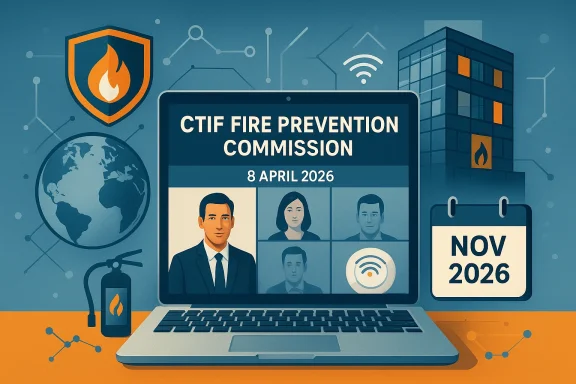
Fire prevention is moving from a specialist discipline to a central policy concern, and CTIF is signaling that shift with an online meeting on 8 April 2026. The invitation from Dr. Aleš Jug, head of the Department for Fire-Safe Sustainable Built Environment, frames the session as more than a routine update: it is a call to revitalize the CTIF Fire Prevention Commission, deepen international cooperation, and prepare for a possible in-person meeting in November 2026. That matters because the commission has a long history, a dormant period, and now a renewed mandate at a moment when fire risk is becoming more complex rather than less. The message is clear: the future of fire prevention will be shaped not only by incidents, but by how quickly professionals adapt, share knowledge, and coordinate across borders. (ctif.org)
CTIF, the international firefighting association founded in 1900, has long organized its work through commissions and working groups that connect practitioners across national systems. The Fire Prevention Commission is one of those structures, and its public profile shows both continuity and disruption: it was founded in 2001, but the commission page also notes that it had been dormant and was only recently back up and running. That combination gives the April 2026 meeting a significance that goes beyond the usual calendar cycle. It is not merely a planning session; it is part of a broader effort to ensure the commission remains relevant, responsive, and operational. (ctif.org)
The commission’s original purpose was practical and wide-ranging. CTIF describes its mission as assessing fire-related risks, proposing fire prevention measures, improving fire safety solutions for different premises, understanding the causes of home fires, evaluating risks to fire department personnel, and improving codes, guidelines, and standards. Those objectives have not become less important over time; if anything, they have become more demanding as buildings, technology, climate, and public expectations have all changed at once. The challenge now is to keep those core goals aligned with newer realities such as smart buildings, connected devices, and climate stress. (ctif.org)
The commission’s recent history shows a deliberate effort to restart collaboration. In May 2024, CTIF said the commission had reformed and started again with a wider focus, including topics such as EU legislation, smart fire safety, IoT, climate change, professional training, and automatic detection and extinguishing systems. The meeting minutes from that period also emphasized the need for a shared platform for documents and feedback, along with both virtual and in-person meetings. In other words, CTIF was already moving from a dormant structure toward a more modern, networked model of cooperation. (ctif.org)
By February 2025, the commission had held a virtual meeting with participants from the Czech Republic, Latvia, and Slovenia. CTIF reported that the group still did not have a chair at that point, and that the issue would be addressed at an in-person meeting in autumn 2025. That detail is important because it shows the commission was still rebuilding its governance and rhythm. The April 2026 invitation therefore arrives in a context where continuity has been restored, but consolidation is still underway. (ctif.org)
The commission also appears to be using the meeting to establish a forward agenda. CTIF’s earlier minutes already discussed creating a common space for documents and feedback, and the invitation now extends that logic into a broader call for revived cooperation. This is not a bureaucratic detail. It is organizational infrastructure, and it determines whether the commission becomes a living network or a name on a website. (ctif.org)
There is also a training dimension. CTIF specifically mentioned the role and training of fire safety professionals, as well as continuing education and adapting to new standards and technologies. That matters because even the best codes and devices are only as effective as the people who interpret, install, inspect, and maintain them. Prevention is increasingly a systems discipline, and systems fail when one layer is neglected. (ctif.org)
The April meeting, then, can be seen as a synchronization point. If member countries are dealing with different risks at different speeds, the commission can help identify which threats are emerging globally and which are still regional. That is a small but powerful function, because it allows prevention to become anticipatory rather than reactive.
The same minutes also note that countries would nominate representatives and suggest priorities so the outputs would be useful to them. That is a quietly important design principle. It means the commission is trying to avoid top-down agendas and instead let participating countries shape the work based on what is actually happening on the ground. In practice, that should improve relevance and buy-in. (ctif.org)
This is especially important because prevention questions often travel across borders faster than regulation does. A problem seen in one country, whether linked to housing patterns, devices, consumer behavior, or climate conditions, may soon appear elsewhere. A commission that meets regularly can help its members see those patterns earlier and debate responses before the issue becomes a crisis. That is one reason international fire prevention cooperation still matters in a digital age.
There is also a reputational component. When public expectations are rising, fire services need to demonstrate that they are not only responding to emergencies but also shaping safer systems. A visible, active prevention commission supports that message by showing that prevention is a standing institutional priority rather than a rhetorical slogan.
The mention of a possible in-person meeting in November 2026 is equally telling. Virtual meetings are efficient, but in-person gatherings usually allow for deeper negotiation, stronger personal relationships, and more ambitious follow-up work. If CTIF wants the commission to produce tangible outputs such as recommendations, guidance, or collaborative projects, a face-to-face session can help convert discussion into commitment.
A useful way to read the invitation is as a three-step process:
The earlier minutes also referred to gathering data from interventions and statistical data from systems. That suggests an evidence-driven direction for the commission. Better data can improve risk assessment, identify recurring failure modes, and support codes that are based on lived operational experience rather than theory alone. In prevention, data quality often determines whether standards evolve or merely repeat old assumptions. (ctif.org)
Another theme is adaptation. CTIF explicitly mentioned climate change and the relationship between climate change and fire risk on safety measures. That is a reminder that prevention cannot be defined only by the built environment. Weather extremes, drought, heat, and changing land-use pressures all alter the risk landscape and may eventually reshape code thinking as much as traditional building standards do. (ctif.org)
For professionals, the implications are different but equally important. Fire safety officers, inspectors, researchers, and trainers need common references and international contact points. A commission that shares documents, presentations, and country priorities can help professionals compare approaches, spot gaps, and borrow proven ideas rather than starting from scratch. That is a tangible benefit in a field where time is often limited and mistakes can be costly. (ctif.org)
The private-sector angle should not be ignored either. Manufacturers, consultants, and system integrators tend to follow standards and guidance closely. When technical commissions sharpen the prevention conversation, they indirectly influence product development and compliance expectations. The result can be better safety technology, but also higher expectations for documentation, interoperability, and accountability. (ctif.org)
Fire prevention is becoming more important because the world around it is becoming more complicated, and CTIF seems to understand that well. The April 8 meeting is significant precisely because it treats prevention as a living, collaborative discipline that must be refreshed, not merely repeated. If the commission keeps its engagement high and its output practical, it can help shape the next phase of international fire safety cooperation in a way that matters far beyond the meeting room.
Source: ctif.org Fire Prevention On-Line meeting April 8
 Background
CTIF, the international firefighting association founded in 1900, has long organized its work through commissions and working groups that connect practitioners across national systems. The Fire Prevention Commission is one of those structures, and its public profile shows both continuity and disruption: it was founded in 2001, but the commission page also notes that it had been dormant and was only recently back up and running. That combination gives the April 2026 meeting a significance that goes beyond the usual calendar cycle. It is not merely a planning session; it is part of a broader effort to ensure the commission remains relevant, responsive, and operational. (ctif.org)The commission’s original purpose was practical and wide-ranging. CTIF describes its mission as assessing fire-related risks, proposing fire prevention measures, improving fire safety solutions for different premises, understanding the causes of home fires, evaluating risks to fire department personnel, and improving codes, guidelines, and standards. Those objectives have not become less important over time; if anything, they have become more demanding as buildings, technology, climate, and public expectations have all changed at once. The challenge now is to keep those core goals aligned with newer realities such as smart buildings, connected devices, and climate stress. (ctif.org)
The commission’s recent history shows a deliberate effort to restart collaboration. In May 2024, CTIF said the commission had reformed and started again with a wider focus, including topics such as EU legislation, smart fire safety, IoT, climate change, professional training, and automatic detection and extinguishing systems. The meeting minutes from that period also emphasized the need for a shared platform for documents and feedback, along with both virtual and in-person meetings. In other words, CTIF was already moving from a dormant structure toward a more modern, networked model of cooperation. (ctif.org)
By February 2025, the commission had held a virtual meeting with participants from the Czech Republic, Latvia, and Slovenia. CTIF reported that the group still did not have a chair at that point, and that the issue would be addressed at an in-person meeting in autumn 2025. That detail is important because it shows the commission was still rebuilding its governance and rhythm. The April 2026 invitation therefore arrives in a context where continuity has been restored, but consolidation is still underway. (ctif.org)
Why This Meeting Matters
The tone of the invitation suggests a commission trying to avoid becoming ceremonial. Jug’s message says fire prevention is only gaining importance, that new risks are emerging, and that expectations from the public and decision-makers are rising. That is a notable framing because it treats prevention as a strategic function, not a technical afterthought. It also implies that if the commission wants to remain influential, it must demonstrate visible output, not just periodic convening.A Commission Built on Participation
One of the strongest parts of the invitation is its emphasis on discussion. Members are encouraged to join not only to receive updates, but to provide brief input that helps reveal the broader picture across countries. That approach reflects a practical truth: fire prevention is deeply local in execution, but increasingly international in the patterns it must address. Shared discussion can expose policy gaps, equipment trends, training differences, and recurring risks faster than isolated national work.The commission also appears to be using the meeting to establish a forward agenda. CTIF’s earlier minutes already discussed creating a common space for documents and feedback, and the invitation now extends that logic into a broader call for revived cooperation. This is not a bureaucratic detail. It is organizational infrastructure, and it determines whether the commission becomes a living network or a name on a website. (ctif.org)
- The meeting is designed to gather country-level perspectives.
- The agenda appears aimed at common problem-solving, not only reporting.
- The commission is trying to build operational momentum for 2026.
- Brief inputs from members are being treated as valuable signals.
- The structure suggests a shift from passive membership to active collaboration.
Fire Prevention in a Changing Risk Landscape
The invitation’s emphasis on “new risks” reflects how broad the fire prevention agenda has become. A decade ago, prevention discussions might have centered mainly on building codes, home fire alarms, and familiar structural hazards. Today, the conversation also has to include energy storage, charging infrastructure, climate-related wildfires, smart building systems, and changing patterns of occupancy such as temporary accommodation or mixed-use spaces. (ctif.org)From Buildings to Systems
The commission’s earlier agenda hints at that shift. CTIF listed integration of fire safety and smart buildings, the use of IoT and smart technologies for monitoring and management, and automatic fire detection and extinguishing systems in smart buildings. Those topics show that fire prevention now sits at the intersection of building design, software, data, and maintenance. That is a major change from the older model in which fire safety could be treated as mostly static infrastructure. (ctif.org)There is also a training dimension. CTIF specifically mentioned the role and training of fire safety professionals, as well as continuing education and adapting to new standards and technologies. That matters because even the best codes and devices are only as effective as the people who interpret, install, inspect, and maintain them. Prevention is increasingly a systems discipline, and systems fail when one layer is neglected. (ctif.org)
The April meeting, then, can be seen as a synchronization point. If member countries are dealing with different risks at different speeds, the commission can help identify which threats are emerging globally and which are still regional. That is a small but powerful function, because it allows prevention to become anticipatory rather than reactive.
Governance and Continuity
The commission’s governance story is as important as its technical agenda. CTIF’s February 2025 report said the commission still lacked a chairman, while the later commission page now lists Dr. Aleš Jug as chair. That progression suggests that leadership continuity has improved, which is often the hidden prerequisite for substantive work. Without a stable chair and predictable rhythm, even a well-designed commission can drift. (ctif.org)Why Leadership Structure Matters
The May 2024 meeting minutes stressed that the next steps included voting the chairman and secretary, creating a knowledge-sharing platform, and organizing both virtual and in-person sessions. Those tasks may sound procedural, but they are the mechanisms that make cross-border coordination possible. A commission without a clear secretary, archive, or communication cadence quickly becomes dependent on memory rather than process. (ctif.org)The same minutes also note that countries would nominate representatives and suggest priorities so the outputs would be useful to them. That is a quietly important design principle. It means the commission is trying to avoid top-down agendas and instead let participating countries shape the work based on what is actually happening on the ground. In practice, that should improve relevance and buy-in. (ctif.org)
- Stable leadership helps sustain technical cooperation.
- A shared document platform improves continuity.
- National priorities make the commission’s output more useful.
- Virtual meetings reduce friction for participation.
- In-person meetings can deepen trust and accelerate decisions. (ctif.org)
The European and International Context
CTIF is not operating in a vacuum. Across Europe and beyond, fire services are dealing with larger wildfires, denser urban environments, more electrification, and more complex building systems. Prevention has to keep up with all of these pressures at once, which makes international exchange valuable even when no single country has a complete solution. The commission’s purpose is to reduce that fragmentation by sharing practice, data, and lessons learned. (ctif.org)Why Cross-Border Exchange Still Works
CTIF’s list of member countries for the Fire Prevention Commission includes a mix of European states plus the United States in the public page, while the recent meetings have drawn participants from a smaller subset. That combination underscores a recurring challenge in international bodies: formal membership is broader than active participation. The April meeting may therefore serve as a practical test of whether the commission can convert formal affiliation into regular engagement. (ctif.org)This is especially important because prevention questions often travel across borders faster than regulation does. A problem seen in one country, whether linked to housing patterns, devices, consumer behavior, or climate conditions, may soon appear elsewhere. A commission that meets regularly can help its members see those patterns earlier and debate responses before the issue becomes a crisis. That is one reason international fire prevention cooperation still matters in a digital age.
There is also a reputational component. When public expectations are rising, fire services need to demonstrate that they are not only responding to emergencies but also shaping safer systems. A visible, active prevention commission supports that message by showing that prevention is a standing institutional priority rather than a rhetorical slogan.
What the April 8 Agenda Signals
The invitation does not provide a long formal agenda, but its wording is revealing. It emphasizes updates, exchange of country experiences, identification of common challenges, and cooperation across the commission. That implies the meeting is less about one technical presentation and more about re-establishing a shared operating model. In that sense, the meeting feels strategic rather than administrative.From Reporting to Coordination
The most notable phrase in the invitation is the call to “revitalise” the work together. That suggests the commission recognizes that a network can stagnate even when its members remain technically capable. The goal is not simply to meet, but to reconnect the function of the commission to the needs of its member countries. That is exactly the kind of reframing a dormant group needs when it comes back to life.The mention of a possible in-person meeting in November 2026 is equally telling. Virtual meetings are efficient, but in-person gatherings usually allow for deeper negotiation, stronger personal relationships, and more ambitious follow-up work. If CTIF wants the commission to produce tangible outputs such as recommendations, guidance, or collaborative projects, a face-to-face session can help convert discussion into commitment.
A useful way to read the invitation is as a three-step process:
- Reconfirm the commission’s current membership and participation.
- Compare national developments and identify shared risks.
- Decide where joint work can produce the most value in 2026.
The Technical Agenda Behind the Meeting
The commission’s earlier discussion points give a strong clue about what the technical conversation will likely involve. CTIF has already identified smart buildings, IoT-based monitoring, automatic suppression systems, climate change, and training as priority topics. Those themes are not isolated innovations; they are interconnected responses to a more dynamic risk environment. Fire prevention now has to be both digital and durable. (ctif.org)Smart Buildings and Data
The spread of smart building systems creates a paradox. On one hand, connected sensors and controls can make it easier to detect hazards early and manage safety more intelligently. On the other hand, the increased complexity can create blind spots if systems are poorly integrated, poorly maintained, or not understood by operators and responders. Prevention work therefore needs to include not just installation standards, but data governance and practical usability. (ctif.org)The earlier minutes also referred to gathering data from interventions and statistical data from systems. That suggests an evidence-driven direction for the commission. Better data can improve risk assessment, identify recurring failure modes, and support codes that are based on lived operational experience rather than theory alone. In prevention, data quality often determines whether standards evolve or merely repeat old assumptions. (ctif.org)
Another theme is adaptation. CTIF explicitly mentioned climate change and the relationship between climate change and fire risk on safety measures. That is a reminder that prevention cannot be defined only by the built environment. Weather extremes, drought, heat, and changing land-use pressures all alter the risk landscape and may eventually reshape code thinking as much as traditional building standards do. (ctif.org)
- Smart sensors can improve early warning.
- Integration failures can undermine advanced systems.
- Operational data can strengthen codes and standards.
- Climate stress is becoming a fire prevention issue.
- Training remains the bridge between technology and practice. (ctif.org)
Consumer, Community, and Professional Impact
For the public, fire prevention usually shows up in visible ways: safer homes, better alarms, stronger building requirements, and clearer advice. But the CTIF discussion hints at a deeper reality. The choices made by technical commissions influence what ends up being mandated, recommended, or normalized in building and safety practice. That means the April meeting could eventually affect ordinary residents even if they never hear about CTIF directly. (ctif.org)Consumer Protection Through Prevention
The commission’s founding mission included understanding the leading causes of home structure fires and fire injuries and casualties, then developing measures to prevent them. That remains highly relevant because consumer safety often depends on systems people do not see. Alarm placement, appliance standards, escape planning, and passive fire protection all shape outcomes long before the first call to emergency services. (ctif.org)For professionals, the implications are different but equally important. Fire safety officers, inspectors, researchers, and trainers need common references and international contact points. A commission that shares documents, presentations, and country priorities can help professionals compare approaches, spot gaps, and borrow proven ideas rather than starting from scratch. That is a tangible benefit in a field where time is often limited and mistakes can be costly. (ctif.org)
The private-sector angle should not be ignored either. Manufacturers, consultants, and system integrators tend to follow standards and guidance closely. When technical commissions sharpen the prevention conversation, they indirectly influence product development and compliance expectations. The result can be better safety technology, but also higher expectations for documentation, interoperability, and accountability. (ctif.org)
Strengths and Opportunities
The April 8 meeting arrives with several structural advantages. CTIF already has a recognizable commission framework, an established chair listed on its public page, and a recent history of reactivation that gives this work momentum. The commission also has a broad, modern topic set that aligns with current risk trends, which increases the chance that members will see value in participation. (ctif.org)- Renewed leadership offers continuity after the dormant period.
- A clear mission keeps the commission anchored to practical outcomes.
- Cross-country exchange can surface issues earlier than isolated national work.
- Smart-building topics keep the agenda relevant to modern construction.
- Climate-linked fire risk broadens the commission’s strategic importance.
- Virtual meetings make participation easier and more regular.
- An in-person meeting can deepen trust and improve follow-through. (ctif.org)
Risks and Concerns
The main risk is that enthusiasm outpaces execution. A revived commission can attract attention quickly, but without firm follow-up it may struggle to produce concrete outputs such as working papers, shared tools, or agreed priorities. The previous history of dormancy is a reminder that structures can exist on paper without becoming consistently active in practice. (ctif.org)- Low attendance could weaken the commission’s credibility.
- Overly broad topics may dilute focus.
- Leadership turnover can disrupt momentum.
- Too much discussion, too little output risks repetition without progress.
- Uneven national capacity may limit shared implementation.
- Technical complexity could make practical guidance harder to agree on.
- Platform fragmentation may undermine document sharing and continuity. (ctif.org)
Looking Ahead
The next few months will show whether the April online meeting is the start of a sustained cycle or simply another checkpoint. The plan for a November 2026 in-person meeting suggests CTIF wants continuity, and the commission’s recent reactivation suggests the will is there. What remains to be seen is whether participation broadens beyond a small core and whether the commission can convert shared concern into visible deliverables.Signals to Watch
- Whether attendance expands beyond the most active member countries.
- Whether the commission sets a small number of measurable priorities.
- Whether a shared knowledge platform becomes operational and useful.
- Whether the November 2026 in-person meeting is confirmed and well-defined.
- Whether the commission produces outputs that can inform national practice. (ctif.org)
Fire prevention is becoming more important because the world around it is becoming more complicated, and CTIF seems to understand that well. The April 8 meeting is significant precisely because it treats prevention as a living, collaborative discipline that must be refreshed, not merely repeated. If the commission keeps its engagement high and its output practical, it can help shape the next phase of international fire safety cooperation in a way that matters far beyond the meeting room.
Source: ctif.org Fire Prevention On-Line meeting April 8
