Currys’ decision to renew and deepen its technology partnership with Munster Rugby is more than a sponsorship line item — it’s a clear signal that consumer retail specialists are moving into the high-performance sports technology arena, supplying hardware and workflow tools that are now critical to elite-team preparation and recovery.
Background
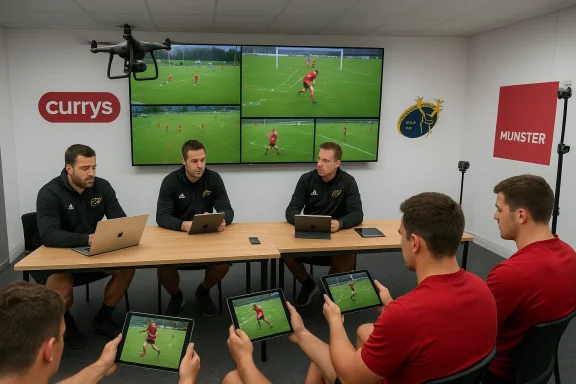
Munster Rugby and Currys first forged a formal technology relationship in 2021, a partnership that has been renewed and extended on multiple occasions as the club embraced a modern, data- and video-driven approach to coaching and athlete development.Under the most recent agreement, Currys will continue as Munster Rugby’s Official Technology Supplier for an additional two seasons. The supply package — described by Munster’s official communications and industry coverage — includes laptops and Apple devices for coaches, large-format LG displays for video review, high-end action cameras and drones for multi-angle capture, and a variety of peripherals that support day‑to‑day operations at the High‑Performance Centre.
This renewal was celebrated at Thomond Park with club players and Currys’ Limerick management in attendance, underscoring the local retail-to-pro-club relationship that underpins the deal.
Why this matters: the role of technology in modern rugby
Video-first coaching and the rise of integrated analysis
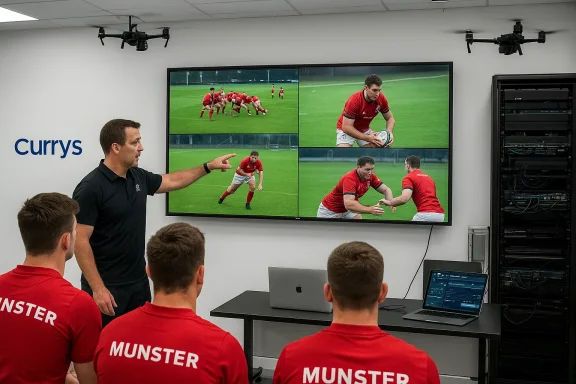
At elite level, sport has become a technology-enabled pursuit: the ability to capture, tag, synchronise and rapidly distribute video clips is central to how coaches communicate, correct and convince. Platforms such as Hudl (and the integrated Sportscode tools used by many pro clubs) have made video libraries and clip-based homework a standard part of the day-to-day. Munster’s performance staff explicitly describe using multi-angle footage captured in training, synced with tracking data, to power analysis and decision-making.Short, structured video clips allow coaches to:
- Highlight mechanical or tactical issues for individual players.
- Share opposition scouting footage in digestible units.
- Deliver remote, on‑demand learning for squad members who must study between sessions.
Multi-angle capture: drones, action cams, and the “eye in the sky”
Capturing training from several vantage points — wide, sideline and player‑level — enables detailed breakdowns of spatial structure, line-speed, support running and set-piece execution. Drones provide high, stable, pitch-scale perspective; GoPro and similar action cameras provide close-up technique and body‑position detail. Munster’s partnership materials explicitly list DJI drones and GoPro-style devices among the tools provided.Industry primers on performance analysis describe this multi-capture approach as standard practice: fixed high-views for structure, drones for overhead context, and wearable or body-mounted cams for kinematic detail. The combined footage can be synchronised with time‑stamped tracking to create composite views of events that matter.
What Currys is supplying — pragmatic kit rather than headline sponsorship
According to Munster and trade coverage, the current supply list focuses on practical, coach‑facing equipment that improves workflow and the immediacy of analysis:- MacBooks and iPads for coach workflows and video tagging.
- Large-screen LG TVs (QNED / smart displays) used for team meetings and instant review.
- DJI drones and GoPro-style action cameras to capture multi-angle training footage.
- Laptops for in‑match and post‑match review — used to collate footage, run software and deliver scouting material.
The commercial logic for Currys — and why retailers are getting into sports tech
Currys is not simply gifting kit; the deal sits at the intersection of product marketing, B2B services and community visibility. For Currys, the arrangement delivers multiple commercial and brand benefits:- Real-world product placement and experiential proof-points for premium displays, laptops and camera products in a high-profile, regional setting.
- A route into B2B and local business services, strengthening relationships with institutions and teams that need ongoing support, repair and upgrade cycles. Recent Currys strategy documents show a wider push into small-business technology services and B2B hubs — an orientation consistent with supplying pro sports customers.
- Local footfall and PR traction: Cork and Limerick retail presence is reinforced by civic-level ties to a major provincial team.
Technical and operational implications for Munster’s High‑Performance Centre
Workflows and integration
Performance analysis requires more than cameras; it requires an integrated pipeline:- Capture from multiple devices (drones, cams, fixed HD cameras).
- Ingest and synchronize footage with external data feeds (GPS/player tracking, heart‑rate streams).
- Tag and clip content inside software (e.g., Hudl, Sportscode) and generate deliverables for coaches and players.
- Distribute via tablets, laptops or shared team screens and iterate on corrective plans.
Data volumes, storage and editing horsepower
Recording multi-angle HD or 4K footage at training every day can create large, rapidly growing media stores. That places demands on:- Local storage (on-prem NAS or fast external drives)
- Backup and archival strategies
- Editing workstations for syncing and rendering clips quickly
Benefits: where the partnership can materially move the needle
- Faster coach feedback loops. Coaches can play multi-angle clips back within minutes, speeding correction and rehearsal in subsequent reps.
- Better individual development. Players get personalized playlists and clip assignments to review at home or during rehab.
- Objective performance tracking. When footage is synchronised with tracking metrics, analysts can quantify improvements in line speed, distances covered and tactical compliance.
- Enhanced scouting and match prep. Large displays in meeting spaces deliver a richer experience for collective tactical briefings.
Risks, governance and verification gaps
Data privacy and player consent
Tracking systems and video libraries contain sensitive, potentially identifiable personal data: position traces, physiological metrics and sometimes health indicators (heart‑rate variability, recovery scores). Across Europe and the UK, this data sits in a complex legal environment governed by GDPR and employment/collective-bargaining rules about who owns and controls player data. Recent industry cases (and player-led legal actions elsewhere) show athletes and unions are increasingly vigilant about how performance and biometric data are collected, stored and shared. Any performance programme that collects tracking or biometric data must have clear legal bases, consent processes and strong access controls.- Action item for clubs: formalise data‑processing agreements, document lawful bases for analysis, and limit third‑party access to strictly necessary functions.
Security, cloud backups and vendor risk
Large media and telemetry datasets are attractive targets — not just for cybercriminals, but also for misuse in commercial contexts (e.g., third-party analysts, betting services). Munster and partners must secure:- Encryption at rest and in transit.
- Role-based access controls.
- Incident response playbooks that include player notification and regulator engagement.
Drone safety and regulatory compliance
Using drones for training capture introduces airspace rules and safety requirements. In Ireland, unmanned aircraft operations are regulated and permitted only under specified circumstances, often with registration and operator privileges required for heavier craft. Teams must ensure certified operators, safety plans and insurance, and avoid operations that could endanger public spaces or contravene local aviation rules.Vendor single‑source claims and verification gaps
Not every detail in local reporting carries the same evidentiary weight. For example:- Some regional reports list Microsoft Copilot‑enabled laptops and NINJA blenders among the supplied items. While the presence of Copilot‑capable devices is plausible — OEMs are now shipping “Copilot+” Windows laptops — that specific claim about Currys supplying Copilot-enabled machines to Munster is documented in local accounts but not explicitly in every official release. It is therefore prudent to classify these details as single-source or not independently corroborated.
How the partnership fits wider sports‑tech trends
The deal reflects several wider market currents:- The commoditisation of capture hardware: consumer-grade drones and action cams now offer resolution, stabilization and reliability that previously required specialist gear. This makes it easier for clubs to deploy multi-camera rigs on modest budgets.
- The centrality of video platforms: vendors like Hudl continue to expand features that connect video with tracking, tagging and clip distribution — turning raw footage into structured learning resources. Munster’s analysis team already references these platforms in its workflows.
- Retailers moving into services: Currys’ broader strategic pivot toward business customers and technology-as-a-service means the company is positioned to offer not just devices but ongoing procurement, installation and support packages to institutional clients. That capability is a natural fit for long-term supply to sports organisations.
Practical recommendations for Munster — and for clubs considering similar deals
- Formalise a data governance policy that covers collection, retention, access, third‑party sharing and deletion timelines. This policy should be communicated to players and staff and reviewed by legal counsel.
- Insist on vendor SLAs for hardware replacement and repair; training is time-sensitive and kit failures must be tolerable. Currys’ retail footprint and repair capabilities make it a pragmatic partner in this respect.
- Build a secure storage topology: on-prem fast storage for working footage, encrypted backups for archives, and audited cloud services for collaboration where required.
- Appoint a dedicated performance‑IT lead — the person responsible for synchronising camera metadata, tracking feeds, tagging standards and export pipelines. Without this role, teams accumulate technical debt and slow the analysis loop.
- Require risk and safety policies for drone operations, including operator qualification and insurance certificates. Confirm compliance with national aviation rules before each flight.
The wider ethical and commercial questions
The commercialization of athlete data raises thorny questions: who benefits if performance datasets become monetised; how do clubs protect player privacy when third‑party vendors are involved; and what contractual protections should players expect? Across Europe, athletes and unions are increasingly assertive about the governance of biometric data — a trend that clubs, sponsors and vendors cannot ignore.Furthermore, as retailers like Currys expand into B2B and institutional services, there’s a shift from transactional supplier relationships toward longer-term service contracts with recurring revenue and deeper operational integration. For sports clubs, that can be a double-edged sword: convenience and consistent support on one hand, and potential vendor lock‑in or opaque data-sharing arrangements on the other. Clear, time-limited procurement terms and strong exit clauses should guard against undesirable dependency.
Conclusion
Currys’ extended role as Munster Rugby’s Official Technology Supplier is a pragmatic and strategically sensible partnership for both parties. For Munster, the deal delivers the practical tools needed to run a modern performance-analysis operation; for Currys, it is an entry point into B2B services and a living showcase for its product lines. The partnership reflects broader industry trends — widespread video analysis adoption, the use of drones and wearables, and retailers’ pivot toward services — and if managed well, it can produce measurable gains in player development and match preparation.At the same time, the most important work happens off-camera: robust data governance, security, transparent player consent and regulatory compliance for drone use. Where media reports contain single-source details (for example, claims about Copilot‑enabled laptops or kitchen appliances), they should be verified with official statements; clubs and sponsors must keep the factual record clear so supporters and players understand exactly what technology is being used and why. If Munster and Currys keep focusing on workflow integrity, player privacy and measurable returns from their kit, this partnership could be a model for other clubs looking to turn consumer tech into professional advantage.
Source: Cork's 96FM Currys extends tech partnership with Munster Rugby