

An exploitable stack-based buffer overflow in U-Boot’s NFS reply handling — tracked as CVE-2019-14201 — exposed a broad class of embedded devices to remote compromise when U-Boot’s network boot features were enabled, and the resulting disclosure, patching and follow-up regressions offer a cautionary case study in bootloader security, network protocol parsing, and maintenance hygiene for OEMs and firmware maintainers. (securitylab.github.com)
Das U-Boot (commonly called U-Boot) is the ubiquitous open-source bootloader used in countless embedded, IoT and single-board computer platforms. In mid-2019 a cluster of NFS-related parsing flaws was disclosed; among them CVE-2019-14201 identified a stack-based buffer overflow in the NFS reply helper function
This article summarizes the technical details, documents the timeline and fixes, assesses real-world impact, and lays out concrete mitigation, detection and hardening steps for anyone responsible for embedded device security—OEMs, integrators, and firmware engineers alike.
The 2019 disclosure was not a single bug in isolation but a family of related flaws in the NFS handler: integer underflows, unchecked lengths derived from network byte order conversions (ntohl/ntohs), and
Key practical implications:
The subsequent discovery of regression issues (CVE-2022-30767) in the same code paths highlights that remediation cannot be a one-off—teams must invest in:
In short: CVE-2019-14201 exposed a real and serious class of pre-OS buffer-overflow risks in U-Boot’s NFS parsing code. The vulnerability is fixable and has been fixed upstream and in major distributions, but the story includes an important follow-up lesson — careless or partial fixes can reintroduce risk — so organizations must combine timely patching with careful validation, improved testing and sensible operational mitigations to fully close the window of exposure. (securitylab.github.com)
Source: MSRC Security Update Guide - Microsoft Security Response Center
 Overview
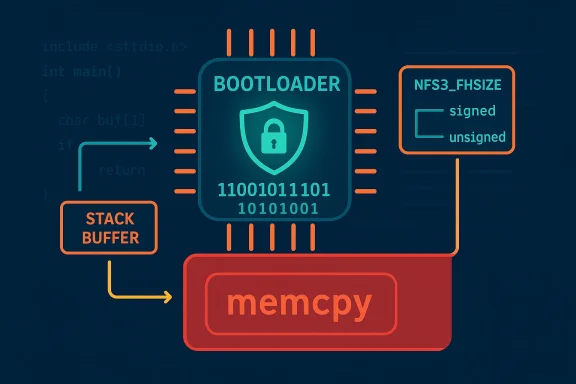
Das U-Boot (commonly called U-Boot) is the ubiquitous open-source bootloader used in countless embedded, IoT and single-board computer platforms. In mid-2019 a cluster of NFS-related parsing flaws was disclosed; among them CVE-2019-14201 identified a stack-based buffer overflow in the NFS reply helper function nfs_lookup_reply. The bug arises when attacker-controlled lengths parsed from a network NFS reply are used in memcpy calls without correct validation, enabling an attacker on the same network — or a malicious NFS server — to feed malformed replies that overflow stack buffers and potentially gain code execution in the bootloader context. (securitylab.github.com)This article summarizes the technical details, documents the timeline and fixes, assesses real-world impact, and lays out concrete mitigation, detection and hardening steps for anyone responsible for embedded device security—OEMs, integrators, and firmware engineers alike.
Background: why U-Boot parsing bugs matter
U-Boot often runs before any operating system or kernel protections are active. It performs low-level tasks such as initializing DRAM, loading kernel images from storage or network (via TFTP/NFS), and handing control to the next stage. Because it runs at an early stage, with privileged access to hardware, any code execution achieved in U-Boot can permit persistent device compromise, firmware flashing, or bypass of downstream verified-boot checks. For devices that fetch images from network services (common in diskless deployments and development rigs), protocol parsing bugs are particularly dangerous. (securitylab.github.com)The 2019 disclosure was not a single bug in isolation but a family of related flaws in the NFS handler: integer underflows, unchecked lengths derived from network byte order conversions (ntohl/ntohs), and
memcpy/memmove usage where attackers fully control the copy length. The nfs_lookup_reply variant (CVE-2019-14201) is one of the most straightforward and exploitable: a length field parsed from the reply could be coerced into a negative value or otherwise manipulated to bypass a naive length cap and produce an overflow against a small global buffer. (securitylab.github.com)Technical analysis
What goes wrong in nfs_lookup_reply
At a high level,nfs_lookup_reply parses fields from an NFS server reply (packed network data) and uses values obtained through network-to-host conversions as lengths in memory copies. The code attempted a safety check to cap the read to NFS3_FHSIZE (the expected maximum file handle size), but the check did not consider signed-to-unsigned conversions or integer-underflow scenarios. An attacker-controlled 32-bit value that is negative when interpreted incorrectly can slip past the comparison and later be interpreted as a very large unsigned length. The subsequent memcpy then writes far beyond the intended destination buffer. This pattern — attacker-controlled length → insufficient validation → memcpy/memmove sink — is repeatedly highlighted in the vulnerability analysis. (securitylab.github.com)Key practical implications:
- The overflow is stack-based in the
nfs_*_replyfamily, meaning return addresses or nearby stack data can be corrupted. - The attacker needs network access to the device’s boot-time NFS service (same broadcast domain or control of the configured NFS server).
- Typical runtime mitigations on modern systems (stack canaries, ASLR) may raise the bar but do not eliminate risk, especially on resource-constrained platforms where such protections are absent or weaker.
Example: how a length check fails
The vuln arises from code paths similar to:- Parse a 32-bit network-packed length using
ntohl(). - Check
if (filefh3_length > NFS3_FHSIZE) filefh3_length = NFS3_FHSIZE; memcpy(filefh, rpc_pkt.u.reply.data + 2, filefh3_length);
filefh3_length is derived from a two’s-complement negative value that becomes a large unsigned integer after conversions or is used in contexts where sign is not properly handled, the comparison and cap can be bypassed or misapplied, letting memcpy perform an unbounded copy into a small 64-byte buffer. The destination buffer in this case (filefh) is global and small, making the overflow trivial to trigger from a single crafted reply. This precise pattern was called out in the security research published during the disclosure. (securitylab.github.com)Affected versions and scope
- Upstream U-Boot versions through 2019.07 were reported as vulnerable for CVE-2019-14201. Several Linux distributions and security trackers list the vulnerability as affecting U-Boot releases prior to the 2020.01 branch or similar fixed releases.
- The impact surface is configuration-dependent: only builds of U-Boot with network/NFS support and with NFS-based fetching enabled are practically exploitable. Devices that never use U-Boot network functionality (common in production devices with local storage) are not directly exposed by this particular vector, but many development setups and diskless deployments are. (securitylab.github.com)
- Multiple downstream distributions (Debian, Ubuntu, SUSE and others) incorporated upstream fixes in packaging updates; distributions recommend updating u-boot packages to versions where fixes were applied (Debian fixed in 2020.01+dfsg-1 in unstable; other vendors published similar advisories). (security-tracker.debian.org)
Timeline and remediation
- Discovery and reporting: Researchers using CodeQL and manual review identified the family of NFS parsing vulnerabilities in mid‑May 2019 and notified U-Boot maintainers. The issue was coordinated prior to public disclosure. (securitylab.github.com)
- Public disclosure: The research was publicly released in late July 2019 under a GitHub Security Lab post that aggregated the findings as CVE-2019-14192 and related CVEs including CVE-2019-14201; maintainers and package maintainers issued follow-ups. (securitylab.github.com)
- Patching: U-Boot upstream accepted fixes and backported corrections to protect the parsing paths by doing stricter length validation, avoiding signed/unsigned pitfalls, and removing unsafe memcpy patterns. Distributions pushed updated u-boot packages in the months that followed; Debian, for example, lists a fixed version in the 2020.01 branch. The Debian security tracker and several vendor advisories reference the upstream commit (commit id cited in vendor trackers) and fixed package versions. (security-tracker.debian.org)
- Regression: Notably, an incorrect or partial fix introduced later led to a separate vulnerability tracked as CVE-2022-30767 in 2022, again in
nfs_lookup_reply, caused by an unboundedmemcpyfrom a failed length check. That regression underscores the danger of superficial fixes for complex parsing bugs and the need for robust test coverage and fuzzing.
Exploitability and real-world risk
- Attack vector: Network-based (adjacent network or same broadcast domain) or malicious NFS server. An attacker who can send crafted replies to U-Boot’s NFS client or control the NFS server configured in a device can trigger the overflow. (securitylab.github.com)
- Complexity: Low to moderate. The vulnerability is conceptually straightforward (length-from-network → memcpy sink). Practical exploitation depends on the target’s architecture, presence of mitigations (stack canaries, NX, ASLR), and boot-time environment. The published analysis suggested that exploitation is not extremely complicated in typical embedded runtime environments. (securitylab.github.com)
- Privileges needed: None — the vulnerable parsing code runs in a privileged bootloader context before OS-level privilege separation, so any attacker capable of supplying network replies can attempt exploitation. (securitylab.github.com)
- Likelihood of in-the-wild exploitation: While widespread, automated exploitation campaigns targeting U-Boot are not commonly observed in mainstream incident reporting; however, the nature of the vulnerability (pre-OS code execution) and the growing number of IoT-targeting threat actors make this category of bug high-risk for devices in exposed networks. Distributions gave moderate-to-high CVSS scores and recommended timely updates.
Patching, detection and mitigation guidance
Immediate mitigation (if patching cannot be done right away)
- Disable U-Boot network features: If a device does not require NFS or other network boot services in production, disable those features at build/configuration time or remove network-based boot commands from the device’s environment. This is the simplest short-term mitigation. (securitylab.github.com)
- Restrict network access to the boot-stage network: Place devices behind network segmentation that prevents untrusted hosts from reaching the device’s bootloader network path. If network booting is necessary, confine NFS servers to tightly controlled management subnets. (securitylab.github.com)
- Harden the NFS server: Ensure any NFS server providing images during boot is trusted and access-controlled, and validate exported images by cryptographic verification at the earliest practical stage (e.g., signed images and verified-boot logic). Note that signature checks in U-Boot happen after image retrieval, so protocol parsing must still be safe. (securitylab.github.com)
Patching best practices
- Apply upstream fixes and vendor patches: Use vendor-supplied or upstream patched U-Boot builds. Distribution and vendor advisories list fixed package versions; for embedded OEM releases, integrate the fixed upstream commits and rebuild firmware images. (security-tracker.debian.org)
- Test patches across configurations: Because U-Boot is compiled into firmware images with many board-specific variations, OEMs must test the patched bootloader on each supported board/platform to avoid regressions such as the later CVE-2022-30767 incident. Continuous integration and hardware-in-the-loop testing help catch regressions early.
- Add protocol parsing unit tests and fuzzing: The family of vulnerabilities came from unchecked network inputs and integer-tracking failures. Unit tests that exercise boundary conditions, augmented with protocol-aware fuzzing, would catch many similar classes of bugs before release. Tools like libFuzzer, AFL, and CodeQL-derived queries were productive in the original research; incorporate them into U-Boot development workflows. (securitylab.github.com)
Detection and monitoring
- Boot-time integrity checks: Use device telemetry (where available) to detect unexpected bootloader behavior: unexpected network connections at boot, crashes during NFS operations, or unexpected reboots may indicate exploitation attempts.
- NFS server and network monitoring: Monitor for malformed or suspicious replies from NFS servers or anomalous UDP/TCP traffic patterns consistent with protocol fuzzing. While detection is challenging at the NFS level, intrusion detection systems can flag unusual packet structures and repeated malformed replies. (securitylab.github.com)
Why this case matters: lessons learned
- Early-stage code is high-impact: Bootloader code runs with the broadest privileges on a device. Flaws here permit attack chains that bypass many downstream protections.
- Protocol parsing must be defensive: Even seemingly small integer checks are brittle. Signedness, integer promotion, and the interplay of host/network representations must be treated carefully. Simple caps are insufficient without strict validation of all inputs and control-flow reasoning about how length propagates. (securitylab.github.com)
- Fixes require thoroughness: The later CVE-2022-30767 regression shows that incomplete fixes, or fixes that do not fully close the dataflow from input to sink, can reintroduce or create new vulnerabilities. Regression testing, code reviews focused on dataflow, and adding test cases that directly simulate adversarial inputs are essential.
- Upstream + downstream coordination is critical: Patching bootloaders for consumer devices requires coordination between upstream projects, distribution packagers, board support package maintainers, and OEMs. The Debian, Ubuntu and SUSE trackers show how downstream distributions adopted patches over months after disclosure; embedded vendors must carry those fixes into device firmware images promptly. (security-tracker.debian.org)
Practical checklist for device maintainers (what to do now)
- Inventory: Identify all devices that use U-Boot and that allow network booting (NFS/TFTP) during initialization.
- Update: Apply vendor-supplied firmware or rebuild and reflash devices using U-Boot versions containing the upstream fixes (packaging trackers list fixed versions; in many cases fixes appear in 2020.01 and later branches). (security-tracker.debian.org)
- Disable: Where possible, disable network boot or remove NFS/TFTP handlers from production boot environments.
- Segment: Place boot-time network services on isolated networks; only allow trusted management hosts to provide images.
- Test: After applying updates, perform hardware acceptance testing that exercises network boot paths and NFS mount flows to ensure no regressions or unforeseen failures.
- Monitor: Add NFS/network-boot monitoring and alerting; log boot failures and anomalous NFS responses.
- Harden: Add signed-image verification checks early in boot where possible; shift to secure boot models that verify boot stages cryptographically to limit the value of early-stage code execution. (securitylab.github.com)
Risk assessment for different stakeholders
- OEMs and integrators: High priority. Devices in customer hands that allow network boot are exposed to remote or adjacent-network attacks until patched. Upgrading firmware across device fleets is often operationally difficult, making mitigations and segmentation critical. (securitylab.github.com)
- Enterprise device managers: Moderate-high priority. Devices in control planes, test labs, or developer networks often leave boot network services enabled; tighten access control and apply firmware updates as part of device lifecycle management. (security-tracker.debian.org)
- End users of consumer embedded products: Lower immediate urgency for devices that never use network booting; however, for products used in local networks exposed to untrusted hosts (public Wi‑Fi, guest VLANs) the risk increases. Contact vendors for firmware updates and follow their guidance.
- Security researchers and incident responders: High interest. The class of vulnerabilities provides instructive examples for fuzzing, protocol-aware analysis, and secure parsing practices. Incident responders should consider pre-OS persistence scenarios when investigating hard-to-explain device behavior. (securitylab.github.com)
Final analysis and recommendations
CVE-2019-14201 is emblematic of a recurring security reality: inexpensive parsing mistakes in early-boot code yield expensive security failures. The specificnfs_lookup_reply overflow is straightforward to understand and — in many U-Boot configurations — straightforward to exploit, particularly in lab or management-network environments where NFS-based booting is used. The research community’s use of CodeQL and focused data-flow analysis demonstrates effective ways to audit firmware code bases at scale. (securitylab.github.com)The subsequent discovery of regression issues (CVE-2022-30767) in the same code paths highlights that remediation cannot be a one-off—teams must invest in:
- robust upstream fixes,
- comprehensive regression tests (including negative/fuzz tests),
- systematic distribution of patched firmware, and
- network-level controls and monitoring to reduce blast radius while patches propagate.
In short: CVE-2019-14201 exposed a real and serious class of pre-OS buffer-overflow risks in U-Boot’s NFS parsing code. The vulnerability is fixable and has been fixed upstream and in major distributions, but the story includes an important follow-up lesson — careless or partial fixes can reintroduce risk — so organizations must combine timely patching with careful validation, improved testing and sensible operational mitigations to fully close the window of exposure. (securitylab.github.com)
Source: MSRC Security Update Guide - Microsoft Security Response Center
