

Das U‑Boot ships with a dangerous surprise in its NFS reply handling: a stack‑based buffer overflow in the nfs_mount_reply helper (tracked as CVE‑2019‑14203) that affects U‑Boot releases up through and including 2019.07 and — in certain configurations — permits remote attackers controlling a malicious NFS server or on‑segment network attacker to crash devices or obtain code execution during the boot phase. (securitylab.github.com)
Das U‑Boot (commonly called U‑Boot) is the universal boot loader widely used on embedded hardware: routers, IoT devices, development boards, Chromebooks, and many custom appliances rely on it to initialize hardware and load the next‑stage image. U‑Boot supports networked boot flows — TFTP and NFS among them — which are invaluable for diskless systems and development, but also expand the attack surface because U‑Boot parses untrusted network data before any guest operating system or its protections are in place. (securitylab.github.com)
In July 2019 a coordinated disclosure described a family of vulnerabilities in U‑Boot’s network/NFS code. One of those, CVE‑2019‑14203, is a classic stack buffer overflow in the NFS reply parsing code, rooted in unvalidated length values taken from the wire and used directly in memcpy‑style operations. The vulnerability sits inside the nfs_mount_reply helper, part of the net/nfs.c NFS reply handling path. Upstream and several major Linux distributions classify the issue as high/critical severity and published fixes or updated packages.
The security research write‑up and audit that disclosed these issues shows that nfs_mount_reply — like several sibling functions (nfs_readlink_reply, nfs_lookup_reply, rpc_lookup_reply, nfs_umountall_reply) — uses attacker‑controlled values as memcpy lengths, permitting an attacker to specify a size larger than the stack buffer and thus write past its bounds. The problem is amplified by network parsing paths that can experience integer underflow when UDP length fields are processed, enabling crafted packets to appear small in one check but large when used as memcpy sizes. (securitylab.github.com)
Caveat: absence of public PoC does not equal absence of private exploit code. Many embedded exploits circulate in narrow communities or in state actor toolkits before—or instead of—public disclosure.
Source: MSRC Security Update Guide - Microsoft Security Response Center
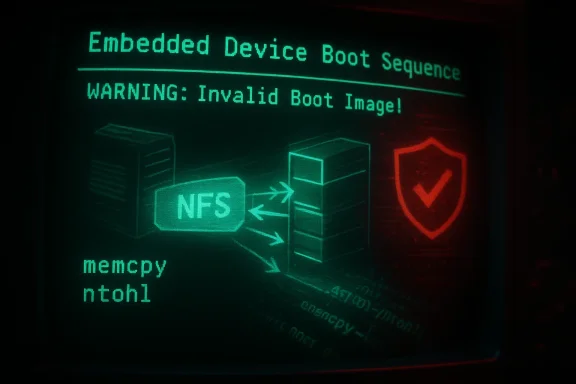 Background / Overview
Das U‑Boot (commonly called U‑Boot) is the universal boot loader widely used on embedded hardware: routers, IoT devices, development boards, Chromebooks, and many custom appliances rely on it to initialize hardware and load the next‑stage image. U‑Boot supports networked boot flows — TFTP and NFS among them — which are invaluable for diskless systems and development, but also expand the attack surface because U‑Boot parses untrusted network data before any guest operating system or its protections are in place. (securitylab.github.com)In July 2019 a coordinated disclosure described a family of vulnerabilities in U‑Boot’s network/NFS code. One of those, CVE‑2019‑14203, is a classic stack buffer overflow in the NFS reply parsing code, rooted in unvalidated length values taken from the wire and used directly in memcpy‑style operations. The vulnerability sits inside the nfs_mount_reply helper, part of the net/nfs.c NFS reply handling path. Upstream and several major Linux distributions classify the issue as high/critical severity and published fixes or updated packages.
The technical root cause: untrusted length → unchecked memcpy
What the code does wrong
At a high level the bug class follows a familiar pattern: network code reads integer length fields from the protocol (via ntohl/ntohs), and later uses those parsed integers directly as source length arguments to memory copy operations without validating the value against the size of the destination buffer or the actual packet payload length.The security research write‑up and audit that disclosed these issues shows that nfs_mount_reply — like several sibling functions (nfs_readlink_reply, nfs_lookup_reply, rpc_lookup_reply, nfs_umountall_reply) — uses attacker‑controlled values as memcpy lengths, permitting an attacker to specify a size larger than the stack buffer and thus write past its bounds. The problem is amplified by network parsing paths that can experience integer underflow when UDP length fields are processed, enabling crafted packets to appear small in one check but large when used as memcpy sizes. (securitylab.github.com)
Why this is especially dangerous in a bootloader
- U‑Boot runs before the OS: exploitation happens in a privileged early environment where typical OS‑level mitigations (SELinux, ASLR, full MMU isolation) may be weaker, not present, or not applied.
- Successful exploitation can produce persistent device compromise: attackers may write malicious payloads to flash or bypass verified boot flows if exploitation occurs prior to signature checks.
- Many embedded devices have limited or no automatic firmware updates — the vulnerable U‑Boot image can remain in the field for years.
Affected versions, dates, and severity
- Affected product: Das U‑Boot through version 2019.07 (inclusive). The CVE entry and vendor/distribution advisories list the vulnerable range as all upstream U‑Boot releases up to the 2019.07 release.
- Vulnerable function: nfs_mount_reply (a reply helper in the NFS handler). (securitylab.github.com)
- CVE publish date (NVD): July 31, 2019 (NVD/CVE record).
- Typical CVSS characterization used in public trackers: a network‑accessible buffer overflow with no authentication required — CVSS v3 scores reported in public trackers range up to 9.8 (Critical) for several of the related NFS issues, reflecting the high impact potential of remote code execution in bootloader code. Distributors sometimes map that differently for their platforms; always check the vendor advisory for the definitive score applied to your distro.
Discovery and disclosure timeline (concise)
- Security researchers using code audit and CodeQL techniques identified multiple NFS and network parsing weaknesses in mid‑May 2019 and escalated findings to U‑Boot maintainers. (securitylab.github.com)
- The research was publicly disclosed in late July 2019, and MITRE/NVD recorded the CVEs on July 31, 2019. (securitylab.github.com)
- Upstream fixes and distribution patches followed over the subsequent months; distributions such as Debian, SUSE, and Ubuntu published advisories and updated u‑boot packages. Administrators should verify the specific fix versions used by their distro and deployment.
How an attacker could trigger the flaw
- Attack vector: network — specifically, a malicious or compromised NFS server, or an on‑segment attacker who can inject spoofed NFS replies to a device performing an NFS mount/boot.
- Preconditions: U‑Boot configured to use NFS/network booting (common in diskless or development setups). The attacker must be able to respond to U‑Boot’s NFS requests with crafted reply packets.
- Effect: a malformed reply causes the bootloader to copy more bytes than the destination buffer can hold, overwriting stack memory. Depending on a device’s build options (stack canaries, compiler‑level hardening), the overflow may lead to control‑flow hijack and code execution inside U‑Boot, or at minimum a crash/denial of boot. (securitylab.github.com)
Evidence of exploitation (what’s known and what isn’t)
Public trackers and vulnerability feeds showed limited exploitation evidence at disclosure: initial EPSS/early exploitation metrics were modest and there were no well‑known commodity proofs‑of‑concept published by vendors at the time of disclosure. However, the vulnerability type and deployment environment mean the window for exploitation remains attractive for attackers who target device fleets that never receive firmware updates. Administrators should assume a risk of exploitation for exposed devices still running vulnerable bootloader versions.Caveat: absence of public PoC does not equal absence of private exploit code. Many embedded exploits circulate in narrow communities or in state actor toolkits before—or instead of—public disclosure.
Patching, vendor response, and distribution fixes
- Upstream: U‑Boot maintainers accepted the security report and merged fixes into upstream branches; deployers should update to U‑Boot releases newer than 2019.07 where the NFS reply parsing checks were hardened. The research disclosure includes recommended mitigations: patch, or disable U‑Boot networking/NFS. (securitylab.github.com)
- Distributions: major Linux distributions issued fixes and updated their u‑boot packages. For example, Debian and SUSE tracked and remediated the vulnerability in their u‑boot packages and published specific advisory entries and fixed package versions; Ubuntu and others backported fixes in stable updates. Operators should consult their distro’s security tracker for the exact package names and versions that contain the patch.
- Workarounds (temporary): disable NFS/network boot in U‑Boot configuration, or ensure that only trusted, isolated networks can serve NFS responses to U‑Boot devices. These are acceptable stopgap measures when updating firmware is infeasible. (securitylab.github.com)
Practical remediation checklist (for practitioners)
Follow the checklist below in order; each step is actionable and prioritized for safety and rapid risk reduction.- Inventory and identify
- Enumerate devices that use U‑Boot for boot and that have networking/NFS enabled at boot time.
- Record U‑Boot versions where possible (serial console, vendor firmware metadata, or by querying device management systems).
- Apply upstream/distribution updates
- If you control device firmware: rebuild images using an upstream U‑Boot release newer than 2019.07 or vendor‑provided firmware that explicitly includes the fix.
- If your distribution provides u‑boot packages (e.g., for development boards), install the vendor/distro security update packages identified for CVE‑2019‑14203.
- Temporary mitigations (if immediate update is impossible)
- Disable networked boot options (NFS/TFTP) in U‑Boot configuration or boot scripts.
- Block NFS/TFTP ports (2049 for NFS, 69 for TFTP, and any auxiliary ports) at network edges for device subnets; require an allowlist for trusted NFS servers.
- Use network segmentation to isolate boot‑time traffic to management VLANs only.
- Verification and hardening
- Where possible, enable verified boot / signed boot images so that even if U‑Boot is compromised, downstream image integrity checks reduce the value of an attack.
- Rebuild U‑Boot and toolchains with hardening options (stack protectors, RELRO, PIE where supported).
- For large fleets, establish a firmware update cadence and vendor follow‑up process.
- Detection and monitoring
- Monitor for anomalous NFS traffic and large/irregular NFS replies on management networks.
- Audit device console logs for crashes or strange behavior during boot, and trigger forensic collection when possible.
- Vendor engagement and supply‑chain follow up
- Contact device vendors to confirm whether shipped images include patched U‑Boot releases.
- If vendor support is discontinued, plan for device replacement for high‑risk installations.
Detection guidance: indicators to look for
- Unusual NFS replies or repeated malformed packet sequences to devices performing network booting.
- Bootloader crashes, unexpected resets, or devices that fail to boot following NFS interactions.
- Abnormal writes to flash or unexpected changes in boot configuration after network boot attempts.
- Network traffic including NFS replies originating from non‑inventory servers when devices attempt to mount over the network.
Why this class of bug keeps being dangerous — and what organizations often miss
- Embedded devices are long‑lived. Bootloader code shipped in 2018–2019 may still be running in critical infrastructure in 2025 and beyond.
- Firmware updates for embedded devices are operationally expensive and frequently not automated — many vendors ship devices with static bootloader builds and little OTA support.
- The attack occurs prior to most OS defenses. Memory corruption inside a bootloader yields opportunities for both immediate control (execute code before the OS) and persistent tampering (write malicious code to flash, alter boot scripts).
- Fixes are nontrivial to test across architectures. U‑Boot supports many platforms; a single patch must be validated across a broad matrix of boards and SoCs, which delays rollout and complicates backporting for vendors. (securitylab.github.com)
Post‑fix regression risk: beware incorrect or incomplete fixes
Historical follow‑ups to the original disclosures show that corrective patches must be applied carefully. In some cases a subsequent fix can introduce or fail to fully remediate related parsing paths, producing new CVEs later on (for example, a later 2022 CVE involving nfs_lookup_reply has been described as tied to an incorrect or incomplete fix for earlier U‑Boot NFS bugs). This underscores the need for thorough testing and code review after patching, especially in the NFS/parsing code paths. Administrators should track downstream advisories and CVE updates for regressions.Long‑term policy and architecture suggestions
- Default to disabling unnecessary network boot options in device manufacturing images. Bootloader network features are powerful in development but risky in production.
- Require signed boot images and chain of trust by default for devices in unmanaged or sensitive networks. Verified boot reduces the value of code execution in the bootloader unless the attacker also compromises signing keys.
- Treat the bootloader as part of the security boundary: include it in firmware‑update programs, vulnerability management, and patch‑validation testing.
- Invest in secure provisioning and update pipelines for embedded devices: make it operationally feasible to update U‑Boot and other low‑level firmware components at scale.
Conclusion
CVE‑2019‑14203 is not an exotic zero‑day; it is a textbook memory‑corruption vulnerability that became consequential because it lives inside a widely deployed bootloader component that operates before typical system defenses. The disclosure and subsequent fixes are well documented, but the real danger lies in the long tail of devices that remain unpatched and exposed to misconfigured or hostile NFS servers. System owners should assume risk for any device running U‑Boot ≤ 2019.07 with network/NFS enabled and act accordingly: inventory, patch when possible, and apply isolating mitigations when updating firmware is not immediately possible. The most effective defenses are prompt patching of U‑Boot images, disabling network boot where it is not required, and adopting verified boot and secure update processes for embedded fleets.Source: MSRC Security Update Guide - Microsoft Security Response Center
