

A small assertion bug in the open‑source libnbd client library (tracked as CVE‑2021‑20286) can cause a denial‑of‑service; Microsoft’s public advisory names Azure Linux as a product that “includes this open‑source library and is therefore potentially affected,” but that statement is a scoped inventory attestation — not a categorical guarantee that no other Microsoft product could contain the same vulnerable component. (nvd.nist.gov)
libnbd is the user‑space Network Block Device (NBD) client library, used by tools and services that talk the NBD protocol. In March 2021 an assertion in libnbd 1.7.3 — inside the function
The National Vulnerability Database (NVD) records the issue and the technical description; vendor and upstream patch references are attached to the NVD entry. (nvd.nist.gov)
Microsoft’s Microsoft Security Response Center (MSRC) vulnerability entry for CVE‑2021‑20286 includes the line quoted in the user’s question: a product‑level statement that Azure Linux includes this open‑source library and is therefore potentially affected. Microsoft has also stated it will publish and update machine‑readable CSAF/VEX attesties more product families — in short, Azure Linux is the confirmed, attested carrier and Microsoft will expand that attestation set if it finds additional affected artifacts. (msrc.microsoft.com)
For operators: verify your artifacts using the inventory checks above, patch any instances of libnbd by applying the upstream or vendor fix, and use SBOM/VEX/CSAF feeds where available to reduce uncertainty in future vulnerability events. The combination of vendor attestations and your own artifact inventory is the practical path to rapid, reliable remediation.
Source: MSRC Security Update Guide - Microsoft Security Response Center
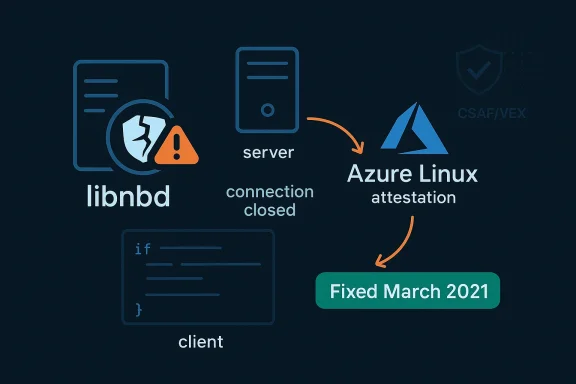 Background / Overview
libnbd is the user‑space Network Block Device (NBD) client library, used by tools and services that talk the NBD protocol. In March 2021 an assertion in libnbd 1.7.3 — inside the function nbd_unlocked_opt_go in lib/opt.c — was found to be reachable when a server unexpectedly went away during an option negotiation. That reachable assertion could cause the client process to abort, producing a denial‑of‑service condition for any consumer that relied on the library. The upstream project accepted and committed a fix in early March 2021. (gitlab.com) (bugzilla.redhat.com)The National Vulnerability Database (NVD) records the issue and the technical description; vendor and upstream patch references are attached to the NVD entry. (nvd.nist.gov)
Microsoft’s Microsoft Security Response Center (MSRC) vulnerability entry for CVE‑2021‑20286 includes the line quoted in the user’s question: a product‑level statement that Azure Linux includes this open‑source library and is therefore potentially affected. Microsoft has also stated it will publish and update machine‑readable CSAF/VEX attesties more product families — in short, Azure Linux is the confirmed, attested carrier and Microsoft will expand that attestation set if it finds additional affected artifacts. (msrc.microsoft.com)
Technical root cause: what actually fails
What the code does and where the bug lives
The vulnerable code path is an assertion within the libnbd client state machine that validates the library’s internal state after waiting for option negotiation to complete. Assertions are programming checks intended to catch logic errors during development; when they fire in production code they typically abort the process. The specific assertion checked that the client was in a negotiation state; upstream maintainers discovered that a race or an unexpected server death could leave the state machine in a different state, making the assertion reachable and therefore able to trigger a crash. The upstream fix replaces the brittle assertion with a tolerant state check so the client will return a normal error instead of aborting. (gitlab.com)Impact model
- Primary impact: denial of service — the client process using libnbd can abort, causing the consuming application or tool to stop functioning.
- Secondary impact: depending on how the library is embedded (long‑running daemon vs. short‑lived tool), the operational impact ranges from a transient failure to repeated crashes and service outages.
- Exploitability: the bug requires the client to be negotiating options with an NBD server; a remote server that intentionally closes the connection or behaves in a way that triggers the race can cause the assertion to fire, so network‑facing or untrusted NBD endpoints increase exposure. The NVD assigns a low to medium severity profile based on exploitability and expected consequences. (nvd.nist.gov)
What Microsoft’s advisory means — and what it doesn’t
Reading Microsoft’s wording precisely
Microsoft’s MSRC phrasing — that “Azure Linux includes this open‑source library and is therefore potentially affected” — is a product‑level attestation, indicating Azure Linux images have been inventory‑checked and found to contain the implicated upstream component. Microsoft also committed to publishing machine‑readable CSAF/VEXram started in October 2025) and to update CVE records when additional Microsoft products are discovered to include the same component. That is a helpful transparency measure for customers who run Azure Linux, but the sentence is not, and should not be read as, an assertion that Azure Linux is the only Microsoft product that could possibly contain libnbd. (msrc.microsoft.com)Inventory attestation vs. exclusivity guarantee
- Inventory attestation: Microsoft has checked Azure Linux (the product family) and found libnbd inside some images; Azure Linux customers can treat the product as in scope for mitigation and patching.
- Not an exclusivity claim: Microsoft has not, in the same single sentence, guaranteed it has scanned every Microsoft kernel, image, container, WSL release, Marketplace VM, appliance or internal build. Those are separate artifacts with independent build configurations and may or may not include the vulnerable upstream code. Absence of a public attestation is not evidence of absence of the component. Security practitioners should therefore treat other Microsoft artifacts as unverified until they are either attested or scanned locally. This interpretation has been repeatedly emphasized by independent analysts and community summaries.
Is Azure Linux the only Microsoft product that includes linswer: No — Azure Linux is the only Microsoft product Microsoft has publicly attested so far to include libnbd for this CVE, but that does not prove it is the only Microsoft product that could include the vulnerable library. Microsoft’s attestation is a scoped inventory result, and other Microsoft artifacts remain unverified until the vendor has completed similar inventory and attestation work for them. (msrc.microsoft.com)
Why this matters in practice
Microsoft ships many distinct Linux‑related artifacts where open‑source components can appear independently:- Azure Linux images and packages (the attested product).
- linux‑azure kernel builds and snapshots used in some Azure Marketplace images or published kernels.
- WSL2 kernel binary that Microsoft distributes as part of Windows subsystem for Linux.
- Marketplace VM images and partner‑published images (these may include kernels curated by Microsoft or by partners).
es, AKS node images, and appliance kernels used in managed services.
Verification: how to check whether a given Microsoft artifact includes libnbd
If you operate a Microsoft product or image and need to confirm whether it contains libnbd (and therefore whether CVE‑2021‑20286 is relevant), use one or more of the following verification techniques.Quick inventory checks on Linux artifacts
- For Debian/Ubuntu‑based systems:
- dpkg -l | grep libnbd
- apt list --installed | grep libnbd
- For RPM‑based systems:
- rpm -qa | grep libnbd
- Search for library files directly:
- find / -name 'libnbd*' 2>/dev/null
- Inspect running processes or services:
- lsof | grep libnbd
- ldd /path/to/binary | grep libnbd
- Container and image scanning:
- Use your image‑scanning tooling to list installed packages inside container images (e.g., docker run —rm image rpm -qa | grep libnbd).
For Windows artifacts (WSL2)
WSL2 uses a Microsoft‑distributed Linux kernel binary; if you need to check whether that kernel was built with or contains libnbd, the recommended approaches are:- Check the WSL2 kernel version shipped with the Windows build and compare against vendor SBOM / release notes, or use local file inspection if you maintain the kernel image.
- If Microsoft publishes a CSAF/VEX attestation for a Windows‑shipped kernel, consult that attestation for component mapping. Microsoft has committed to publishing such attestations progressively. (msrc.microsoft.com)
Mitigation and remediation recommendations
If you confirm libnbd is present in a product you manage, follow these prioritized steps.Immediate steps (short term)
- Update package to a non‑vulnerable version. Upstream fixed this assertion issue and the patch is available in the libnbd commit history; update to the patched libnbd build provided by your distribution vendor or upstream. The upstream commit that introduced the tolerant behavior was accepted in March 2021. (gitlab.com)
- Restart affected services after patching to be sure no running process is still linked to the old library.
- Temporarily restrict network access to untrusted NBD servers if untrusted peers can trigger the assertion; restrict NBD control and management interfaces by ACLs or firewall rules.
- Harden crash handling: monitor for repeated crashes and configure supervisors (systemd, process monitors) to restart gracefully while alerting operators.
Medium term
- Rebuild images and containers that include the vulnerable library, then re‑scan and redeploy.
- Use SBOMs and VEX/CSAF where available. If Microsoft has published a CSAF/VEX attestation for a particular product, treat that as authoritative for that product; if not, rely on local SBOM scanning.
- Audit your supply chain: identify which teams build or curate images that might include libnbd (for example, teams that build qemu tools, virtualization guests, storage tooling, or custom appliances).
Longer term (process improvements)
- Establish per‑artifact inventory: maintain per‑product SBOMs and a central vulnerability inventory so product owners can respond to upstream CVEs quickly.
- Automate image scanning with CI gates that block publishing if a high‑severity CVE is present.
- Coordinate with vendors: for third‑party or marketplace images, require vendors to attest and patch in a timely fashion.
Practical examples: commands and checks operators can run now
- Check for installed libnbd on Debian/Ubuntu:
- dpkg -l | grep libnbd
- apt show libnbd0
- Check for installed libnbd on RHEL/CentOS/Alma:
- rpm -qa | grep libnbd
- yum info libnbd
- Find binaries that link to libnbd:
- grep -R --line‑number "libnbd" /var/lib/containers /usr/lib /opt 2>/dev/null
- ldd /usr/bin/qemu-system-x86_64 | grep libnbd
- Scan container images:
- docker run --rm image-name rpm -qa | grep libnbd
- OR use the image scanner you already operate to list installed packages
Risk analysis: who should care, and why
Likely affected targets
- Systems that directly use NBD (virtualization tooling, disk image tooling, backup/restore tools that rely on NBD) are the primary risk surface.
- Operating system images that include libnbd as a packaged dependency or link against it.
- Container images built from distros that ship libnbd.
- Cloud images or appliances that embed libnbd‑using tooling.
Less likely but possible exposure
- Generic server infrastructure that does not run NBD‑using clients is unlikely to be impacted.
- Windows desktop and server products that do not ship a Linux userla ship a WSL2 kernel or Linux image that contains the library.
Why Microsoft’s attestation matters operationally
Microsoft’s MSRC entry gives Azure Linux customers a clear, actionable signal: if you run Azure Linux images, treat CVE‑2021‑20286 as in‑scope and apply the distro’s update. That reduces the immediate investigation burden for Azure Linux customers. However, the advisory is not a substitute for each customer’s own artifact inventory: administrators should still verify whether other Microsoft artifacts in their environment contain the library. Several independent writeups and community threads emphasize this distinction and caution against over‑interpreting the attestation as universal.Cross‑reference and verification of claims
To produce a defensible, verifiable pictureindependent sources:- The NVD entry for CVE‑2021‑20286 documents the vulnerability and links the fix history. (nvd.nist.gov)
- The upstream libnbd project’s commit that removes the brittle assertion and tolerates the server death was committed in March 2021; that commit provides the authoritative technical fix. (gitlab.com)
- Red Hat’s bug tracking record summarizes the issue, references the upstream fix, and documents distribution‑specific exposure commentary. (bugzilla.redhat.com)
- Microsoft’s MSRC advisory language and the community interpretation explain that Azure Linux is an attested product and that Microsoft will expand attestations with CSAF/VEX records. (msrc.microsoft.com)
Operational checklist for security teams (actionable)
- Identify all images and artifacts in your environment that might include libnbd:
- Azure Linux instances (attested).
- Marketplace images, WSL kernels, custom appliance images, container base images.
- Run package and binary inventory checks across those artifacts to detect libnbd.
- If libnbd is present:
- Apply the vendor or upstream patch that contain
- Rebuild and redeploy images/containers with patched libraries.
- Monitor for crash signatures (application aborts, core dumps, systemd service failures).
- If libnbd is not present:
- Document the verification result in your vulnerability management system.
- Continue to monitor CSAF/VEX or vendor advisories for any changes.
- For Azure Linux customers:
- Prux patch cycle per MSRC guidance and your operational change windows.
- Treat Azure Linux as a confirmed carrier until you have validated otherwise.
Strengths and limits of Microsoft’s response
Strengths
- Microsoft’s decision to publish product‑level attestations and to roll out machine‑readable CSAF/VEX is a meaningful improvement in supply‑chain transparency. It gives customers a clear starting point for remediation when a Microsoft‑shipped product is confirmed to include vulnerable open‑source components.
- Publicly naming Azure Linux as an attested product saves customers time: they know immediately which product family to patch without having to discover the issue first.
Limits / Risks
- The attestation model is explicitly scoped. Attesting one product does not imply all Microsoft artifacts have been scanned. Treat un‑attested artifacts as unverified, not safe.
- Automated CVE‑mapping and attestations take time; there can be a lag between upstream fixes and an exhaustive vendor inventory. Customers with mixed artifact fketplace images + Azure Linux) must maintain their own verification processes rather than relying solely on a single vendor attestation.
- Assertion bugs like this one can be subtle; even low‑severity DoS issues can be operationally disruptive if they affect critical tooling.
Conclusion
CVE‑2021‑20286 is a real, fixed assertion bug in libnbd that can cause client processes to abort. Microsoft’s public statement that Azure Linux includes the open‑source library and is therefore potentially affected is an important and accurate product attestation for Azure Linux customers, but it should not be read as an exclusivity guarantee that no other Microsoft product could contain the same vulnerable component. The attestation tells you where Microsoft has already completed inventory work; absence of attestation is not evidence of absence. (nvd.nist.gov) (gitlab.com)For operators: verify your artifacts using the inventory checks above, patch any instances of libnbd by applying the upstream or vendor fix, and use SBOM/VEX/CSAF feeds where available to reduce uncertainty in future vulnerability events. The combination of vendor attestations and your own artifact inventory is the practical path to rapid, reliable remediation.
Source: MSRC Security Update Guide - Microsoft Security Response Center
