

The Go runtime’s handling of Unix setuid/setgid binaries contained a dangerous blind spot: when privileged Go programs were started with standard I/O file descriptors closed or when they crashed, the runtime did not take the usual, protective steps other runtimes or C programs take to sanitize the process environment. That oversight — tracked as CVE-2023-29403 (GO-2023-1840) — can let a local attacker cause privileged Go processes to read or write attacker-controlled files or, in some crash/terminate scenarios, leak register or memory state. This article explains exactly what went wrong, which Go versions were affected, how attackers could realistically abuse the flaw, how distributions and the Go project fixed it, and concrete mitigation steps both operators and developers should apply today.
Go’s runtime, as shipped in certain versions, did not automatically distinguish a process running with setuid/setgid from an ordinary process. If a privileged Go binary began execution with its standard I/O file descriptors closed, the first file opened by the program could be assigned to file descriptor 0, 1, or 2 — and subsequent reads/writes might silently go to an attacker-controlled file or device. Separately, when a Go process panics or is terminated by a signal, the runtime can emit diagnostic data; in the setuid/setgid context, such output could leak sensitive state.
In panic/crash scenarios, Go’s runtime may include diagnostic outputs (stack traces, register contents) that are written to stderr; when stderr has been hijacked or points at attacker-controlled storage, diagnostic dumps can leak sensitive internal state. That’s a secondary but serious concern.
On forums and in community trackers we saw coordinated coverage of related Go toolchain CVEs and follow-up hardening guidance; these community artifacts helped operators understand what test cases and wrappers needed to be audited in production systems. Our own repository of vulnerability threads shows the Go toolchain issues grouped with other build-time and runtime CVEs that affected developer toolchains in 2023 — a useful context for sysadmins maintaining mixed-language stacks.
Other runtimes and languages have historically included special-case code for privileged execution or else recommended that privileged wrappers be used. The Go project chose a different default for execution semantics, and this CVE shows the operational consequences of those design choices when used in low-level system tooling. Security teams and developers should therefore question whether any runtime-level assumption could be hazardous when elevated privileges are involved.
For operators: prioritize inventory and patching. For developers: avoid setuid/setgid where possible, sanitize early, and use small audited shims for privileged operations. For platform teams: include privileged-execution cases in runtime threat models. Taken together, those steps remove the conditions that made CVE-2023-29403 a practical risk and reduce the likelihood of similar surprises in the future.
Source: MSRC Security Update Guide - Microsoft Security Response Center
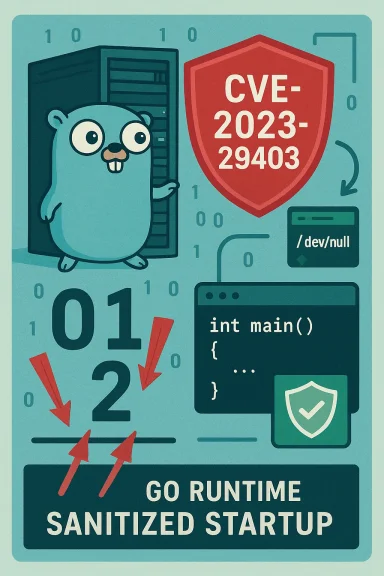 Background
What CVE-2023-29403 is, in plain terms
On Unix-like systems, the classic expectations for programs that run with setuid/setgid are well established: the runtime or the program should treat privileged execution as exceptional and sanitize anything that could leak privileges or be abused. That includes reopening or redirecting standard file descriptors (stdin, stdout, stderr) to safe targets (for example, /dev/null) if they are closed, clearing sensitive memory, and avoiding debug dumps that could reveal secrets.Go’s runtime, as shipped in certain versions, did not automatically distinguish a process running with setuid/setgid from an ordinary process. If a privileged Go binary began execution with its standard I/O file descriptors closed, the first file opened by the program could be assigned to file descriptor 0, 1, or 2 — and subsequent reads/writes might silently go to an attacker-controlled file or device. Separately, when a Go process panics or is terminated by a signal, the runtime can emit diagnostic data; in the setuid/setgid context, such output could leak sensitive state.
Discovery and attribution
The vulnerability was reported by Vincent Dehors of Synacktiv and publicly disclosed in June 2023. It was assigned CVE-2023-29403 and labeled in Go’s internal vulnerability database as GO-2023-1840. The issue is a design/behavioral vulnerability in the Go runtime rather than a classic memory-safety bug.Technical analysis
How setuid/setgid semantics usually protect you
When a Unix binary runs with elevated privileges (setuid root, for example), common safe behaviors include:- Reopening standard file descriptors to known safe endpoints to avoid descriptor hijacking.
- Clearing or protecting sensitive memory and avoiding non-deterministic diagnostic output to untrusted destinations.
- Dropping privileges as soon as possible if the program doesn’t need full privileges.
What the Go runtime did (and didn’t) do
Rather than treating setuid/setgid processes as requiring special startup sanitization, the Go runtime historically invoked program entry as it would for normal processes: no built-in reopening of closed standard descriptors, no automatic relocating of diagnostic output in privileged contexts, and no forced privilege drop. That means a privileged Go program running with closed descriptors could internally invoke os.Open() and — because the kernel returns the lowest unused file descriptor — receive file descriptor 0/1/2 pointing at an attacker-controlled path. The program then might perform writes or reads with elevated privileges to or from that file descriptor, resulting in privileged file writes or data disclosure.In panic/crash scenarios, Go’s runtime may include diagnostic outputs (stack traces, register contents) that are written to stderr; when stderr has been hijacked or points at attacker-controlled storage, diagnostic dumps can leak sensitive internal state. That’s a secondary but serious concern.
A simple exploitation outline
A minimal exploitation scenario can be constructed by an adversary who can:- Prepare a writable file with world-writable permissions (or otherwise control a file that will be opened by the privileged process).
- Arrange for the privileged Go binary to be launched with closed stdin/stdout/stderr (this can be done by a wrapper that closes descriptors before exec).
- The Go program calls os.Open or similar before it explicitly reopens stdin/stdout/stderr; the kernel hands back fd 0/1/2 mapped to the attacker-controlled file.
- The program performs writes/reads that the attacker then observes or manipulates with root-level semantics.
Affected versions and the fix
Versions impacted
The vulnerability affects the Go runtime across multiple releases. Broadly, versions before and including certain point releases in the Go 1.19 and 1.20 series were affected:- Affected up to, but not including, Go 1.19.10.
- Affected in the 1.20 branch from 1.20.0 up to (but not including) 1.20.5.
Fixes and release notes
The Go project released patches as part of their 1.19 and 1.20 point releases. The practical, actionable guidance is simple: upgrade to Go 1.19.10 or later in the 1.19 line, or to Go 1.20.5 or later in the 1.20 line, which incorporate the runtime changes that treat setuid/setgid execution as a distinct mode requiring sanitization. Distribution advisories from several Linux vendors (Red Hat, Debian, Amazon Linux and others) adopted these fixes into vendor packages and backports.Cross-checking the record
NVD, Debian’s security tracker, OSV, and vendor advisories all describe the same root cause and the same set of fixed releases. When verifying which release in your environment contains the fix, consult both the Go release notes and your vendor’s package metadata: some distributions backported the fix to their packaged golang or go-toolset packages under their own versioning. Always verify package-level changelogs or vendor security advisories before assuming your distro’s package is updated.Real-world impact: confidentiality, integrity, availability
Confidentiality
The most immediate confidentiality risk is leakage of sensitive data via misdirected diagnostic output or via the runtime accidentally reading secrets into descriptors that an attacker then controls. If a privileged Go process panics and writes diagnostic state to a hijacked stderr, that can expose register contents, stack traces, or other in-memory data. This is especially dangerous for tooling that handles secrets (credential managers, key-handling daemons, or privileged helper programs).Integrity
Because a hijacked descriptor can receive writes with elevated permissions, an attacker can cause a privileged Go program to write attacker-controlled data into files it opens. This can corrupt configuration files, write malicious payloads to sensitive locations, or otherwise alter system state with elevated privileges. The integrity impact is therefore high when setuid/setgid Go binaries perform file I/O before sanitizing descriptors.Availability
While the vulnerability’s primary concerns are confidentiality and integrity, availability implications exist. A privileged tool that is tricked into writing bad data or that repeatedly crashes due to attacker-controlled inputs can cause services to be disrupted. In certain environments, repeated exploitation could escalate into sustained or persistent denial-of-service conditions for system services that depend on the misbehaving binary. The NVD and vendor CVE records note availability impacts alongside confidentiality and integrity.What vendors and distributions did
Multiple vendors issued advisories and packages to address the problem. Red Hat, Debian, Amazon Linux, Oracle, and others released updated golang or go-toolset packages or provided backports for their supported platform releases.ies typically reference the upstream Go advisory and align on the guidance to update to the patched Go point releases or to apply vendor-supplied packages.On forums and in community trackers we saw coordinated coverage of related Go toolchain CVEs and follow-up hardening guidance; these community artifacts helped operators understand what test cases and wrappers needed to be audited in production systems. Our own repository of vulnerability threads shows the Go toolchain issues grouped with other build-time and runtime CVEs that affected developer toolchains in 2023 — a useful context for sysadmins maintaining mixed-language stacks.
Immediate mitigations for operators (short-term)
If you cannot immediately update Go or your distribution package, apply these pragmatic mitigations to reduce exposure.- Audit for setuid/setgid Go binaries:
- Search deployed systems for Go-built executables that have the setuid or setgid bit set.
- Remove the setuid/setgid bit unless it is strictly required. Most modern setups do not need setuid binaries; privileged operations should be handled via dedicated, audited helpers or via system services.
- Ensure standard file descriptors are opened and not left to attacker control:
- If you run any privileged wrapper or service that launches Go binaries, ensure the launcher explicitly opens /dev/null for descriptors 0, 1, and 2 if they are closed before exec.
- Audition service unit files and init scripts to guarantee systemd or the init system opens descriptors correctly.
- Avoid running untrusted Go binaries with elevated privileges:
- Disable or limit local build-and-exec patterns where untrusted builds can be executed as privileged users.
- Wrap setuid operations in a safe native shim:
- If you must have setuid behavior, use a small, audited C wrapper that performs the established sanitization (reopens STDIN/OUT/ERR to /dev/null, clears environment, and drops privileges unless absolutely required) before invoking the Go binary in a non-privileged mode.
Developer guidance — how to write safer privileged helpers
Developers building code that requires elevated privileges must harden both program startup and error paths:- Reopen and validate standard file descriptors early:
- At program start, check whether file descriptors 0, 1, or 2 are open; if closed, reopen them to /dev/null or to a secure log.
- Avoid long periods of operation while running privileged:
- If possible, perform privilege-required operations in a short, isolated path and drop privileges immediately after.
- Prefer using kernel capabilities (Linux capabilities) or setcap rather than setuid in many cases; capabilities can reduce the need to run an entire program as root.
- Be conservative about diagnostic dumps:
- Avoid printing register or large memory dumps to stderr or syslog in privileged code paths. Prefer to log minimal, non-sensitive diagnostics to a secure channel.
- Embrace wrappers for the last-mile exchange with privileged resources:
- Implement a small well-audited native shim that performs sanitization and then spawns the main logic in a less-privileged process, or use an IPC model where a small privileged daemon performs only the minimal privileged actions requested by unprivileged clients.
- Test privileged execution paths:
- Add unit and integration tests that simulate closed descriptors and ensure the program behaves safely (does not write to attacker-controllable files).
How to verify your environment is safe (audit checklist)
- Inventory:
- 1.) List all executables on servers that are Go-built (you can detect Go binaries by reading the ELF note or by using packer-aware tools).
- 2.) Identify which of those have setuid/setgid bits set.
- Execution flow:
- 3.) For each setuid/setgid Go binary, review startup logic: does it open files or assume STDIN/OUT/ERR are valid before sanitizing?
- 4.) Check service wrappers, cronjobs, and init scripts to ensure they do not intentionally close descriptors before launching privileged Go processes.
- Package versions:
- 5.) Confirm installed Go runtime and go-toolset package versions match the fixed releases (Go >= 1.19.10 or >= 1.20.5 for the affected branches), or confirm vendor backports were installed. When in doubt, consult your distribution’s CVE advisory entries.
Why this class of bug matters beyond Go
CVE-2023-29403 is a reminder of the subtle responsibilities of system runtimes. Many runtime design decisions optimize for portability and developer ergonomics at the cost of assuming a non-adversarial environment. When programs are run with privileges, those assumptions break down.Other runtimes and languages have historically included special-case code for privileged execution or else recommended that privileged wrappers be used. The Go project chose a different default for execution semantics, and this CVE shows the operational consequences of those design choices when used in low-level system tooling. Security teams and developers should therefore question whether any runtime-level assumption could be hazardous when elevated privileges are involved.
Risk assessment: who should care most
- System utilities and helper programs that must run as root or setuid/setgid (for example, installers, privileged helpers, or device management tools).
- Embedded and IoT appliances that ship with Go-based privileged binaries and have local attacker models (shared hosting, untrusted local users).
- Developers building CLI tools intended to be installed with elevated bits or to run under privileged service accounts.
Longer-term lessons and systemic fixes
CVE-2023-29403 has prompted two complementary responses that together harden the ecosystem:- Upstream runtime hardening: The Go project patched the runtime to recognize and handle setuid/setgid execution in a safer way, correcting the default behavior that led to descriptor and diagnostic leakage. Upgrading the runtime is the durable fix.
- Operational best practices: Distributions and cloud vendors incorporated fixes and published advisories; operators updated packaging and recommended that setuid execution be minimized, replaced, or performed via audited, small shims. Our industry’s standard patch-and-validate loop — report, patch, vendor backport, and operator audit — worked here, albeit after disclosure.
What we could not verify and cautionary notes
- Public exploitation in the wild: As of the last public advisories and security tracker updates consulted for this article, there were no authoritative, widely-corroborated reports of mass exploitation of CVE-2023-29403 in the wild. That absence does not mean attackers did not exploit isolated hosts; it only means public evidence is not currently available. Treat this as no confirmed widespread abuse reported publicly, and continue to monitor vendor and CERT announcements.
- Vendor-specific backports: Some distributions applied backported fixes under different package versions. Always confirm the package-level changelog in your distro’s repository to ensure a fix has been applied; do not rely only on upstream version numbers. If a vendor provides a remediation advisory, follow it as authoritative for that platform.
Practical, prioritized checklist (for immediate action)
- Inventory and identify any Go-built binaries with the setuid/setgid bit on your servers.
- If found, remove setuid/setgid unless strictly required — do not merely "defer" the problem.
- If removal is impossible, ensure a sanitized launcher (reopen STDIN/OUT/ERR to /dev/null, clear the environment) wraps the privileged binary.
- Patch to a Go runtime version that includes the fix (1.19.10+ or 1.20.5+), or install a vendor backport with confirmed CVE remediation.
- Add tests for closed-descriptor startup scenarios in your CI to prevent regressions.
- Monitor vendor advisories and subscribe to relevant distro CVE trackers for follow-up backports and related runtime fixes.
Conclusion
CVE-2023-29403 exposed a deceptively simple but severe class of risk: when a language runtime treats privileged execution like ordinary execution, the gap can be exploited to turn local control over the process environment into privileged file reads/writes or sensitive data disclosure. The fix required both a runtime-level change from the Go project and operational diligence from distributions and operators.For operators: prioritize inventory and patching. For developers: avoid setuid/setgid where possible, sanitize early, and use small audited shims for privileged operations. For platform teams: include privileged-execution cases in runtime threat models. Taken together, those steps remove the conditions that made CVE-2023-29403 a practical risk and reduce the likelihood of similar surprises in the future.
Source: MSRC Security Update Guide - Microsoft Security Response Center
