

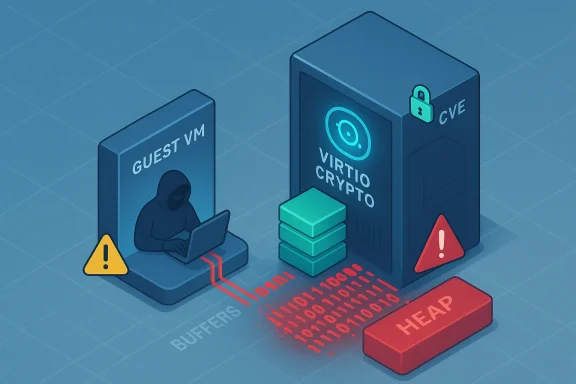
A heap buffer overflow in QEMU’s virtual crypto device — specifically in the function virtio_crypto_sym_op_helper() — creates a fragile attack surface that can be triggered when the reported source and destination lengths for a symmetric crypto operation differ; the result is a potentially exploitable out‑of‑bounds write that can crash the host process, deny service to guests, and in some circumstances enable more dangerous memory-corruption outcomes.
Virtualized environments rely on a long chain of code to transport device requests from guests to host-side emulation layers. QEMU implements many such emulated devices, including a virtual crypto device exposed through the virtio interface for guests that need hardware-accelerated or offloaded cryptographic operations. In August 2023, a defect was disclosed in the virtio crypto path: a missing validation that allows mismatched lengths — a discrepancy between the guest-supplied source length (src_len) and destination length (dst_len) — to produce a heap buffer overflow inside virtio_crypto_sym_op_helper().
This vulnerability is cataloged as CVE‑2023‑3180 and has been addressed in downstream distribution advisories and vendor errata. The issue was reported by upstream maintainers and subsequently tracked by vendors such as Red Hat, Debian, SUSE and others; distributions shipped patches or backported fixes in their qemu packages.
Source: MSRC Security Update Guide - Microsoft Security Response Center
 Background
Virtualized environments rely on a long chain of code to transport device requests from guests to host-side emulation layers. QEMU implements many such emulated devices, including a virtual crypto device exposed through the virtio interface for guests that need hardware-accelerated or offloaded cryptographic operations. In August 2023, a defect was disclosed in the virtio crypto path: a missing validation that allows mismatched lengths — a discrepancy between the guest-supplied source length (src_len) and destination length (dst_len) — to produce a heap buffer overflow inside virtio_crypto_sym_op_helper().This vulnerability is cataloged as CVE‑2023‑3180 and has been addressed in downstream distribution advisories and vendor errata. The issue was reported by upstream maintainers and subsequently tracked by vendors such as Red Hat, Debian, SUSE and others; distributions shipped patches or backported fixes in their qemu packages.
Why this matters: the attack surface and consequences
The vulnerable component and attack surface
- The bug lives in QEMU’s virtio-crypto implementation, which handles symmetric encryption/decryption requests forwarded by a guest. The vulnerable code path is reached during normal cryptographic operations when a guest requests data processing via the virtio crypto device. Because the code fails to validate that src_len == dst_len before copying or operating on buffers, the host may write past a heap allocation if the guest reports mismatched sizes.
- Attack vector: Local to the guest: an attacker must control a guest (or convince a privileged guest to send crafted virtio crypto requests) to trigger the flaw. This makes the vulnerability highly relevant to multi‑tenant environments, public clouds, or any infrastructure where untrusted or semi-trusted guests run on shared hosts. Distribution advisories and CVE metadata uniformly classify the attack vector as local with low complexity but high potential for availability impact.
Realistic impacts
- Denial of service (DoS): The most straightforward impact is a crash or corruption of the QEMU process, which may terminate guest instances or destabilize the host’s VM management service. The amplitude of this impact is broad in hosts that run multiple VMs: a single malicious VM or workload can degrade or halt other tenants’ operations by forcing restarts or triggering failovers. Advisories emphasize availability as the primary impact.
- Memory corruption and escalation potential: Heap buffer overflows in C code are a textbook path to control flow manipulation and arbitrary code execution, depending on surrounding mitigations like ASLR, heap hardening, and compiler defenses. While many distributors and trackers rate the immediate confidentiality and integrity impacts as none or limited, some aggregated assessments flag that an exploit could lead to more serious memory‑corruption outcomes in particular configurations. That ambiguity is important: defenders should treat the bug as capable of both DoS and, in worse-case chains, privilege escalation or host compromise.
- Multi-tenant risk: Cloud providers and service operators are most exposed. Any tenant that can submit crafted virtio crypto requests — either because they have a guest VM or can influence a guest — gains a direct path to disrupt the host. This class of vulnerability is historically attractive to attackers aiming to escape isolation boundaries and gain higher privileges or persistent access. Security analysts have called out virtualization device emulation layers as high-value targets for that reason.
Technical anatomy: what goes wrong in virtio_crypto_sym_op_helper()
The code-level failure mode (high level)
At its core, CVE‑2023‑3180 is a missing bounds check. The virtio crypto device’s symmetric operation helper expects the guest to provide consistent values for the source buffer length and the destination buffer length. The implementation assumed the two values matched; it did not explicitly verify that assumption. When a malicious or buggy guest intentionally supplies different lengths — for example, a smaller src_len and larger dst_len — the host-side code may copy or write more bytes than were allocated for the destination buffer, resulting in an out‑of‑bounds write on the heap.Why a simple validation prevents the issue
A disciplined validation pattern—checking that src_len == dst_len (or ensuring dst_len is at least the number of bytes the code will write)—changes the bug from exploitable to trivial to avoid. The change is conceptually small: validate or clamp size fields before any allocation or memcpy-like operation. Distribution patches and upstream fixes took precisely that approach, which is why vendors were able to backport and ship fixes quickly.Where the uncertainty lives: exploitability details
Public advisories are clear that the attack vector is local and that privileges required can be non‑trivial (often classified as high in some vendor CVSS treatments because the guest must have sufficient authority to perform virtio crypto requests). However, the exact ease of achieving arbitrary code execution versus a robust DoS depends on runtime mitigations (hardened allocators, heap metadata protections, ASLR, control-flow integrity where available), on the exact QEMU build, and on how the hypervisor process is insulated by the orchestration layer. Several vulnerability trackers assign a medium CVSS score emphasizing availability impact, while others record a higher score depending on local risk models. This variability underscores the need for environment-specific triage.Who and what is affected
Multiple Linux distributions and downstream QEMU consumers acknowledged and patched CVE‑2023‑3180. Vendor notices list impacted qemu package versions and the distribution-specific fixed package releases.- Debian: patched in Debian 10 buster updates and referenced in a Debian LTS security announcement; packages were updated to include the fix. Administrators running QEMU from Debian repositories should map CVE‑2023‑3180 to their qemu package versions and apply the vendor’s update.
- SUSE and Red Hat: SUSE lists the issue as resolved in their advisories and rates severity for their customers; Red Hat’s description contributed the original CVE description submitted to MITRE/NVD. Operators of RHEL, SLES or derivative distributions should consult their vendor errata to identify the specific RSA/KVM/QEMU packages to update.
- Ubuntu and other ecosystems: Ubuntu’s security tracker flags the CVE and shows which releases include patched qemu packages; cloud and edge OS vendors similarly incorporated fixes or protective mitigations.
Mitigation and remediation: how to act now
If you operate infrastructure that runs QEMU or KVM with the virtio-crypto device enabled, prioritize the following actions.Immediate triage (first 24–72 hours)
- Inventory — Identify hosts that run QEMU in any role (VM hosts, nested virtualization, CI runners). Determine which qemu/qemu-system packages and versions are installed. Use distro package tools (apt, yum/dnf, zypper) or configuration management records.
- Patch — Apply vendor-security updates for qemu packages as published by your distribution. Debian, Ubuntu, Red Hat and SUSE have published updates and advisories; deploy those updates following normal change control. Patches were released upstream and backported by distributions, and they remove the missing check.
- Temporary hardening — If you cannot patch immediately:
- Disable or restrict the virtio-crypto device for untrusted guests.
- Isolate hosts that run unpatched QEMU from untrusted networks.
- Use network segmentation or host-level ACLs to reduce guest-to-host attack surface.
Longer-term controls
- Enforce minimal guest privileges and avoid enabling optional device features for multi‑tenant or temporary guests.
- Harden host processes with modern allocator and kernel hardening features, and run QEMU under dedicated service accounts to restrict blast radius.
- Where possible, prefer vendor-supplied, packaged QEMU builds over custom builds without security backports; follow vendor errata closely.
Detection and hunting guidance
Detecting exploitation attempts or attempts at triggering this bug requires host-side telemetry and guest introspection.- Monitor QEMU logs and systemd journal entries for unexpected QEMU crashes or segfaults. Frequent or reproducible crashes associated with qemu processes are a hallmark of attempted exploitation or malformed guest input.
- Watch orchestration alerts: mass VM restarts, LVM or storage errors coincident with QEMU crashes, or repeated guest termination events. These can be indirect indicators of a DoS triggered via malformed virtio requests.
- Within the guest: reconcile any unusual requests that interact with virtio crypto (if the guest exposes instrumentation). Guest-side monitoring of applications using the virtual crypto device may reveal suspicious or malformed calls.
- Network/hypervisor correlation: where possible, correlate guest activity (e.g., a guest that repeatedly sends crypto operations) with host crashes. This threading is often the strongest signal of a guest‑originated attempt to trigger a guest-to-host bug.
For cloud providers and multi‑tenant hosts: an elevated playbook
Cloud and hosting operators must treat virtualization-device bugs as high‑impact, because one tenant can affect many others by exploiting or probing sensitive device code paths.- Prioritize patching of hypervisor images and orchestration nodes immediately; these are the highest-value artifacts attackers target.
- Consider rolling maintenance windows that update QEMU across clusters and gracefully migrate or drain guests; use live-migration in controlled sequences if your environment supports it.
- Audit which guest images and workload types actually require virtio-crypto. If the device is seldom used, consider disabling it platform-wide for tenants that do not opt in.
- Add CVE‑based checks to your image- and package-supply chain pipelines so newly provisioned hosts automatically avoid shipping with vulnerable qemu packages. Vendor advisories and distribution trackers provide the mapping from CVE to package versions.
What defenders and incident responders should watch for
- Core dumps and crash signatures for qemu-system processes — capture and preserve for analysis.
- Unexpected or repeated VM reboots or live-migration failures occurring after specific guest operations.
- High-severity alerts from host-based intrusion prevention / EDR telemetry for QEMU memory‑corruption patterns.
- Forensic review of guest workloads that show unusual use of virtual crypto APIs — these may be malicious test cases.
- Cross-tenant impact: if multiple VMs on a host show disruption at similar timestamps, suspect a host-level quiesce or crash triggered by a single guest.
Critical analysis: strengths of the vendor response and remaining risks
Strengths
- Prompt vendor triage and distribution patches: Major distributions and vendors documented CVE‑2023‑3180 and shipped fixes relatively quickly via QEMU upstream patches and backports in distro packages. Advisories from Debian, SUSE and others provide concrete package-level remediation guidance. This rapid triage reduced the window of exposure for many operators.
- Low complexity fixes: The root cause — a missing equality/length check — is conceptually simple and straightforward to remediate. That made the upstream diff small and reviewable, aiding fast backporting.
Remaining and emerging risks
- Exposure in legacy or unmanaged environments: Many production environments lag on OS or package updates. Hosts that continue to run unpatched qemu builds remain vulnerable. Public cloud tenants who rely on provider patching should nevertheless verify host patch policies and timelines.
- Proof-of-concept and exploitation evolution: At disclosure time the primary easily reproducible impact is DoS; however, skilled exploit developers routinely study heap overflows to craft more advanced memory-corruption chains. Even if no public PoC exists for arbitrary code execution today, the vulnerability remains a candidate for escalation if paired with other bugs or misconfigurations. Track exploit chatter and proof‑of‑concept releases closely.
- Complexity of downstream mapping: Operators must map CVE to exact package versions and patched builds specific to their distribution and vendor. That mapping is sometimes non‑trivial across enterprise SKUs, cloud images, and custom builds. Follow vendor errata closely rather than relying on general CVE-summaries alone.
Practical checklist for administrators
- Inventory qemu package versions across all hosts (production, CI, developer workstations).
- Immediately apply vendor-released qemu security updates; verify package integrity after update.
- If you cannot patch immediately: disable virtio-crypto for untrusted guests or enforce guest-level restrictions that prevent use of that device.
- Enable robust logging and alerting for qemu crashes and abnormal virtio device activity.
- For cloud providers: schedule rolling upgrades and coordinate tenant communications; consider temporary quarantines for suspect guests.
- After patching: validate by running workload acceptance tests, focusing on guests that use virtual crypto functionality.
Final assessment and recommendations
CVE‑2023‑3180 is a focused but serious vulnerability that demonstrates how small logic errors in device emulation can lead to outsized impact in virtualized infrastructures. The technical root cause is simple and the fix is small, but the operational realities of patch management, multi‑tenant exposure, and the potential for evolving exploit chains make this the kind of vulnerability that warrants immediate attention from virtualization operators.- For most organizations, the prioritized path is clear: inventory, patch, and harden. Distribution advisories from Debian, SUSE, Ubuntu and vendor errata provide the concrete package updates you need to apply.
- For cloud providers and anyone running public- or shared-hosting infrastructure, the burden is higher: patch quickly, isolate untrusted workloads, and add runtime detection for qemu process anomalies. These layers of defense help reduce both the immediate DoS risk and the longer-term risk of a more serious memory‑corruption exploit.
- Finally, treat this CVE as a reminder: device emulation and guest-host interfaces are critical crown jewels in virtualized environments. Regular code audits, hardened toolchains and coordinated vendor patching are the only durable defenses against the class of memory‑safety bugs exemplified by CVE‑2023‑3180.
Source: MSRC Security Update Guide - Microsoft Security Response Center
