

The knplabs/knp-snappy library — a widely used PHP wrapper for wkhtmltopdf and wkhtmltoimage — contains a high‑severity unsafe deserialization vulnerability that can be trivially abused to achieve remote code execution when the application environment and usage patterns permit it; the bug (tracked as CVE‑2023‑41330) is a bypass of an earlier PHAR‑deserialization fix and was patched in knp‑snappy 1.4.3. (nvd.nist.gov)
knp‑snappy is a small but popular PHP component that developers use to generate thumbnails, PDF snapshots, and images from HTML by calling out to wkhtmltopdf/wkhtmltoimage. Because it accepts output filenames and can operate on user‑supplied content in many common integrations, it is frequently embedded inside web back‑ends where attackers may be able to supply filenames or upload files. The bug disclosed as CVE‑2023‑41330 is explicitly a deserialization issue that stems from the way PHAR stream wrappers are handled inside the library’s output‑preparation routines. (github.com)
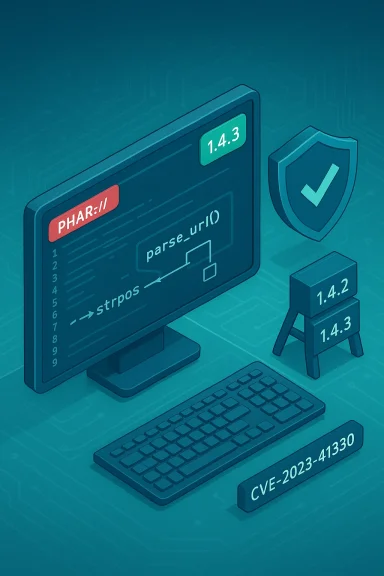
This is not a theoretical problem: an earlier, related disclosure (CVE‑2023‑28115) already documented an RCE via PHAR deserialization in the same project, and the 1.4.2 release attempted to patch that issue. However, the patch was incomplete — it checked for a literal lowercase prefix string but overlooked PHP’s case‑insensitive treatment of stream wrapper names, allowing an attacker to bypass the check by using uppercase or mixed‑case wrapper names such as "PHAR://". The bypass is the root cause of CVE‑2023‑41330. (github.com)
Why this matters to teams: PHP applications commonly run with legacy versions and often accept or construct filenames from user input or uploaded artifacts. When a library that prepares output files fails to neutralize PHAR stream wrapper attackers, the application’s process can be tricked into deserializing untrusted PHAR metadata — and PHP deserialization of crafted PHAR metadata has long been a reliable vector to instantiate gadget chains that lead to code execution. Multiple vulnerability trackers rate this particular issue as critical (CVSS 3.x: 9.8) because it combines ease of exploitation with a direct path to code execution under realistic conditions. (nvd.nist.gov)
Source: MSRC Security Update Guide - Microsoft Security Response Center
 Background / Overview
knp‑snappy is a small but popular PHP component that developers use to generate thumbnails, PDF snapshots, and images from HTML by calling out to wkhtmltopdf/wkhtmltoimage. Because it accepts output filenames and can operate on user‑supplied content in many common integrations, it is frequently embedded inside web back‑ends where attackers may be able to supply filenames or upload files. The bug disclosed as CVE‑2023‑41330 is explicitly a deserialization issue that stems from the way PHAR stream wrappers are handled inside the library’s output‑preparation routines. (github.com)This is not a theoretical problem: an earlier, related disclosure (CVE‑2023‑28115) already documented an RCE via PHAR deserialization in the same project, and the 1.4.2 release attempted to patch that issue. However, the patch was incomplete — it checked for a literal lowercase prefix string but overlooked PHP’s case‑insensitive treatment of stream wrapper names, allowing an attacker to bypass the check by using uppercase or mixed‑case wrapper names such as "PHAR://". The bypass is the root cause of CVE‑2023‑41330. (github.com)
Why this matters to teams: PHP applications commonly run with legacy versions and often accept or construct filenames from user input or uploaded artifacts. When a library that prepares output files fails to neutralize PHAR stream wrapper attackers, the application’s process can be tricked into deserializing untrusted PHAR metadata — and PHP deserialization of crafted PHAR metadata has long been a reliable vector to instantiate gadget chains that lead to code execution. Multiple vulnerability trackers rate this particular issue as critical (CVSS 3.x: 9.8) because it combines ease of exploitation with a direct path to code execution under realistic conditions. (nvd.nist.gov)
Technical anatomy: what went wrong
The vulnerable flow
- knp‑snappy exposes generation functions such as
generateFromHtml()(and related wrapper APIs) that accept an output filename parameter which eventually reaches an internalprepareOutput($filename, $overwrite)routine. (github.com) - Earlier in 2023 a PHAR deserialization RCE (CVE‑2023‑28115) was discovered that exploited the ability to pass a
phar://url as a filename, causing PHP to treat the PHAR archive as a stream and automatically deserialize object metadata in the archive. The project released version 1.4.2 with a targeted fix: it added a simple check of the output filename usingstrpos($filename, 'phar://') === 0and threw an exception if a PHAR wrapper was detected. (github.com) - The 1.4.2 fix failed to account for wrapper name case insensitivity in PHP. In PHP the stream wrapper name comparison is effectively case‑insensitive, so a filename prefixed with
PHAR://(uppercased) still invokes the PHAR wrapper. Because the check tested only for lowercasephar://, attackers could evade the guard simply by sendingPHAR://…or other case variants. That bypass is the precise issue addressed by CVE‑2023‑41330. (nvd.nist.gov)
The proof-of-concept and prerequisites
- Exploitation requires the attacker to be able to cause the application to pass a crafted filename to the prepare/output flow. In typical scenarios that means the attacker needs either the ability to upload files to a location the web application can address, or some other channel to influence the filename parameter passed to
generateFromHtml(); blindly remote exploitation without any input/upload capability is not possible. The NVD/GitHub advisories also note that the server must be running a PHP version earlier than 8 for the exploit to operate as described. (nvd.nist.gov) - When the conditions are met, PHP’s PHAR stream wrapper will parse the supplied PHAR archive and deserialize metadata that can be constructed to trigger gadget deserialization chains in userland classes, enabling arbitrary code execution or filesystem access. This is a classic CWE‑502: deserialization of untrusted data pattern.
The actual code-level patch
- The maintainers merged a targeted change in commit d3b742d that replaces the brittle
strpos()check with a more robust parsing approach: the code now parses the filename withparse_url(), extracts the scheme, normalizes it to lowercase, and rejects non‑file schemes (or raises exceptions for unsupported schemes). The change also adds unit tests to explicitly cover uppercasePHAR://and similar bypass attempts. The commit is included in the 1.4.3 release. (github.com)
Who is affected
- All applications that include the knp‑snappy package at versions <= 1.4.2 are within scope. The NVD and GitHub advisories explicitly call out versions up to and including 1.4.2 as vulnerable; 1.4.3 contains the patch. (nvd.nist.gov)
- Exploitation is conditional on two practical factors:
- The attacker must be able to provide or influence the filename parameter passed into the generation routine (for example, via file upload or name injection). (nvd.nist.gov)
- The target host must run a PHP version prior to PHP 8 in the attack scenario described in the advisories; runtime characteristics and PHP internals differ across versions and certain PHAR behaviors have changed across releases. Administrators running modern PHP versions should still evaluate risk — the advisories treat PHP < 8 as the documented exploitation environment. (nvd.nist.gov)
- Because knp‑snappy is often used in web back‑ends that process user content, any public‑facing installation that accepts uploads or user‑controlled filenames and ships an older library is at meaningful risk. Security scanners and dependency management systems will flag this as critical. Snyk and other vendors assigned high or critical severity ratings to the issue and published remediation guidance.
Exploitability and real‑world risk
Attack complexity and accessibility
- This vulnerability produced a low attack complexity rating in vendor‑supplied CVSS data: once the attacker can control filename input, the bypass is straightforward (change case), and the practical exploitation path is well documented in prior PHAR deserialization advisories. That said, it is not a pure unauthenticated remote exploit that any internet adversary can pull off without interaction — the attacker needs a file upload or similar capability integrated into the target application. (nvd.nist.gov)
Why PHP version and environment matter
- The advisories repeatedly identify PHP versions prior to 8 as the exploitation context. That is because the interplay of stream wrapper behavior, PHAR internals, and deserialization gadget chains varies between PHP versions; mitigations or behavioral changes in newer runtimes can alter practical exploitability. Teams that maintain older PHP stacks should treat this as materially higher risk and prioritize remediation. (nvd.nist.gov)
Likelihood of active exploitation
- Public trackers rate the exploit probability with modest EPSS estimates in the months after disclosure, but the high CVSS severity combined with the simple bypass makes this an attractive target in environments where the prerequisites are present. Organizations that accept file uploads or permit users to control filenames used by snappy should assume that opportunistic attackers — and more sophisticated threat actors — will attempt exploitation if vulnerable endpoints are exposed. Snyk and other vulnerability intelligence vendors published exploit maturity notes and suggested urgent upgrades.
Remediation: patching and short‑term mitigations
Immediate action (recommended)
- Upgrade knp‑snappy to version 1.4.3 or later as soon as practicable. The project’s commit d3b742d and the 1.4.3 release explicitly fix the PHAR wrapper bypass and add tests to prevent regressions. This is the single most important step. (github.com)
- If you cannot upgrade immediately, apply strict access controls: ensure that only trusted users can submit data that reaches
AbstractGenerator->generate(...)and related APIs; block anonymous file uploads and validate or sanitize filename parameters before they reach the library. The official advisories recommend this as a temporary mitigation when upgrade is delayed. (nvd.nist.gov) - Harden the runtime: move to a supported PHP release (PHP 8.x) if feasible; older PHP versions are explicitly documented as the risk environment for exploitation. Upgrading the PHP runtime reduces the blast radius for many historical PHAR deserialization vectors. (nvd.nist.gov)
Runtime configuration mitigations (cautious)
- Consider disabling the PHAR stream wrapper or the PHAR extension where possible. Note: disabling or removing the phar extension can have side effects on other applications and package operations, and not all hosting environments or distributions permit removing extensions; test before rolling out. Some administrators use php.ini settings such as
phar.readonly = On(which prevents PHAR writing) and limit stream wrappers, but these are not guaranteed to stop all read‑time attacks. Use these as mitigations only when you have validated their effects in your environment. Flagged as precautionary rather than substitute fixes.
Recommended patch management cadence
- Inventory all projects and services that include knp‑snappy in composer.lock files or vendor trees.
- Prioritize public‑facing systems and services that accept uploads or user‑controlled filenames.
- Apply the 1.4.3 upgrade in a staged fashion: test in staging with representative workloads, then promote to production.
- After patching, rotate any credentials or secrets that might have been exposed in systems that may have been reachable while vulnerable. Because exploitation can lead to arbitrary code execution, assume potential compromise if evidence of exploitation is found and act accordingly. (github.com)
Detection and post‑patch validation
What to look for (indicators)
- Unexpected PHP exceptions referencing PHAR or
InvalidArgumentExceptioncoming from PDF/image generation routines. - Unusual file upload activity followed by calls to generation endpoints.
- Suspicious process activity immediately following calls to snappy/wkhtmltopdf; attackers often attempt to execute shells or spawn processes after gaining code execution.
- Web application or access logs showing filenames with
PHAR://or mixed‑case variants (e.g.,PHAR://,PhAr://) passed to generation endpoints. These strings should be treated as suspicious and investigated. (nvd.nist.gov)
Post‑patch verification
- Verify that the library version is 1.4.3 or newer across all environments by checking composer.lock, vendor metadata, or runtime introspection.
- Run the new unit tests added by the maintainers (if you vendor the package) or craft equivalent tests to ensure the
prepareOutputflow rejectsPHAR://…and similar inputs. - Conduct focused penetration testing or red‑team exercises against critical web endpoints that allow file uploads or filename control to confirm the fix blocks the attack vector end‑to‑end. (github.com)
Broader lessons: design and supply‑chain hygiene
Why deserialization keeps biting
Deserialization vulnerabilities, and PHAR‑based vectors in particular, are a recurring theme in PHP ecosystems because:- PHAR archives and stream wrappers provide a convenient but powerful way to embed object metadata that the runtime will deserialize automatically.
- Libraries frequently accept filenames or URLs with insufficient validation, and defenders underestimate the attack surface surface area created by user‑supplied filenames.
- Patch rollouts can be brittle: small string checks are easy to get wrong (case sensitivity, encoding corner cases, alternate wrappers), which is why robust parsing and normalized checks are necessary.
Engineering controls that reduce future risk
- Favor explicit parsing and canonicalization of input (use parse_url + normalized scheme checks) rather than fragile substring checks.
- Where possible, avoid calling into runtime features that can implicitly deserialize untrusted data; require explicit, safe parsers and avoid automatic deserialization of serialized objects sent by users.
- Enforce secure defaults at the dependency level: supply packaged libraries should default to denying non‑file schemes for file outputs unless explicitly required. The fix merged into knp‑snappy follows this pattern by validating and normalizing the scheme. (github.com)
Supply‑chain monitoring and dependency scanning
- Add continuous scanning for Composer dependencies and treat high‑severity advisories as urgent. Tools such as Snyk, GitHub Dependabot, and vendor advisories will flag this CVE; incorporate them into triage and patch workflows.
- Lock down allowed library versions via composer.lock and CI gates that fail builds when critical advisories affect the locked tree.
Critical analysis: strengths of the response and remaining risks
What the maintainers did well
- The maintainers responded with a quick follow‑up patch and added unit tests covering uppercase wrapper bypasses; the d3b742d patch shows a measured, defensive change that goes beyond a brittle string match to proper URL parsing and scheme normalization. That is a pragmatic, correct approach for this class of bug. (github.com)
- The project used GitHub security advisories to document both the original PHAR deserialization (CVE‑2023‑28115) and the bypass (CVE‑2023‑41330), helping downstream consumers track and remediate the problem. The advisories and NVD entries provide clear remediation guidance and version mappings. (github.com)
Remaining or adjacent risks organizations must mind
- A patched library does not equal immediate safety: any deployed instance that hasn’t been upgraded remains exploitable. Organizations with manual or ad‑hoc dependency updates are particularly vulnerable.
- The attack surface includes not only file uploads, but any feature that accepts or constructs filenames using information from users, uploaded metadata, or third‑party integrations. Full inventory of these flows is necessary to be confident of safety.
- Runtime configuration mitigations (e.g., disabling PHAR) can introduce operational tradeoffs and may not be feasible in shared hosting or managed environments; they are complementary to patching, not substitutes. Treat such mitigations as stopgaps while you upgrade and harden.
Practical playbook for defenders (30–90 minute checklist)
- Inventory: find every composer.lock and vendor/knplabs/snappy presence across codebases and servers.
- Prioritize: flag public‑facing services and modules that accept file uploads or user‑controlled filenames.
- Patch: upgrade knp‑snappy to 1.4.3+ in all affected projects, test in staging, then deploy.
- Harden: if patching is delayed, restrict upload capabilities, validate filename inputs before they reach snappy, and consider restricting PHAR handling in the PHP runtime (test first).
- Detect: add WAF/IDS rules to look for PHAR:// and case variants in incoming requests and instrument app logs to alert on suspicious generation calls.
- Validate: run unit tests (or the new vendor tests) that check PHAR variant rejection; perform focused security testing against the generation endpoints.
- Learn: add this incident to your secure‑coding training, emphasizing canonicalization and normalization of input and the risks of implicit runtime deserialization. (github.com)
Conclusion
CVE‑2023‑41330 is a textbook example of how a narrowly scoped patch can be fragile if it relies on brittle string checks and how small language subtleties — in this case, PHP’s case‑insensitive stream wrapper names — can reintroduce critical risk. The good news is that the maintainers produced a precise, test‑backed fix in knp‑snappy 1.4.3 and published advisories that make remediation straightforward. The operational challenge is simple: identify all footprints of knp‑snappy in your environment and upgrade immediately where the package is used in contexts that accept uploads or user‑supplied filenames. For teams that cannot upgrade instantly, reduce exposure by locking down upload paths, validating all filename inputs, and moving to supported PHP releases — but treat those steps as short‑term hedges while you deploy the upstream patch. Vigilant dependency management, canonical input handling, and runtime hardening remain the best defenses against this class of deserialization attacks. (nvd.nist.gov)Source: MSRC Security Update Guide - Microsoft Security Response Center
