

FRRouting users and network operators should treat CVE‑2023‑41361 as a serious, remediable threat: a boundary-checking bug in the BGP OPEN handling of FRR 9.0 allowed an attacker to send a crafted BGP OPEN whose received software version field exceeded expected bounds, triggering a crash or potentially a buffer‑overflow condition in bgpd. This flaw was assigned CVE‑2023‑41361 and fixed upstream within days of disclosure; the FRR project’s 9.0.1 release explicitly lists the length check as the remedial change.
BGP sessions begin with an OPEN handshake. During OPEN processing, a BGP implementation parses optional parameters and capabilities sent by the peer; those fields frequently include variable‑length data. In FRRouting FRR 9.0 the code path in bgpd that parsed the rcv software version did not validate the length robustly, creating a classic boundary‑check vulnerability in bgpd/bgp_open.c. When an attacker supplies an overly large length for that element, parsing can read or copy data outside intended buffers — behavior classified as CWE‑120 (buffer copy without checking size of input). The National Vulnerability Database (NVD) entry for CVE‑2023‑41361 records this concise description and the discovery date of August 29, 2023.
That description matches the upstream fix and vendor advisories: FRRouting’s 9.0.1 notes include the line “Check the length of the rcv software version” under the bgpd fixes, and the remediation commit that landed the patch is referenced in downstream security trackers.
Key contextual points:
At the same time, the most direct and immediate source for the FRR patch is the FRRouting project itself: their release notes and security pages list CVEs and link to the commits and PRs implementing fixes. Use the upstream repository and release tags for the most granular view of what was changed.
Source: MSRC Security Update Guide - Microsoft Security Response Center
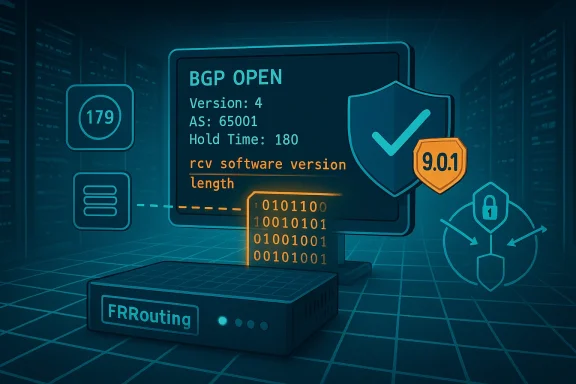 Background / Overview
BGP sessions begin with an OPEN handshake. During OPEN processing, a BGP implementation parses optional parameters and capabilities sent by the peer; those fields frequently include variable‑length data. In FRRouting FRR 9.0 the code path in bgpd that parsed the rcv software version did not validate the length robustly, creating a classic boundary‑check vulnerability in bgpd/bgp_open.c. When an attacker supplies an overly large length for that element, parsing can read or copy data outside intended buffers — behavior classified as CWE‑120 (buffer copy without checking size of input). The National Vulnerability Database (NVD) entry for CVE‑2023‑41361 records this concise description and the discovery date of August 29, 2023.That description matches the upstream fix and vendor advisories: FRRouting’s 9.0.1 notes include the line “Check the length of the rcv software version” under the bgpd fixes, and the remediation commit that landed the patch is referenced in downstream security trackers.
What the vulnerability means in practice
How an attacker would abuse it
- An unauthenticated remote actor that can open a TCP session to a vulnerable bgpd instance (BGP runs over TCP port 179) can craft a BGP OPEN message containing a capability/optional parameter that identifies the peer software version with an excessive length value.
- Because the vulnerable code path did not enforce an upper bound on that length before allocating or copying data, the malformed message can cause abnormal behavior ranging from process crash (denial of service) to memory corruption that might be escalated into code execution depending on surrounding conditions and platform hardening.
Real‑world impact scenarios
- Provider edge routers and cloud virtual routers that accept BGP peering from untrusted peers, transit providers, or misconfigured peers are at greatest risk: a single crafted OPEN could crash bgpd on an edge node and remove routes or cause immediate failover.
- Network appliances and white‑box routers shipped with embedded FRR versions (for example, vendor images using FRR 9.0.x) may be vulnerable until their vendor ships firmware updates; in many environments these appliances are slow to patch and can remain exposed for months.
- Persistent exploitation or repeat attacks could produce sustained service outages (repeated crashes) while a single, well‑crafted exploit might escalate to full compromise if memory corruption is exploitable as code execution on the target platform.
Verification, remediation, and timelines
Upstream fix and release
FRRouting’s immediate upstream response was to implement proper length checking in the affected code path and merge the fix into the project tree; the change is present in the tag/release history for FRR 9.0.1. The official FRR 9.0.1 release notes call out the bgpd fix by name and the related commit is visible in FRR’s repository history. Operators that upgraded to FRR 9.0.1 or later receive the upstream patch.Distribution and vendor updates
- Debian, the FRR upstream release, and other distro trackers categorized the issue and published updates (for example, Debian’s DLA entry and security tracker show the fix and backport tracking). Enterprise Linux vendors and appliance makers followed with their own timelines and packaging updates; some vendors rated the issue differently for product‑specific reasons, but the upstream patch was the canonical fix.
What to patch (short checklist)
- Identify hosts and appliances running FRRouting FRR 9.0.x (or vendor images that bundle that code).
- If the vendor or distribution provides a security update that references CVE‑2023‑41361 or includes the bgpd fix, apply it immediately and plan controlled reboots if necessary.
- If you build FRR from source, upgrade to the upstream commit or tag that contains the fix, or rebuild from the 9.0.1 release tag.
- For appliances and cloud images, confirm with the vendor that a firmware/package update is available; apply vendor guidance and test the update in a maintenance window.
Mitigations and defenses while you patch
Patching is the definitive fix, but real networks have constraints. Use the following layered mitigations to reduce exposure until you can apply the upstream or vendor patch.- Network‑level restrictions:
- Block or restrict inbound TCP 179 (BGP) to only trusted peer IP addresses at your perimeter routers and firewall ACLs.
- Limit which neighbors can establish sessions with control‑plane ACLs and uRPF where appropriate.
- BGP hardening:
- Use session authentication mechanisms supported by your platform (TCP‑MD5 or TCP‑AO where available) to prevent unauthorized peers from establishing TCP sessions.
- Enable TTL security for EBGP multihop sessions where supported.
- Implement strict prefix‑ and AS‑filters to reduce downstream damage in case of session gaps.
- Operational monitoring:
- Watch for sudden bgpd restarts, crashes, or core dumps on routers and virtual routers.
- Monitor for unusual numbers of BGP OPENs, repeated session attempts from unexpected sources, or malformed OPEN behavior in flow captures.
- Intrusion prevention / IPS:
- Deploy or tune IDS/IPS rules to detect abnormal BGP OPENs with suspiciously large optional parameters or capabilities fields; many commercial IDS vendors added signatures for malformed BGP OPEN messages soon after disclosure.
- Asset controls:
- Inventory all devices running FRR, including virtual routers and appliance images; vendors sometimes ship older FRR versions embedded inside firmware.
Detection and incident response guidance
If you suspect exploitation or anomalous behavior related to this vulnerability, follow an incident‑response path focused on containment, analysis, and recovery.- Contain
- Isolate affected routers from untrusted peers by applying temporary ACLs limiting TCP/179 to known peer addresses.
- If a device is repeatedly crashing, remove it from production and route traffic to standby systems.
- Capture evidence
- Preserve bgpd logs, core dumps, and system logs before rebooting or reloading the device.
- Capture packet traces covering BGP sessions (forensic PCAPs) that include the OPEN handshake; malformed OPENs are the key artifact for this issue.
- Analyze
- Look for BGP OPEN messages with unusually large optional parameter/capability length values and abnormal parsing errors in logs.
- Correlate logs with network captures to identify source IPs; repeated OPEN attempts or high‑volume probing often precede or accompany exploitation attempts.
- Remediate
- Apply upstream vendor patches or FRR upgrades and harden BGP peering as described above.
- Replace or rebuild affected virtual appliances if the vendor indicates no patch is available.
- Recover
- Restore services, validate routing, and monitor for re‑attempts from the identified IP sources.
- Consider blackholing or rate‑limiting traffic from persistent attackers that do not respond to standard mitigations.
How serious is the risk? (weighing CVSS, exploitability, and real world exposure)
Multiple vulnerability aggregators listed CVSS ratings at the top of the scale, citing a vector consistent with unauthenticated remote network exploitation and high impact to confidentiality, integrity, and availability. The widely‑referenced CVSS 3.1 vector associated with public reports places the base score in the critical range. At the same time, vendor or distribution trackers sometimes apply their own contextual severity ratings based on product usage and exploitability within their ecosystems.Key contextual points:
- Network‑facing BGP services are by definition reachable by the network; if a router accepts sessions from a wide address set, exposure is higher. Conversely, if the architecture already restricts BGP peering to a small set of authenticated IPs, the practical attack surface is smaller.
- Public exploit code for CVE‑2023‑41361 did not immediately become widely shared at disclosure time; many trackers mark "no public exploit" or show moderate-to-high exploitation probability scores depending on their telemetry. That said, buffer overflow classes are historically attractive to attackers, and the presence of craftable network packets makes exploitation a realistic risk for exposed systems.
Why the bug happened (brief root‑cause analysis)
The core problem is poor input validation in a protocol‑parsing routine. Parsing variable‑length protocol fields requires explicit, defensively coded checks on the claimed length before any buffer allocation or memory copy. In this case, the code path responsible for handling the rcv software version field in bgpd’s OPEN processing failed to enforce an upper bound, allowing a crafted peer to trick the parser into out‑of‑range memory activity. That class of error — missing bounds check on network input — is one of the most common causes of remotely exploitable vulnerabilities in network daemons and is cataloged as CWE‑120. The upstream fix enforces the length check at the point of parsing, illustrating the straightforward nature of the corrective action and the need for systematic input validation in protocol parsers.Practical considerations for large networks and vendors
Large providers and vendors operate many autonomous systems and devices; patch windows can be long and appliance lifecycles mean older binaries may persist in fielded systems. Two operational implications are critical:- Vendor dependency: Many network appliances ship with a bundled version of FRR. Even when FRR issues a patch, vendors must integrate, test, and distribute firmware/OS updates; this can delay remediation for months in some product families. Track vendor advisories and insist on timelines for security updates where possible.
- Live network constraints: Rolling upgrades of control‑plane software require coordination; some deployments must schedule maintenance windows and validate failover behavior. Use a risk‑based approach: prioritize border routers that peer with many third parties, transit edges, and devices with externally reachable control planes.
A note on authoritative advisories and reporting
The Microsoft Security Response Center’s advisory pages are commonly used in enterprise environments to coordinate vulnerability remediation guidance; when FRRouting‑related CVEs appear in vendor or distributor listings, MSRC entries are often referenced as the authoritative advisory for a given CVE in Windows contexts. If you collected the MSRC advisory as part of your intake for CVE‑2023‑41361, treat that advisory as a central record for impacted Microsoft customers and for cross‑platform coordination.At the same time, the most direct and immediate source for the FRR patch is the FRRouting project itself: their release notes and security pages list CVEs and link to the commits and PRs implementing fixes. Use the upstream repository and release tags for the most granular view of what was changed.
Strengths of the community response — and remaining risks
What went right- Upstream FRRouting reacted quickly and merged a minimal, focused fix that addressed the length check and shipped it in a point release (9.0.1). The commit and release make root cause and remediation straightforward for packagers.
- Distribution maintainers and security trackers documented the CVE and tracked backports and package updates; this reduced ambiguity for operators about which packages applied to which OS releases.
- Many network appliances embed FRR, and supply‑chain lag means devices in production may remain vulnerable long after an upstream fix is available. Operators should pressure vendors for timely firmware updates and, where possible, insist on images that can be independently upgraded.
- Detection of subtle memory‑corruption exploitation is hard: an adversary who escalates memory corruption into code execution may leave few obvious traces. Collecting detailed forensic artifacts (core dumps, PCAPs) at the time of incident is therefore essential.
Recommended action plan (prioritized)
- Inventory: Find all routers, virtual routers, L3 appliances, and vendor images that use FRRouting FRR 9.0.x. Treat this CVE as high priority for any externally reachable BGP peer.
- Patch: Apply vendor or distribution packages that include the FRR 9.0.1 fixes, or upgrade to a patched FRR release built from the upstream commit. Test in staging before production.
- Mitigate: Until patched, restrict TCP/179 to trusted IPs, enable BGP session authentication where possible, and restrict control‑plane access. Monitor for repeated BGP OPENs and bgpd restarts. (See the mitigations checklist above.)
- Monitor and inspect: Retain bgpd logs and collect PCAPs for any session anomalies. Use IDS rules to detect suspiciously long BGP OPTIONAL parameters.
- Vendor follow‑up: Track vendor advisories for firmware images that bundle FRR and prioritize their updates, especially for appliances in customer‑facing or transit roles.
Conclusion
CVE‑2023‑41361 is a textbook example of why robust input validation in protocol parsers matters for network infrastructure: a single unchecked length field in bgpd’s OPEN handling could crash or corrupt a BGP daemon, with immediate routing consequences. The vulnerability was fixed quickly upstream, and the FRR 9.0.1 release contains the remedial change; distributions and vendors produced backports and advisories to close the window of exposure. Operators should prioritize inventory and patching for all devices running FRR 9.0.x, apply network‑level mitigations until updates are in place, and treat control‑plane hardening as a continuous requirement rather than an occasional task. For Windows‑centric environments that referenced the MSRC advisory as part of coordination, rely on that advisory as a canonical enterprise record while using the FRRouting release notes and commit history as the technical source of truth for the exact code changes.Source: MSRC Security Update Guide - Microsoft Security Response Center
