

A subtle bug in a popular Go markdown library quietly turned into a disruptive denial-of-service vector: a malformed citation in certain parser modes can trigger an out‑of‑bounds read and crash any application that renders untrusted input with the affected code path. This vulnerability, tracked as CVE‑2023‑42821, affects the
The
The issue was catalogued and assigned the CVE identifier CVE‑2023‑42821 and linked to the GitHub advisory GHSA‑m9xq‑6h2j‑65r2. Multiple vulnerability databases (including the NVD, OSV, and vendor trackers) classify the flaw as an out‑of‑bounds read that results in a runtime panic — effectively a denial‑of‑service (DoS) condition for programs that parse attacker‑controlled content.
For defenders, the combination of high severity, trivial proof‑of‑concepts, and the prevalence of the affected library in Go ecosystems means this should be triaged promptly rather than deferred as a low priority bug.
The upstream project also published a GitHub security advisory and merged the fix into the project's repository, providing both the technical diff and advisory metadata for integrators to consume. Maintainers usually recommend upgrading to the patched pseudoversion or a later tagged release that includes the commit.
Key supply‑chain takeaways:
Source: MSRC Security Update Guide - Microsoft Security Response Center
github.com/gomarkdown/markdown parser when the parser.Mmark extension is enabled and was patched upstream in a targeted commit; operators and developers who embed this library in web services, static-site generators, or internal tools should treat the issue as a supply‑chain risk and apply immediate mitigation or updates.
 Background
The gomarkdown/markdown project is a widely used, BSD‑licensed Markdown parser and HTML renderer for Go. It advertises fast parsing, a small dependency surface, and compatibility with common Markdown features, which is why it is frequently embedded in web apps, documentation pipelines, and content management tooling. The vulnerability disclosed on 22 September 2023 affects the parser’s citation handling code and is specific to the parser.Mmark extension (an extension that supports certain Markdown features).The issue was catalogued and assigned the CVE identifier CVE‑2023‑42821 and linked to the GitHub advisory GHSA‑m9xq‑6h2j‑65r2. Multiple vulnerability databases (including the NVD, OSV, and vendor trackers) classify the flaw as an out‑of‑bounds read that results in a runtime panic — effectively a denial‑of‑service (DoS) condition for programs that parse attacker‑controlled content.
What went wrong: a technical breakdown
Where the crash occurs
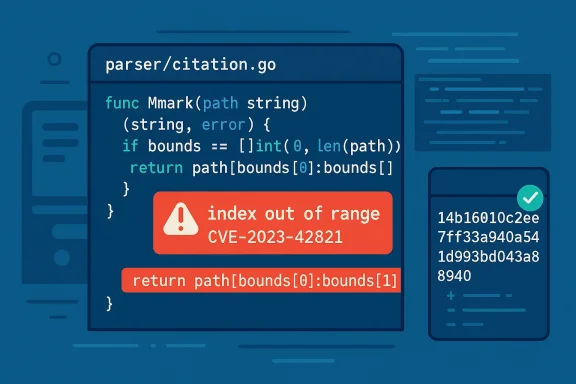
At the heart of the problem is a bounds‑checking oversight inparser/citation.go. When the parser receives a malformed citation token under the parser.Mmark extension, a code path attempts to index a slice beyond its available length, producing a runtime panic: index out of range. This is a straightforward CWE‑125: Out‑of‑Bounds Read that in Go manifests as a crash/fatal panic rather than silent memory corruption. Multiple advisories point to line 69 of citation.go as the site of the faulty access prior to the upstream fix.Preconditions and exploitability
Not every markdown input triggers the bug — the parser must be configured with theparser.Mmark option enabled. When that extension is active, the parser exercises a citation parsing path that does not correctly validate array/slice bounds for certain malformed inputs (for example, the minimal payload [@] has been shown to reproduce the panic in test PoCs). Because the parser typically operates on untrusted input (user comments, documentation uploads, or third‑party content), an attacker who can submit crafted Markdown to an endpoint can reliably induce a crash without authentication or special privileges.Nature of impact in real systems
The vulnerability’s practical consequence is availability loss: any service that renders Markdown with the vulnerable configuration can be forced to crash or otherwise terminate processing. In single‑process binaries or services without robust isolation, this may equate to a full service outage. In multi‑tenant platforms or long‑running daemons, repeated triggering can cause resource exhaustion and disrupt client connections. Because the bug produces a deterministic panic, it is trivial to reproduce and weaponize in automation.Severity and scoring
Vulnerability scanners and maintainers have converged on a High severity classification for CVE‑2023‑42821. The CVSS v3.1 base score commonly published for the CVE is 7.5 (High), with the primary impact being Availability (the vulnerability causes a crash/DoS) while Confidentiality and Integrity are not impacted. Several vulnerability databases and security vendors reflect this scoring and note the low attack complexity and absence of required privileges or user interaction for exploit.For defenders, the combination of high severity, trivial proof‑of‑concepts, and the prevalence of the affected library in Go ecosystems means this should be triaged promptly rather than deferred as a low priority bug.
Reproducing the issue (proof‑of‑concept summary)
Security advisories and OSV/visibility portals publish small PoCs that demonstrate the problem with minimal code. The canonical PoC pattern is:- Configure the parser to include
parser.Mmark. - Call
markdown.ToHTMLon a crafted byte slice such as[]byte("[@]"). - Observe a runtime panic:
index out of rangeoriginating fromparser.citation.
Affected versions, fixes, and vendor response
The vulnerability affectsgithub.com/gomarkdown/markdown releases prior to the pseudoversion 0.0.0-20230922105210-14b16010c2ee, which corresponds to the upstream commit 14b16010c2ee7ff33a940a541d993bd043a88940. The project maintainers merged a targeted fix in that commit to add the missing bounds check (or otherwise ensure the slice access is guarded), and several packaging ecosystems have recorded the fixed package versions. Security trackers from Debian, Ubuntu, and others list patched package revisions in their repositories.The upstream project also published a GitHub security advisory and merged the fix into the project's repository, providing both the technical diff and advisory metadata for integrators to consume. Maintainers usually recommend upgrading to the patched pseudoversion or a later tagged release that includes the commit.
Who should care: practical exposure and supply‑chain risk
- Developers who import
github.com/gomarkdown/markdowndirectly into web servers, documentation sites, microservices, static site generators, or CLI tools that process user input are directly exposed. - Projects that depend indirectly on gomarkdown via other Go modules should examine their dependency graphs; even transitive uses can lead to runtime exposures if the calling code enables the
Mmarkextension. - CI/CD pipelines and packaging systems that build and distribute binaries containing the vulnerable module may propagate the risk to downstream consumers.
- Cloud services and multi‑tenant platforms that allow users to submit Markdown payloads (e.g., blog engines, wikis, issue trackers) are particularly at risk because unauthenticated attackers could be able to submit payloads that crash processing workers.
Immediate mitigation steps (what to do now)
If you operate systems that parse Markdown using Go, treat the following as prioritized remediation actions:- Identify affected binaries
- Run a dependency scan on your Go modules (for example,
go list -m allandgo mod graph) to detectgithub.com/gomarkdown/markdownpresence — both direct and transitive. - Apply patches
- Upgrade to the patched pseudoversion
0.0.0-20230922105210-14b16010c2eeor any later release that includes commit14b16010c2ee7ff33a940a541d993bd043a88940. Rebuild and redeploy artifacts after updating the module. - Short‑term workarounds (if immediate upgrade isn’t possible)
- Disable or avoid enabling the
parser.Mmarkextension in your parser configuration when processing untrusted input. - Run untrusted Markdown in isolated worker processes or containers with resource limits and restart policies to limit blast radius.
- Harden processing pipelines
- Add input validation and content size limits.
- Wrap markdown rendering calls in guarded subprocesses or sandboxed execution contexts so a crash cannot take down the entire service.
- Monitor and detect
- Deploy application‑level crash detection and structured logging to flag repeated panics originating from Markdown processing.
Mmark, isolate renderers) against the long‑term fix (update the module and rebuild). Debian and Ubuntu trackers list patched package versions if you manage packages at the OS level; enterprise packagers should apply the available updated packages or vendor the patched module into their build pipelines.Hardening considerations and longer‑term defenses
Beyond patching a single library, this incident highlights several practices every engineering and security team should adopt to reduce future supply‑chain and runtime risks:- Dependency hygiene: track and pin module versions in
go.mod, and routinely run tooling that flags vulnerable transitive dependencies. - Defense in depth: never assume a parser or common utility is safe — always treat user‑controlled content as an attack surface and sanitize or sandbox its processing.
- Runtime confinement: adopt isolation patterns so a single worker or request cannot crash the control plane. Use supervisors, sidecars, or process pools to isolate risky operations.
- Automated testing: add targeted fuzzing or property‑based tests around parsing logic for libraries that handle untrusted input. Small mutation fuzzers often find indexing and bounds errors early.
- Supply‑chain observability: record module checksums, rebuild artifacts reproducibly, and maintain a software bill of materials (SBOM) so you can rapidly identify which deployed artifacts contain a vulnerable module when a CVE is published.
- Vulnerability response playbook: build a documented, tested runbook that includes detection, patching, backporting decisions, and communication templates for internal and customer notices.
Detection: how to spot exploitation attempts and post‑mortem traces
Detecting exploitation of an out‑of‑bounds read that results in a panic is straightforward in many environments:- Crash logs and stack traces will often show the panic originating from
parser.citationincitation.go. Instrument your log aggregation to alert on repeated panics with that stack trace. - Application monitoring systems (APM, process monitors) will show increased restarts of worker processes or elevated error rates tied to Markdown rendering endpoints.
- Web‑access logs may reveal repeated requests with short payloads targeting Markdown upload endpoints; correlate such requests with crash timestamps.
- Static code or SBOM analysis will reveal the presence of the vulnerable module across builds; use this to prioritize remediation across services.
The supply‑chain angle: why small libraries matter
This vulnerability demonstrates a recurring reality of modern software: small libraries are everywhere. A single out‑of‑bounds access in a helper file can replicate across dozens of downstream projects. Go modules make it easy for libraries to be embedded transitively, which is beneficial for reuse but increases attack surface.Key supply‑chain takeaways:
- Track both direct and transitive dependencies. A module you didn’t import directly may still be present in your binary or container image.
- Lock dependencies for production builds and regenerate locks only under controlled processes.
- Patch and rebuild images promptly after a CVE, and ensure automated deployment pipelines can push fixed images quickly.
- Maintain an inventory/SBOM for critical applications so triage after disclosure is fast and accurate.
Real‑world scenarios and risk examples
- Public comment platforms: a user‑facing comment field that renders Markdown on the server could be used by an attacker to crash the rendering service with the
[@]‑style payload ifMmarkis enabled. - Static‑site generator pipelines: CI jobs that convert Markdown to HTML (for example, during documentation deployment) could be forced to fail, delaying releases or automating denial of service against the documentation site.
- Microservices that accept Markdown via API: load balancers or orchestrators could see unsteady request handling and worker churn if crashes are frequent, increasing latency and dropping connections for benign users.
Recommendations for maintainers and integrators
For projects that maintain downstream packages or distribute binaries:- Backport the fix to supported release branches if you maintain an enterprise fork that cannot upgrade to the upstream pseudoversion immediately.
- Update package metadata and security advisories to list affected versions, fixed revisions, and workarounds in plain language.
- Publish patched releases with clear migration notes and ensure CI pipelines use the updated module versions.
- Coordinate with downstream packagers (Linux distributions, container registries) so updates propagate quickly.
- Run a dependency scan across repositories and images to identify where
github.com/gomarkdown/markdownis used. - Prioritize updates for public‑facing services and multi‑tenant platforms.
- If necessary, implement temporary content filters or disable
Mmarkuntil you can deploy a patched binary.
Final analysis: strengths, risks, and broader lessons
The vendor response and patch were swift and surgical: the upstream commit addressed the specific bounds check and maintainers published advisory metadata. That’s the correct short‑term outcome and reflects good security hygiene by the project. However, the incident exposes systemic risks:- Strengths:
- The fix was small, reviewed, and merged; multiple security databases synchronized advisories and PoCs.
- The vulnerability is easy to detect and patch via module upgrades, and distros have already released updated packages for many release lines.
- Risks:
- Widespread transitive use means many projects are potentially at risk without direct knowledge.
- The trivial PoC and lack of required privileges make automated exploitation practical for attackers.
- Operational impact is real: availability outages can cascade in poorly isolated systems.
Conclusion
CVE‑2023‑42821 is not a theoretical bug: it is a practical, publicly documented out‑of‑bounds read in a commonly embedded Go library that yields a straightforward denial‑of‑service. The path to remediation is clear — update to the pseudoversion that contains commit14b16010c2ee7ff33a940a541d993bd043a88940, or otherwise remove or disable the parser.Mmark extension until you can patch and rebuild. Operators should treat this disclosure as a timely reminder that dependency visibility, process isolation, and rapid patching are indispensable defenses in modern software supply‑chain security.Source: MSRC Security Update Guide - Microsoft Security Response Center
