

A subtle design choice in QUIC’s path‑validation code turned into a practical denial‑of‑service lever: CVE‑2023‑49295 lets a remote peer drive a quic‑go server into memory exhaustion by abusing PATH_CHALLENGE/PATH_RESPONSE exchanges, and the problem—disclosed in late 2023 and published with fixes in January 2024—forced maintainers to change the balance between strict RFC compliance and real‑world robustness.
quic‑go, the Go implementation of the QUIC protocol, implements the path validation mechanism required by RFC‑9000: when a peer probes a new network path it sends a PATH_CHALLENGE frame; the receiver MUST echo those bytes back in a PATH_RESPONSE frame. That requirement, while correct for correctness and migration semantics, can be weaponized: a malicious peer can stream many PATH_CHALLENGE frames while simultaneously manipulating congestion control and RTT signals so the victim cannot transmit the matching PATH_RESPONSE frames quickly enough. The result is an ever‑growing queue of responses waiting to be sent, which ultimately exhausts process memory and causes a denial of service. This behavior was disclosed publicly on December 18, 2023 and formally assigned CVE‑2023‑49295 with fixes made available in quic‑go releases in January 2024.
This article unpacks how the attack , which versions are affected, what the quic‑go team changed, how operators should respond, and what the incident implies for QUIC as a protocol. I cross‑checked vendor advisories and independent analyses to validate the technical details and patch guidance.
Key, actionable points for operators:
Conclusion: CVE‑2023‑49295 is not a headline‑style remote code execution — its damage is blunt and operational — but that does not make it unimportant. Availability is a core property of production systems, and a small protocol mechanism combined with practical networking realities was sufficient to craft a denial‑of‑service weapon. The response from maintainers was swift and sensible; the remaining work is procedural and organizational: patch, monitor, and push the protocol community to bake in safe defaults so similar surprises are less likely to recur.
Source: MSRC Security Update Guide - Microsoft Security Response Center
 Overview
quic‑go, the Go implementation of the QUIC protocol, implements the path validation mechanism required by RFC‑9000: when a peer probes a new network path it sends a PATH_CHALLENGE frame; the receiver MUST echo those bytes back in a PATH_RESPONSE frame. That requirement, while correct for correctness and migration semantics, can be weaponized: a malicious peer can stream many PATH_CHALLENGE frames while simultaneously manipulating congestion control and RTT signals so the victim cannot transmit the matching PATH_RESPONSE frames quickly enough. The result is an ever‑growing queue of responses waiting to be sent, which ultimately exhausts process memory and causes a denial of service. This behavior was disclosed publicly on December 18, 2023 and formally assigned CVE‑2023‑49295 with fixes made available in quic‑go releases in January 2024.This article unpacks how the attack , which versions are affected, what the quic‑go team changed, how operators should respond, and what the incident implies for QUIC as a protocol. I cross‑checked vendor advisories and independent analyses to validate the technical details and patch guidance.
Background: QUIC path validation in a nutshell
- QUIC allows connection migration: the 4‑tuple identifying a connection can change during the lifetime of the connection.
- To confirm a new (or probed) path is reachable, the sender emits a PATH_CHALLENGE frame containing 8 bytes of unpredictable data.
- The receiver must respond with a PATH_RESPONSE frame that echoes those 8 bytes; that exchange is used both for reachability and for measuring RTT on the probed path.
The vulnerability — how PATH_CHALLENGE becomes a memory‑exhaustion vector
The mechanics, step‑by‑step
- Attacker sends frequent packets containing PATH_CHALLENGE frames to a victim endpoint (server or peer).
- For every challenge, the victim allocates and queues a PATH_RESPONSE to be sent back.
- The attacker withholds acknowledgements or sends selective ACK patterns that make the victim believe most of its transmitted packets were lost; this causes the victim’s congestion window to collapse and its send rate to drop dramatically.
- The attacker can additionally skew RTT estimates by delaying explicit ACKs, convincing the victim to back off further.
- Because the victim’s sending rate is throttled, queued PATH_RESPONSE frames accumulate faster than they can be drained, leading to growing memory use and eventual exhaustion.
Why this is practical (not just theoretical)
- PATH_CHALLENGE and PATH_RESPONSE are small frames, but they are generated per received challenge. If the victim is forced to stop sending, the number of queued responses can become arbitrarily large.
- Congestion control is by design conservative when it sees losses; selective ACKing is a real technique the attacker can use to manipulate a sender’s congestion window and RTT estimate.
- The attack does not require breaking cryptography or hijacking flows; it works within the protocol semantics. That made it protocol‑level and not merely an implementation quirk.
Scope and affected versions
- Affected product: quic‑go (the Go implementation of QUIC).
- Affected versions (as published): all releases before the fixed versions and specific ranges included in advisories—commonly cited patched releases are 0.37.7, 0.38.2, 0.39.4, and subsequent updates in later minor lines. Operators should treat releases older than these fixed versions as vulnerable.
- Public disclosure timeline: the vulnerability disclosure and writeup appeared in mid‑December 2023 (disclosed to the working group in October and publicly on December 12 and December 18, 2023), and the CVE record was published January 10, 2024.
The patch: practical change that relaxes strict RFC behavior
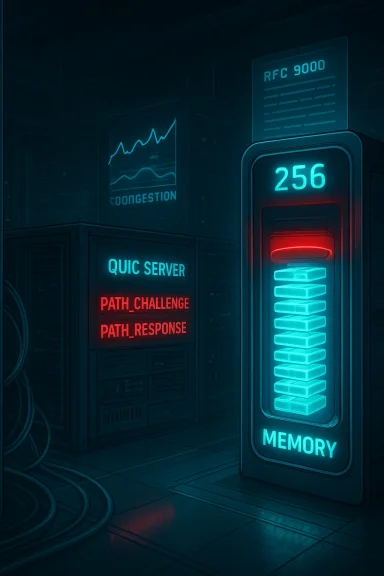
The core mitigation in quic‑go is pragmatic: the implementation limits the number of queued PATH_RESPONSE frames per connection to a bounded value (for example, a limit like 256 queued responses was proposed and adopted). This bound caps memory use and converts an unbounded allocation into a small, predictable cost. Marten Seemann—the author who reported the issue and a quic‑go maintainer—explicitly documented why the limit solves the problem in practice while noting the fix technically makes the implementation less strictly conformant with the letter of RFC 9000 in an edge case where compliance would enable a denial‑of‑service attack.- Strength of the patch: it removes the unbounded allocation and turns a potentially catastrophic resource exhaustion path into a bounded, low‑impact condition.
- Trade‑off: the implementation now refuses to respond to excessive PATH_CHALLENGE floods, which is arguably a legitimate defensive move but represents a departure from the RFC in an extreme and unlikely scenario. Seemann and the quic community recommended that the specification itself be clarified to allow implementations to defend against this class of attack.
Exploitability and risk assessment
- Attack complexity: High. The adversary must carefully craft timing, selective ACKs and sequence of probes to collapse the victim’s congestion window and distort RTT estimates while continuing to send challenges. This is non‑trivial but well within the abilities of a motivated remote attacker. NVD and other databases list the attack complexity as high.
- Privileges required: Low. The attacker only needs network access to the victim’s QUIC endpoint.
- Impact: Availability only. The flaw is an uncontrolled resource consumption problem (CWE‑400) that results in denial of service; confidentiality and integrity are not impacted.
- Real‑world ease: moderately low—while conceptually straightforward attackers must manage timing and per‑connection behavior. Public writeups and subsequent fixes indicate this pattern was feasible for multiple QUIC stacks and therefore worth remediating quickly.
Which QUIC implementations were affected? (protocol vs. implementation)
Marten Seemann’s disclosure made an important point: this class of attack targets the protocol behavior (path validation semantics) and therefore many RFC‑compliant stacks could be susceptible in principle. In practice, the impact varied:- Vulnerable implementations reported in initial outreach included quic‑go (the author’s own), Cloudflare’s quiche and Fastly’s quicly; other stacks were found not affected because of different implementation choices or additional limits.
- The CVE we’re focused on, CVE‑2023‑49295, is specifically assigned to quic‑go and tracked as such by NVD and other databases. Downstream distributions and projects that vendor quic‑go (for example some containerized apps and products) were also noted as affected until they upgraded.
- Not all QUIC implementations share the same risk profile for this exact exploit; however, the underlying protocol semantics motivated broader community discussion and follow‑up hardening in other stacks.
Downstream consequences: packages, distros and applications
Because quic‑go is a dependency used by several projects, the vulnerability caused ripples:- Distributions and downstream applications that embed quic‑go had to issue updates. Examples include container projects, peer‑to‑peer apps and other Go projects that vend the library. Some package maintainers quickly removed vulnerable versions from repositories or issued rebuilds with patched upstream.
- The incident also prompted CVE trackers, security scanners and distro security teams to flag vulnerable images and packages. Operators should treat any package or container image that includes quic‑go versions older than the patched releases as requiring immediate remediation.
Recommended immediate actions for operators
- Inventory: Identify which applications in your estate depend on quic‑go (directly or via vendored dependencies). Use binary/package scanning tools and SBOMs to find occurrences of vulnerable versions.
- Patch: Upgrade libraries to the fixed versions listed in advisories—0.37.7, 0.38.2, 0.39.4, or later releases in the same lines that include the mitigation. For downstream apps, apply vendor patches or rebuild with an updated quic‑go.
- Network controls: Where practical, apply rate limiting and source reputation controls at perimeter gateways to make exploitation harder (note: this does not replace a patch).
- Monitoring: Track unusual memory growth or sustained TCP/UDP endpoints with rising response queues, and set alerts for memory pressure and process restarts.
- Defense‑in‑depth: Combine update management with egress/ingress filtering, limiting traffic from untrusted peers to services that accept QUIC connections. No vendor workaround eliminates the root cause, so patching remains the primary measure.
Detection and hunting guidance
- Metric to watch: a steady increase in outgoing queue length or unsent UDP packet buffers associated with the quic process; frequent creation of tiny PATH_RESPONSE objects if you can instrument the stack.
- Behavioral signatures: sustained incoming packets that contain PATH_CHALLENGE frames at a high rate from one peer; many selective ACK patterns from an otherwise normal peer.
- Logs: enable detailed QUIC logging temporarily where feasible and look for repeated path probe activity and retransmission/backoff loops.
- Endpoint telemetry: process memory growth correlated to QUIC sockets that remain non‑responsive should trigger an investigation.
Protocol implications and the specification debate
CVE‑2023‑49295 highlighted a tension between protocol purity and robustness:- RFC‑mandated behavior can, in edge cases, open opportunities for resource exhaustion if the specification leaves no explicit defensive allowance to limit work per peer.
- The quic‑go team adopted a pragmatic cap on queued responses to protect real systems, and the author argued the specification should permit reasonable defensive limits. That position has seen support in the community: protocol standards should allow implementers to adopt safety limits for resource‑intensive behaviors.
Strengths of the response — what the quic community did right
- Rapid disclosure and coordinated fixes: the reporter engaged the IETF QUIC working group and implementers; quic‑go and several other stacks issued patches or mitigations quickly. That coordination limited the window of widespread exposure.
- Pragmatic mitigation: bounding queued responses is simple, low‑risk, and highly effective at eliminating the memory exhaustion vector.
- Community learning: the issue prompted a broader audit of QUIC mechanisms related to resource management (connection IDs, path probing, etc.) and improved defensive guidance for implementers.
Residual risks and limitations
- Spec drift vs. hardening: implementing defensive caps means code is technically not following the RFC in corner cases. Until the specification explicitly allows such bounds, implementers must accept this mismatch or risk future incompatibilities.
- Downstream lag: container images, embedded devices and slow release cycles mean some environments may remain vulnerable longer than expected; operators must actively track and remediate these supply‑chain occurrences.
- Unverified claims and attack variations: while the canonical attack uses selective ACKs and RTT manipulation, variant techniques could emerge. Defenders should remain vigilant and not assume the only viable exploit pattern has been fixed. Where claims are ambiguous across trackers, treat the scenario conservatively and patch.
What this means for Windows admins and enterprise networks
- If you run applications or services that embed quic‑go, treat CVE‑2023‑49295 as an availability risk and patch immediately. Use SBOMs and package scanners to find transitive quic‑go usage in containers and microservices.
- If your environment uses a different QUIC stack (for example, msquic or browser QUIC stacks), consult vendor advisories for those products—msquic and others have independent advisories and CVEs on different issues, and they should be evaluated separately. Do not conflate CVE‑2023‑49295 with unrelated msquic CVEs.
- For perimeter and gateway teams: add rate limiting and UDP‑level filtering rules for unexpected high‑rate QUIC path probe traffic; combine with telemetry that detects sustained memory growth on service endpoints. These mitigations reduce risk while patching is applied.
Final assessment and takeaways
CVE‑2023‑49295 is a textbook example of how protocol semantics can be weaponized when resource allocation is left unbounded. The vulnerability did not break cryptography or confidentiality; it attacked availability through unchecked allocations combined with manipulation of congestion control logic. The quic‑go team’s fix—bounding queued PATH_RESPONSE frames—was simple, effective and pragmatic, and it sparked a healthy conversation about making the QUIC specification practical for hostile networks.Key, actionable points for operators:
- Inventory: find quic‑go usage across your estate.
- Patch: upgrade to the published fixed releases (0.37.7, 0.38.2, 0.39.4 or later for the respective lines).
- Monitor: implement telemetry rules to detect unusual path probe rates and memory growth.
- Harden: apply network rate limits and ingress protections where possible.
- Engage: if you maintain or vendor a QUIC stack, consider adding conservative resource caps and push for specification guidance allowing such limits.
Conclusion: CVE‑2023‑49295 is not a headline‑style remote code execution — its damage is blunt and operational — but that does not make it unimportant. Availability is a core property of production systems, and a small protocol mechanism combined with practical networking realities was sufficient to craft a denial‑of‑service weapon. The response from maintainers was swift and sensible; the remaining work is procedural and organizational: patch, monitor, and push the protocol community to bake in safe defaults so similar surprises are less likely to recur.
Source: MSRC Security Update Guide - Microsoft Security Response Center
