

The glibc library’s getaddrinfo implementation suffered a subtle — but operationally important — regression in late 2023 that introduced a memory leak capable of producing denial‑of‑service conditions in networked services: CVE‑2023‑5156 is a memory‑leak bug in getaddrinfo.c, introduced as a follow‑on to a previous fix and patched in glibc 2.39 (with distribution backports).
Glibc (the GNU C Library) is the foundational C runtime on most Linux systems. Its networking helpers — notably getaddrinfo() — are invoked across an enormous surface: server daemons, web stacks, system daemons, embedded appliances and client tools all call name resolution routines. When a library that low in the stack mismanages memory, the operational fallout can be disproportionate: a tiny, repeatable leak in a frequently called code path can exhaust process memory and crash otherwise healthy services.
CVE‑2023‑5156 was disclosed in September 2023 after maintainers discovered the leak while addressing an earlier getaddrinfo bug (CVE‑2023‑4806). Multiple vulnerability databases and vendor advisories recorded the issue as a regression: the earlier fix created an unfreed allocation in certain getaddrinfo code paths, so repeated calls can accumulate leaked blocks until the process is destabilized.
For operators and administrators:
Source: MSRC Security Update Guide - Microsoft Security Response Center
 Background
Glibc (the GNU C Library) is the foundational C runtime on most Linux systems. Its networking helpers — notably getaddrinfo() — are invoked across an enormous surface: server daemons, web stacks, system daemons, embedded appliances and client tools all call name resolution routines. When a library that low in the stack mismanages memory, the operational fallout can be disproportionate: a tiny, repeatable leak in a frequently called code path can exhaust process memory and crash otherwise healthy services.CVE‑2023‑5156 was disclosed in September 2023 after maintainers discovered the leak while addressing an earlier getaddrinfo bug (CVE‑2023‑4806). Multiple vulnerability databases and vendor advisories recorded the issue as a regression: the earlier fix created an unfreed allocation in certain getaddrinfo code paths, so repeated calls can accumulate leaked blocks until the process is destabilized.
Why this matters to WindowsForum readers and administrators
- getaddrinfo() is used indirectly by most networked processes; a single library defect can cascade into web servers, mail servers, proxies, containers and more.
- The vulnerability is exploitable over the network with no privileges required; it can be triggered by carefully crafted requests that exercise the affected path, meaning remote attackers or malformed upstream responses can cause degradation.
- Memory‑leak DoS is stealthy. Single requests only leak a small amount; the attacker’s goal is repetition. This makes detection harder than a simple crash‑on‑first‑request vulnerability. Systems under repeated load may show slow memory growth before a final failure.
Technical overview: what went wrong
The regression narrative
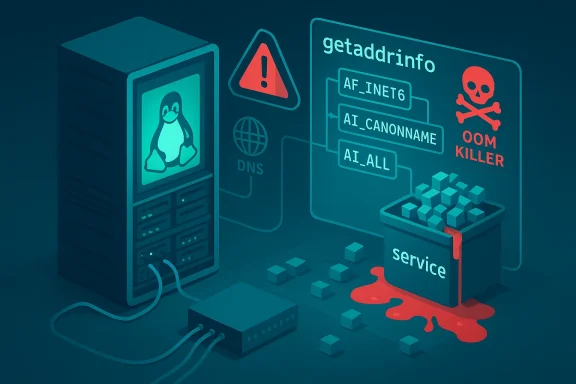
CVE‑2023‑5156 is a classic “fix introduced a new bug” story. A prior fix (CVE‑2023‑4806) addressed a rare use‑after‑free in getaddrinfo(). During that remediation, an error path was left where allocated memory was not freed in all exit paths. Over many repeated invocations this unfreed memory accumulates and can lead to application crashes or process termination by the OOM killer. Multiple vulnerability databases explicitly call out this regression pattern.Code paths and trigger conditions
Implementations differ by distribution and glibc version, but published technical writeups and vendor advisories converge on concrete trigger conditions:- The vulnerable path is in getaddrinfo.c (the name resolution stack implemented in glibc). The leak is reachable when getaddrinfo() is called with certain flag combinations (notably AF_INET6 in conjunction with AI_CANONNAME, AI_ALL and AI_V4MAPPED in some analyses) and when name resolution traverses particular NSS or resolver code paths.
- In practice the exploit scenario is: a client or remote peer causes repeated getaddrinfo() workload to exercise the leaked branch (for example, through repeated requests that cause name resolution or through server‑side handling of crafted inputs). Each invocation leaks a modest amount of heap; repeated invocations eventually exhaust process memory.
- The issue is not a memory corruption or remote code execution vulnerability — confidentiality and integrity are not directly impacted. The principal impact is availability (High). Scoring authorities assigned a high availability impact and a CVSS v3.1 base score of 7.5.
Exploitability and likelihood
- Attack complexity is low: an unauthenticated remote actor can cause repeated calls that exercise the path. No privileges or user interaction are needed in common networked scenarios.
- Despite the low complexity, the EPSS (exploit prediction) scores were low at disclosure time — there were no widespread public exploits documented, and many deployments were patched quickly by mainstream distributions. Still, the risk model for memory‑leak DoS is different: an attacker who can target a specific service repeatedly can induce failure even without sophisticated exploitation.
A verified timeline (concise)
- A use‑after‑free in getaddrinfo() (CVE‑2023‑4806) was reported and patched upstream earlier in September 2023.
- The fix introduced a code path that failed to free allocated memory in all cases; this regression was filed and tracked as CVE‑2023‑5156 and disclosed on or around September 25, 2023.
- Upstream glibc maintainers reverted or corrected the regression; the definitive fix landed in glibc 2.39 and was backported to supported branches where distributions applied security updates.
- Major distributions (Ubuntu, Red Hat, NixOS and others) included patches or advisories; Ubuntu’s USN noted the issue specifically for some releases during the December 2023 glibc security notice.
Which systems were impacted?
- The bug affected glibc releases from 2.34 up to but excluding 2.39, per multiple vulnerability trackers. Many Linux distributions that shipped those versions in 2023 were therefore in scope until vendors released backports or upgrades.
- Vendor treatment varied: Red Hat documented the issue in their advisories and coordinated fixes; some older platform releases required backports. Ubuntu’s security notices identified specific Ubuntu releases where the regression had operational impact and included it among the December 2023 glibc fixes.
- Not every product that bundles glibc is equivalent to “vulnerable in production.” Products that ship their own statically linked copies, containers with older base images, or appliances using older glibc trees could still be affected if they use the vulnerable versions. Vendor attestation language matters: when a vendor (for example, a cloud vendor) says a product includes an upstream component, that statement is scoped to the specific artifact they inspected—it is not a guarantee that no other products include the same vulnerable code. Administrators must therefore check product‑level and distribution‑level advisories, not just the upstream CVE text.
Operational detection and indicators
Detecting this class of bug in production requires attention to performance and memory signals rather than attack signatures.- Look for unexplained, slow memory growth in long‑lived daemons. Memory usage that increases in small steady increments in response to repeated requests is a hallmark of leaks.
- Correlate memory growth with network events. If the growth coincides with a spike of certain request types (for example, requests that cause DNS lookups, or that provoke the server to call getaddrinfo() with particular flags), treat it as suspicious.
- Monitor OOM killer logs and sudden restarts. If a service repeatedly crashes under load without core dumps showing corruption, a resource exhaustion vector like this bug is plausible.
- Use tools:
- heap profilers and memory allocators that expose allocation histograms,
- in‑process diagnostic endpoints (where safe) that report allocations,
- and system metrics (prometheus, datadog, etc.) to set alerts for non‑typical memory growth patterns.
Fixes, patches and practical remediation
The short, unambiguous answer: upgrade or install vendor patches.- Upstream: the library fix was committed and included in glibc 2.39. Distributors shipped backports or updated glibc packages for supported releases.
- Distributors: check and apply the vendor security notices relevant to your operating system. Ubuntu included the problem in its December 2023 glibc security updates for specific releases. Red Hat and other enterprise vendors issued advisories and packages.
- Inventory your fleet for glibc versions. On Linux hosts run: ldd --version or inspect libc package versions using your package manager. Prioritize systems running glibc between 2.34 and 2.38 inclusive.
- Apply vendor patches or upgrade to a glibc version that includes the fix (2.39 or vendor backport). Use your distro’s official repositories or vendor channels; do not substitute untrusted binaries.
- For high‑availability services, stage the patch on test or canary instances first and validate memory behavior under representative load. Don’t rely purely on fingerprint/version — test the specific workload.
- If a patch cannot be applied immediately, consider mitigations:
- Reduce exposure of affected services (rate‑limit requests that trigger name resolution).
- Add local caching to reduce repeated calls to getaddrinfo from identical request patterns.
- Use process recycling or supervisor‑driven restarts as a temporary mitigation to avoid long‑term memory accumulation. These are workarounds, not long‑term solutions.
Hardening and long-term recommendations
- Treat library fixes as code changes with potential for regressions. Implement a patch‑testing pipeline that includes high‑volume, realistic workload tests that can reveal resource‑leak regressions. Small unit tests won’t always find these problems.
- Supply chain hygiene: build an inventory of third‑party components (including base images used to build containers) so you can find and patch all copies of an affected library. Vendor attestations should be read carefully and validated against your own inventory; a vendor may say a product includes an upstream component, but only your internal mapping proves it’s the same artifact and version you run.
- Observe the “patch, test, rollout” cycle: apply upstream fixes into a staging environment, run load and memory stability tests, then slowly roll to production with health checks that validate memory growth remains bounded.
- For cloud and multi‑tenant environments, configure resource limits and guardrails (cgroups, container memory limits, Kubernetes pod eviction policies) so that a leak in one process does not cascade to system‑wide failures.
Real‑world risk: how dangerous was CVE‑2023‑5156?
CVE‑2023‑5156 is a high‑availability risk but not a code‑execution or privilege escalation issue. That nuance matters: attackers cannot use this flaw to pivot or to directly exfiltrate data in the normal sense, but they can degrade or deny service.- Scoring agencies assigned a High severity with a CVSS v3.1 base score of 7.5, driven primarily by availability impact.
- Published exploit activity was limited; EPSS numbers were small, indicating low active exploitation in the wild at the time of disclosure. That said, the nature of the bug (repeatable, network‑triggerable leak) means a low‑effort attacker could achieve persistent denial in poorly defended environments.
- The practical attack model is often a slow‑burn: repeated, low‑bandwidth requests targeted at a single endpoint are more likely to succeed than a bursty, noisy campaign — and that makes detection by simple rate anomaly detectors more difficult. This behavior is why many operators classify memory‑leak DoS as materially dangerous even when public exploit code is scarce.
Case study: what an operator should do this week (concrete checklist)
- Inventory: produce a prioritized host list of systems running glibc 2.34–2.38. Use package queries and image manifests.
- Patch plan: schedule patch windows for critical infrastructure and deploy patched glibc packages from your vendor. Validate with staging.
- Tune detection: add short‑term alerts for unusual memory growth on network‑facing services and track OOM events.
- Apply mitigations where patching is delayed: implement request rate limiting, caching of resolution results, and restart policies for services that exhibit unbounded memory growth under load.
- Post‑patch validation: run stress or soak tests that specifically invoke name resolution workloads in patterns similar to production to ensure memory growth is stable.
Strengths and the hidden risks of the community response
Strengths
- The glibc maintainers and downstream distribution teams responded quickly: upstream fixes and distribution patches were produced and backported in standard channels, which is the correct operational behavior for a critical library.
- Public registries and multiple vulnerability trackers documented the issue clearly and assigned consistent severity, enabling admins to triage based on accurate risk signals.
Risks and caveats
- Regressions are a persistent supply‑chain risk. Patches for one bug can unintentionally create another — CVE‑2023‑5156 is a textbook example. Organizations must assume that any security patch could change behavior and require realistic operational testing.
- Vendor statements that “a product includes this upstream component” are necessary but not sufficient; operators must map those statements to their own deployment artifacts. Misreading vendor attestation can create a false sense of security.
- Memory‑leak DoS attacks are stealthy and slow, and therefore harder to attribute and detect. Standard intrusion detection systems may miss them until an endpoint crashes.
Final thoughts and practical takeaways
CVE‑2023‑5156 was not the most sensational security bug of 2023 — it did not enable remote code execution or credential theft — but it underlined a vital operational truth: fixes to critical libraries must be treated as high‑risk software changes that require thorough testing under representative workloads.For operators and administrators:
- Treat glibc updates as infrastructure events, not routine package churn. Inventory, test and then roll.
- Instrument memory usage and correlate with request patterns to detect slow attacks that leak resources.
- When you hear that a vendor “includes” an upstream library, verify the artifact and version in your own images or appliances — vendor attestations are scoped and may not reflect your actual runtime footprint.
Source: MSRC Security Update Guide - Microsoft Security Response Center
