

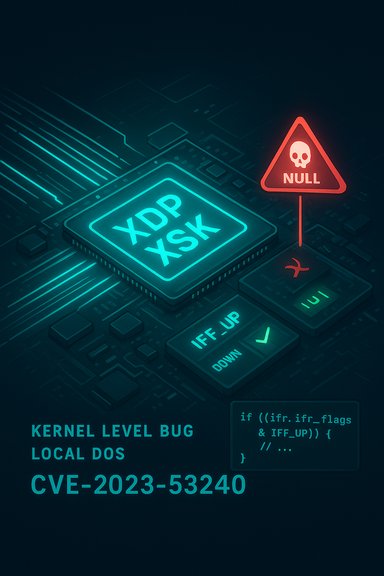
A kernel-level bug in the Linux XDP socket (XSK) transmit path — tracked as CVE-2023-53240 — allows a local, low-privileged actor to trigger a NULL-pointer dereference and crash the kernel; the fix is a targeted rework of the XSK transmit flow that moves an IFF_UP check earlier and consolidates common logic to prevent marking NAPI IDs for interfaces that are down.
The eXpress Data Path (XDP) and its user-space socket API (AF_XDP / XSK) are high-performance networking primitives widely used for packet processing, accelerated forwarding, and network function offload. XSK exposes a socket-like API that bypasses some of the traditional kernel networking paths to deliver low-latency, high-throughput I/O for user-space workloads.
CVE-2023-53240 is not a cryptographic flaw or a user-mode parsing error. It’s a logic bug in the kernel’s XSK transmit routines: under certain sequences, the kernel marks a NAPI (New API) ID — a core construct for high-performance RX/TX processing — on an interface that is not actually up (the kernel’s IFF_UP flag is not yet set). That premature NAPI marking can then lead to code paths that dereference a NULL pointer and panic the kernel, producing a denial-of-service (DoS) condition on the affected host. The condition manifests via either sendmsg or poll system calls that flow into a shared helper, and corrective patches move the IFF_UP test earlier in the transmit path and centralize sanity checks.
For Windows-centered administrators, the practical takeaway is operational: any Linux kernel instances in your estate — VMs, containers, WSL, or embedded appliances — must be inventoried and updated. Even if Windows servers themselves are unaffected, mixed estates mean a Linux kernel panic can still take down services, automation, or monitoring that Windows teams rely on. Patch quickly, validate that the OOPS signature disappears, and restrict untrusted local access until updates are applied.
Source: MSRC Security Update Guide - Microsoft Security Response Center
 Background
The eXpress Data Path (XDP) and its user-space socket API (AF_XDP / XSK) are high-performance networking primitives widely used for packet processing, accelerated forwarding, and network function offload. XSK exposes a socket-like API that bypasses some of the traditional kernel networking paths to deliver low-latency, high-throughput I/O for user-space workloads.CVE-2023-53240 is not a cryptographic flaw or a user-mode parsing error. It’s a logic bug in the kernel’s XSK transmit routines: under certain sequences, the kernel marks a NAPI (New API) ID — a core construct for high-performance RX/TX processing — on an interface that is not actually up (the kernel’s IFF_UP flag is not yet set). That premature NAPI marking can then lead to code paths that dereference a NULL pointer and panic the kernel, producing a denial-of-service (DoS) condition on the affected host. The condition manifests via either sendmsg or poll system calls that flow into a shared helper, and corrective patches move the IFF_UP test earlier in the transmit path and centralize sanity checks.
Technical overview
What goes wrong: sendmsg, poll, and xsk_xmit
The vulnerable code path has two visible user-facing entry points: the sendmsg syscall used to transmit from an AF_XDP socket, and poll which can also trigger outbound processing. Both paths ultimately share a common xsk_xmit helper. The two call sites originally performed different sanity checks, and one of the paths could mark NAPI activity for an interface that was not IFF_UP. That inconsistency allowed the kernel to continue execution in a state where certain structures (or their pointers) were not valid, culminating in a NULL-pointer dereference and an OOPS trace. The publicly posted OOPS trace demonstrates the offending instruction and the stack where xsk_sendmsg and sock_sendmsg appear. A simplified pseudo-code (as reconstructed from public advisories) shows the mismatch:- __xsk_sendmsg:
- if (!xsk_is_bound(xs) return -ENXIO;
- [additional checks]
- may mark NAPI ID
- xsk_poll:
- if (!xsk_is_bound(xs) return mask;
- [additional checks]
- xsk_xmit:
- if (!(xs->dev->flags & IFF_UP) return -ENETDOWN;
- if (!xs->tx) return -ENOBUFS;
Why the change is small but important
Kernel maintainers frequently prefer minimal, surgical changes for logic bugs that cause availability problems: add defensive checks, convert unsafe blocking waits into asynchronous operations, or centralize validation into a small helper. For XSK, the correction is an example of that pattern — it eliminates a timing/state mismatch rather than rewriting large subsystems. While the code change is small, the operational impact of leaving it unfixed is high: a trivial local action can crash a host or container, interrupting services and automated infrastructure. This pattern is common for kernel fixes that prioritize availability and stability.Scope and affected systems
- Affected component: Linux kernel XDP/AF_XDP (XSK) transmit path; the bug is in the kernel networking subsystem rather than in userland libraries.
- Attack vector: local. An attacker must be able to execute code or perform socket operations on the host (for example, an account on the system, a containerized process, or a compromised tenant on a multi-tenant host). The kernel-level crash is not a remote, unauthenticated wormhole in itself.
- Privileges required: low (local user-level process that can open and operate AF_XDP sockets). This makes the bug particularly relevant for shared systems, development hosts with multiple accounts, or misconfigured VMs.
- Realistic exposure: hosts running kernels with XDP/XSK support compiled in and in-use — this includes many modern distributions, embedded appliances that use XDP for fast path forwarding, and cloud images that expose Linux guest kernels to multi-tenant workloads. Vendor kernels and appliance images that lag upstream stable merges are at particular risk because they may not have received the small upstream fix. NIST/NVD and distro trackers list the kernel commits and the stable backports that remediate the problem.
Impact analysis: confidentiality, integrity, availability
- Primary impact: availability. The bug produces a kernel NULL-pointer dereference that typically results in an OOPS or panic and a service outage. The CVSS modeling for the issue reflects this availability-first impact.
- Secondary impact: in theory, a kernel crash could be used as a stepping stone in complex multi-stage attacks to cause failover, disrupt logging/forensics, or create windows for other attacks; however, there is no evidence the bug by itself leads to remote code execution or privilege escalation. Treat availability as the core operational risk.
- Exploitability: no public proof-of-concept (PoC) or active exploitation was observed in public feeds at the time of disclosure, but local DoS primitives are straightforward to weaponize in opportunistic and insider scenarios, especially on shared hosts or misconfigured environments. That absence of a PoC is a mitigative data point, not a guarantee of safety; organizations must prioritize patching accordingly.
What maintainers and operators changed (the patch approach)
Upstream fixes and stable backports for this CVE follow a conservative, low-risk pattern:- Centralize the transmit logic into xsk_xmit and ensure RCU and pointer-state handling are correct.
- Move the IFF_UP (interface up) test earlier in the flow so NAPI IDs are never marked for a downed interface.
- Pull sanity checks into the sendmsg and poll entry paths so neither will mark NAPI unless the socket and device state are consistent.
- Backport the minimal diffs into stable kernels and distribution packages rather than sweeping rewrites.
Detection: what to look for in logs and telemetry
Operational detection should focus on the kernel-side symptomology (availability indicators) rather than a network signature:- dmesg/journalctl -k: look for OOPS traces referencing xsk_sendmsg, xdpsock, xsk_xmit, or explicit "BUG: kernel NULL pointer dereference" messages. The public OOPS in advisories shows the exact pattern produced by the bug.
- Repeated kernel oopses or reboots on hosts that run networking workloads or containerized network functions.
- Unexplained service failures on multi-tenant hosts correlated with user or container socket activity.
- In environments with EDR/host telemetry, hunt for local processes using AF_XDP sockets or tools known to use XDP (e.g., certain dataplane or packet-processing apps) around the time kernel oops messages appear.
Remediation: prioritized mitigation checklist
- Identify exposed systems
- Inventory kernels that include XDP/XSK and hosts that run applications using AF_XDP. Check workload manifests, container images, and kernel config (CONFIG_XDP_SOCKETS) if possible.
- Search images and VMs for modules or processes that reference XDP/XSK.
- Patch promptly
- Apply the vendor-supplied kernel update that lists CVE-2023-53240 as fixed. Use distribution package managers, cloud-image updates, or vendor firmware updates for appliances.
- Test patches in a representative environment before wide rollout; the fix is small and low-risk, but kernel updates require reboots and validation windows.
- For environments that cannot patch immediately
- Restrict untrusted local access: disallow unprivileged users from creating or using AF_XDP sockets where possible, and apply stricter container isolation.
- Limit who can load kernel modules or adjust interface flags (require elevated/controlled operations for interface bring-up).
- Harden multi-tenant hosts: enforce strict tenant isolation and reduce the attack surface of local socket APIs.
- Validate and monitor
- After patching, validate that kernel logs no longer show the specific OOPS traces and that normal AF_XDP workloads function.
- Add alerts for recurrence of the kernel OOPS signature or related stack traces in centralized log collectors.
- If your estate includes Linux VMs, cloud workloads, or edge appliances managed from Windows consoles, ensure these Linux kernels receive the patch. Use asset inventories and cloud provider notices to map CVE→kernel package→image version.
- WSL: Windows Subsystem for Linux uses its own kernel in newer WSL2 implementations; check WSL kernel versions and update where the vendor publishes kernel updates for WSL images. If you rely on non-updated WSL kernels in controlled developer environments, ensure those hosts are not exposed to untrusted local users.
- Containers: redeploy images that rely on host kernels only after the host kernel is patched; container updates alone will not fix a vulnerable host kernel.
Risk management and prioritization
- High priority: multi-tenant hosts, shared developer servers, network appliances performing packet processing, and any environment where local unprivileged code can run AF_XDP code.
- Medium priority: single-user desktops and workstations that are tightly controlled and not used for packet-processing workloads.
- Low priority: systems where XDP/AF_XDP is not built into the kernel and there is no exposure to local users.
Verification and cross-checks
Multiple independent trackers and vendor advisories were consulted to form the above assessment:- The National Vulnerability Database (NVD) entry contains the technical description, the OOPS excerpt, and references to kernel.org stable commits that implement the fix.
- Distribution advisories (Ubuntu, Debian/OSV) and vendor trackers list the vulnerability and map it to distro-specific kernel updates. These pages also reproduce the OOPS trace and the sendmsg/poll/xsk_xmit analysis that explains why the IFF_UP test must be moved earlier.
- Public threat-intel summaries and vulnerability feeds (Feedly, CVE aggregators) summarize exploitability and confirm the availability-first impact model; they also reported no publicly known PoC at the time of disclosure.
Unverified claims & cautionary notes
- There is no publicly confirmed exploitation in the wild or publicly released exploit code at the time of writing; however, local DoS primitives are trivial to exercise in many setups and therefore should not be discounted. This statement is based on the absence of PoC in public feeds, which is not proof of non-existence — treat the lack of a PoC as provisional.
- Some vendor or embedded kernels may have different code paths and additional mitigations; always verify the patch applicability for vendor-forked kernels rather than assuming upstream merges automatically apply. Vendor timelines for backporting stable commits vary.
Practical remediation checklist (one-page quick actions)
- Inventory:
- Find Linux hosts running kernels with AF_XDP/XDP support.
- Identify containers and VMs that use packet-processing tools.
- Patch:
- Apply distro or vendor kernel updates that list CVE-2023-53240 as fixed.
- Reboot hosts per your change-control policy.
- Short-term compensations:
- Restrict local untrusted access and limit who can create AF_XDP sockets.
- Isolate affected hosts from high-value networks until patched.
- Validate:
- Confirm absence of the xsk_sendmsg/null-pointer OOPS in dmesg / journalctl.
- Monitor:
- Add an alert for OOPS traces that include xsk_sendmsg, xdpsock, or xsk_xmit.
Conclusion
CVE-2023-53240 is a classic example of how a small logic inconsistency in kernel networking code — marking a NAPI ID before confirming an interface is actually up — can produce a high-impact availability bug. The public advisories and kernel patch notes show the fix is small in diffs but important in effect: move the IFF_UP check earlier, centralize transmit logic, and avoid marking NAPI for a down interface. This vulnerability has a local attack vector and is best mitigated by straightforward kernel updates from distributions or vendors.For Windows-centered administrators, the practical takeaway is operational: any Linux kernel instances in your estate — VMs, containers, WSL, or embedded appliances — must be inventoried and updated. Even if Windows servers themselves are unaffected, mixed estates mean a Linux kernel panic can still take down services, automation, or monitoring that Windows teams rely on. Patch quickly, validate that the OOPS signature disappears, and restrict untrusted local access until updates are applied.
Source: MSRC Security Update Guide - Microsoft Security Response Center
