

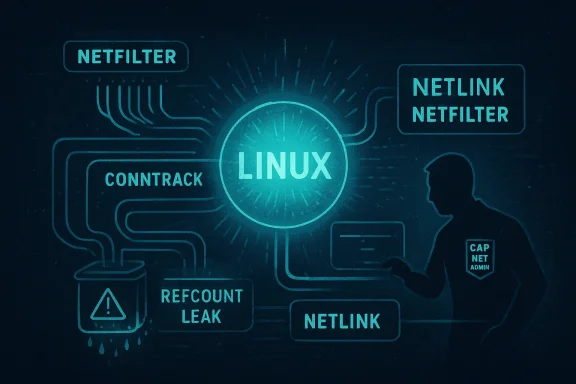
CVE-2023-7192 is a memory-management bug in the Linux kernel’s netfilter conntrack netlink path that can leak references and eventually cause a denial-of-service (DoS) condition; the flaw lives in ctnetlink_create_conntrack (net/netfilter/nf_conntrack_netlink.c) and can be triggered by a local actor holding CAP_NET_ADMIN (or by attackers who escalate to that capability via user‑namespace tricks), and downstream distributions have released fixes—administrators should treat this as an availability‑first risk and patch or mitigate without delay.
The Linux connection tracker (conntrack) is the kernel component that records state for network flows so that NAT, stateful firewalling, and related features can track connections across packets. Netfilter exposes a netlink interface (ctnetlink) that userland tools use to insert, enumerate, and manage conntrack entries. The function ctnetlink_create_conntrack is responsible for handling NETLINK requests that create new conntrack entries. Errors in this path can directly affect kernel resource accounting because conntrack objects are kernel objects managed via reference counts; if the reference‑counting protocol is broken (a “refcount leak”), objects can remain permanently reachable and will never be freed, with cascading resource exhaustion or invariant breakage.
This CVE was published in January 2024 after maintainers and downstream vendors tracked and fixed the problem. The official records and multiple vendor advisories describe the problem as a refcount leak in ctnetlink_create_conntrack leading to potential DoS via refcount overflow. Several distributions (Debian, Ubuntu, Red Hat, SUSE, Amazon Linux) issued security updates; the upstream kernel received a patch; downstream package updates followed.
Acknowledgement: the technical facts in this article are drawn from the Linux kernel commit and multiple vendor advisories and vulnerability trackers; administrators should consult their distribution’s security advisory for the exact package names and fixed versions applicable to their environment.
Source: MSRC Security Update Guide - Microsoft Security Response Center
 Background / Overview
The Linux connection tracker (conntrack) is the kernel component that records state for network flows so that NAT, stateful firewalling, and related features can track connections across packets. Netfilter exposes a netlink interface (ctnetlink) that userland tools use to insert, enumerate, and manage conntrack entries. The function ctnetlink_create_conntrack is responsible for handling NETLINK requests that create new conntrack entries. Errors in this path can directly affect kernel resource accounting because conntrack objects are kernel objects managed via reference counts; if the reference‑counting protocol is broken (a “refcount leak”), objects can remain permanently reachable and will never be freed, with cascading resource exhaustion or invariant breakage.This CVE was published in January 2024 after maintainers and downstream vendors tracked and fixed the problem. The official records and multiple vendor advisories describe the problem as a refcount leak in ctnetlink_create_conntrack leading to potential DoS via refcount overflow. Several distributions (Debian, Ubuntu, Red Hat, SUSE, Amazon Linux) issued security updates; the upstream kernel received a patch; downstream package updates followed.
What exactly is wrong (technical summary)
Short technical takeaway
- The bug is a reference-count imbalance in the conntrack netlink creation path: a code path may increment or acquire a reference on a conntrack object but then fail to drop that reference on certain error/insert‑failure flows.
- Repeated triggering of this path lets a local attacker cause many conntrack objects to accumulate references that never drop, ultimately exhausting kernel resources or causing a refcount to overflow — both of which can cause serious availability problems (hangs, OOMs, panics).
How the leak happens (more detail)
Kernel conntrack objects are tracked with a refcount (usually via helpers in the conntrack code). When creating a conntrack entry via netlink the path:- allocates a new conntrack object,
- populates it,
- attempts to insert it into the conntrack hash table using a function such as nf_conntrack_hash_check_insert(),
- depending on the result, either makes the entry publicly visible or tears it down.
Patch summary and upstream fix
Upstream maintainers committed targeted fixes to the netfilter code to ensure that when nf_conntrack_hash_check_insert() reports a failure the caller properly releases the reference acquired earlier, and to harden the insertion path so that the “make public” transition does not leave a leaked refcount if an insertion error occurs. The fix is narrow (a cleanup in the error path and additional defensive refcount handling), but sufficient to close the specific leak that led to this CVE. Multiple distribution advisories reference the same upstream commit id for the change.Real‑world impact and exploitation model
Who can exploit it
- The direct exploit model is local: the attacker needs the ability to talk to NETLINK_NETFILTER and submit conntrack creation messages. That typically requires CAP_NET_ADMIN (a kernel capability).
- However, many environments (containers, certain unprivileged usernamespace configurations, or privileged helper processes) give local processes that capability either intentionally or by misconfiguration. Ubuntu’s advisory explicitly warns that unprivileged user namespaces can be abused as an escalation vector to gain the needed capabilities in some configurations.
What an attacker can achieve
- The primary impact is availability: repeated exploitation leaks kernel resources, and attackers can cause:
- memory exhaustion leading to OOM or system instability,
- refcount wrap/overflow which may trigger kernel assertions or panics,
- persistent failure modes (for example, blocking removal of the conntrack module or preventing network namespace teardown).
- There is no indication in the public advisories that confidentiality or integrity can be subverted directly by this CVE; however, large availability incidents can create secondary impacts (service outages, loss of observability, escalation windows) that matter operationally.
Exploit complexity and public exploits
- The exploit complexity is low in the sense that once an attacker has CAP_NET_ADMIN they can repeatedly invoke the vulnerable code path. Writing a PoC that crafts incomplete or specific netlink messages is straightforward for an experienced kernel/network programmer; several writeups and PoC sketches appeared in public vulnerability writeups.
- There were no authoritative reports of wide‑scale public exploitation in the wild at disclosure, and EPSS/KEV listings indicate low real‑world exploit prevalence; nevertheless, the availability impact means defenders must treat the bug seriously.
Who should worry most
- Systems that allow untrusted local code to obtain CAP_NET_ADMIN, including:
- poorly configured containers or container runtimes that grant NET_ADMIN,
- shared hosting environments where container escapes or misconfigured capabilities are possible,
- developer workstations and CI machines with permissive user namespaces,
- embedded or appliance devices that lag kernel updates (network appliances, IoT gateways) and expose netfilter features.
- Any infrastructure that relies on kernel stability (routers, NAT boxes, firewall appliances, cloud VMs) should prioritize fixes because the attack directly targets network‑state code.
Detection and hunting guidance
Short, pragmatic checks to detect either exploitation attempts or symptomatic problems:- Monitor kernel logs (dmesg/syslog) for repeated WARN or BUG traces referencing conntrack, nf_conntrack, or ctnetlink. A stray trace following mass conntrack activity can be an early sign.
- Watch for sustained increases in conntrack table size or a conntrack entry count that never drops after attempted removals.
- Alert on abnormal memory growth or persistent kworker threads spinning inside conntrack cleanup paths (this pattern has been observed when leaked objects prevent netns teardown).
- Instrument processes and containers for use of CAP_NET_ADMIN and audit NETLINK_NETFILTER usage via auditd or eBPF tracing to spot scripts or tools that make repeated NETLINK requests.
- If you use centralized telemetry, create a rule to flag sustained increases in nf_conntrack count or repeated netlink message bursts coming from untrusted containers.
- Check kernel version:
- uname -r
- Inspect conntrack table counts (if conntrack-tools is installed):
- conntrack -L | wc -l
- Audit NET_ADMIN capabilities in running containers:
- For Docker: docker ps + docker inspect on suspicious containers to see CapAdd fields.
- Check kernel logs for conntrack warnings:
- dmesg | egrep -i 'conntrack|ctnetlink|nf_conntrack|nfnetlink'
Mitigation and remediation (practical steps)
The only reliable remediation is to install upstream or vendor‑supplied kernel updates. Vendors have shipped fixes across major distributions; you should apply vendor advisories appropriate to your platform. For immediate hardening where patching is delayed, apply these mitigations:- Patch first
- Apply kernel packages from your distribution’s security channel that include the conntrack netlink fix. The NVD and distro trackers list fixed package versions; check and deploy them.
- Reduce attack surface and capabilities
- Remove CAP_NET_ADMIN from untrusted processes and containers.
- Avoid running netlink‑capable code in contexts that are reachable by untrusted users.
- If possible, run containers without NET_ADMIN and use fine‑grained networking capabilities (CNI policies, network policies) rather than broad kernel capabilities.
- Disable unprivileged user namespaces (temporary mitigation)
- In environments where unprivileged user namespaces can be used to escalate, temporarily disable them (Ubuntu documents a sysctl toggle). Example:
- sudo sysctl -w kernel.unprivileged_userns_clone=0
- Persist with: echo kernel.unprivileged_userns_clone=0 | sudo tee /etc/sysctl.d/99-disable-unpriv-userns.conf
- This reduces attack vectors but may break workflows that legitimately rely on unprivileged user namespaces; evaluate impact before applying cluster‑wide.
- Constrain netlink interactions
- Use seccomp or eBPF sandboxing to restrict or filter NETLINK_NETFILTER operations from untrusted processes where possible.
- Consider using userland proxies or controlled APIs for conntrack management rather than allowing arbitrary processes direct netlink access.
- Monitor and alert
- Add alarms for abrupt or sustained increases in conntrack entries, leaked memory footprints, or repeated netlink traffic spikes.
Short checklist for sysadmins (ordered)
- Identify affected hosts (uname -r and distro package checks).
- Patch kernels using vendor security updates as soon as possible.
- Temporarily disable unprivileged user namespaces if you cannot patch quickly.
- Remove CAP_NET_ADMIN from containers and untrusted processes.
- Add monitoring for conntrack counts and netlink activity.
- Reboot hosts where real leaks or stuck state are observed after patching, to return to a clean baseline.
- Review access policies to avoid reintroducing the capability exposure (CI runners, developer VMs).
Why this class of bug keeps recurring (analysis)
- Reference‑counting is fragile. Kernel code often moves ownership of objects between contexts; a small missed put or the wrong ordering during error cleanup causes a leak. Conntrack is a particularly delicate area because entries cross CPU and namespace boundaries and are touched during insert, confirmation, and destruction.
- Netlink paths are complex. The netlink interface takes structured attributes and can fail at many points; every failure path must undo prior actions exactly. That surface multiplies the chances an edge case is missed.
- Container/namespace models increase risk. Modern cloud and container environments expose new privilege boundaries that, if misconfigured, let non‑privileged users exercise operations historically reserved for admins.
- Upstream patches are usually small but nontrivial to reason about. The fix here is surgical: ensure put calls happen and harden the insertion semantics. Surgical fixes carry low risk but require careful review and distribution—which can be slow across embedded and vendor kernels.
Strengths of the response, and remaining risks
Strengths
- The upstream fix is targeted; vendors quickly produced packages for mainstream distributions. That means the operational fix is straightforward: upgrade kernel packages.
- The vulnerability’s exploit requires local capability (CAP_NET_ADMIN), so pure remote exploitation without any local foothold is unlikely in typical server setups. This reduces the immediate risk surface for externally facing servers that do not allow untrusted local execution.
Remaining risks and caveats
- Many containerized workloads routinely grant NET_ADMIN for legitimate reasons (advanced networking, host‑level tooling). Those setups remain at risk until administrators remove the capability or patch kernels.
- Embedded and appliance devices often run older kernels and are slow to receive updates; these devices may never be patched, leaving them vulnerable for long periods.
- The bug class (refcount leaks) has appeared in several related netfilter dump/expectation paths in later kernel commits (the pattern of double‑increment and leak was seen again in other ctnetlink dumper fixes), which suggests similar weaknesses may appear in other code paths and additional CVEs could follow if not audited comprehensively. Administrators should not assume that fixing this CVE eliminates all refcount issues in conntrack code.
Practical timeline and vendor guidance (what vendors have done)
- Upstream kernel maintainers committed fixes and referenced the insertion‑error cleanup; the change was picked into the kernel trees and subsequent stable releases. Distribution vendors (Red Hat, Ubuntu, Debian, SUSE, Amazon Linux) produced advisories and backported patches to their supported kernels. Administrators should consult their distribution advisory channel and apply the specific advisory that matches their kernel series.
- If you run vendor kernels (RHEL, Ubuntu LTS, SUSE), prefer vendor packages rather than compiling your own upstream kernel unless you are prepared to track and test backports yourself.
Takeaway and final recommendation
CVE-2023-7192 is a kernel‑level availability vulnerability caused by a refcount leak in the conntrack netlink creation path. The direct exploit requires local NET_ADMIN capability, but container and user‑namespace misconfiguration can widen that surface. The fix is available upstream and has been rolled into vendor advisories; the correct operational response is:- Immediately inventory your fleet for vulnerable kernels,
- Apply vendor kernel updates or backports as soon as they are validated in your environment,
- Remove or restrict CAP_NET_ADMIN and NETLINK_NETFILTER access from untrusted processes and containers,
- If you cannot patch immediately, consider temporary mitigations such as disabling unprivileged user namespaces and implementing netlink/namespace access controls,
- Add monitoring to detect abnormal conntrack growth and kernel warnings.
Acknowledgement: the technical facts in this article are drawn from the Linux kernel commit and multiple vendor advisories and vulnerability trackers; administrators should consult their distribution’s security advisory for the exact package names and fixed versions applicable to their environment.
Source: MSRC Security Update Guide - Microsoft Security Response Center
