

The curl/libcurl vulnerability tracked as CVE-2024-2466 is a practical reminder that a vendor attestation — “Azure Linux includes this open‑source library and is therefore potentially affected” — is an important, but scoped, inventory statement, not a categorical guarantee that other Microsoft products do or do not include the same vulnerable code. Microsoft has confirmed Azure Linux as a known carrier; however, whether other Microsoft artifacts also ship libcurl built against mbedTLS depends on per‑artifact build choices and inventory work that Microsoft continues to perform. (curl.se)
CVE-2024-2466 is a medium‑severity flaw in libcurl that causes certificate verification to be skipped for TLS connections when the target is specified as an IP address and libcurl was built to use the mbedTLS backend. In short: if an application uses a vulnerable libcurl build with mbedTLS and connects to an IP address over TLS, the normal hostname‑to‑certificate validation step can be bypassed, opening the door to man‑in‑the‑middle (MitM) attacks against affected stacks. The curl security advisory and vulnerability metadata provide the technical summary, affected versions, and the upstream fix.
Two practical facts reduce (but do not eliminate) the real‑world attack surface for this bug. First, the problem is only present when libcurl is built against the mbedTLS backend — many libcurl builds use other TLS stacks. Second, many TLS connections to raw IP addresses are rare in production; SNI and hostname usage mean servers are typically addressed by name. Still, the vulnerability is real and has been fixed upstream; the recommended remediation is to upgrade libcurl/curl to a patched release or rebuild with a non‑affected TLS backend.
Why this matters: a VEX/CSAF attestation is an automation‑friendly way for a vendor to say “we checked this product and here is its status.” It is excellent for reducing noise and helping customers prioritize response. But it only covers the named artifact(s). Microsoft started its phased rollout of VEX attestations with Azure Linux; by design, the initial scope is limited and will expand as inventories for other products finish. Until Microsoft updates a given CVE entry to list more products, absence of an attestation is not proof of absence.
Concretely, the types of Microsoft artifacts you should consider and consult your own inventories for include:
However, that same wording is not a global safety net. The attestation is scoped to the specific product Microsoft inspected; it is not an exclusivity guarantee. Because libcurl’s exposure to CVE‑2024‑2466 depends on build‑time choices — specifically whether mbedTLS was selected as the TLS backend — Microsoft’s attestation for Azure Linux does not automatically clear other Microsoft artifacts that may ship separate builds or third‑party images through Microsoft channels. In short: Azure Linux = attested in‑scope; other Microsoft artifacts = verify locally or wait for further attestations.
Operationally, the right posture for defensive teams is straightforward and practical: accept Microsoft’s Azure Linux attestation as authoritative for that product, but don’t treat the lack of attestations for other Microsoft artifacts as proof of safety. Run the checks described above, prioritize patching where vulnerable libcurl/mbedTLS is present, and implement compensating controls where immediate fixes are impractical. In doing so, you align your response with both the technical reality of the bug and the operational reality of how vendors publish scoped inventory attestations.
CVE-2024-2466 is fixable and already patched upstream — but its real risk in any environment is an artifact‑by‑artifact question: which binary did you ship, which TLS backend was chosen at build time, and which images or packages are in active use? Microsoft’s Azure Linux attestation is helpful; use it. Then do the local verification steps to make it complete.
Source: MSRC Security Update Guide - Microsoft Security Response Center
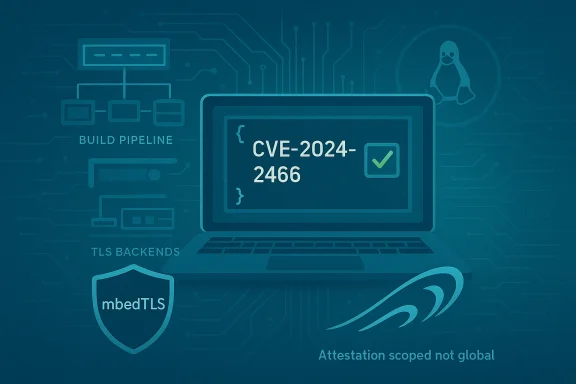 Background / Overview
CVE-2024-2466 is a medium‑severity flaw in libcurl that causes certificate verification to be skipped for TLS connections when the target is specified as an IP address and libcurl was built to use the mbedTLS backend. In short: if an application uses a vulnerable libcurl build with mbedTLS and connects to an IP address over TLS, the normal hostname‑to‑certificate validation step can be bypassed, opening the door to man‑in‑the‑middle (MitM) attacks against affected stacks. The curl security advisory and vulnerability metadata provide the technical summary, affected versions, and the upstream fix.Two practical facts reduce (but do not eliminate) the real‑world attack surface for this bug. First, the problem is only present when libcurl is built against the mbedTLS backend — many libcurl builds use other TLS stacks. Second, many TLS connections to raw IP addresses are rare in production; SNI and hostname usage mean servers are typically addressed by name. Still, the vulnerability is real and has been fixed upstream; the recommended remediation is to upgrade libcurl/curl to a patched release or rebuild with a non‑affected TLS backend.
What Microsoft actually said — and what that wording means
Microsoft’s Security Response Center (MSRC) entry for this and similar third‑party CVEs has followed a consistent pattern: the entry names Azure Linux (Microsoft’s own distro) as a product that “includes this open‑source library and is therefore potentially affected,” and the page reassures customers that Microsoft will publish machine‑readable VEX/CSAF attestations and update the CVE mapping if additional Microsoft products are found to include the affected component. That wording is deliberate: it is an inventory attestation for the product(s) Microsoft has checked so far, not a global statement that no other include the same upstream component.Why this matters: a VEX/CSAF attestation is an automation‑friendly way for a vendor to say “we checked this product and here is its status.” It is excellent for reducing noise and helping customers prioritize response. But it only covers the named artifact(s). Microsoft started its phased rollout of VEX attestations with Azure Linux; by design, the initial scope is limited and will expand as inventories for other products finish. Until Microsoft updates a given CVE entry to list more products, absence of an attestation is not proof of absence.
The technical context: libcurl, TLS backends and why “which build” matters
To understand which Microsoft products might be exposed, you must separate the source code issue (libcurl contains code paths that, when paired with mbedTLS in certain configurations, skip hostname checks for IP targets) from the binary or artifact question (which Microsoft deliverables actually include a libcurl binary that was compiled against mbedTLS).- libcurl is a multi‑backend client stack: it supports many TLS providers — OpenSSL, LibreSSL, GnuTLS, wolfSSL, mbedTLS, Schannel (Windows native), Secure Transport (macOS), rustls, and others. The TLS backend used is a compile‑time/build‑time choice. If libcurl is compiled against mbedTLS, CVE-2024-2466 is relevant to that binary; if the same libcurl is compiled against Schannel, OpenSSL, or another backend, the specific mbedTLS issue will not apply.
- On Windows, Microsoft’s shipped curl builds historically use native Windows TLS (Schannel) or other backends rather than mbedTLS. That makes the Windows‑shipped curl generally not vulnerable to this particular mbedTLS‑specific issue, because the affected behavior depends on the mbedTLS backend implementation. Curl project documentation and Windows curl build notes show that Schannel is a common Windows backend choice, and Microsoft’s own guidance for some curl/CVE triage has identified Windows‑shipped curl as not built against mbedTLS in similar vulnerability assessments. Nevertheless, custom Windows builds or third‑party Windows packages could be different, so you must check the actual binary.
- On Linux and embedded systems, maintainers choose the TLS backend when packaging. Alpine Linux and some lightweight container images commonly use mbedTLS because of its small footprint; many other distributions use OpenSSL or the distribution’s preferred TLS implementation. That means Linux‑based Microsoft artifacts that include a packaged curl or libcurl could, in principle, carry a vulnerable mbedTLS‑linked build — but whether they do depends on the given image and packaging choices. Practical examples in the broader ecosystem (Alpine, container images, distros) show how widely variant choices can be.
Is Azure Linux the only Microsoft product that includes mbedTLS and is therefore potentially affected?
Short answer: No — not necessarily. Azure Linux is the only Microsoft product Microsoft has publicly attested so far to include the implicated open‑source component for the CVE in question, and that attestation is authoritative for that product. Howevs limited by scope and sampling: it reflects the inventory work Microsoft has completed to date. Other Microsoft artifacts — depending on how they are built and which upstream packages were included — may also include libcurl linked against mbedTLS and therefore be potentially affected until Microsoft either attests them as not affected or publishes fixes. Treat the Azure Linux attestation as a confirmed “yes” and other Microsoft artifacts as “unknown” until verified.Concretely, the types of Microsoft artifacts you should consider and consult your own inventories for include:
- Azure Linux images and packages (attested by Microsoft).
- Custom Azure Marketplace VM images and partner images published through Microsoft channels (build choices vary).
- Azure Kubernetes Service (AKS) node images or container host images that reference or include libcurl packages compiled with mbedTLS; these are separate artifacts from the core Azure Linux distribution and must be checked individually.
- Appliance‑style kernels and userland images Microsoft maintains for specific managed services (they may include packaged userland like curl).
- Windows Subsystem for Linux (WSL) images and kernel artifacts: WSL userland typically comes from a distro image; if that distro image contains a vulnerable libcurl build, the WSL instance could be affected. The WSL kernel or Windows host per se is a separate consideration (WSL userland vs Windows binary).
How to verify whether a Microsoft artifact you run is affected
Administrators and security operators should assume “potentially affected” for Azure Linux instances that match Microsoft’s attestation and should also perform targeted checks on other Microsoft‑delivered artifacts they run. Practical detection steps:- Inventory the artifacts you run that may include libcurl (containers, VM images, appliance binaries, management agents, OS images). Prioritize artifacts that run network clients or perform inbound TLS to remote IPs.
- Inspect the curl/libcurl binary and determine the TLS backend and version. On a running system you can often run curl --version or ldd/nm on the libcurl binary to see the linked TLS provider:
- Example: curl --version will list the SSL backend in its features line.
- For packages, query the package manifest (apk, apt, rpm) to find which curl package/version is installed.
- If the curl/libcurl you use is in the vulnerable version range and is built against mbedTLS, upgrade to a patched curl/libcurl release (upstream fixes were introduced and later releases remove the bug), or rebuild libcurl linking to a different TLS backend. The upstream advisory recommends upgrading to the fixed release; many downstream distro vendors have published patches.
- If you cannot immediately upgrade, apply compensating controls: avoid pointing clients at raw IP addresses over TLS, or enforce application‑level hostname validation (if possible), and restrict where clients may connect to reduce exposure. These are stopgaps, not replacements for patching.
Mitigation and remediation — prioritized actions
- For Azure Linux customers: follow Microsoft’s Azure Linux advisories and VEX/CSAF updates. Microsoft has committed to publishing machine‑readable attestations and to update CVEs when more Microsoft artifacts are identified as affected; treat the Azure Linux attestation as authoritative for Azure Linux images. Patch Azure Linux images when Microsoft publishes fixed packages for the distro.
- For other Microsoft artifacts under your control: perform the verification steps above. If you discover a Microsoft‑provided image or appliance in your estate that includes libcurl linked against mbedTLS in the vulnerable range, treat it as in scope for patching/rebuild. If the artifact is supplied as a managed service, contact the service owner or Microsoft support and ask for the product‑scoped attestation or remediation timeline.
- For Windows desktops/servers: Microsoft’s shipped curl builds typically use Schannel (the platform’s native TLS). That means, for the common case of Windows‑shipped curl, this particular mbedTLS issue should not apply; nevertheless check your environment — custom builds, third‑party packages, or developer toolchains shipped onto Windows can differ. Use curl --version and your software inventory to confirm.
- For containerized workloads: container images often inherit the curl/libcurl packaging decisions of their base image. Alpine and other minimal images are more likely to use mbedTLS or other lightweight stacks; check base image vulnerabilities and rebuild images with patched curl/libcurl packages or switch TLS backend as appropriate. Many container security scanners already flag CVE-2024-2466 in images that contain affected curl builds.
The supply‑chain angle: why vendor attestations help — but also why they are not a substitute for local verification
Microsoft’s rollout of CSAF/VEX for Azure Linux is a meaningful step: machine‑readable attestations let customers automate triage and prioritize patching for products Microsoft has checked and declared “Known Affected,” “Fixed,” or “Not Affected.” That clarity is very useful, and Microsoft’s public commitment to expand VEX coverage is the right operational approach. However:- VEX/CSAF attestation is only as comprehensive as the inventory work that produced it. Microsoft’s initial VEX population focused on Azure Linux; other products require separate inventory and mapping work. Until an artifact is listed in Microsoft’s VEX/CSAF output, customers should treat it as unverified and perform local checks if the artifact is used in their environment.
- Binary builds, vendor forks, and packaging differences make it possible for two artifacts with the “same” upstream source to have different risk profiles. An In‑House or partner image may include a backported version of libcurl, a different TLS backend, or additional patches that alter exposure. Only an artifact‑level inspection or vendor attestation can settle the question definitively. The practical implication: don’t rely on absence of a vendor attestation as proof of safety.
What to watch for next — practical signals and timelines
- Microsoft updates to the CVE/VEX mapping: Microsoft has pledged to publish and expand CSAF/VEX attestations starting with Azure Linux and to update CVE entries when additional products are identified as carriers. Watch MSRC VEX/CSAF feeds and your vendor security channels for product‑scoped attestation changes tied to CVE‑2024‑2466.
- Distribution and container vendor updates: Alpine, major Linux distributions, and container image maintainers will continue to release patched curl/libcurl packages; those updates will propagate into images and packages you consume. Use your usual patching pipelines and container rebuild processes to ensure patched artifacts reach production.
- Evidence of exploitation or PoC code: as of the most recent advisories and vulnerability trackers, there was no widespread public exploit for CVE‑2024‑2466. That can change; keep threat feeds and vulnerability management tooling current.
Practical checklist for security teams (short, actionable)
- Confirm whether you run Azure Linux images; if yes, prioritize patching/updates per Microsoft’s advisory and the distro’s package feeds.
- Inventory where curl/libcurl is deployed (VMs, containers, management agents, appliances). Use package managers and image manifests to find versions.
- Run curl --version (or equivalent) on suspect hosts to learn the TLS backend and version. If the TLS backend is mbedTLS and curl/libcurl version falls within the affected range, prioritize remediation.
- Where immediate patching is not possible, implement mitigation controls: avoid TLS connections to raw IP addresses, lock down client networking where feasible, and add application‑level hostname checks where the application allows it.
- Subscribe to Microsoft’s CSAF/VEX feed and your distro/vendor advisories for authoritative attestations and patch availability.
Final assessment — strengths, limits, and risk posture
Microsoft’s public attestation that Azure Linux includes the relevant open‑source component is a strength: it gives Azure Linux customers a clear, machine‑readable signal to drive remediation. Publishing CSAF/VEX data improves automation, reduces ambiguity, and demonstrates a practical vendor commitment to supply‑chain transparency. For organizations that run Azure Linux, this is actionable and reduces the time to patch.However, that same wording is not a global safety net. The attestation is scoped to the specific product Microsoft inspected; it is not an exclusivity guarantee. Because libcurl’s exposure to CVE‑2024‑2466 depends on build‑time choices — specifically whether mbedTLS was selected as the TLS backend — Microsoft’s attestation for Azure Linux does not automatically clear other Microsoft artifacts that may ship separate builds or third‑party images through Microsoft channels. In short: Azure Linux = attested in‑scope; other Microsoft artifacts = verify locally or wait for further attestations.
Operationally, the right posture for defensive teams is straightforward and practical: accept Microsoft’s Azure Linux attestation as authoritative for that product, but don’t treat the lack of attestations for other Microsoft artifacts as proof of safety. Run the checks described above, prioritize patching where vulnerable libcurl/mbedTLS is present, and implement compensating controls where immediate fixes are impractical. In doing so, you align your response with both the technical reality of the bug and the operational reality of how vendors publish scoped inventory attestations.
CVE-2024-2466 is fixable and already patched upstream — but its real risk in any environment is an artifact‑by‑artifact question: which binary did you ship, which TLS backend was chosen at build time, and which images or packages are in active use? Microsoft’s Azure Linux attestation is helpful; use it. Then do the local verification steps to make it complete.
Source: MSRC Security Update Guide - Microsoft Security Response Center
