

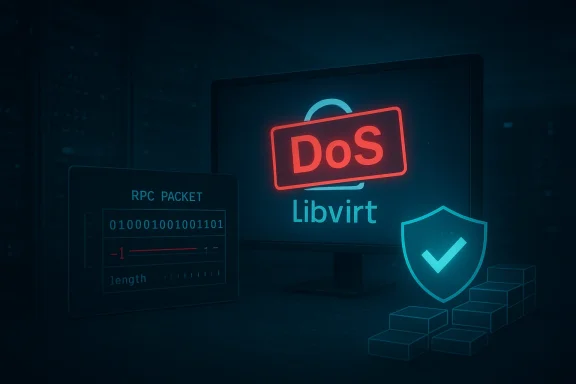
The discovery of CVE-2024-2494 exposed a simple but dangerous class of bug inside libvirt’s RPC deserialization: a negative array length read from an attacker-controlled RPC message can be passed to GLib’s g_new0 allocator and — because the negative value is interpreted as a very large unsigned size — trigger an unbounded allocation that crashes the libvirt daemon and causes a denial‑of‑service of virtualization management. This is not a remote code‑execution hole; it is an availability risk with real operational consequences where an unprivileged local actor who can speak to the libvirt RPC interface can repeatedly crash or exhaust the libvirt process, interrupting VM management and, in many setups, broad virtualization availability. (lists.libvirt.org)
Libvirt is the widely used virtualization management layer that provides APIs and a daemon (commonly libvirtd) for controlling hypervisors such as QEMU/KVM, Xen, and others. Because libvirt mediates lifecycle operations — creating, pausing, stopping, snapshotting, and querying guests — stability of the libvirt daemon is essential to day‑to‑day operations in development, on-premises virtualization, and cloud hosting environments. A crash or persistent unavailability of libvirt does not generally corrupt guest state, but it can prevent operators and automated systems from managing virtual machines, creating significant operational disruption.
CVE-2024-2494 was disclosed and patched in March–April 2024 after researchers from the ALT Linux team, using AFLplusplus, identified the problematic deserialization pattern in the RPC server code. The upstream patch — landed and discussed publicly on the libvirt development list — adds explicit checks for negative length/count fields before any g_new0 allocations occur and adjusts the RPC code-generator so server stubs validate list lengths earlier. The upward flow of the fix was quickly picked up by distributors and packaged security updates followed in Debian, Ubuntu and other distributions. (lists.libvirt.org)
Conclusion: patch quickly, audit your socket access controls, and treat deserialization logic as a first‑class attack surface in virtualization stacks — the fix is straightforward, but the availability consequences for delayed remediation can be severe.
Source: MSRC Security Update Guide - Microsoft Security Response Center
 Background / Overview
Libvirt is the widely used virtualization management layer that provides APIs and a daemon (commonly libvirtd) for controlling hypervisors such as QEMU/KVM, Xen, and others. Because libvirt mediates lifecycle operations — creating, pausing, stopping, snapshotting, and querying guests — stability of the libvirt daemon is essential to day‑to‑day operations in development, on-premises virtualization, and cloud hosting environments. A crash or persistent unavailability of libvirt does not generally corrupt guest state, but it can prevent operators and automated systems from managing virtual machines, creating significant operational disruption.CVE-2024-2494 was disclosed and patched in March–April 2024 after researchers from the ALT Linux team, using AFLplusplus, identified the problematic deserialization pattern in the RPC server code. The upstream patch — landed and discussed publicly on the libvirt development list — adds explicit checks for negative length/count fields before any g_new0 allocations occur and adjusts the RPC code-generator so server stubs validate list lengths earlier. The upward flow of the fix was quickly picked up by distributors and packaged security updates followed in Debian, Ubuntu and other distributions. (lists.libvirt.org)
What the bug is — a technical breakdown
The root cause in plain terms
The bug is an allocation‑time integer semantics issue:- The RPC deserializer reads an integer field from the incoming RPC message that represents the number of elements to allocate for a list or array.
- The code then calls GLib’s g_new0(type, n) to allocate space for n elements before the code performs the defensive, non‑negative checks that the public C API entry points later execute.
- If an attacker supplies a negative value for n, that signed integer is interpreted by the allocator as a very large unsigned value (integer underflow/wraparound), leading to an attempt to allocate an enormous buffer.
- That allocation typically fails or otherwise destabilizes the process — causing a crash or sustained resource exhaustion — which results in loss of availability for libvirt and anything that depends on it. (lists.libvirt.org)
Where it occurs in libvirt
The problem lives in the RPC server paths — the code that turns on‑the‑wire RPC data into in‑process parameters and then invokes the libvirt C API. The C API itself has non‑negative checks for many of these list/length parameters, but the deserialization step performs allocations before those checks execute. The upstream patch inserted explicit negative‑length checks in a large set of remote dispatch functions (for example: Domain block stats, vcpu pin info, memory parameters, vcpus, node memory stats, interface parameters and many others), plus a change in the RPC code generator to automatically reject negative list lengths at stub generation time. The patch was authored and committed by libvirt maintainers and credited the ALT Linux finders. (lists.libvirt.org)How bad is this? Threat model and impact
Who can exploit it
- The vulnerability is local in the classic CVE sense: it requires the ability to contact the libvirt UNIX socket or otherwise talk to the libvirt daemon’s RPC interface. In most systems that means a local user account that can reach the socket, or an untrusted local process that has been granted that access through misconfiguration. It is not a remote network‑exposed wormable flaw by default.
What an attacker achieves
- Denial of Service (availability loss): By sending a carefully crafted RPC message containing negative length/count fields, an attacker can cause libvirt to attempt an impossible allocation and crash, or to be pushed into an OOM condition that exhausts memory and prevents the daemon from servicing further requests. Multiple repeated attempts can make the condition sustained. This interrupts VM management, prevents new VM lifecycle operations, and can impede orchestration systems that rely on libvirt’s availability.
- No direct confidentiality or integrity impact documented: Public advisories and the upstream discussion classify the issue strictly as an availability/DoS risk — there’s no confirmed ability to escalate to remote code execution or data exfiltration arising from this specific bug, although unbounded allocations sometimes escalate to memory corruption in other contexts — that did not appear in the disclosures for this CVE.
Why this matters to cloud and multi‑tenant environments
In environments where many users or tenants share host systems — such as managed KVM clouds or multi‑user lab servers — the ability for a single low‑privileged user to crash the host’s libvirt daemon effectively removes management control for all other tenants. Even if guests keep running at the hypervisor level, operational control, monitoring, and automated remediation are severely impaired until libvirt is restored. Multiple advisories explicitly call out the real-world operational severity of such availability failures.Timeline and vendor response
- Discovery and initial upstream patching: The issue was found and diagnosed by the ALT Linux Team using AFLplusplus; the upstream patch was discussed and posted to the libvirt development mailing list on 21 March 2024. The patch adds negative‑length checks in numerous remote dispatch functions and updates the RPC stub generator to enforce non‑negative list lengths earlier. (lists.libvirt.org)
- Distributor backports and advisories: Within weeks distributors began shipping updates. Debian, Ubuntu and other vendors released security packages and patches; Ubuntu’s security tracker shows fixes published against affected releases (with specific package version updates noted in distribution advisories). The OSV index and several vendor trackers list the CVE and link it to vendor errata.
- Public tracking and aggregator notices: NVD, Debian security tracker and multiple security databases recorded the CVE and classified it as a local, medium‑severity availability issue (CVSS 3.x consensus around 6.2 in several trackers). Several security databases and vendor advisories reference the same upstream commit and the same remediation sequence.
The patch — what changed
Upstream fixes took two complementary approaches:- Code‑level checks in dispatch handlers: The remote dispatch handlers that parsed RPC parameters now validate that length and count fields are non‑negative before performing any g_new0/g_new allocations. In many functions this is a small precondition check that returns an RPC error and aborts processing when a negative or otherwise invalid length is present. This prevents the allocator from ever seeing a value that would underflow into a huge unsigned size. (lists.libvirt.org)
- Code‑generator stub adjustment: The RPC code generator (gendispatch.pl) was changed so the generated server stubs include a non‑negative check for list‑max variables in server mode. That means future RPC operations generated from the protocol description will have the check automatically, removing the reliance on manual insertion in each handler. (lists.libvirt.org)
Recommended mitigation and operational steps
If you manage systems that run libvirt (libvirtd), treat this as a priority availability patch. The practical steps to reduce exposure and recover quickly are:- Apply vendor patches immediately: Update the libvirt packages from your distribution’s official security repositories and reboot or restart the libvirt daemon where required. Confirm the package version matches your vendor’s advisory for the CVE. Ubuntu’s security tracker and Debian changelogs list fixed package versions for affected release lines.
- Restrict local access to the libvirt socket: Ensure UNIX socket permissions and ACLs only permit trusted administrator accounts and orchestrator users to access libvirt. If you must allow non‑admin users to manage guests, consider limiting those capabilities or using targeted privilege separation. This is a risk‑reduction measure while patching is scheduled.
- Apply containment policies: Use mandatory access control (SELinux, AppArmor) profiles to reduce the blast radius of a crashed daemon or malicious client. Ensure orchestration agents that manage libvirt can be tightly scoped.
- Add process supervision and restart controls: Running libvirt under a process supervisor that can automatically restart the daemon reduces downtime; however, automated restart is not a substitute for patching — repeated crashes may cause further host instability if the underlying resource exhaustion is not remediated.
- Monitor for indicators of exploitation: Watch for repeated libvirtd crashes in system logs, OOM killer events referencing libvirt, or unexpectedly large allocation attempts and memory spikes tied to libvirt processes. Correlate with local user activity and socket connections. (See Detection section below.)
- Where quick patching is not possible, apply access controls or temporary network restrictions for remote management interfaces to limit which hosts/users can talk to libvirt. Remember that many cloud management frameworks and orchestrators depend on libvirt, so such restrictions can have operational impact and should be planned.
Detection and forensics guidance
If you suspect the CVE has been exploited or that someone attempted an attack:- Check libvirt logs (journal/system log and libvirt‑specific logging) for process crashes, stack traces, or "malloc"/"out of memory" style messages tied to the libvirt daemon.
- Inspect kernel OOM killer logs for repeated kills of libvirtd or high memory allocations shortly before a crash.
- Audit who connected to the libvirt socket around the time of a crash. Auditd or socket access logs (if enabled) can show which UID/PID had an open connection.
- Correlate with user activity and running processes: a local user invoking specialized clients or custom scripts may be sending malformed RPCs.
- Preserve relevant logs and core dumps for triage; if you need to reproduce the crash for debugging, do so only in an isolated test environment and not on production systems.
Risk assessment: short and medium term
- Short term: Systems that remain unpatched and expose the libvirt socket to untrusted users are at moderate risk of local denial‑of‑service. The exploit complexity is low: an attacker who can craft RPC messages and has local socket access can trigger the crash. Several distributors rated the CVE medium with CVSS around 6.2 reflecting the purely local but reliable availability impact.
- Medium term: Once patched, risk drops sharply. The upstream fix and vendor backports are straightforward (defensive checks and generator updates). The vulnerability class — allocation before validation — is well understood, and the fix is mechanical and easy to audit. Continue to monitor for any other related RPC deserialization paths that may have escaped the initial patch set. (lists.libvirt.org)
- Strategic: This CVE is a reminder that deserialization security must be treated in a layered way: validation should precede any allocation of untrusted resource lengths, and code generation tools for RPC/IDL stubs can and should enforce safe patterns automatically.
Practical checklist for administrators (step‑by‑step)
- Identify libvirt package versions in your fleet and check vendor advisories for fixed versions. If you use Ubuntu or Debian, consult your distro’s security changelog for the libvirt package and confirm the installed version is the patched one.
- Schedule and apply the package update from your vendor’s security repository; restart libvirtd in a controlled maintenance window and validate operation.
- Harden access to the libvirt socket and any remote management interfaces; ensure only administrators and trusted orchestration agents have access.
- Enable and review logging/auditing for libvirt socket connections and crashes. Preserve logs and cores for incidents.
- If you cannot patch immediately, restrict service exposure and consider temporarily revoking non‑essential user access to the socket.
- After patching, verify that the patch is present (package changelog or upstream commit referenced) and that the daemons no longer crash when subjected to malformed inputs in a controlled test harness. (lists.libvirt.org)
Broader lessons for virtualization and C API authors
- Validate early, allocate later: Any code that deserializes untrusted data should validate size/length fields before allocation calls. The bug demonstrates how checks in higher-level API entry points are insufficient if lower‑level stubs allocate before those checks run.
- Favor defensive code‑generation rules: When using IDL or RPC code generation, ensure the generator emits length checks on the server side so whole classes of functions receive consistent coverage automatically.
- Fuzz and coverage testing matter: The issue was found by AFLplusplus; fuzzing is a proven tool to surface cases where allocation and validation ordering interact poorly. Encouraging continuous fuzzing for RPC/IDL layers is high‑value.
- Operational hardening reduces blast radius: Even the best code has bugs — system hardening (socket ACLs, MAC policies, good observability) reduces the chance an untrusted local actor can convert a vulnerability into a multi‑tenant outage. (lists.libvirt.org)
Final analysis and recommendation
CVE-2024-2494 is an operationally meaningful denial‑of‑service vulnerability: it is easy to trigger from an unprivileged local account that can access the libvirt RPC interface, and the impact — sustained or persistent loss of management availability — is disruptive in shared virtualization environments. The technical root cause is straightforward and has been fixed upstream with defensive checks and generator improvements; distributors have backported the patch and published updated packages. Administrators should prioritize applying vendor patches, harden access to libvirt interfaces, and monitor for indicators of exploitation. The incident is a clean example of how simple ordering errors (allocate before validate) in deserialization code can yield outsized availability impacts, and it reinforces the need for defense‑in‑depth: good code practices, test‑tooling (fuzzing), and operational constraints together keep infrastructure resilient. (lists.libvirt.org)Conclusion: patch quickly, audit your socket access controls, and treat deserialization logic as a first‑class attack surface in virtualization stacks — the fix is straightforward, but the availability consequences for delayed remediation can be severe.
Source: MSRC Security Update Guide - Microsoft Security Response Center
