

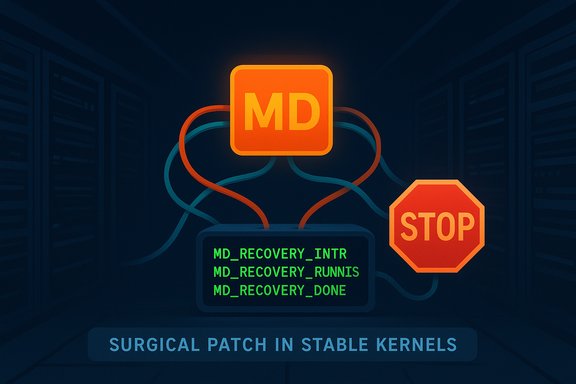
A subtle race-condition fix in the Linux kernel’s MD (multiple device / RAID) code has been assigned CVE‑2024‑26757 after maintainers discovered that a recent stopping‑sync-thread change could leave the md daemon unable to unregister a sync thread when arrays are toggled read‑only — a hang that manifests as an availability impact and that requires kernel updates or vendor patches to remediate.
The Linux md subsystem manages software RAID arrays and implements the logic that keeps mirrored and parity data consistent across member devices. A core component of that machinery is the sync thread (also called the recovery thread) responsible for resynchronizing data, writing superblocks and performing integrity operations when an array moves between states such as readonly, read‑write, suspended, or stopped.
CVE‑2024‑26757 describes a logic/regression problem introduced by an earlier change intended to improve how the kernel stops sync threads. The regression allows a specific sequence of state changes (array toggled from read‑only to read‑write and back, concurrent sync thread registration, then stop) to reach a code path where the daemon cannot clear MD_RECOVERY_RUNNING, preventing the sync thread from being properly unregistered and causing a hang during md_stop. The vulnerability was identified and recorded by the Linux kernel CVE team and is published across major trackers.
The handling by kernel maintainers is appropriate: identify the regression, craft a minimal fix, and land stable backports with explicit commit references. Distribution advisories and major trackers have followed suit with packaging and lists of affected kernels. Operators should treat this as a high‑priority availability patch for hosts where md arrays are critical or where multiple tenants share the same physical host. Two practical takeaways:
Source: MSRC Security Update Guide - Microsoft Security Response Center
 Background / Overview
The Linux md subsystem manages software RAID arrays and implements the logic that keeps mirrored and parity data consistent across member devices. A core component of that machinery is the sync thread (also called the recovery thread) responsible for resynchronizing data, writing superblocks and performing integrity operations when an array moves between states such as readonly, read‑write, suspended, or stopped.CVE‑2024‑26757 describes a logic/regression problem introduced by an earlier change intended to improve how the kernel stops sync threads. The regression allows a specific sequence of state changes (array toggled from read‑only to read‑write and back, concurrent sync thread registration, then stop) to reach a code path where the daemon cannot clear MD_RECOVERY_RUNNING, preventing the sync thread from being properly unregistered and causing a hang during md_stop. The vulnerability was identified and recorded by the Linux kernel CVE team and is published across major trackers.
- Issue class: logic / race condition in RAID management (availability impact).
- Primary consequence: hang/denial‑of‑service of md management operations.
- Introduced in tree: legacy regression traced to earlier commits; fixed in stable kernel trees as part of a patch series.
Technical anatomy: what went wrong
At a high level the failure scenario plays out like this:- An array starts out in read‑only state.
- Some code (for example, a dm‑raid superblock update path) briefly sets mddev->ro to zero to make the array read‑write, which can cause a new sync thread to register.
- Before the daemon finishes its cleanup, the array is set back to read‑only by the same or another component.
- When the array is stopped shortly after, stop_sync_thread sets MD_RECOVERY_INTR and wakes the sync thread; the code then waits for MD_RECOVERY_RUNNING to clear before continuing.
- The sync thread performs its final work and sets MD_RECOVERY_DONE, but the daemon-side cleanup in md_check_recovery contains a logic path that ignores read‑only arrays and returns before clearing MD_RECOVERY_RUNNING — leaving the wait in md_stop blocked indefinitely.
Why the regression happened
The kernel’s md code maintains several assumptions about when a sync thread is registered and when it should be unregistered. Historically:- If an array is not read‑write, md_check_recovery would not register a new sync_thread.
- If an array is read‑write and a sync_thread is present, md_set_readonly would unregister the sync_thread before flipping the array readonly.
Evidence and verification
- The Linux kernel CVE announcement documents the problem, reproducer scenario and identifies the affected file as drivers/md/md.c; it also maps the fix to stable kernel commits (the CVE announcement lists the upstream commits that remove the regression in 6.7.7 and in 6.8 branches).
- Major distribution trackers (Ubuntu, SUSE, Red Hat, Oracle) and vulnerability feeds include the same technical summary and classify the impact consistently as an availability issue requiring kernel updates. Ubuntu’s advisory lists a CVSS v3.1-style numeric indication (5.5 / Medium) for the reported scenario.
- OSV and other aggregators import the CVE and reference the stable-tree commits as canonical remediations; the upstream patch series and kernel mailing list discussion provide the immediate developer rationale and the small change set.
Impact, exploitability and real‑world risk
This is a local availability problem, not a remote code‑execution primitive.- Attack vector: LOCAL. An attacker or misbehaving process that can influence array state transitions (e.g., by mounting/manipulating RAID metadata, using device‑mapper/DM‑raid tooling, or running local administrative operations) can trigger the hang. Multi‑tenant and shared‑host scenarios (cloud hypervisors, build CI runners, virtualization hosts) are highest risk because a local hang can affect other tenants or services.
- Privilege required: Low to medium depending on configuration. On many systems, the operations that flip mddev->ro or stop arrays require elevated privileges or are performed by administrative daemons; however, environments that expose array control to less‑trusted actors (test labs, auto-mounting hosts, or misconfigured container environments) increase practical exploitability.
- Typical result: denial‑of‑service (blocked shutdown or md_stop hang). There is no public evidence that this condition is directly weaponizable into a memory‑corruption primitive or RCE; the consensus among trackers is that the bug is an availability‑focused regression.
Affected versions and patches
The kernel CVE announcement and stable commit references make the timeline explicit:- The bug was introduced historically (the announcement traces the problematic change back to a commit in the 4.8 timeframe) and was fixed in later stable kernel trees (fixed in 6.7.7 with a stable commit and again referenced in 6.8). The Linux kernel CVE listing includes the upstream stable commit IDs that close the issue.
Mitigation and remediation checklist
Apply the following prioritized plan to remove the hang condition from production hosts:- Inventory first
- Run uname -r on all Linux hosts to identify running kernel versions.
- Identify hosts that mount or manage software RAID (mdadm, device‑mapper arrays, or vendor images that include MD components).
- Prioritize multi‑tenant hosts, virtualization hosts, CI runners, and automated image processing boxes.
- Patch and reboot
- Install vendor kernel updates that mention CVE‑2024‑26757 or that contain the upstream stable commit IDs referenced in the kernel CVE announcement.
- If your vendor provides livepatches that include the fix, test and apply them as appropriate; otherwise, schedule a reboot to boot into the patched kernel.
- Validate the kernel changelog or package release notes reference the md fix or the upstream commit ID before you roll the change out widely.
- Short‑term compensations (if you cannot patch immediately)
- Avoid toggling array read/write status programmatically from untrusted contexts. Restrict who can run mdadm / device‑mapper manipulation commands.
- Quarantine or disallow untrusted image mounts on hosts that perform automatic array management operations.
- Monitor kernel logs (dmesg / journalctl -k) for repeated md‑related wait events, hung md_stop operations or daemon traces that point to md_check_recovery and MD_RECOVERY_RUNNING/MD_RECOVERY_INTR flags.
- Hunting and detection
- Add SIEM or log rules that look for md subsystem messages, blocked md_stop calls, or repeated waits on MD_RECOVERY_RUNNING. Preserve stack traces and full logs for any hang investigation; these are critical for mapping to upstream commits and for vendor support interactions.
- Prefer reproducing any test when housed in a safe, isolated lab environment; do not run integrity-caching.sh or risky reproductions on production arrays unless you have offline backups and a test recovery plan.
- Vendor engagement and long‑tail devices
- Embedded appliances, OEM kernels, and specialized distributions often lag upstream. Open tickets with your vendor and request explicit backports to their kernel release if the public advisory is not yet reflected in their update stream.
- Plan device‑level firmware or kernel update campaigns for embedded fleets where md is used (NAS appliances, storage nodes, etc..
Why the upstream fix is sensible — and where residual risk remains
The kernel fixes applied in stable branches are small, surgical changes that correct the daemon’s cleanup logic and ensure the md daemon does not return early for arrays that should let it clear MD_RECOVERY_RUNNING. That minimal approach reduces regression risk and makes backporting feasible across multiple stable kernels. The kernel community typically prefers targeted fixes for such correctness regressions; the public patch series and cv‑announce explain the reasoning and provide the commit IDs. Strengths of the fix:- Small and low‑regression: change is localized to md_check_recovery/stop logic.
- Easy to backport for distributions and vendors.
- Removes a deterministic hang without altering normal md semantics.
- Vendor lag: not all distributions and OEMs will push the stable backport at the same time, producing a long tail of vulnerable devices.
- Misconfiguration: hosts that allow unprivileged toggling of array state or untrusted images to be mounted remain more exposed.
- Operational complexity: kernel upgrades require careful testing because even small kernel fixes can interact with vendor drivers or features in subtle ways; test in a staging ring before mass rollout.
Practical detection queries and commands
- Identify RAID arrays and md usage:
- sudo mdadm --detail --scan
- lsblk and findmnt to list block devices and filesystems.
- Check kernel logs for md hangs or recovery flags:
- journalctl -k | grep -i md
- dmesg | grep -E "md_check_recovery|MD_RECOVERY|md_stop|sync_thread"
- Confirm kernel version and package changelog:
- uname -a
- apt changelog linux-image-$(uname -r) OR rpm -q --changelog kernel-$(uname -r)
- If you run a patched kernel, validate by running test workloads in staging and confirming no md_stop hangs occur under controlled array toggle sequences.
Critical analysis and editorial verdict
CVE‑2024‑26757 is a textbook example of how defensive assumptions in kernel state‑management code can be inverted by a seemingly innocuous fix elsewhere. The bug itself is not a classic memory‑safety vulnerability that yields information disclosure or code execution; its principal harmful effect is availability — a deterministic hang during array stop if a particular interleaving occurs. That makes it operationally important for infrastructure where RAID management is automated or where arrays are manipulated by non‑trusted code paths.The handling by kernel maintainers is appropriate: identify the regression, craft a minimal fix, and land stable backports with explicit commit references. Distribution advisories and major trackers have followed suit with packaging and lists of affected kernels. Operators should treat this as a high‑priority availability patch for hosts where md arrays are critical or where multiple tenants share the same physical host. Two practical takeaways:
- Update kernels promptly on hosts where md/raid is relied upon; map your installed kernels to vendor advisories rather than assuming upstream fixes are present.
- Harden array management operations and restrict who or what can flip array states in automated or multi‑tenant systems — this reduces exposure until fixes are deployed.
Conclusion
CVE‑2024‑26757 is not a flashy RCE or memory‑corruption headline, but it is an operationally serious regression that can hang RAID management flows and cause denial‑of‑service in critical storage contexts. The fix is to apply the stable‑tree patches that correct md_check_recovery behavior or to install vendor kernel updates that include those commits. Prioritize patching for multi‑tenant hosts, virtualization nodes, and any system where md arrays are manipulated by automation or untrusted processes, and verify fixes via package changelogs and kernel logs before returning systems to normal operations. The Linux kernel community’s surgical remedial approach is effective, but patch‑backport and vendor update lag remain the greatest practical risk — so operators must act decisively and verify remediation in their environment.Source: MSRC Security Update Guide - Microsoft Security Response Center
