

A small but important Linux-kernel fix — tracked as CVE-2024-26885 — closed a subtle integer‑overflow check in the BPF devmap code that could be triggered on 32‑bit architectures; Microsoft’s public advisory identifies Azure Linux as a product that includes the upstream component, but that attestation is a product‑scope inventory statement, not a technical guarantee that no other Microsoft artifact can contain the same vulnerable code.
CVE-2024-26885 is a kernel-level vulnerability in the eBPF subsystem’s DEVMAP_HASH handling. The problem isn’t a complicated exploit chain — it’s a classic ordering mistake in defensive code that becomes dangerous on 32‑bit platforms.
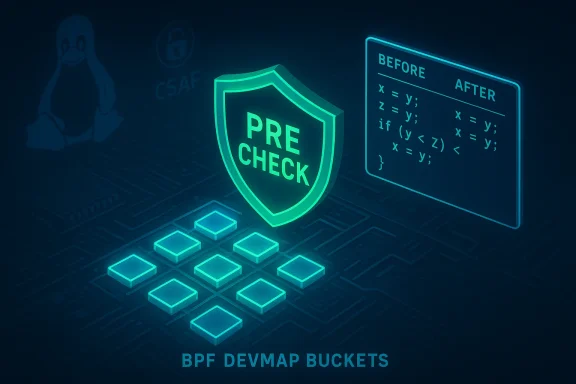
At creation time the devmap code rounds up the requested number of entries to the next power of two (so the number of buckets is a power of two). On systems where sizeof(unsigned long) == 4 (typical 32‑bit builds) that rounding operation can itself perform a left shift that overflows the native width, triggering undefined behavior. The original code did an overflow check after the roundup; syzbot demonstrated that on arm32 a crafted map with max_entries > 0x80000000 could cause a crash when the code later attempted to update that map. The upstream fix moves the overflow check to before the rounding operation so the risky shift never occurs.
Why this matters even in 2026: while 32‑bit Linux hosts are far less common on modern servers and desktop installs, embedded devices, appliances, and specialized ARM32-based systems still run 32‑bit kernels. A kernel panic or crash on those devices can be a critical availability risk. The fix has been merged into the stable kernel trees and backported by several distributions; consumers should rely on their distro vendor advisories for patch timing.
Two important practical points follow from that approach:
I also examined local forum archives and analyst threads that discuss identical MSRC wording and its operational interpretation; those writeups reinforce the same product‑vs‑artifact distinction.
If you operate a heterogeneous fleet — cloud VMs, on‑prem appliances, WSL endpoints, and container hosts — do not rely solely on a single vendor attestation for risk coverage. Treat each artifact independently: request VEX/SBOM files, check kernel commit IDs, and insist on documented patch windows and backport policies from vendors.
Source: MSRC Security Update Guide - Microsoft Security Response Center
 Background / Overview
CVE-2024-26885 is a kernel-level vulnerability in the eBPF subsystem’s DEVMAP_HASH handling. The problem isn’t a complicated exploit chain — it’s a classic ordering mistake in defensive code that becomes dangerous on 32‑bit platforms.At creation time the devmap code rounds up the requested number of entries to the next power of two (so the number of buckets is a power of two). On systems where sizeof(unsigned long) == 4 (typical 32‑bit builds) that rounding operation can itself perform a left shift that overflows the native width, triggering undefined behavior. The original code did an overflow check after the roundup; syzbot demonstrated that on arm32 a crafted map with max_entries > 0x80000000 could cause a crash when the code later attempted to update that map. The upstream fix moves the overflow check to before the rounding operation so the risky shift never occurs.
Why this matters even in 2026: while 32‑bit Linux hosts are far less common on modern servers and desktop installs, embedded devices, appliances, and specialized ARM32-based systems still run 32‑bit kernels. A kernel panic or crash on those devices can be a critical availability risk. The fix has been merged into the stable kernel trees and backported by several distributions; consumers should rely on their distro vendor advisories for patch timing.
What the technical fix changed
The root cause (simple, but subtle)
- The code used roundup_pow_of_two(n_entries) to compute buckets.
- On 32‑bit systems the internal implementation performs left shifts that can pass the native width, producing undefined results.
- The original overflow test examined the 32‑bit truncated result after the rounding, meaning the rounding could already have produced UB or wrapped values that the later test could miss.
- The correct pattern is to test whether n_entries already exceeds the safe threshold (for example, > 1UL << 31) and reject it before any shifting is attempted. This pre-check keeps the rounding helper from being driven into undefined territory.
Effect and exploitability
- Primary impact: denial of service / kernel crash when an attacker (or a local process) attempts to create or update a specially sized DEVMAP_HASH map on a vulnerable 32‑bit kernel.
- Privilege model: local (the attacker needs the ability to create or update BPF maps; many systems restrict that to privileged users or require CAP_BPF/CAP_SYS_ADMIN).
- Remote exploitation: unlikely as a standalone remote RCE, but kernel instability is usable in complex attack chains and is a real availability threat for embedded appliances and devices.
Where this vulnerability appears in vendor advisories
Multiple independent vulnerability trackers and distribution advisories document the same technical root cause and the upstream fixes:- NVD (US NIST) summarizes the issue and links to upstream fixes.
- OSV and several distro trackers point at the stable kernel commits that contain the remedy and show which trees were patched/backported.
- Ubuntu and other major distributions have recorded the CVE and mapped the kernel commits that introduced the fix (Ubuntu’s advisory shows the upstream commits that introduced/fixed the behavior).
The Microsoft angle: Azure Linux attestation vs. exclusivity
Microsoft’s Security Response Center has increasingly published machine‑readable attestations (CSAF/VEX) for third‑party CVEs and began that public VEX rollout with Azure Linux. In plain language Microsoft’s product mapping for a CVE often states something like: “Azure Linux includes this open‑source library and is therefore potentially affected by this vulnerability.” That wording is an authoritative, product‑scope statement — it confirms Microsoft has completed inventory for the Azure Linux product family and found the implicated upstream component. Microsoft also committed to publish CSAF/VEX attestations (announced October 22, 2025) and to update CVE mappings if additional Microsoft products are identified as affected.Two important practical points follow from that approach:
- Azure Linux is the only Microsoft product Microsoft has publicly attested (so far) to include the specific upstream component for certain CVEs — that attestation is authoritative for Azure Linux customers and should be acted on promptly. (windowsforum.com)
- The attestation is not a technical proof that other Microsoft products or images cannot include the same open‑source code. Microsoft maintains multiple Linux kernel artifacts (WSL2 kernels, linux‑azure images, Marketplace images, device or appliance images, management agents that may include kernel modules) and each artifact must be inventoried individually. Absence of public attestation ≠ absence of exposure.
I also examined local forum archives and analyst threads that discuss identical MSRC wording and its operational interpretation; those writeups reinforce the same product‑vs‑artifact distinction.
The short answer administrators need
- Is Azure Linux the only Microsoft product that includes the open‑source library and therefore potentially affected by CVE‑2024‑26885?
- As a public attestation: Yes — Azure Linux is the only Microsoft product Microsoft has publicly attested (as of the advisory) to include the implicated upstream component for this CVE. That attestation is a clear signal for Azure Linux customers to remediate.
- As a technical guarantee: No — Microsoft’s attestation is product‑scoped and phased, and the lack of an attestation for other Microsoft products is not a proof those products do not include the vulnerable code. Administrators should treat other Microsoft-provided kernels, WSL images, Marketplace images, and embedded Linux artifacts as potential carriers until verified.
Practical guidance: what to do now (step‑by‑step)
If you run any Microsoft-supplied Linux artifacts, or you operate Linux hosts that might include DEVMAP_HASH/BPF functionality, follow this sequence:- Inventory first
- Identify any Microsoft‑supplied Linux artifacts you run: Azure Linux images, linux‑azure kernel packages, WSL2 kernels, Azure Marketplace VM images, appliance images, or vendor-supplied VMs.
- Retrieve SBOMs/VEX attestations where available. Start with Microsoft’s CSAF/VEX feeds (MSRC) for Azure Linux and expand inventory to other product families.
- Check kernels and commits
- For each kernel build, check whether it includes the upstream fixes that remedied CVE‑2024‑26885 — distro advisories and OSV/NVD entries list the relevant commits and patched stable versions. If you maintain custom kernels, inspect the change set around the BPF hashtab/devmap fixes.
- Patch or apply vendor fixes
- For Azure Linux: apply the Microsoft‑published updates for Azure Linux as soon as they’re available; MSRC’s VEX entries for Azure Linux are the authoritative mapping for that product.
- For other distros or custom kernels: follow distro security advisories (Ubuntu, Red Hat, SUSE, Debian, etc.) and backport where necessary.
- Reduce attack surface while you patch
- Limit which users can create BPF maps: restrict to root or to bounded container runtimes that don’t expose untrusted code creation paths.
- Use kernel lockdown features, seccomp, or BPF policy enforcement where applicable to limit arbitrary BPF program creation or map updates.
- Consider network isolation and host hardening for embedded devices if they cannot be patched quickly.
- Monitor and verify
- Look for new kernel oopses, unexpected reboots, or logged BPF failures that indicate attempted edge cases.
- Maintain an audit trail when you update kernels so you can reconstitute which artifacts were patched and when.
- Engage vendors for VEX/SBOMs
- If you consume third‑party or vendor images (including Microsoft Marketplace images), request SBOM / VEX attestations and require them as part of your procurement or security review process. Microsoft’s phased VEX rollout is a useful precedent, but it’s not yet a complete picture for every Microsoft product family.
Who is actually at risk?
- High‑risk (must patch quickly)
- 32‑bit Linux systems that allow unprivileged or semi‑privileged users to create or update BPF maps.
- Embedded and appliance devices where kernel updates are infrequent or complicated by vendor constraints.
- Lower‑risk (still relevant)
- 64‑bit server and cloud instances are typically not susceptible to this particular undefined‑shift behavior — the underlying UB is tied to 32‑bit left shifts — but any system that includes vendor kernel backports should still be inventoried and patched if upstream commits were not included.
Vendor coordination and supply‑chain transparency
Microsoft’s public commitment to publish CSAF/VEX attestations (starting with Azure Linux) is a meaningful transparency improvement: it delivers machine‑readable answers for a particular product family so customers don’t have to guess whether a Microsoft image contains a specific upstream component. That rollout also includes an explicit promise to update the CVE record if additional Microsoft products are identified as affected. This commitment is operationally useful, but it also underscores the phased nature of vendor attestations: customers must continue to perform artifact‑level verification throughout their estates.If you operate a heterogeneous fleet — cloud VMs, on‑prem appliances, WSL endpoints, and container hosts — do not rely solely on a single vendor attestation for risk coverage. Treat each artifact independently: request VEX/SBOM files, check kernel commit IDs, and insist on documented patch windows and backport policies from vendors.
Technical verification checklist for sysadmins and engineers
- Confirm whether a host is running a 32‑bit kernel:
- uname -a and inspect sizeof(unsigned long) or distribution build metadata.
- If 32‑bit: verify kernel package version and cross-check against distro advisories (Ubuntu, Red Hat, SUSE, Debian) and upstream commit lists referenced in OSV/NVD.
- If you maintain custom kernel builds: search your tree for the specific devmap/hashtab commits (commit IDs are listed in multiple advisories and OSV entries).
- If you run Azure Linux, consult MSRC’s VEX/CSAF attestation for the exact product version to confirm Microsoft’s mapping and follow Microsoft’s remediation guidance.
Strengths and limits of current disclosures
- Strengths
- Upstream fix was small, straightforward, and landed across stable kernels — making it feasible for distributions to backport and for vendors to remediate without large regressions.
- Multiple independent vulnerability trackers (NVD, OSV, distro advisories) document the technical fix and list affected kernel commits, enabling administrators to verify patch applicability rather than relying on opaque version strings.
- Microsoft’s VEX/CSAF rollout for Azure Linux improves automation for customers who consume Microsoft images.
- Limits / Risks
- Microsoft’s attestation process is phased and product‑scoped; a lack of attestation for other Microsoft products is not proof of absence. Customers must not assume exclusivity.
- Embedded devices and appliances often lag on kernel updates and may not expose clear SBOMs. Those endpoints remain the most operationally dangerous class for a 32‑bit kernel bug.
- The MSRC update pages sometimes require dynamic rendering; automation that scrapes HTML may miss machine‑readable CSAF/VEX JSON files unless that feed is used explicitly. Administrators automating inventories should fetch the CSAF/VEX JSON artifacts rather than relying on rendered HTML.
Final assessment
Microsoft’s public statement that “Azure Linux includes this open‑source library and is therefore potentially affected” is an authoritative and actionable attestation for Azure Linux customers; it means Azure Linux images should be treated as in‑scope for remediation. However, that wording should be read as product‑scoped and phased: Microsoft chose to begin the VEX/CSAF rollout with Azure Linux, and it will expand attestations as it inventories other product families. Consequently, Azure Linux is the only Microsoft product Microsoft has publicly attested (so far) as including the implicated upstream component for this CVE, but Azure Linux is not necessarily the only Microsoft product that could include the vulnerable code — other Microsoft kernels or images may still contain the code until they are inventoried and declared not affected. Administrators should therefore act on the Azure Linux attestation immediately, while also performing artifact‑level inventories and patch rollouts across all Microsoft‑supplied kernels and images in their environment.Quick reference — immediate actions
- Azure Linux users: apply Microsoft’s published updates for the affected product (follow MSRC VEX/CSAF for the exact attestation).
- All operators: inventory kernels, check for 32‑bit builds, and ensure your kernels include the upstream commits that fix the DEVMAP_HASH check.
- For embedded devices: prioritize patching or isolating devices that cannot be patched quickly.
Source: MSRC Security Update Guide - Microsoft Security Response Center
