

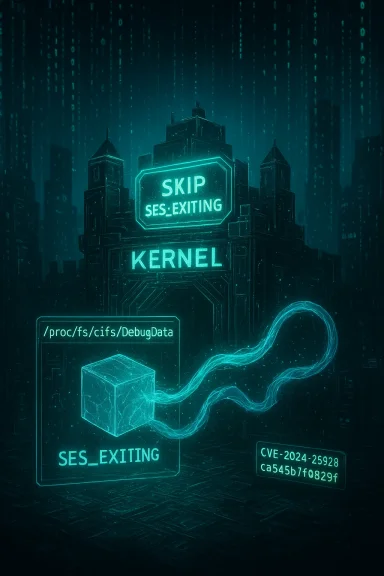
A small, easily overlooked change in the Linux SMB client — a single check that skips sessions already tearing down — closed a deceptively dangerous use‑after‑free (UAF) bug in the CIFS/SMB debug path that could, in practice, let an attacker repeatedly deny availability or cause kernel instability when the right race is hit. The defect, tracked as CVE‑2024‑26928, is narrow in code scope but important in operational impact: it targets the kernel's debug output routines (cifs_debug_files_proc_show()) that expose CIFS internal state via /proc, and the upstream patch simply avoids accessing session objects with status == SES_EXITING to prevent dereferencing freed memory.
The CIFS (Common Internet File System) layer in the Linux kernel — today maintained under the fs/smb/client tree for the SMB client — exposes various diagnostic pseudo‑files under /proc/fs/cifs such as DebugData and Stats. These files are invaluable for debugging mounts, sessions and per‑share state but they also traverse kernel data structures while producing human‑readable reports. One of the routines that walks session and connection lists is cifs_debug_files_proc_show(). If that routine attempts to inspect a session that is concurrently being torn down, it can access memory that another thread has already freed: a classic use‑after‑free condition. Upstream developers resolved the issue by skipping sessions whose status is SES_EXITING.
This vulnerability is not about malformed SMB network packets; it is a concurrency/lifecycle race inside the kernel module. That makes exploitability dependent on timing, system load, and how debug reads and session teardown events are triggered. However, categories of impact assigned by vendors — including availability and potential information disclosure — mean the bug deserves serious operational attention on systems that mount SMB shares or offer CIFS client functionality.
If one thread iterates the session list and another concurrently marks a session as tearing down and frees it, the iterating thread can be left holding a pointer to freed memory. The bug fixed in CVE‑2024‑26928 is this exact race in the debug show routine: the code did not always check the session's status before using it. The fix adds a guard that skips sessions in SES_EXITING state, preventing the subsequent read‑side code from touching memory that can be freed concurrently.
Vendor responses vary in timing and distribution:
Even when the attack vector is local, the operational outcomes can be similar to a remote denial of service: services that depend on shared files may fail to start, scheduled jobs that mount SMB shares may not run, and troubleshooting can require kernel updates and reboots. These are real availability impacts that affect support windows and maintenance windows for mixed Windows/Linux estates. Vendors and community trackers have documented similar CIFS client fixes over the previous years, so this CVE is part of a broader hardening trajectory for SMB code in the kernel.
Stay proactive: even small fixes in layered, widely deployed subsystems like SMB/CIFS can have outsized operational effects when they touch kernel memory management. Treat CIFS client updates as part of routine hardening for mixed‑platform environments and validate vendor errata against upstream commit identifiers when you perform risk assessments.
Source: MSRC Security Update Guide - Microsoft Security Response Center
 Background / Overview
The CIFS (Common Internet File System) layer in the Linux kernel — today maintained under the fs/smb/client tree for the SMB client — exposes various diagnostic pseudo‑files under /proc/fs/cifs such as DebugData and Stats. These files are invaluable for debugging mounts, sessions and per‑share state but they also traverse kernel data structures while producing human‑readable reports. One of the routines that walks session and connection lists is cifs_debug_files_proc_show(). If that routine attempts to inspect a session that is concurrently being torn down, it can access memory that another thread has already freed: a classic use‑after‑free condition. Upstream developers resolved the issue by skipping sessions whose status is SES_EXITING.This vulnerability is not about malformed SMB network packets; it is a concurrency/lifecycle race inside the kernel module. That makes exploitability dependent on timing, system load, and how debug reads and session teardown events are triggered. However, categories of impact assigned by vendors — including availability and potential information disclosure — mean the bug deserves serious operational attention on systems that mount SMB shares or offer CIFS client functionality.
What exactly was wrong: the technical root cause
The data model and lifecycle
The CIFS/SMB client represents remote connections via a hierarchy of objects: servers, connections, and session objects that model per‑user authentication contexts. Kernel code holds references and walks lists of those objects when performing operations such as reporting active sessions in /proc. Session objects are subject to teardown when a mount is unmounted, a connection fails, or user credentials are dropped.If one thread iterates the session list and another concurrently marks a session as tearing down and frees it, the iterating thread can be left holding a pointer to freed memory. The bug fixed in CVE‑2024‑26928 is this exact race in the debug show routine: the code did not always check the session's status before using it. The fix adds a guard that skips sessions in SES_EXITING state, preventing the subsequent read‑side code from touching memory that can be freed concurrently.
Why the fix is small — and correct
The patch is intentionally minimal: it avoids over‑engineering the debug path with heavy locking or lifetime changes by simply avoiding the risky code path when a session is in the process of being torn down. That choice reduces the attack surface and keeps the debug facility useful without introducing additional lock order complexity or long‑held locks that degrade runtime behavior. The upstream commit referenced in vendor advisories is ca545b7f0823f... and it was backported into stable trees and vendor kernels where appropriate.Who and what is affected
- Any Linux system with CIFS/SMB client support built into the kernel and exposing the debug pseudo‑files is functionally at risk if the running kernel version predates the upstream fix.
- Distribution kernels — including those from Ubuntu, SUSE and Oracle Linux — issued advisories and backports; severity assignments vary between vendors because of differing CVSS assessments and attack surface assumptions. For example, some vendors scored the bug as High for real‑world operational impact, pointing to the combination of low attack complexity with potentially serious availability consequences.
- Cloud and appliance images that keep long‑running kernel instances (NAS appliances, file‑sharing gateways, embedded devices) are particularly relevant: repeated exploitation attempts, or repeated triggering of the race in heavy‑use or multi‑user environments, can turn a small memory error into a sustained denial‑of‑service. Vendor packages for Amazon Linux, Oracle Linux and others include tracked advisories tying specific packages and errata to the fix.
Operational impact and real‑world risk
Availability is the primary concern
Several vendor assessments emphasize availability impact: a successful race can cause general protection faults, oops/panic conditions or non‑canonical addresses that crash the kernel or panic the host. Those failures translate directly to denial‑of‑service (DoS) — either transient while the attacker maintains pressure or persistent if the underlying host requires manual recovery. The MSRC advisory language the user provided underscores the severity of availability losses tied to this class of bugs. The public vulnerability trackers and vendor advisories align on the potential for significant availability impact.Exploit complexity and required access
- Privilege model: while the vulnerability may be reachable by local unprivileged users in some setups, many vendors note that privileges required can be low to high depending on kernel configuration and policy. This variability is why different vendors produced differing CVSS strings.
- Timing: this is a timing‑dependent race, and reliably exploiting it for information disclosure or privileged code execution is non‑trivial. That said, reliable DoS (triggering a kernel fault) is easier to achieve than arbitrary code execution in many kernel UAF cases.
- Correlated vulnerabilities: the real danger is when this kind of UAF exists alongside other weaknesses in the same code path; combined, they can raise escalation potential. That chaining risk is what prompts higher severity classification in some distro advisories.
Attack examples and abuse cases
- Denial of service by racing frequent session teardowns with repeated reads of /proc/fs/cifs/DebugData.
- Local attackers or compromised user accounts on multi‑user hosts could repeatedly trigger the condition to cause instability.
- In cloud or shared‑hosting environments, a tenant with mount privileges or an ability to interact with SMB shares could disrupt co‑tenants or platform services.
The upstream patch and vendor response
Upstream kernel maintainers applied the fix by adding a guard skip for sessions in SES_EXITING. The patch has been backported into several stable series and vendor kernels; maintainers communicated the change on stable mailing lists and repository branches. The upstream commit and its backports are referenced in distro advisories and security trackers — both the commit metadata and vendor changelogs consistently describe the change as "skip sessions that are being teared down (status == SES_EXITING) to avoid UAF."Vendor responses vary in timing and distribution:
- Ubuntu, SUSE, Oracle and Amazon Linux published advisories and backports; Ubuntu and SUSE gave higher priority labels reflecting local assessments of risk.
- Distribution and cloud vendors mapped the fix to their kernel package names and release channels, and some listed errata in long‑term support or stable kernels.
Detection and validation steps for administrators
- Identify kernel version and vendor package:
- Run uname -r to discover the running kernel. Compare the output to your vendor's fixed kernel versions or advisory mappings.
- Check for backport/patch presence:
- Inspect your distribution's changelog for the kernel package or consult the vendor security advisory for CVE‑2024‑26928.
- If you must verify the specific code path:
- Use your distribution's kernel source or the upstream stable tree to confirm whether commit ca545b7f0823f... (the upstream patch referenced by stable trees) or equivalent backport exists in your kernel package.
- Look for logs or oopses:
- Review dmesg and kernel logs for GPF or oops traces referencing cifs_debug_data_proc_show or cifs_debug_tcon, which are symptoms previously observed in related races. Such call traces indicate the buggy code path was hit and may point to exploitation attempts.
Mitigation and remediation — practical guidance
- Patch first (recommended)
- The single most effective action is to update kernels to versions where the patch is included or apply your vendor's backported kernel update. Distributors have rolled the fix into stable and long‑term branches; follow your normal patch management pipeline to deploy updates.
- Short‑term mitigations if patching is delayed
- Restrict who can read /proc/fs/cifs/DebugData: limit local unprivileged user access to the debug pseudo‑files where possible. Note that /proc is often world‑readable; administrators can use kernel configuration and mount namespaces, container security policies, or local file permissions (where supported) to reduce exposure.
- Limit who can mount or interact with SMB shares: tighten sudoers, mount policies and restrict network access to SMB servers from untrusted endpoints.
- Reduce CIFS debug footprint: if your kernel is built with optional CIFS debug features enabled (CONFIG_CIFS_DEBUG or CONFIG_CIFS_DEBUG2), consider disabling them for production kernels where debug output is not required. These kernel config options control the additional debug facilities exposed by the module.
- Monitor and defend
- Configure host monitoring to alert on kernel oopses or repeated crashes in CIFS/SMB code paths.
- For multi‑tenant systems, watch for unusual mount/unmount patterns or rapid session churn which could be attempts to trigger the race condition.
- Long term
- Apply the principle of least privilege to users that can mount network shares.
- Ensure appliance and embedded vendors track upstream fixes and provide timely kernel updates — these systems are often forgotten but can run unpatched kernels for years.
Why this matters to WindowsForum readers and Windows‑heavy environments
Many Windows administrators and engineers rely on Linux hosts as SMB/CIFS clients — for backups, file sync, networked services or management workflows. The Linux CIFS client serves as a bridge between Windows file servers and Linux consumers. A kernel crash or persistent instability caused by a CIFS client UAF can disrupt cross‑platform operations, prevent new mounts, or force manual intervention.Even when the attack vector is local, the operational outcomes can be similar to a remote denial of service: services that depend on shared files may fail to start, scheduled jobs that mount SMB shares may not run, and troubleshooting can require kernel updates and reboots. These are real availability impacts that affect support windows and maintenance windows for mixed Windows/Linux estates. Vendors and community trackers have documented similar CIFS client fixes over the previous years, so this CVE is part of a broader hardening trajectory for SMB code in the kernel.
Critical analysis — strengths of the upstream approach, and residual risks
Strengths
- The upstream fix is minimal and low‑risk: by avoiding access to objects in SES_EXITING state, maintainers removed the dangerous path without introducing heavy locking or complex lifetime redesigns that can increase regressions.
- Patch distribution was typical of kernel security practice: upstream commit, stable branch backports, and vendor advisories that mapped the patch to distro kernels and errata.
- The problem and fix are well‑scoped and reviewable; it is straightforward for operators to validate whether a kernel contains the change by comparing commits or vendor changelogs.
Residual risks and caveats
- The debug pseudo‑files remain a potential attack surface: they traverse internal kernel structures without necessarily providing hardened lifetime guarantees. Even when this particular race is fixed, other races or reference‑count mistakes in nearby code paths remain possible.
- Operational exposure depends heavily on system configuration: multi‑user hosts, systems that allow unprivileged users to mount remote shares, and environments that deliberately enable CIFS debug features carry higher risk.
- Distribution differences: vendors may rate the severity differently and schedule updates on different timelines. Administrators must consult their vendor advisory rather than rely solely on upstream commit messages.
Practical checklist for administrators (quick reference)
- Run uname -r and record your kernel release.
- Consult your distro vendor advisory for CVE‑2024‑26928 and confirm whether your kernel package includes the fix.
- If a vendor kernel is available, schedule kernel package updates through your usual change control and reboot windows.
- If patching will be delayed, restrict access to /proc/fs/cifs debug files and limit who can mount SMB shares.
- Monitor dmesg and system logs for oopses referencing cifs*debug** routines and alert on repeated occurrences.
- For appliances or embedded devices, contact your vendor for a firmware/kernel update if you cannot update the kernel yourself.
Conclusion
CVE‑2024‑26928 is a textbook example of how debugging interfaces can become a real security liability: the code that helps engineers diagnose problems walked live kernel objects without sufficient lifecycle checks, and that oversight created a raceable window for use‑after‑free behavior. The good news is that the upstream fix is concise and non‑disruptive — skip sessions whose status is SES_EXITING — and distro vendors have backported the change into stable kernels and advisories. The practical takeaways for administrators are simple: verify your kernel packages, patch promptly, and apply short‑term mitigations where necessary to reduce exposure.Stay proactive: even small fixes in layered, widely deployed subsystems like SMB/CIFS can have outsized operational effects when they touch kernel memory management. Treat CIFS client updates as part of routine hardening for mixed‑platform environments and validate vendor errata against upstream commit identifiers when you perform risk assessments.
Source: MSRC Security Update Guide - Microsoft Security Response Center
