

Microsoft’s brief attestation that “Azure Linux includes this open‑source library and is therefore potentially affected” is precise — and it is not, by itself, a guarantee that no other Microsoft product could ship the same vulnerable component. //archive.vn/2025.12.07-220032/https%3A/msrc.microsoft.com/update-guide/vulnerability/CVE-2025-38333)
CVE‑2024‑27308 is a vulnerability in the Rust mio crate (the low‑level Metal I/O library) that can cause invalid tokens for named pipes to be delivered after those pipes are deregistered, which in turn can lead to crashes or a use‑after‑free when applications rely on tokens to carry pointers. The bug is Windows‑specific and only triggers for named pipes; other mio IO resources are unaffected. The upstream advisory and vendor advisories show the bug was fixed in mio v0.8.11, and the vulnerability affects mio versions >= 0.7.2 and < 0.8.11. Applications that embed mio — most notably projects built on Tokio — are the highest‑risk consumers; Tokio combined with vulnerable mio under certain versions can yield a true use‑after‑free.
This short explanation matters because Microsoft’s public note names Azure Linux (the rebranded CBL‑Mariner family) as a product that “includes the open‑source library and is therefore potentially affected.” That statement is an inventory attestation for a single Microsoft product family — useful, authoritative for that product — but it is not a categorical exclusivity guarantee that no other Microsoft product includes the same upstream code. Microsoft explicitly says it will update CVE entries and publish machine‑readable CSAF/VEX attestations as its product inventories expand.
Two critical operational points follow:
Why that distinction matters:
However, there are important risks and gaps to acknowledge:
CVE‑2024‑27308 is a reminder that small, low‑level I/O library bugs can cascade into high‑severity outcomes when combined with popular async runtimes and careless pointer handling. Microsoft’s product‑scoped attestation for Azure Linux gives a valuable, actionable signal — but defenders must not stop there. Treat that attestation as the start of an artifact‑wide hunt: scan your software supply chain, prioritize Windows‑running Rust binaries and Tokio consumers, and update mio to v0.8.11 as quickly as possible to remove the exposure.
Source: MSRC Security Update Guide - Microsoft Security Response Center
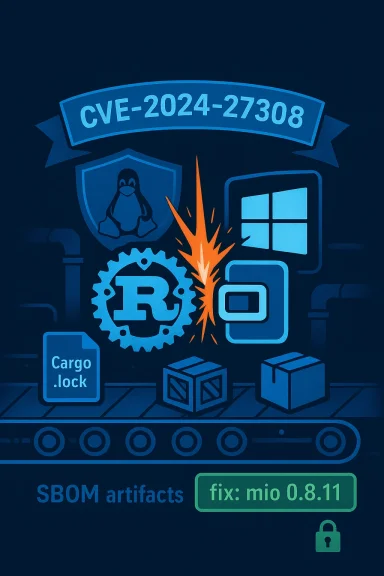 Background / Overview
CVE‑2024‑27308 is a vulnerability in the Rust mio crate (the low‑level Metal I/O library) that can cause invalid tokens for named pipes to be delivered after those pipes are deregistered, which in turn can lead to crashes or a use‑after‑free when applications rely on tokens to carry pointers. The bug is Windows‑specific and only triggers for named pipes; other mio IO resources are unaffected. The upstream advisory and vendor advisories show the bug was fixed in mio v0.8.11, and the vulnerability affects mio versions >= 0.7.2 and < 0.8.11. Applications that embed mio — most notably projects built on Tokio — are the highest‑risk consumers; Tokio combined with vulnerable mio under certain versions can yield a true use‑after‑free.This short explanation matters because Microsoft’s public note names Azure Linux (the rebranded CBL‑Mariner family) as a product that “includes the open‑source library and is therefore potentially affected.” That statement is an inventory attestation for a single Microsoft product family — useful, authoritative for that product — but it is not a categorical exclusivity guarantee that no other Microsoft product includes the same upstream code. Microsoft explicitly says it will update CVE entries and publish machine‑readable CSAF/VEX attestations as its product inventories expand.
What CVE‑2024‑27308 actually is (technical summary)
- The vulnerability is a logic/race condition in mio’s Windows named‑pipe handling: tokens returned to event registries may correspond to resources that have already been removed. If an application stores pointers or references inside those tokens (or otherwise uses the token as a handle to in‑memory structures), delivered tokens that point to freed memory can produce use‑after‑free behavior.
- Affected mio versions: >= 0.7.2 and < 0.8.11. Fixed in mio v0.8.11.
- Tokio interaction: Tokio users are at increased risk when using vulnerable mio together with Tokio ≥ 1.30.0; Tokio prior to 1.30.0 ignored invalid tokens and therefore avoided the most severe classes of failure. That means remediation may require either upgrading mio or ensuring the Tokio/mio combination in your runtime is known-good.
- Platform scope: the bug is Windows‑only because it depends on Windows named‑pipe behavior. A Linux system running code that uses mio for Linux IO paths is not directly exploitable via this specific flaw. However, presence of the library in an SBOM or package manifest still matters from a supply‑chain and inventory perspective.
What Microsoft’s wording means in practice
Microsoft’s short MSRC FAQ line — the same phrasing repeated across several MSRC entries — is a deliberate, product‑scoped inventory statement: it confirms Microsoft’s internal supply‑chain scanning found the upstream component inside the Azure Linux product family and so Azure Linux images should be treated as in scope for remediation. Microsoft also says it will publish machine‑readable VEX/CSAF attestations and update CVE mappings when additional products are discovered to ship the same upstream component.Two critical operational points follow:
- Authoritative for Azure Linux: If you run Azure Linux images (or downstream artifacts Microsoft distributes anux), treat Microsoft’s attestation as an authoritative signal: apply updates, rebuild images, and follow Microsoft’s guidance for those artifacts.
- Not evidence of absence elsewhere: The attestation is not proof that other Microsoft products or artifacts are unaffected. Lack of an attestation is best read as “not yet verified” rather than “not affected.” Microsoft has dozens of internal artifacts, customized images, and productized kernels — whether any of those include the same vulnerable upstream component depends on exact package lists, build versions, configuration flags, and whether a product ships Rust binaries that embed vulnerable mio crates.
Is Azure Linux the only Microsoft product that includes mio and is therefore potentially affected?
Short answer: No — not necessarily. Azure Linux is the only Microsoft product Microsoft has publicly attested to include the implicated upstream library for this CVE at the time of the advisory, but that attestation is an inventory result for the Azure Linux family, not a global exclusion. Treat other Microsoft products as unverified until either Microsoft’s VEX/CSAF mappings explicitly list them or you verify artifacts yourself.Why that distinction matters:
- Microsoft ships many different artifacts that could, in principle, embed or package Rust components: container hosts, management agents, marketplace appliances, and even service components that run inside Azure or on Windows. Any artifact that includes a binary or library built from Rust source that depends on the mio crate (or includes a bundled binary that uses mio) is a potential carrier, regardless of the upstream OS of the artifact.
- The vulnerability’s exploitability still depends on runtime platform and usage. Because CVE‑2024‑27308 is Windows‑specific and requires named‑pipe usage, many Azure Linux customers will see no local remote attack path from this flaw alone — Linux images that include the source may still carry the vulnerable crate, but the runtime conditions to exploit it do not exist on Linux. Nevertheless, for downstream consumers who build cross‑platform artifacts or produce Windows binaries from Linux build hosts, the presence of the vulnerable crate in the supply chain is relevant.
Examples and precedents
- Downstream OS vendors and other software vendors quickly flagged CVE‑2024‑27308 in their vulnerability databases and advisories; several enterprise packages were identified as carrying the vulnerable mio versions (for example, IBM published a security bulletin noting mio usage inside IBM Maximo components). Independent vulnerability feeds (Recorded Future, Wiz, Vulners, dbugs/PT) all show the same affected‑versions and mitigation guidance: upgrade to mio v0.8.11.
- Microsoft’s own product‑scoped attestations have repeatedly followed the same pattern in 2024–2025: start with Azure Linux (CBL‑Mariner lineage) as an initial attestable product, publish that it includes the implicated upstream library, and promise to expand product mappings as inventories complete. That rollout model is operationally sensible but creates the common misunderstanding that a named product is the only possible carrier — which it is not.
Practical guidance for defenders and software builders
If you are responsible for vulnerability management, build pipelines, or runtime security, here are concrete steps to triage, detect, and remediate CVE‑2024‑27308 and to respond to Microsoft’s attestation:1. Identify where mio appears in your software supply chain
- Use automated SBOM/manifest scanning to find cargo/Cargo.lock entries that mention mio and note the version. Tools: cargo‑audit, OSV queries, SCA scanners (Snyk, GitHub Dependabot, etc.). Cross‑check any binary distributions for embedded Rust dependencies (static linking is common).
- For containers and images, run image scans that can look inside layers for Cargo.lock or installed runtime libraries. If an image includes a Rust binary, check the linked crates and the build process that produced it.
2. Prioritize risk by platform and usage
- Remember: the vulnerability is Windows‑only and requires named‑pipe usage. If a vulnerable mio is present but the component runs only on Linux and never executes Windows‑named‑pipe code paths, exploitability is low. That said, presence in the supply chain still matters for cross‑platform builds and for future reuse.
- Pay special attention to components that build cross‑platform binaries or are repackaged for Windows. If you ship or run any Rust‑based components on Windows that use Tokio or mio, treat them as high‑priority to patch.
3. Patch or rebuild
- Upgrade mio to v0.8.11 or later and rebuild your artifacts. This is the upstream fix.
- If you use Tokio, ensure the Tokio + mio combination is supported: upgrading mio is the primary fix, but verify Tokio versions and any runtime assumptions documented in Tokio advisories.
- For packaged OS images (distributions, container hosts), apply the vendor patches — Microsoft has published updates for Azure Linux families, and many distro vendors issued downstream advisories. If you run Azure Linux images, follow Microsoft’s update guidance.
4. Workarounds and mitigations if you cannot immediately patch
- Defensive filtering: libraries that consume mio can detect and ignore invalid tokens as a stopgap. Some upstream projects documented this mitigation in threduces exploitation surface but is not a substitute for the upstream fix.
- For services that run on Windows, increase monitoring for stability anomalies: unexpected crashes, memory corruption events, or logs showing invalid token handling. Instrumentation that captures stack traces and crash dumps will accelerate triage.
- Apply principle of least privilege and micro‑segmentation where possible to reduce attacker access to Windows named‑pipe endpoints.
5. Hunt and detection guidance
- Look for increased crash/restart rates and oddities in telemetry for Rust‑based services running on Windows.
- Use binary and dependency scanning to find any Windows executables that link (statically or dynamically) to mio or include Cargo.lock files reflecting vulnerable versions.
- Search your CI/CD artifacts: check build logs, Cargo.lock, andes for mio versions in the vulnerable range. This is often the fastest way to find transitive exposure.
Supply‑chain and vendor‑attestation implications
The Microsoft approach — inventory Azure Linux first, publish CSAF/VEX attestations, and then expand mappings — is a pragmatic operational model for a large vendor with many product families. It provides customers a concrete remediation signal for a known product while Microsoft completes broader inventories. However, defenders must treat these attestations as positive confirmations, not as all‑clear signals for other products. In short:- Treat Microsoft’s attestation as authoritative for Azure Linux builds (apply updates).
- Treat absence of attestation for other Microsoft products as “not yet verified.” Continue internal artifact scanning and vendor engagement.
- Push for SBOM and VEX coverage in your vendor relationships. CSAF/VEX artifacts make machine verification much easier; Microsoft’s public commitment to publish VEX for Azure Linux and then expand is a positive step toward that model.
What to tell management and customers (short brief)
- CVE‑2024‑27308 is a high‑impact library bug fixed upstream in mio v0.8.11; exploitation requires Windows + named‑pipe usage plus vulnerable application behavior.
- Microsoft has confirmed Azure Linux includes the implicated library and is therefore potentially affected — that means Azure Linux customers need to apply vendor updates. Microsoft will update CVE/VEX if additional Microsoft products are identified as carriers.
- Do not assume other Microsoft products are safe simply because they are not listed. If you run Microsoft artifacts beyond Azure Linux, run SBOM/dependency scans and engage Microsoft support/VEX feeds to confirm product scope.
Risk breakdown and realistic attack scenarios
- Realistic attack vector: an attacker who can reach a Windows process that listens on named pipes and that uses a vulnerable mio/Tokio combination could trigger invalid token delivery and potentially cause memory corruption or a crash. In the worst case (when tokens are used to carry pointers), a use‑after‑free can lead to memory corruption and code execution, depending on the binary and memory layout.
- Low‑risk scenarios: Linux‑only deployments that do not build or run Windows targets; purely Linux IO paths are not affected by this Windows‑specific flaw. For these, the vulnerability is mostly a supply‑chain hygiene issue rather than an immediate runtime threat.
- Why vendors like Microsoft still list Linux products: Microsoft and other vendors often publish CVE mappings for a product because that product’s packaging or toolchain contains a copy of the upstream project — the product‑level attestation helps customers triage affected images and packages even if the exploitability on that OS is limited. It also flags the presence of the vulnerable source in the vendor’s artifacts.
Final analysis — strengths, gaps, and recommended next steps
Microsoft’s public attestation program (beginning with Azure Linux and moving toward machine‑readable CSAF/VEX) is a strength: it gives customers a clear, prioritized starting point for patching and automates triage where Azure Linux is in use. The company’s promise to update CVE pages when additional products are identified is also the right operational posture.However, there are important risks and gaps to acknowledge:
- The attestation model can create a false sense of safety for unlisted Microsoft products. Many teams will read “only Azure Linux is listed” and assume other Microsoft artifacts are safe — that assumption is incorrect unless confirmed. Treat unlisted artifacts as unverified, not unaffected.
- The technical nuance — this CVE is Windows‑specific but the library itself appears across many build artifacts — increases the cognitive load for triage teams. Organizations must be able to differentiate between presence of vulnerable source and actual runtime exploitation risk.
- Visibility gaps remain where organizations do not collect SBOMs or do not scan CI/CD caches, which is where transitive vulnerabilities like this are most often missed. Improve build‑time scanning and artifact inventorying.
- Immediately scan your repositories, images, and build artifacts for mio in the vulnerable range. Use cargo‑audit, OSV, and SCA tooling.
- Prioritize Windows‑deployed Rust software and any services that use named pipes; plan updates to mio v0.8.11 and rebuild releases.
- For Azure Linux customers, apply Microsoft’s patches and watch for Microsoft’s VEX/CSAF updates to confirm any newly identified Microsoft carriers.
- Improve SBOM coverage and establish automated ingestion of vendor VEX/CSAF feeds so that future, similar attestations are handled automatically.
CVE‑2024‑27308 is a reminder that small, low‑level I/O library bugs can cascade into high‑severity outcomes when combined with popular async runtimes and careless pointer handling. Microsoft’s product‑scoped attestation for Azure Linux gives a valuable, actionable signal — but defenders must not stop there. Treat that attestation as the start of an artifact‑wide hunt: scan your software supply chain, prioritize Windows‑running Rust binaries and Tokio consumers, and update mio to v0.8.11 as quickly as possible to remove the exposure.
Source: MSRC Security Update Guide - Microsoft Security Response Center
