

A subtle bug in PHP’s password verification logic — tracked as CVE‑2024‑3096 — let an attacker gain account access in a corner case: if a stored password hash begins with a NUL (0x00) byte, calling password_verify() with a blank password could return true. Microsoft’s Security Response Center (MSRC) has published an attestation that Azure Linux “includes this open‑source library and is therefore potentially affected”, and that phrasing has left many defenders asking a single, urgent question: is Azure Linux the only Microsoft product that could carry this vulnerable code? The short, practical answer for operations teams is: no — not necessarily. Azure Linux is the only Microsoft product Microsoft has publicly attested so far for the affected component, but that attestation is a scoped inventory claim, not a technical guarantee of exclusivity across every Microsoft artifact. This feature unpacks what that distinction means, why it matters, and what defenders must do now.
The vulnerability behind CVE‑2024‑3096 is deceptively simple and highly actionable when the right conditions align. The PHP code path in question treats password hashes as strings in contexts where a leading NUL byte can short‑circuit comparisons. If a stored hash begins with 0x00 and an attacker submits an empty password (""), the vulnerable logic can treat those two states as matching — resulting in an unauthorized authentication success.
This is not a hypothetical academic bug: the PHP project addressed the issue in its security releases in April 2024. The practical elements every defender should know right away:
Why? Because whether a compiled artifact contains a particular upstream source file or library depends on per‑artifact build choices:
Sample SQL approach (MySQL, binary hash column):
Adapt these examples to your environment and test queries on non‑production data first.
However, the phased approach carries operational risk: customers may misinterpret the early attestation universe as comprehensive. Until VEX covers other product families, customers must not assume their non‑attested Microsoft artifacts are unaffected. That is particularly important for large enterprises that use a mix of Microsoft‑published images, Azure services, Marketplace appliances, WSL, and self‑published images that may have been built from Microsoft sources.
Put bluntly: Microsoft’s attestation program reduces uncertainty for the artifacts it covers, but it transfers some of the inventory burden back to customers for all remaining artifacts. For risk‑averse organizations, that’s an acceptable trade — but only if teams understand the difference between “attested” and “comprehensively scanned.”
Source: MSRC Security Update Guide - Microsoft Security Response Center
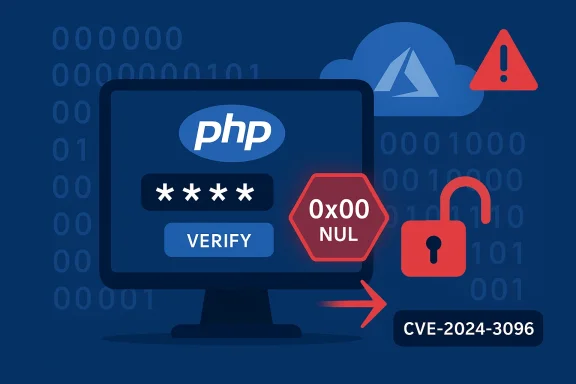 Background / Overview
The vulnerability behind CVE‑2024‑3096 is deceptively simple and highly actionable when the right conditions align. The PHP code path in question treats password hashes as strings in contexts where a leading NUL byte can short‑circuit comparisons. If a stored hash begins with 0x00 and an attacker submits an empty password (""), the vulnerable logic can treat those two states as matching — resulting in an unauthorized authentication success.This is not a hypothetical academic bug: the PHP project addressed the issue in its security releases in April 2024. The practical elements every defender should know right away:
- Affected PHP families: PHP 8.1 (fixed by 8.1.28), PHP 8.2 (fixed by 8.2.18), and PHP 8.3 (fixed in later 8.3.x releases). Older maintenance branches were also considered in vendor advisories.
- Exploit precondition: the stored password hash must begin with a NUL (0x00) byte. That can arise from unusual password choice (leading NULs are syntactically valid but rarely used), from data corruption, export/import issues, or from custom code that inadvertently prepends or stores binary data.
- Exploit mechanism: calling password_verify() with an empty string against such a hash may return true on vulnerable builds, bypassing authentication.
- Fix: upgrade PHP to the patched releases; where immediate patching is not possible, treat affected accounts proactively (force password resets, enable MFA, etc.).
What Microsoft actually wrote — and why the wording matters
Microsoft’s public advisory text for a number of third‑party CVEs follows a concise template: a short statement along the lines of “Azure Linux includes this open‑source library and is therefore potentially affected.” That sentence performs two separate operational tasks at once:- It is a product‑level inventory attestation. Microsoft is telling Azure Linux customers: “we inspected the Azure Linux images/kernels/packages and found the implicated component there; treat those images as in scope.” That signal is authoritative and actionable for Azure Linux operators.
- It is a status note about Microsoft’s ongoing attestation program. Microsoft has adopted machine‑readable CSAF/VEX attestations and is rolling them out progressively. Their stated practice is to start with Azure Linux and expand coverage over time; when they find the same upstream component in other Microsoft products, they will update the CVE record accordingly.
Why product‑level attestations are valuable — and why they’re not the full story
Large vendors cannot instantly inventory every build, image, appliance, and installable artifact they have ever shipped. The pragmatic model many enterprises and vendors use is:- Pick a product family that can be inventoried end‑to‑end (for Microsoft, Azure Linux / CBL‑Mariner was an early target).
- Produce deterministic, machine‑readable attestations (CSAF/VEX) that map CVEs to that product family.
- Expand coverage gradually, publishing attestations for additional product families as inventories complete.
Why? Because whether a compiled artifact contains a particular upstream source file or library depends on per‑artifact build choices:
- kernel / runtime / package version and exact upstream commit range,
- build-time configuration flags and compile options,
- packaging decisions (module vs compiled-in),
- whether a vendor backported a specific change or trimmed a component.
Practical implications for Microsoft customers and admins
Translate the technical and process reality above into a short operations checklist:- Treat Microsoft’s Azure Linux attestation as authoritative for Azure Linux images and nodes. If you run Azure Linux, remediate immediately per the advisory.
- Do not assume that other Microsoft artifacts — WSL kernels, linux‑azure kernels used in some Azure services, Marketplace VM images, managed container host images, or appliances offered through Microsoft channels — are outside scope simply because they aren’t listed yet.
- Inventory your own estate: find where PHP is installed (Linux images, containers, Windows PHP builds, third‑party appliances) and check the PHP version and vendor packaging against the patched release numbers.
- Assume “unattested” Microsoft SKUs are unverified until proven otherwise. Either obtain the vendor’s SBOM/VEX attestation for that SKU or validate locally (binary/package listing, package manager metadata, or an image scan).
Step‑by‑step remediation and detection guidance
Below is a practical, prioritized playbook for defenders who manage PHP‑backed services.1) Patch first, everywhere
- Confirm PHP versions in use across all systems, containers, and images.
- Upgrade vulnerable PHP installations to the patched releases (the PHP project published security builds in April 2024 that address this issue).
- Where vendor packages lag behind upstream, apply vendor security updates (distributors issued advisories and packaged fixes shortly after the upstream releases).
2) Scan your user database for NUL‑leading stored hashes
You need to find accounts with stored password hashes that begin with a NUL byte. Approaches vary by database and how hashes are stored (text vs binary).- Quick idea for SQL systems that store hashes as raw bytes: search for rows where the hex representation begins with 00. For example, in MySQL:
- If password hashes are stored as VARBINARY/BLOB, use HEX():
- SELECT id, username FROM users WHERE HEX(password_hash) LIKE '00%';
- If hashes are stored as TEXT, the query trick depends on column collation; you can still search for the NUL character using functions in some DB engines, or export and scan with a script.
- If you cannot directly query for NUL, export the password hash column to a file and scan using a binary‑capable tool or script that inspects the first byte.
3) Force immediate remediation for affected accounts
For any account whose stored hash begins with 0x00:- Force a password reset or invalidation of the existing hash and require the user to pick a new password that cannot contain NUL bytes.
- If you have the ability, rehash stored passwords with a safe workflow (a forced reset is often simpler and more reliable).
- Enable or enforce multi‑factor authentication (MFA) for accounts in sensitive roles and all admin accounts.
4) Harden authentication logic and logging
- Treat any successful login with an empty password as suspicious on vulnerable builds; add logging and alerts to detect anomalous successful authentications that involve empty or unusually short credentials.
- Implement input validation: disallow leading NUL bytes in passwords at creation time. That prevents new vulnerable hashes from being created and is a cheap, high‑value mitigation.
- Where possible, treat password storage as binary and avoid implicit string handling that assumes C‑style NUL termination.
5) Audit containers, vendor images, and managed services
- Scan container images and virtual machine images (local and marketplace) for PHP versions and vendor packaging.
- For cloud services that abstract runtime patching (e.g., managed platforms), consult your service provider’s advisory feed and confirm whether the platform images will be updated automatically or require your intervention.
- In Azure specifically, prioritize remediation of any workloads running Azure Linux images that Microsoft has attested as affected.
6) Monitor threat activity and PoC releases
- Watch for publicly released proof‑of‑concept code that automates scanning for accounts with vulnerable hashes. If a PoC appears, prioritize detection and password rotation for affected accounts.
- Increase monitoring for credential stuffing and empty‑password attempts in authentication logs. Attackers scanning for vulnerable accounts will frequently attempt blank passwords at scale.
Technical notes for developers and ops teams
- The bug is a comparison/termination mismatch where binary data containing NUL interacts with C string logic. Binary‑safe APIs and strict encoding/validation on input creation are the durable long‑term solutions.
- If your stack uses third‑party libraries that wrap or normalize hashes (for example, frameworks that encode/escape data before storing), audit those paths to ensure they didn’t introduce NUL bytes accidentally.
- When storing password hashes, prefer binary‑safe columns with explicit encoding to reduce surprises from serialization or transfer.
Code:
$hash = $row['password_hash']; // fetch from DB
if (isset($hash[0]) && $hash[0] === "\0") {
    // Mark this account as needing remediation
}
Code:
SELECT id, username
FROM users
WHERE HEX(password_hash) LIKE '00%';Cross‑checking the claims: technical verification and vendor timelines
Because operational decisions depend on precise patch levels and dates, here are the verified facts defenders should base actions on:- The vulnerability was publicly disclosed in April 2024 and tracked as CVE‑2024‑3096. Upstream security releases remedied the issue in PHP maintenance branches shortly after disclosure.
- Patch releases from the PHP project addressed the issue in the April 2024 security updates; distributor advisories followed with packaged fixes for major Linux distributions and cloud OS images.
- Microsoft’s published attestation that “Azure Linux includes this open‑source library and is therefore potentially affected” is an accurate, product‑scoped statement: it reflects Microsoft’s inventory result for Azure Linux at the time of publishing and its process to publish CSAF/VEX attestations. Microsoft has also stated a phased rollout approach for VEX (beginning with Azure Linux) and committed to update CVE/VEX entries if additional Microsoft products are later identified as carriers.
Where defenders commonly trip up — and how to avoid it
- Mistake: assuming “not listed” means “not affected.” Don’t. Inventory or demand attestation for the exact artifact you run. Silence from a vendor’s attestation feed is not a security guarantee.
- Mistake: treating vendor attestation as a remediation. Attestations tell you which products contain the component; they do not replace patching or other mitigations. If a product is attested as affected and a fix exists, patch promptly.
- Mistake: focusing only on upstream runtime versions. Also check packaged builds, containers, and appliances. The same upstream source can appear in many downstream forms; each downstream build is an artifact that must be checked.
Recommended organizational actions (prioritized)
- Emergency: Patch all PHP installations to the upstream‑patched releases or to vendor packages that include the fix.
- High: Scan user databases for stored hashes that start with a NUL byte and force reset for impacted accounts.
- High: Enforce or enable MFA on all sensitive accounts; monitor login logs for blank‑password successes.
- Medium: Ingest Microsoft’s CSAF/VEX feed for Azure Linux and subscribe to vendor advisories for other Microsoft product families you run.
- Medium: Inventory all Microsoft‑provided images and appliances you use — WSL kernels, Marketplace images, managed container hosts — and request or wait for attestation or scan them locally.
- Low: Add explicit input validation to block leading NUL characters on password creation, and update developer guidance and secure coding rules.
Strengths and potential risks in Microsoft’s attestation approach
Microsoft’s move to publish machine‑readable CSAF/VEX attestations is a clear strength. It gives customers a deterministic, automatable signal they can consume in vulnerability orchestration platforms. For Azure Linux customers, that signal reduces the time between disclosure and targeted remediation.However, the phased approach carries operational risk: customers may misinterpret the early attestation universe as comprehensive. Until VEX covers other product families, customers must not assume their non‑attested Microsoft artifacts are unaffected. That is particularly important for large enterprises that use a mix of Microsoft‑published images, Azure services, Marketplace appliances, WSL, and self‑published images that may have been built from Microsoft sources.
Put bluntly: Microsoft’s attestation program reduces uncertainty for the artifacts it covers, but it transfers some of the inventory burden back to customers for all remaining artifacts. For risk‑averse organizations, that’s an acceptable trade — but only if teams understand the difference between “attested” and “comprehensively scanned.”
Final assessment and action summary
- CVE‑2024‑3096 is a real authentication bypass risk when specific conditions are met; it was fixed by upstream PHP releases in April 2024.
- Microsoft’s statement that “Azure Linux includes this open‑source library and is therefore potentially affected” is accurate and should be treated as an authoritative attestation for Azure Linux artifacts.
- The statement is not an exclusive guarantee. Other Microsoft products or images could include the same vulnerable PHP component; you must verify each artifact you run or obtain attestation/SBOMs from the vendor.
- Immediate, high‑priority actions for defenders: patch PHP everywhere possible, search for and remediate any stored password hash beginning with a NUL byte, enable MFA, and audit all Microsoft‑supplied images you operate.
- Longer‑term: integrate CSAF/VEX ingestion into your VM/image management pipeline, demand SBOMs or attestations for third‑party appliances you rely on, and build automated checks that scan new images and containers for vulnerable package versions as part of CI/CD.
Source: MSRC Security Update Guide - Microsoft Security Response Center
