

The short answer is: no, Azure Linux is not necessarily the only Microsoft product that could include the vulnerable Git code — it is the only Microsoft product Microsoft has publicly attested (via its CSAF/VEX inventory) to include the affected open‑source component for the CVE at the time of the advisory, but that attestation is product‑scoped, not an exclusivity guarantee. erview
CVE‑2024‑32021 is a Git core issue: when performing a local filesystem clone under certain conditions, Git’s local‑clone optimizations can create hardlinks in the new repository’s objects/ database that point to arbitrary user‑readable files on the same filesystem. The vulnerability is a race where a file that appears to be a regular object during a safety check can be swapped for a symlink before the hardlink operation, allowing an attacker with control over files on the same filesystem to cause unexpected hard links into the clone’s objects directory. This behavior can create future integrity and interference hazards because the hardlinked file remains controlled by the attacker.
The Git project patched the issue in the maintenance releases listed below; users and packagers were urged to upgrade. The patched Git versions are: 2.45.1, 2.44.1, 2.43.4, 2.42.2, 2.41.1, 2.40.2, and 2.39.4. The fix is available in upstream Git advisories and is reflected in vulnerability databases and distro advisories.
Microsoft’s Security Update Guide / MSRC entries for a set of open‑source CVEs — including Linux and library issues — commonly include the FAQ line: “Is Azure Linux the only Microsoft product that includes this open‑source library and is therefore potentially affected?” Their published answer emphasizes Azure Linux (the distribution formerly known as CBL‑Mariner) as the Microsoft product they have inventory‑checked and for which they publish CSAF/VEX attestations. Microsoft also explains it will update the CVE/VEX entries if additional products are identified.
That statement is important but narrowly scoped: it is an inventory attestation. Microsoft is saying, in effect, “We have checked and confirmede It is not the same as saying “No other Microsoft product ships this library.” Multiple independent observers and internal community analyses emphasize that Microsoft’s wording should be read as a product‑scoped attestation rather than a comprehensive, across‑the‑board exclusion of other Microsoft artifacts. In short: absence of an MSRC attestation for a given Microsoft SKU is absence of evidence — not evidence of absence.
Key examples:
However, that sentence is not a comprehensive inventory of every Microsoft product or image. In practice, Git and Git‑derived tooling appear across Microsoft’s ecosystem — IDEs, hosted agents, runner images, and developer toolchains — and any artifact that shipped an unpatched Git version should be treated as potentially at risk until verified and patched. The correct defensive posture is to apply the upstream Git patches where present, inventory and verify other Microsoft artifacts you rely on, and monitor MSRC’s expanding CSAF/VEX attestations rather than assuming exclusivity based on a single product attestation.
If you’re responsible for any of the following — Azure Linux hosts, developer workstations, hosted runners, or build images — prioritize inventory, patching, and conservative cloning practices. The vulnerability is fixable, but only operational vigilance will close the gap between a single product attestation and the broader reality of where Git runs in your environment.
Source: MSRC Security Update Guide - Microsoft Security Response Center
CVE‑2024‑32021 is a Git core issue: when performing a local filesystem clone under certain conditions, Git’s local‑clone optimizations can create hardlinks in the new repository’s objects/ database that point to arbitrary user‑readable files on the same filesystem. The vulnerability is a race where a file that appears to be a regular object during a safety check can be swapped for a symlink before the hardlink operation, allowing an attacker with control over files on the same filesystem to cause unexpected hard links into the clone’s objects directory. This behavior can create future integrity and interference hazards because the hardlinked file remains controlled by the attacker.
The Git project patched the issue in the maintenance releases listed below; users and packagers were urged to upgrade. The patched Git versions are: 2.45.1, 2.44.1, 2.43.4, 2.42.2, 2.41.1, 2.40.2, and 2.39.4. The fix is available in upstream Git advisories and is reflected in vulnerability databases and distro advisories.
 What Microsoft actually said (and what that wording means)
Microsoft’s Security Update Guide / MSRC entries for a set of open‑source CVEs — including Linux and library issues — commonly include the FAQ line: “Is Azure Linux the only Microsoft product that includes this open‑source library and is therefore potentially affected?” Their published answer emphasizes Azure Linux (the distribution formerly known as CBL‑Mariner) as the Microsoft product they have inventory‑checked and for which they publish CSAF/VEX attestations. Microsoft also explains it will update the CVE/VEX entries if additional products are identified.That statement is important but narrowly scoped: it is an inventory attestation. Microsoft is saying, in effect, “We have checked and confirmede It is not the same as saying “No other Microsoft product ships this library.” Multiple independent observers and internal community analyses emphasize that Microsoft’s wording should be read as a product‑scoped attestation rather than a comprehensive, across‑the‑board exclusion of other Microsoft artifacts. In short: absence of an MSRC attestation for a given Microsoft SKU is absence of evidence — not evidence of absence.
Why the MSRC attestation is authoritative for Azure Linux — and why it does not end the investigation
- Microsoft’s CSAF/VEX rollout began as a phased program, first publishing machine‑readable attestations for Azure Linux to improve transparency and accelerate triage. That makes the Azure Linux attestation authoritative for that product: if Azure Linux packages include a vulnerable Git, Microsoft’s attestation means customers running Azure Linux should consider themselves in scope and apply the updated packages or mitigations.
- However, Microsoft distributes many artifacts, environments, and services beyond Azure Linux: developer tools, hosted build agents, IDE installers, cloud images, and services that consume the Git toolchain at runtime. Each of those artifacts must be inventory‑checked separately to assert whether they ship a particular upstream component or version. Microsoft explicitly committed to expanding VEX coverage to other products over time; until those additional attestations exist, those products remain in the “not yet attested” bucket.
Where Git shows up inside the Microsoft ecosystem (evidence)
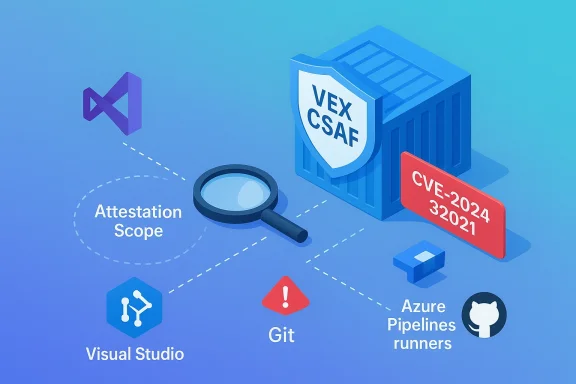
If you step back from the single‑sentence MSRC FAQ and look at Microsoft’s product family, you’ll find Git or Git‑implementations present in multiple places — and in many of those places the vulnerability could be relevant if the distribution/package provided an affected Git version.Key examples:
- Visual Studio / Visual Studio tooling: Visual Studio provides integrated Git tooling (the IDE uses Git to perform version control operations and offers a UI for Git). Visual Studio can use a system‑installed Git or the Git that ships as part of the developer workload. That means developers running Visual Studio on Windows commonly have access to a Git client that may be packaged with the product or installed alongside it.
- Microsoft‑hosted CI/CD agents (Azure Pipelines hosted agents): Microsoft’s hosted build agents include a curated set of developer tools and explicitly ship a Git client inside the VM images; the Azure Pipelines documentation shows how to view the included software per image and even explains how to prefer the agent‑bundled Git versus a PATH Git. If those images carried an affected Git build at the time a CVE was introduced, pipeline runs using local clone semantics could be in scope.
- Git for Windows and MSYS2 ecosystem: The Windows port of Git (Git for Windows) is maintained outside of Microsoft, but it is the common binary Windows developers install; some Microsoft installers and developer images bundle a Git for Windows distribution. The Git for Windows packaging and MSYS2 build chain are, therefore, relevant to people and products running Git on Windows.
- GitHub / GitHub Enterprise / GitHub Actions: GitHub — now a Microsoft company — runs Git in many contexts. GitHub‑hosted runners and GitHub Enterprise Server images contain Git tooling. Those environments are frequently updated, but they are separate product trees and must be audited independently for inclusion of a specific upstream Git release.
Technical risk assessment: how serious is CVE‑2024‑32021 in practice?
- Attack surface and prerequisites. The vulnerability is local‑only (it is not remotely exploitable without local privileges). Exploitation requires that a user clone a repository across a filesystem boundary where an untrusted actor can manipulate files in the source repository or the shared filesystem. The attack vector involves race conditions and symlink manipulation, so the practical attack surface is limited compared with network‑exposed bugs.
- Impact profile. The vulnerability is rated with a low CVSS base score by public databases (the vector reflects local attack with user interaction), but it has systemic integrity implications in multi‑user environments: if an attacker can cause hardlinks into another user’s repository objects, the attacker may later manipulate those source files to influence the victim’s repository when objects are read or garbage‑collected. This can produce confusing corruption, potential denial‑of‑service, or low‑integrity data inclusion scenarios.
- Workarounds and mitigations. Upgrading Git to the patched maintenance releases is the canonical fix. As an operational workaround, users cloning potentially untrusted local repositories can avoid git’s local hardlink optimizations by using
git clone lfile://protocol (or by ensuring clones happen across network protocols that do not use hardlinks). Note that the patched builds introduced a defense‑in‑depth change that can affect Git LFS behavior; users cloning LFS‑enabled repositories may need to rungit lfs pull` after cloning in certain versions.
Is Azure Linux the only Microsoft product that includes the vulnerable library?
- Microsoft has publicly attested that Azure Linux (CBL‑Mariner / Azure Linux distribution) includes the upstream component (in this case, Git or another third‑party library) for the CVE in question and therefore is potentially affected; Microsoft will update the CVE/VEX record if more products are identified. That is the official Microsoft position and it is authoritative for Azure Linux customers.
- That attestation, however, is not a blanket statement that other Microsoft products are unaffected. Independent analyses and community guidance repeatedly stress that a single‑product attestation is a scoped inventory confirmation rather than a global exclusion. Practically speaking, other Microsoft products, images, and services frequently include Git or Git‑derived components, and each of those artifacts should be inventoried and verified independently for the vulnerable Git versions.
- Put simply: the correct operational posture is to treat Azure Linux as a confirmed carrier (and patch accordingly), and to treat other Microsoft products or images that you use — Visual Studio, hosted build agents, GitHub runners, custom VM images, WSL images, and anything that bundles or runs Git — as potentially in scope until those products are explicitly attested or you independently verify the shipped Git version.
Practical steps for defenders and administrators
- Immediate patching for confirmed Azure Linux deployments. If you run Azure Linux (CBL‑Mariner), install Microsoft’s updated packages as published in the MSRC/CBL‑Mariner advisories and follow the VEX/CSAF guidance that Microsoft provides for Azure Linux customers. Treat the MSRC attestation as authoritative and apply the available updates immediately.
- Inventory your environment for Git binaries and versions. For every environment under your control, identify whether a Git client is present and which version is installed:
- On Windows developer machines and build agents check Git for Windows and Visual Studio‑bundled Git.
- In CI/CD images (Azure Pipelines, GitHub‑hosted runners) review the image’s included software list and pipeline logs to see the Git version the runner uses. Azure Pipelines documents the agent images and the included software explicitly; pipelines can also be configured to prefer the agent‑bundled Git or a PATH Git.
- **If you find an unpatched Git, upgrade to one of the patched releases.roject has issued the maintenance fixes. Upgrading to the patched releases listed earlier (2.45.1, 2.44.1, etc.) is the definitive remediation. For packaged distributions, apply vendor updates. For Windows, run the latest Git for Windows installer or update your Visual Studio workloads as recommended.
- Use conservative cloning practices for untrusted local sources. When you must clone a repository that resides on the same filesystem and you do not fully trust the owner, use
git clone --no-localorgit clone file://...to force a safe copy instead of hardlink optimizations. Avoid blindgit cloneof untrusted archives or repositories obtained from other users without making an isolated copy first. - Audit hosted runners and build images. If you rely on Microsoft‑hosted images (Azure Pipelines or GitHub Actions runners), check the image’s included Git version and track the provider’s advisories. For self‑hosted runners or internal build VMs, ensure your images use patched packages. Azure Pipelines documents the “Included Software” for each image; use those manifests to identify at‑risk runners.
- Monitor MSRC VEX/CSAF updates and vendor attestations. Microsoft’s phased publishing of machine‑readable attestations (CSAF + VEX) started with Azure Linux; Microsoft expects to expand coverage over time. Watch MSRC’s VEX feed and your distributor’s advisories for expanded mappings that name additional Microsoft products if and when they’re discovered to ship the vulnerable component.
What to tell management and developers
- Tell management that Azure Linux is a confirmed carrier of the open‑source component referenced by the MSRC attestation and that Azure Linux images should be updated immediately where applicable. That is the defensible, machine‑readable fact from Microsoft’s VEX files.
- Tell developers and build‑ops teams to treat other Microsoft artifacts as potentially affected until they are verified. Visual Studio, Git for Windows, hosted agents, and GitHub runners are all places Git commonly appears; those artifacts deserve targeted verification. Avoid blanket reliance on the MSRC sentence as an “only affected product” statement.
- Prioritize remediation by risk: production systems running Azure Linux, build images that run untrusted code, or multi‑tenant build runners where different users’ repositories might interact on the same filesystem should be higher priority for verification and patching.
Notable strengths and remaining uncertainties
Strengths:- Microsoft’s move to publish CSAF and VEX attestations (starting with Azure Linux) is a real improvement for supply‑chain transparency; these machine‑readable artifacts make it easier to decies to a product without manual triage. That’s valuable and reduces noise for customers.
- Upstream Git fixed the issue quickly and provided maintenance release paths for multiple supported release lines; distro rs had clear upgrade targets.
- Scope ambiguity: Microsoft’s single‑product attestations should not be conflated with a company‑wide audit; other Microsoft artifacts — particularly developer images, hosted runners, or bundled binaries — may still have the vulnerable Git version until specifically inventoried and patched. This is the central operational risk to organizations that assume “Azure Linux only” means “no other Microsoft product is at risk.”
- Supply‑chain timing: If a CI image, VM snapshot, or installer shipped earlier with an unpatched Git and remains in use, automated pipelines or developer workstations could still be exposed. Detecting these cases requires active inventory, not passive reliance on a single vendor statement.
- Local‑only attack profile can lull teams into complacency: Because CVE‑2024‑32021 is a local attack (not remotely exploitable in the usual sense), teams may deprioritize patching. That would be a mistake in multi‑user or CI contexts where local access or shared filesystems are common.
Quick checklist (for engineers)
- Check
git --versionon your dev machines, build agents, and images. If the installed version is older than the patched releases, schedule an upgrade. - If you use Azure Linux images, apply the MSRC/CBL‑Mariner updates Microsoft published.
- On CI runners, inspect the “Included Software” manifest and pipeline logs to confirm Git version; where necessary, add an explicit step to upgrade or to prefer a patched Git from PATH.
- Avoid
git cloneof untrusted local repositories without--no-localor without copying to an isolated path first. - If you rely on third‑party images or vendor snapshots (including internal Golden Images), rebuild them with patched packages.
Conclusion
Microsoft’s public statement that “Azure Linux includes this open‑source library and is therefore potentially affected” is an authoritative, product‑scoped attestation that Azure Linux customers must treat as actionable.However, that sentence is not a comprehensive inventory of every Microsoft product or image. In practice, Git and Git‑derived tooling appear across Microsoft’s ecosystem — IDEs, hosted agents, runner images, and developer toolchains — and any artifact that shipped an unpatched Git version should be treated as potentially at risk until verified and patched. The correct defensive posture is to apply the upstream Git patches where present, inventory and verify other Microsoft artifacts you rely on, and monitor MSRC’s expanding CSAF/VEX attestations rather than assuming exclusivity based on a single product attestation.
If you’re responsible for any of the following — Azure Linux hosts, developer workstations, hosted runners, or build images — prioritize inventory, patching, and conservative cloning practices. The vulnerability is fixable, but only operational vigilance will close the gap between a single product attestation and the broader reality of where Git runs in your environment.
Source: MSRC Security Update Guide - Microsoft Security Response Center
