

Microsoft’s terse MSRC wording — that “Azure Linux includes this open‑source library and is therefore potentially affected” — answers a narrow inventory question about CVE‑2024‑34062, but it does not prove exclusivity: Azure Linux is the product Microsoft has attested contains the vulnerable tqdm component so far, yet other Microsoft artifacts could still ship the same vulnerable library until they have been explicitly inventoried and published. s://www.microsoft.com/en-us/msrc/blog/2025/10/toward-greater-transparency-machine-readable-vulnerability-exploitability-xchange-for-azure-linux)
CVE‑2024‑34062 is a locally exploitable command‑line injection flaw in the widely used Python progress‑bar library tqdm. The root problem is that certain optional, non‑boolean CLI options were passed into Python’s built‑in eval() for parsing, which allowed a crafted argument value to execute arbitrary Python code in the context of the user running the program. The maintainers fixed the issue in the 4.66.3 release.
This CVE received broad distributor tracking and vendor advisories: Ubuntu and several Linux distributors issued security notices and backports, and upstream GitHub posted a security advisory and a patch release. Multiple third‑party vulnerability trackers (NVD, SUSE, Debian, and distribution security notices) document the same technical description and the patched version.
Why this matters: tqdm is lightweight and often bundled inside Python packages, DevOps scripts, CI/CD runners, data‑processing tools, and container images. Even though exploitation requires local access and user interaction, an attacker who already has the ability to supply arguments to a process running tqdm can pivot into remote code execution scenarios—especially in multi‑tenant or shared environments where less‑privileged processes run as service accounts. Several vendors therefore moved quickly to publish fixes or mitigations.
To be explicit:
Why that distinction matters:
Act quickly where you are confirmed affected, and verify broadly across your estate where Microsoft’s product‑by‑product inventory has not yet completed — that pragmatic two‑track approach (patch where attested, verify where not) is the most defensible posture for enterprise operators facing CVEs tied to widely reused open‑source libraries.
Source: MSRC Security Update Guide - Microsoft Security Response Center
 Background
CVE‑2024‑34062 is a locally exploitable command‑line injection flaw in the widely used Python progress‑bar library tqdm. The root problem is that certain optional, non‑boolean CLI options were passed into Python’s built‑in eval() for parsing, which allowed a crafted argument value to execute arbitrary Python code in the context of the user running the program. The maintainers fixed the issue in the 4.66.3 release.This CVE received broad distributor tracking and vendor advisories: Ubuntu and several Linux distributors issued security notices and backports, and upstream GitHub posted a security advisory and a patch release. Multiple third‑party vulnerability trackers (NVD, SUSE, Debian, and distribution security notices) document the same technical description and the patched version.
Why this matters: tqdm is lightweight and often bundled inside Python packages, DevOps scripts, CI/CD runners, data‑processing tools, and container images. Even though exploitation requires local access and user interaction, an attacker who already has the ability to supply arguments to a process running tqdm can pivot into remote code execution scenarios—especially in multi‑tenant or shared environments where less‑privileged processes run as service accounts. Several vendors therefore moved quickly to publish fixes or mitigations.
Technical overview: how the CLI injection works
- The CLI parser in tqdm accepted optional non‑boolean arguments such as
--delim,--buf-size, and--manpath. Instead of treating these values as opaque strings, earlier code paths fed them into Python’s eval() to coerce or parse types. - Using eval() on attacker‑controlled input is a classic unsafe pattern: it runs the interpreter on arbitrary text and can execute any Python code available in that runtime, including system calls. An attacker could construct an argument that embeds an exec() or other Python call to run shell commands or open network connections.
- The vulnerability is local by design: exploitation requires being able to execute the tqdm binary or a Python module invocation that exposes the vulnerable CLI parsing. The severity therefore depends on where and how tqdm is used — e.g., local development scripts are lower risk than system services or automation runners that accept untrusted inputs.
Microsoft’s advisory: what it says — and what it does not
Microsoft’s public CVE entry for CVE‑2024‑34062 (and similar entries) uses a specific phrasing: Azure Linux is a product Microsoft has inventory‑checked and found the implicated open‑source component in, and is therefore potentially affected. That sentence is an authoritativntory attestation — not a universal statement that no other Microsoft product ships the same vulnerable code.To be explicit:
- When Microsoft says “Azure Linux includes this open‑source library,” it confirms that Microsoft’s Azure Linux images or packages include the vulnerable upstream software in the builds Microsoft examined. That means Azure Linux customers should treat the attestation as a direct, actionable signal and apply the appropriate updates.
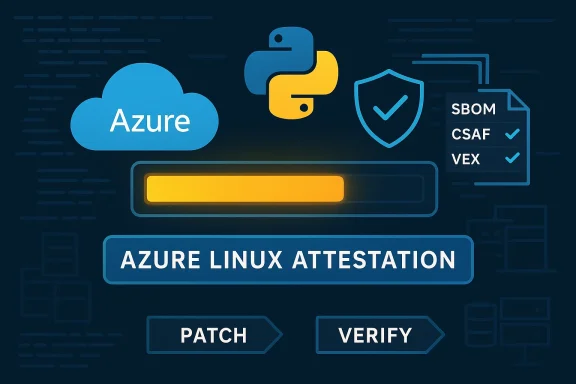
- Microsoft’s phrasing deliberately avoids claiming exclusivity. Microsoft has publicly stated it began publishing machine‑readable VEX/CSAF attestations beginning with Azure Linux in October 2025, and that it will update the CVE mapping if additional Microsoft products are found to carry the same component. In other words, the attestation is a found‑positive for Azure Linux and a promise to expand invenroof that other Microsoft SKUs are clean.
Is Azure Linux the only Microsoft product that includes tqdm (and so potentially affected)?
Short answer: No — Azure Linux is the only Microsoft product Microsoft has publicly attested (so far) to include the affected tqdm version for CVE‑2024‑34062, but that does not prove that other Microsoft products cannot or do not include the same upstream code.Why that distinction matters:
- Microsoft’s attestation is an inventory result for a named product family; it is authoritative for the artifacts Microsoft checked. It is not an absolute, global scan of every Microsoft image, kernel build, container base image, or bespoke appliance. Other Microsoft artifacts — for example, Marketplace VM images, curated container base images, Windows Subsystem for Linux (WSL) kernels, internal automation tools, or partner distributions used in managed services — might include tqdm depending on how they were built and which package sets they include.
- The presence of a Python package in an artifact is a per‑artifact, build‑time property. Different products use different packaging, base images, and pin levels. Therefore a single‑line attestation cannot replace per‑artifact verification across a large estate.
Cross‑checks and independent corroboration
To avoid relying on a single vendor claim, defenders should triangulate using multiple authoritative sources:- Upstream and package maintainers: GitHub posted a security advisory and the fix for tqdm (patched in v4.66.3). This is the canonical upstream remediation record.
- Vulnerability databases: NVD, distributor advisories (Ubuntu, SUSE, Debian), and enterprise vendor bulletins (IBM, SUSE) independently document the vulnerability’s description, severity, and affected ranges. These sources confirm the technical facts and the existence of a released patch.
- Distribution CVE notices: Ubuntu’s USN and Debian security trackers show how downstream packagers treated the issue and which distro versions received backports. This helps operators understand whether a distro image in their stack was patched or needs an update.
Practical steps for Azure Linux customers (immediate actions)
- Verify whether your systems run a vulnerable tqdm package or any packages that vendor‑bundle tqdm as a dependency.
- If you find vulnerable versions, upgrade to tqdm >= 4.66.3 or apply your distribution’s security update that contains the patched package. Ubuntu and other distributors provided backported fixes for their supported releases.
- For managed or immutable images (VM images, containers): rebuild the image with updated packages and redeploy, or patch in‑place where allowed.
- If you manage a multi‑tenant service or CI/CD runners, audit the use of tqdm in pipelines and restrict who can submit or modify runner‑side scripts that could invoke the CLI with untrusted arguments.
- Where practical, apply the principle of least privilege: run long‑lived automation with accounts that cannot run arbitrary system‑level changes if compromised.
How to check across an estate (detection guidance)
- Search package metadata and Python environments:
- On Linux images: query package managers (apt, rpm) for installed tqdm packages and versions.
- For Python virtualenvs and site‑packages: inspect pip freeze outputs for tqdm and parse versions.
- For container images: use an image scanner or run a temporary container and check installed Python packages.
- For forensic or runtime detection:
- Look for unexpected subprocess creations or unexplained shell commands originating from processes that call Python‑based utilities.
- Monitor command‑line invocations and argument values for suspicious patterns, especially where user content is inserted into CLI arguments.
- For build pipelines:
- Record SBOMs for images and artifacts; ensure SBOMs list runtime Python packages and versions. If your vendor produces VEX/CSAF files, consume them in your triage pipeline to map vulnerabilities to specific SKUs.
- Run package version queries across endpoints and containers to find tqdm instances.
- Correlate results with the fixed version (>= 4.66.3).
- Flag any artifact not yet patched and schedule remediation.
- Where possible, enforce image and package signing to prevent untrusted changes.
Risk analysis and scenarios
Not every environment with tqdm is high risk. Consider these factors when prioritizing remediation:- Exploitability: The flaw requires the attacker to supply CLI arguments to the vulnerable invocation. Services that accept untrusted user input and pass it, directly or indirectly, to a process that invokes tqdm are high priority.
- Privileges: If tqdmed service account (root or high‑privilege user), successful exploitation yields far greater impact than exploitation under an unprivileged local user.
- Exposure surface: Multi‑tenant runners, shared CI agents, developer machines with exposed shells, and container build systems often accept inputs that could be weaponized. These should be patched first.
- Mitigating compensations: Sandboxing, process isolation, and restricted runtime privileges reduce impact even if code is executed.
Recommendations for Microsoft product consumers and partners
- Treat Microsoft’s Azure Linux attestation as an immediate, actionable signal for that product family. Apply the vendor updates Microsoft and your distribution advise.
- For other Microsoft products, do not assume “not affected” merely because a product is unnamed in the MSRC advisory. Instead:
- Check the Microsoft VEX/CSAF feed for product‑specific attestations (MSRC has begun publishing VEX files starting with Azure Linux). ([microsoft.com](Toward greater transparency: Introducing Machine-readable Vulnerability Exploitability Xchange (VEX) for Azure Linux and beyond SBOMs/package inventories for any Microsoft artifacts you rely on (Marketplace images, WSL distributions, managed appliance images).
- If uncertainty remains, contact Microsoft support or your account team and ask for verification that the specific SKU or artifact you use is not subject to the vulnerability.
- Automate consumption of vendor CSAF/VEX files and integrate these into your vulnerability management platform so product‑level attestations translate into triage and remediation actions automatically.
Strengths, limitations, and potential risks in Microsoft’s approach
Strengths- Microsoft’s move to publish machine‑readable CSAF and VEX attestations increases transparency and makes automated triage practical for customers and security vendors. Publishing a definitive inventory for Azure Linux is a practical first step that gives customers a reliable signal to act on.
- Phased inventory rollout creates temporal gaps. Until Microsoft completes attestations across all product families, customers must perform artifact‑level verification for other SKUs. That creates a window where an otherwise avoidable exposure could persist in an unmanaged or overlooked image.
- The wording “is therefore potentially affected” is precise but can be misread by non‑technical audiences as implying exclusivity. Security teams should be aware of this semantics and apply a conservative verification posture.
- Dependence on SBOM and build metadata quality: VEX/CSAF helps only if the underlying SBOMs and package inventories are complete and accurate. Incomplete metadata reduces the value of automated attestations.
Final checklist for defenders (short, actionable)
- If you run Azure Linux: patch to the distributor‑provided package or upgrade tqdm to >= 4.66.3.
- For other Microsoft images and artifacts: verify via VEX/CSAF, SBOMs, or direct inventory checks before assuming they are unaffected.
- Harden CI/CD and automation runners: restrict who can submit runner scripts and avoid running third‑party CLI tools with elevated privileges.
- Automate ingestion of vendor CSAF/VEX feeds and integrate them into patching pipelines.
Conclusion
CVE‑2024‑34062 is a straightforward but real local CLI‑injection vulnerability in tqdm that is fixed in the 4.66.3 release; operators should patch vulnerable installations. Microsoft’s MSRC statement that “Azure Linux includes this open‑source library and is therefore potentially affected” is an important, authoritative inventory attestation for Azure Linux customers, but it is not a global exclusivity guarantee. Treat the attestation as a confirmed “yes” for Azure Linux, and treat non‑attested Microsoft artifacts as not yet validated until Microsoft publishes additional VEX/CSAF attestations or you confirm via SBOM and artifact inspection.Act quickly where you are confirmed affected, and verify broadly across your estate where Microsoft’s product‑by‑product inventory has not yet completed — that pragmatic two‑track approach (patch where attested, verify where not) is the most defensible posture for enterprise operators facing CVEs tied to widely reused open‑source libraries.
Source: MSRC Security Update Guide - Microsoft Security Response Center
