

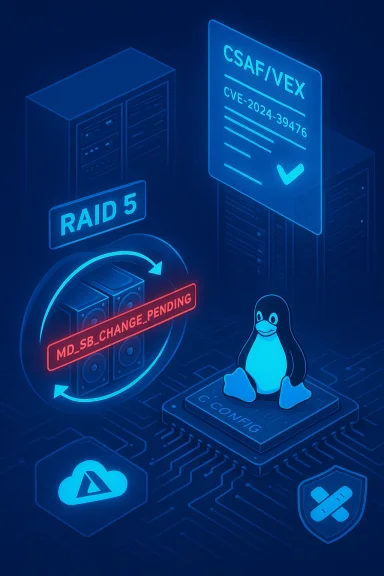
The Linux kernel fix addressing CVE-2024-39476 — a deadlock in the md/raid5 subsystem where raid5d() could wait for itself to clear MD_SB_CHANGE_PENDING — is an important stability patch that has rippled through distributions and cloud images. Microsoft’s public guidance has confirmed that Azure Linux is a confirmed carrier of the affected upstream code and therefore in-scope for remediation, but the practical security question for administrators and incident responders is broader: does that Microsoft statement mean every Microsoft product is safe except Azure Linux? The short, actionable answer is: No — Azure Linux is the only Microsoft product Microsoft has attested as containing the upstream md/raid5 code so far, but absence of attestation is not proof of absence. This article explains the technical issue, maps how vendors have responded, analyses Microsoft’s attestation approach (CSAF/VEX), and gives step-by-step checks and mitigation guidance for operators who must decide whether and how urgently to act.
The root cause of CVE-2024-39476 lies inside the RAID‑5 device driver logic in the Linux kernel. The daemon thread that manages RAID‑5 stripes — commonly called raid5d() — can enter a pathological loop in certain timing and locking scenarios. The simplified chain of events is:
Key technical characteristics that operators must note:
The fix is conservative and focuses on scheduling/ordering rather than wholesale functional change: it prevents raid5d() from stalling the system while waiting for its own superblock update to complete. Distributors backported or packaged the fix into stable kernels for affected series, and vendors released advisories classifying severity generally in the medium range (CVSS v3 ~5.5) because the vector is local and impact is availability.
Multiple mainstream Linux vendors and distributions (for example, major vendor kernel advisories and distribution security bulletins) have included this fix in their kernel updates. Cloud providers that ship their own kernel packages or curated images have also pushed kernel updates once they mapped the upstream fix to their builds.
Two points of high operational importance come from that phrasing:
That makes these attestations highly useful for automated risk management:
Strengths of this approach:
Source: MSRC Security Update Guide - Microsoft Security Response Center
 Background: what CVE-2024-39476 actually is
The root cause of CVE-2024-39476 lies inside the RAID‑5 device driver logic in the Linux kernel. The daemon thread that manages RAID‑5 stripes — commonly called raid5d() — can enter a pathological loop in certain timing and locking scenarios. The simplified chain of events is:- raid5d() calls md_check_recovery(), which needs to clear a state flag named MD_SB_CHANGE_PENDING.
- Clearing that flag requires holding reconfig_mutex (a kernel lock).
- raid5d() also processes IO in a tight loop until IO is issued; but the IO issuance path can be blocked by MD_SB_CHANGE_PENDING.
- If another context holds reconfig_mutex, and raid5d() is waiting for MD_SB_CHANGE_PENDING to clear, the system can enter a deadlock: raid5d() spins and consumes CPU while work needed to clear the pending flag cannot proceed.
Key technical characteristics that operators must note:
- The issue is in upstream Linux kernel md/raid5 code and was repaired by upstream kernel patches.
- Impact is primarily availability (DoS/CPU hang).
- Exploitation requires local privileges or conditions that allow triggering the pathological sequence (e.g., creating or operating RAID‑5 arrays and timing IO and control operations appropriately).
- Distributions and cloud vendors have issued patches as kernel updates or stable backports; operators should treat this as a stability/security patch for any kernel that includes md/raid components.
Where the fix came from and how it behaves
Upstream kernel maintainers diagnosed the regression and landed code changes that avoid the circular wait: instead of continuing to attempt IO while MD_SB_CHANGE_PENDING is still set, raid5d() now skips issuing IO in that state and relies on waking the daemon when reconfig_mutex is released. That change mirrors approaches used in other md drivers (raid1/raid10) and breaks the deadlock cycle.The fix is conservative and focuses on scheduling/ordering rather than wholesale functional change: it prevents raid5d() from stalling the system while waiting for its own superblock update to complete. Distributors backported or packaged the fix into stable kernels for affected series, and vendors released advisories classifying severity generally in the medium range (CVSS v3 ~5.5) because the vector is local and impact is availability.
Multiple mainstream Linux vendors and distributions (for example, major vendor kernel advisories and distribution security bulletins) have included this fix in their kernel updates. Cloud providers that ship their own kernel packages or curated images have also pushed kernel updates once they mapped the upstream fix to their builds.
Microsoft’s public statement: what it actually says
Microsoft’s Security Response Center (MSRC) entry for related Linux kernel CVEs — and similar entries around kernel maintenance — typically includes a short FAQ: Is Azure Linux the only Microsoft product that includes this open-source library and is therefore potentially affected by this vulnerability? Microsoft’s answer has been to confirm that Azure Linux (Microsoft’s curated Linux distribution images for Azure customers) is included and kept up to date, and that Microsoft began publishing machine-readable CSAF/VEX attestations as part of a rollout to describe which of its products include specific open-source components. The company has also stated it will update CVE entries if impact to additional Microsoft products is identified.Two points of high operational importance come from that phrasing:
- Microsoft is making a product-scoped attestation for Azure Linux: the attestation affirms that Azure Linux images were inspected and were found to include the implicated kernel component (and therefore are in-scope for the CVE).
- Microsoft is not — in that message alone — asserting that no other Microsoft products include the same upstream code. Rather, Microsoft is indicating Azure Linux is the product it has checked and attested to at the time of the advisory, and that the inventory work will expand.
Why product‑scoped attestations matter (CSAF/VEX explained in practice)
CSAF (Common Security Advisory Framework) and VEX (Vulnerability Exploitability eXchange) are machine-readable formats intended to let vendors publish structured attestation information about which of their products are affected by specific upstream vulnerabilities. When a vendor publishes a VEX/CSAF attestation for a product it is essentially saying “we scanned or inventoried this product and we confirm a hit (or confirm not present).”That makes these attestations highly useful for automated risk management:
- An attestation is a positive signal that a named artifact was checked.
- It is not a comprehensive statement about every artifact a vendor publishes.
- Vendors commonly roll out attestations gradually: they start with a manageable product set (for example, a single cloud distro) and expand.
Why Azure Linux being the only attested product so far does not mean others are safe
There are multiple reasons you cannot conclude “only Azure Linux is affected” simply from the attestation:- Microsoft builds and ships multiple Linux kernel artifacts and images. Examples include the WSL2 kernel distributed with Windows, specialized kernel builds used by some Azure VM images (linux‑azure), AKS node images, Marketplace VM images and appliance kernels. Each build uses a specific upstream kernel version and a specific kernel configuration (CONFIG_* flags). Whether md/raid5 code is present depends on both the upstream commit range and configuration: the code can be built-in or compiled as modules.
- An attacker or administrator who relies solely on the absence of a Microsoft attestation risks missing exposure in other Microsoft artifacts. For example, a WSL2 kernel or older linux‑azure build could contain the vulnerable code if it was built from an upstream commit range predating the fix or if the vendor backported an earlier patch set.
- Microsoft’s VEX/CSAF rollout deliberately started with Azure Linux as an initial scope; other product families are being inventoried in subsequent stages. Absence of a public attestation for a product is therefore not an assurance of absence.
What systems and images you must check right now
If you are responsible for systems where Linux kernels are supplied by Microsoft (or where Microsoft is the publisher of the image), make these checks a matter of urgency.- Inventory all Linux kernels you run that come from Microsoft or run on Microsoft-hosted platforms:
- Azure VM images (both Microsoft-curated and Marketplace images).
- AKS node images and custom node pools.
- WSL2 instances on Windows hosts (check the WSL kernel version).
- Any specialized appliances or images labeled as Microsoft-supplied.
- At the host/instance level, run these commands to determine whether md/raid is present and whether the kernel is likely vulnerable:
- Check kernel version:
uname -r - Check MD status:
cat /proc/mdstat - Check for loaded modules:
lsmod | grep md_modandlsmod | grep raid5 - Inspect kernel config if available:
zcat /proc/config.gz | grep CONFIG_MD(or check the distro’s /boot/config-* file) - If md modules are present or arrays exist, treat the host as potentially exposed until a kernel package is confirmed patched.
- For WSL2 users:
- Query the WSL kernel version:
wsl uname -r - Compare that version/branch against the upstream fix range and Microsoft’s WSL kernel release notes.
- If your WSL kernel predates the upstream fix and you do not use a custom kernel, consider updating the WSL kernel per Microsoft’s guidance.
- For Azure images and Marketplace VMs:
- Check the image manifest and kernel version.
- Confirm whether the image uses Azure Linux (attested) or a different kernel lineage.
- If the image uses a third-party kernel, consult that publisher’s advisory.
Mitigation and remediation steps (practical checklist)
- Patch kernels: Apply vendor-provided kernel updates that include the md/raid5 fix. For Azure Linux customers, follow Microsoft’s patch guidance for the Azure Linux image in use.
- Reboot schedule: Because kernel updates often require reboots, schedule maintenance windows, especially for production storage nodes hosting RAID arrays.
- Module removal / temporary mitigation: If you cannot immediately update, consider whether you can unload md modules safely on affected systems without disrupting production. This is rarely feasible on systems actively using md arrays.
- Reduce attack surface: Limit local user access on systems that host RAID block devices. Because exploitation requires local actions, strict access control reduces practical exploitability.
- Monitor for symptoms: Watch for processes pegged at high CPU centered on
raid5dor unexplained IO stalls. Instrumentation that correlates CPU spikes with md-related kernel threads will help detect unintended hangs. - Inventory automation: Use automated inventory tools to report kernel versions and presence of md components across your fleet. Map kernel versions to upstream commit ranges to confirm presence or absence of the fix.
- WSL and developer devices: Treat WSL kernels as part of your asset inventory where sensitive operations occur (CI runners, developer test rigs). If a build or test platform uses WSL and local RAID device emulation, update accordingly.
Critical analysis of Microsoft’s attestation strategy and its operational effects
Microsoft’s decision to publish CSAF/VEX attestations and to begin with Azure Linux is strategically sensible: start with a product family that is cohesive, widely used, and where Microsoft controls the artifact lifecycle end-to-end. That yields quick wins in transparency and helps Azure customers prioritize patching.Strengths of this approach:
- Clear guidance for Azure Linux customers: operators who run Azure Linux images have definitive, vendor-backed information they can rely on.
- Machine-readable attestations: CSAF/VEX enables automation in vulnerability response and reduces manual mapping work for security teams that consume those attestations.
- Public commitments to update: Microsoft’s statement that CVE entries will be updated if more products are affected is constructive and helps set expectations.
- Attestation scope vs. fleet reality: Microsoft distributes or influences many kernel artifacts (WSL, linux‑azure, Marketplace images). A product-scoped attestation does not automatically cover those other artifacts. Security teams that assume attestation coverage is exhaustive may under-protect their estate.
- Timing and coverage gaps: Attestations are effective only once published. Microsoft’s initial rollout timeline means there is a window where other Microsoft artifacts remain unverified.
- Opaque backports and forks: Even when a vendor publishes an attestation, separate backports or internal forks might include vulnerable code or different patch semantics; defenders must still verify artifact-specific details such as kernel configuration and backport history.
- Operational complexity for defenders: The practical burden falls to defenders to perform granular checks (e.g., presence of md modules, kernel version matching), which can be time-consuming across large fleets.
Practical examples and scenarios
Scenario A — You run Azure Linux VMs on production storage nodes
Action: Treat this as a confirmed hit. Patch kernel packages for Azure Linux immediately according to Microsoft’s guidance. Schedule reboots if kernel updates require them. Validate the fix by checking that the kernel package version matches the vendor advisory or by confirming that the kernel’s commit set includes the upstream fix.Scenario B — You run third-party Marketplace images in Azure
Action: Do not assume Marketplace images are free of the vulnerable code. Check each image’s kernel version and its /proc/mdstat or lsmod output. If the image uses Microsoft’s linux‑azure kernel or a kernel that predates the fix, either update the image, apply in-place kernel patches, or migrate workloads to patched images.Scenario C — Developers using WSL2 on Windows machines
Action: Confirm the WSL kernel version. If the WSL kernel build predates the upstream fix and MD is present, consider updating WSL (Microsoft periodically publishes kernel updates via Windows Update and WSL tooling). For high-value developer systems that run RAID operations or test frameworks, enforce patching or isolate the environment.Scenario D — Mixed cloud/edge deployments with custom kernels
Action: Inventory kernel configs for devices and appliances. If device kernels include CONFIG_MD or md modules, validate kernel versions against the upstream fix. Work with device vendors to obtain patched firmware or kernel updates.How to verify a kernel has the upstream fix (practical verification)
If you are a technical operator comfortable with kernel internals, use the following process to triangulate whether a particular kernel build includes the upstream fix:- Get the kernel version and build identifier:
uname -aand note the exact version string. - Check vendor advisories: match the kernel version to the vendor security bulletin for CVE-2024-39476 and confirm the fixed package version.
- Inspect the kernel source or stable commit list used for the build:
- If you can access the build manifest or a package changelog, look for the upstream commit IDs mentioned in the upstream patch.
- If source access is not possible, test for the condition (careful — destructive in production):
- In a controlled test environment, simulate RAID‑5 operations and stress the system to attempt to trigger the hang. Confirmed hangs that match the described behavior indicate unpatched code.
- For module-level builds, check if md/raid code is present:
grep -i raid /boot/config-$(uname -r)to see whether RAID drivers are built-in or modular.- If modules are used,
modinfo raid5orlsmod | grep raid5can confirm presence.
Final recommendations for security teams
- Prioritize patching for systems that are both (a) Microsoft-published Azure Linux images (confirmed) and (b) any system on which local user or automation can manipulate md/raid devices (high impact).
- Treat Microsoft VEX/CSAF attestations as authoritative for the product they name. For everything else from Microsoft, assume unknown until you either (i) obtain a Microsoft attestation, (ii) verify the artifact locally, or (iii) obtain vendor confirmation.
- Automate inventory to report kernel version, presence of md modules, and whether a machine publishes a vendor-provided kernel. Use that inventory to trigger remediation workflows.
- Include WSL kernels in your asset inventory where they run workflows tied to CI, testing, or privileged operations.
- If you cannot patch immediately, reduce exposure via access controls and monitoring for raid5d / md-related hangs.
Conclusion
CVE-2024-39476 is a classic example of a kernel-level availability defect that became a cross-distribution maintenance issue: upstream fixed the deadlock by changing raid5d() behaviour, vendors backported the patch, and cloud providers and distributors released updates. Microsoft’s public wording makes Azure Linux the one Microsoft product they have explicitly attested as including the vulnerable upstream code — which means Azure Linux customers should treat the advisory as definitive for that product and remediate accordingly. However, the broader operational reality remains: attestation is product-scoped and incremental, and absence of a Microsoft attestation for other Microsoft artifacts does not equal proof that those artifacts are unaffected. Defenders must therefore maintain a conservative posture: inventory Microsoft-supplied kernels, check for the presence of md/raid components, apply vendor patches, and treat unverified Microsoft artifacts as potentially in-scope until proven otherwise.Source: MSRC Security Update Guide - Microsoft Security Response Center
