

A subtle bug in the Sentry Python SDK (sentry-sdk) that caused environment variables to leak into child processes — tracked as CVE‑2024‑40647 — has triggered an important question for Azure customers and defenders alike: when Microsoft’s MSRC advisory says “Azure Linux includes this open‑source library and is therefore potentially affected,” does that mean only Azure Linux is at risk? The short, practical answer is: no — Azure Linux is the only Microsoft product Microsoft currently lists as an attested carrier of the affected component, but that product‑level attestation is not an exclusivity guarantee. Organizations must treat Azure Linux images as confirmed in‑scope while performing artifact‑level discovery across all Microsoft‑provided images, containers, SDKs and appliances they operate until Microsoft expands its attestations or your inventories prove otherwise.
Sentry’s Python SDK — widely known as sentry‑sdk or Sentry‑Python — is a popular open‑source client used to capture errors, exceptions and tracing data and forward them to Sentry’s monitoring service. It integrates with many Python frameworks and, by default, enables a set of integrations including the Stdlib integration that instruments Python’s standard library functions such as subprocess calls.
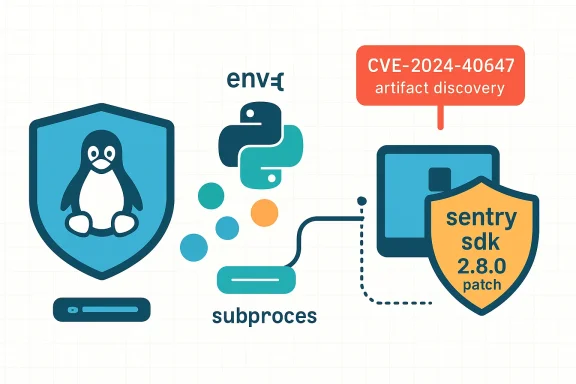
In July 2024 the Sentry project fixed a bug where instrumentation introduced by the Stdlib integration caused a call that used an explicit empty environment (env={}) for a subprocess to be interpreted incorrectly, resulting in the full process environment being inherited by the child instead of the intentionally empty environment. This behavior violated the expectation developers rely on to prevent sensitive environment variables (API keys, credentials, tokens, secrets) from being accessible to subprocesses. The behaviour was tracked as CVE‑2024‑40647 and the upstream fix landed in sentry‑sdk 2.8.0 (and was backported to a supported 1.x maintenance release).
Why this matters in real world deployments is straightforward: many applications put secrets and credentials in environment variables (for example, cloud credentials used by code launched by a larger service). If a library you depend on accidentally re‑injects the full environment into a spawned child process, a subprocess you otherwise think is isolated can gain access to data you explicitly tried to hide.
Important nuance: that phrasing does not mean Microsoft is claiming that no other Microsoft product could include tomponent. Microsoft’s statement is a signal about what the vendor has inventory‑checked and confirmed for the named product family (Azure Linux) — in other words, it’s an attestation of what Microsoft has finished, not a proof that other artifacts are free of the component. Many WindowsForum and industry analyses have emphasized ce of a VEX/CSAF attestation for a product is absence of attestation, not proof of absence of the component. Treat Microsoft’s attestation for Azure Linux as authoritative for that product while verifying everything else independently.
Microsoft’s advisory that “Azure Linux includes this open‑source library and is therefore potentially affected” is authoritative for Azure Linux customers — it signals a confirmed carrier — but it should not be read as an exclusivity guarantee that no other Microsoft product can include the library. Treat Azure Linux updates as an urgent priority, and assume uncertainty elsewhere until you can verify other Microsoft artifacts via SBOMs, image scans and dependency inventories. In short: act quickly where Microsoft has attested, and verify everywhere else until attestations or your own scans prove those artifacts are clean.
Source: MSRC Security Update Guide - Microsoft Security Response Center
 Background / Overview
Sentry’s Python SDK — widely known as sentry‑sdk or Sentry‑Python — is a popular open‑source client used to capture errors, exceptions and tracing data and forward them to Sentry’s monitoring service. It integrates with many Python frameworks and, by default, enables a set of integrations including the Stdlib integration that instruments Python’s standard library functions such as subprocess calls.In July 2024 the Sentry project fixed a bug where instrumentation introduced by the Stdlib integration caused a call that used an explicit empty environment (env={}) for a subprocess to be interpreted incorrectly, resulting in the full process environment being inherited by the child instead of the intentionally empty environment. This behavior violated the expectation developers rely on to prevent sensitive environment variables (API keys, credentials, tokens, secrets) from being accessible to subprocesses. The behaviour was tracked as CVE‑2024‑40647 and the upstream fix landed in sentry‑sdk 2.8.0 (and was backported to a supported 1.x maintenance release).
Why this matters in real world deployments is straightforward: many applications put secrets and credentials in environment variables (for example, cloud credentials used by code launched by a larger service). If a library you depend on accidentally re‑injects the full environment into a spawned child process, a subprocess you otherwise think is isolated can gain access to data you explicitly tried to hide.
What the bug actually does (technical summary)
- The vulnerability only appears when the Stdlib integration is enabled (it is enabled by default in sentry‑sdk).
- The bug occurs in the instrumentation that wraps the Python subprocess machinery. When a developer calls subprocess.* with env={} to request no environment to be passed to the child, the instrumentation treats the empty dict as if the caller had passed None, and consequently inherits the parent process environment.
- This means child processes can receive environment variables such as API keys, database URIs, cloud credentials, and other secrets — even though the application developer explicitly used env={} to prevent that. The underlying root cause is an instrumentation logic error in the SDK's patch of the standard library subprocess interface.
Confirmed fixes and recommended remediations
The upstream Sentry project fixed the bug and published the patched SDK:- Fixed in sentry‑sdk 2.8.0. The fix was merged as part of pull request #3251. Upgrading to 2.8.0 or newer is the primary remediation.
- A backport was published for the 1.x maintenance line (the backported version is identified in advisories; operators who still run 1.x should move to the patched 1.45.x backport or upgrade to the current 2.x line).
- Temporary mitigations if you cannot upgrade immediately:
- Avoid calling subprocess with env={} — use a minimal explicit mapping (for example, env={"EMPTY_ENV": "1"}) to prevent the instrumentation from confusing an explicit empty mapping with None.
- Disable the Stdlib integration when initializing Sentry: initialize with integrations=[] or selectively exclude Stdlib so Sentry does not patch subprocess calls. This reduces telemetry but avoids the problematic instrumentation.
What Microsoft actually said — and how to read it
In Microsoft’s MSRC Security Update Guide entry for CVE‑2024‑40647 (the page linked in your note), the short FAQ line reads in the same standardized phrasing Microsoft now uses for many advisories: “Azure pen‑source library and is therefore potentially affected…” That sentence is an authoritative, product‑scoped inventory attestation: Microsoft inspected the Azure Linux distribution artifacts and found the implicated upstream component, so Azure Linux images are in‑scope and should be patched. Microsoft has also publicly committed to expand the machine‑readable CSAF/VEX attestations it publishes and to update CVE mappings later if additional products are identified as carriers.Important nuance: that phrasing does not mean Microsoft is claiming that no other Microsoft product could include tomponent. Microsoft’s statement is a signal about what the vendor has inventory‑checked and confirmed for the named product family (Azure Linux) — in other words, it’s an attestation of what Microsoft has finished, not a proof that other artifacts are free of the component. Many WindowsForum and industry analyses have emphasized ce of a VEX/CSAF attestation for a product is absence of attestation, not proof of absence of the component. Treat Microsoft’s attestation for Azure Linux as authoritative for that product while verifying everything else independently.
Direct answer: Is Azure Linux the only Microsoft product potentially affected?
- Microsoft’s public advisory lists Azure Linux as a product that includes the implicated open‑source library and is therefore potentially affected — that is a confirmed, authoritative signal for Az- However, no, that phrasing should not be read as a guarantee that only Azure Linux can include the vulnerable sentry‑sdk component. The statement reflects the subset of Microsoft products Microsoft has finished inventorying and attesting to; other Microsoft artifacts, images, managed services, or SDKs could include the same open‑source library depending on build choices, packaging and which versions were used when an artifact was assembled. Until Microsoft publishes VEX/CSAF attestations for those other product families — or until you perform artifact‑level verification — you must treat the presence/absence question as unknown and verify locally for any Microsoft artifacts you run.
Practical implications for defenders and Azure customers
- Prioritize Azure Linux updates
- If you run Azure Linux images, treat this as a confirmed remediation priority: update to the patched OS image revisions or packages that include the updated sentry‑sdk or newer base images provided by Microsoft.
- Microsoft’s attestation makes Azure Linux customers the first group with the most direct operational signal.
- Perform artifact‑level discovery everywhere else
- Do not assume other Microsoft artifacts are clean. Search inside:
- Container base images and private registries
- Marketplace images and VM images you import
- Internal build artifacts produced by your CI/CD that embed Microsoft packages or base images
- Any Microsoft-distributed SDKs, agents or utilities you run (for example, Azure CLI plugins, managed agent images, telemetry agents, or internal automation tooling that may ship Python wheels)
- Tools and methods:
- SBOMs and Software Composition Analysis (SCA) scanners (e.g., pip‑deptree + greps, docker image scanners, dependency‑scanners).
- Automated image scanning in CI that looks for pip packages and wheel filenames that match sentry‑sdk.
- For compiled/packaged artifacts, use string search, pip freeze listings in build logs, or decompress wheels/wheels caches from images to check for sentry‑sdk presence.
- Apply the upstream remediation where present
- If you find sentry‑sdk in an image or artifact, upgrade to sentry‑sdk ≥ 2.8.0 or to the patched 1.x backport where appropriate.
- If upgrading is impossible immediately (for example, because an image is baked into a legacy appliance), apply the workaround (avoid env={} or disable Stdlib integration) and plan an urgent rebuild.
- Rotate secrets where risk is plausible
- If you discover that a child process could have received a secret as a result of the bug in production, treat that secret as potentially exposed and rotate credentials and tokens where practically necessary. The extent of rotation depends on the threat model and whether child processes were exposed to untrusted code or environments.
- Harden CI/CD and image supply chain
- Add a scan for vulnerable versions of sentry‑sdk in your build pipelines and image registries.
- Enforce minimal base images and pinned dependency versions; rebuild images rapidly using patched base layers once the upstream fix is available.
Detection strategies — how to find instances of sentry-sdk in your estate
- In source repositories:
- Search requirements.txt, pyproject.toml, Pipfile.lock, and poetry.lock for sentry‑sdk references.
- Search for "sentry_sdk" import statements in Python code.
- In container images:
- Use image scanners (SCA tools or simple scripts) to list installed pip packages inside images (docker run --rm image pip list or extract site‑packages from image layers).
- Inspect wheels and site‑packages directories inside image layers with tar/grep.
- In package caches and wheels:
- Check pip cache directories and wheelhouse artifacts in CI artifacts or artifact repositories for versioned sentry‑sdk packages.
- In running systems:
- Search deployed virtual environments and global site‑packages for installed sentry‑sdk packages (pip show sentry‑sdk).
- For managed Microsoft artifacts:
- Request or fetch SBOMs from Microsoft where available; Microsoft has committed to publishing CSAF/VEX data as part of their transparency program, and those artifacts can be used to accelerate discovery once available.
Threat modeling and realistic risk scenarios
- Local-only vs remote exposure: The vulnerability is about inheriting environment variables into subprocesses. Whether that is exploitable in practice depends on:
- Whether attacker‑controlled or untrusted code can be executed as a subprocess.
- Whether those subprocesses can exfiltrate environment contents (for example, by making network calls or writing to shared storage).
- Whether sensitive secrets were present in the environment of the parent.
- Typical high‑risk patterns:
- Web services that spawn worker processes or shell commands which are reachable by unauthenticated or low‑privilege inputs.
- CI runners that check out untrusted pull reqprocesses — CI systems often have elevated credentials in environment variables.
- Automated job systems that execute third‑party user scripts with inherited environments.
- In many standard app deployments where subprocesses are strictly controlled and child processes do not accept untrusted inputs, the practical exploitation path is limited. But in mixed trust systems and CI, this vulnerability can dramatically increase the blast radius of untrusted code.
Strengths and weaknesses of Microsoft’s wording and process
Strengths:- The MSRC phrasing is a useful, immediate signal — naming Azure Linux tells operators which Microsoft product family has been inventory‑checked and should be prioritized for remediation. That gives teams a clear operational starting point.
- Microsoft’s public commitment to expand machine‑readable CSAF/VEX attestations increases transparency and will help automate artifact discovery as those ashed.
- The wording is product‑scoped and not explicit about its limits; some readers can interpret the phrasing as an exclusivity claim when it is not. That misreading can lead to neglect of other artifacts where the same vulnerable component may be present.
- Until Microsoft’s VEX/CSAF inventory covers more product families, defenders must not treat absence of listing as evidence of absence. Operational owners should verify Microsoft artifacts they run using SBOMs, image scanning, and dependency analysis.
Recommended checklist for operators (actionable steps)
- Immediately: prioritize Azure Linux image updates and apply Microsoft’s guidance for the CVE if you run Azure Linux images.
- Inventory: run dependency scans across repos/builds/images to locate sentry‑sdk references.
- Patch: upgrade sentry‑sdk to ≥ 2.8.0 or apply the vendor‑recommended backport where necessary.
- Short term mitigation: if you cannot upgrade immediately, disable Stdlib integration in Sentry or change env={} calls to a minimal explicit mapping until you can patch.
- Secrets review: identify secrets stored in environment variables; kely child processes could have received them; rotate secrets that face a plausible exposure vector.
- CI hardening: block build jobs that run untrusted code with credentials in their environment; add a scanner job in CI that fails builds if vulnerable versions of sentry‑sdk are discovered.
- Request SBOMs and VEX guidance: where Microsoft artifacts are used, request product SBOMs or tooling assistance; monitor Microsoft’s expanded CSAF/VEX outputs as they are published.
Unverifiable claims and cautionary notes
- If you read messaging that implies only Azure Linux can possibly include the vulnerable library, treat it with caution: Microsoft’s phrasing is about what Microsoft has checked and attested so far, not an exhaustive cross‑product survey. Absence of a listing for other Microsoft products is not proof those products are unaffected. This is an important distinction that has been reinforced in multiple advisories and community analyses.
- Determining whether a specific Microsoft‑provided artifact (for example, a Marketplace VM image, a curated container, or an internal Azure service agent) contains the vulnerable library requires artifact inspection or a Microsoft VEX/CSAF attestation for that product family.
Longer view: supply‑chain hygiene and what this advisory exposes
CVE‑2024‑40647 is not the most dramatic supply‑chain bug you will see, but it is a useful reminder of two persistent realities:- Instrumentation and convenience code — the libraries we install to make diagnostics and observability easier — can change semantics in subtle ways. Sentry’s goal is to make error capture easy; the Stdlib integration’s instrumentation is powerful but when it modifies the surface behavior of standard library calls (such as subprocess environment handling), that introduces new failure or risk modes.
- Vendor attestations (like those Microsoft is producing for Azure Linux) are very helpful — they reduce ambiguity and provide a defensible remediation priority. However, these attestations are a snapshot of which product families have been fully inventoried so far. Robust defenders build artifact‑level verification into their normal procedependent on vendor attestations alone.
Conclusion
CVE‑2024‑40647 in the Sentry Python SDK is a real, medium‑severity confidentiality risk: the Stdlib integration could cause explicit env={} subprocess calls to inherit the full parent environment, exposing secrets. Upgrading to sentry‑sdk 2.8.0 (or an appropriate backport) is the correct fix; if you cannot immediately upgrade, disable the Stdlib integration or avoid env={} patterns until you can.Microsoft’s advisory that “Azure Linux includes this open‑source library and is therefore potentially affected” is authoritative for Azure Linux customers — it signals a confirmed carrier — but it should not be read as an exclusivity guarantee that no other Microsoft product can include the library. Treat Azure Linux updates as an urgent priority, and assume uncertainty elsewhere until you can verify other Microsoft artifacts via SBOMs, image scans and dependency inventories. In short: act quickly where Microsoft has attested, and verify everywhere else until attestations or your own scans prove those artifacts are clean.
Source: MSRC Security Update Guide - Microsoft Security Response Center
