

The short answer is: No — Azure Linux is not necessarily the only Microsoft product that could include the vulnerable nf_tables code, but it is the only Microsoft product Microsoft has publicly attested so far as carrying that upstream component. Microsoft’s advisory is a product-level inventory statement for Azure Linux and a promise to expand machine-readable VEX/CSAF attestations; it is not, by itself, a technical guarantee that other Microsoft kernel artifacts are free of the same code. This distinction matters for defenders because the presence (or absence) of a kernel vulnerability is an artifact- and build-time property — not an automatic, company-wide truth.
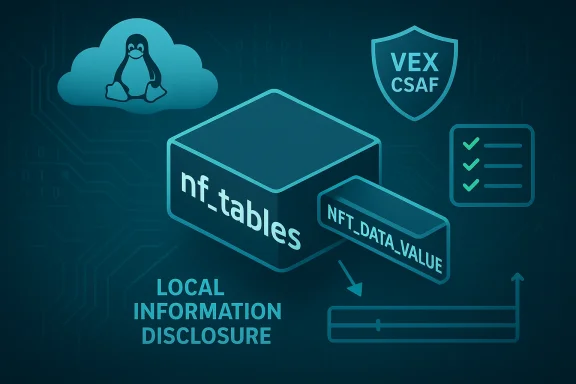
CVE-2024-42070 is a Linux-kernel vulnerability in the netfilter subsystem, specifically within the nf_tables code path. The bug is caused by incomplete validation when storing a set element into data registers: the register store validation for NFT_DATA_VALUE was conditional, but the datatype used by the code path can be either NFT_DATA_VALUE or NFT_DATA_VERDICT. Because the validation was incomplete, engineered inputs could cause a pointer to a chain object to be leaked into a register. In plain language, kernel memory that should remain private can be disclosed via an nf_tables operation.
Attribution and baseline technical facts:
However, two points are crucial:
However, the attestation does not mean Azure Linux is the only Microsoft product that could include the vulnerable code. Other Microsoft-distributed Linux kernel artifacts — for example, the WSL2 kernel binary and source tree Microsoft publishes, linux-azure kernel builds, and certain Marketplace images — are plausible carriers depending on kernel version, build configuration (CONFIG_NF_TABLES and related flags), and backports.
Action you can take immediately:
In short: Azure Linux is the only Microsoft product Microsoft has publicly attested to include the implicated code so far — but it is not necessarily the only Microsoft product that could be affected. Verify per-artifact kernel builds and configurations, apply patches, and use VEX/CSAF updates from Microsoft to close the gap between “not yet attested” and “confirmed not affected.”
Source: MSRC Security Update Guide - Microsoft Security Response Center
 Background / Overview
CVE-2024-42070 is a Linux-kernel vulnerability in the netfilter subsystem, specifically within the nf_tables code path. The bug is caused by incomplete validation when storing a set element into data registers: the register store validation for NFT_DATA_VALUE was conditional, but the datatype used by the code path can be either NFT_DATA_VALUE or NFT_DATA_VERDICT. Because the validation was incomplete, engineered inputs could cause a pointer to a chain object to be leaked into a register. In plain language, kernel memory that should remain private can be disclosed via an nf_tables operation.Attribution and baseline technical facts:
- The vulnerability lives in nf_tables (the modern packet classification framework used by nft) and concerns NFT_DATA_VALUE register stores.
- The practical risk is a local information disclosure (pointer leak) and potentially stability impacts; exploitation requires the ability to issue nft/netfilter operations on the host or inside a guest kernel that offers nft support.
- The vulnerability was fixed upstream in kernel stable branches; downstream vendors (major Linux distributions) produced kernel patches and advisories.
- Microsoft’s public advisory identified Azure Linux as a product that includes the implicated open-source library and is therefore potentially affected, and Microsoft emphasized that it has begun publishing machine-readable CSAF/VEX attestations and will update those attestations if other products are discovered to carry the component.
Why Microsoft named Azure Linux — and what that attestation means
Microsoft’s statement that “Azure Linux includes this open-source library and is therefore potentially affected” is an inventory attestation — a declaration that the company inspected the Azure Linux product family and found the upstream code in the artifacts they examined. The attestation is useful and actionable for Azure Linux customers because it confirms a direct carrier and usually accompanies a patch timeline.However, two points are crucial:
- Product attestation is product-scoped: it tells you about Azure Linux build artifacts that Microsoft examined. It does not automatically speak for every Microsoft binary or image that might contain a Linux kernel.
- Microsoft’s VEX/CSAF program (rolled out as a phased pilot starting in October 2025) is intended to publish machine-readable attestations on a per-product basis. In practice this means Microsoft will publish “Known Affected / Not Affected / Under Investigation / Fixed” statuses per product as it completes inventories. Absence of a VEX entry for a product is absence of attestation, not proof the product is clean.
Why Azure Linux being attested does not guarantee exclusivity
The presence of a particular upstream source file in a vendor’s source tree is not enough to conclude that every delivered kernel binary across that vendor’s product portfolio contains the same vulnerable code. Whether a given Microsoft product (for example, a WSL kernel binary, a linux-azure kernel package, or an appliance image) is affected depends on three independent, technical factors:- Kernel version and exact upstream commit(s): did the kernel tree used to build the artifact contain the vulnerable commits or the fixing commit(s)?
- Kernel configuration (CONFIG_* flags): was nf_tables enabled at build time? Was it compiled in or built as a module? Downstream kernels often enable or disable features depending on target purpose.
- Packaging and backports: did the vendor backport the fix into a specific kernel branch? Or did the build leave the vulnerable code unchanged?
Microsoft artifacts to check (short list)
If you operate Microsoft-hosted or Microsoft-provided infrastructure or endpoints, treat these artifacts as plausible candidates that might carry the same upstream component until verified:- WSL2 kernel images and source trees that Microsoft publishes and distributes to Windows clients.
- linux-azure kernel packages or curated kernel images Microsoft uses for certain Azure VM families.
- Azure Marketplace images or appliance images that include a Microsoft-supplied kernel.
- Specialized Microsoft VM or container host build artifacts (for example, node images used by AKS node pools).
- Device or edge images where Microsoft supplies a Linux kernel (less common but possible).
Technical verification: how to determine whether an artifact is affected
Detecting whether a particular Microsoft-supplied kernel is vulnerable is an artifact-by-artifact exercise. The following is a practical triage checklist you can use immediately on any machine, VM, WSL instance, or image:- Identify the running kernel version:
- Run uname -a inside the environment you want to check.
- Inspect kernel configuration for nf_tables flags:
- Look for /proc/config.gz (zcat /proc/config.gz | grep NF_TABLES) or a distribution-provided /boot/config-$(uname -r).
- Check for CONFIG_NF_TABLES and related options such as CONFIG_NF_TABLES_SET, CONFIG_NFT_FLOW_TABLE, CONFIG_NFT_NUMGEN, etc.
- Check module presence and load status:
- Run lsmod | grep nf_tables and inspect /lib/modules/$(uname -r) for nf*tables.ko or nft** modules.
- Map kernel version against published affected ranges or vendor advisories:
- If your kernel version falls in the upstream affected ranges (or predates the vendor’s fix), treat it as potentially vulnerable until patched.
- For WSL specifically:
- Run uname -a from within the WSL instance to obtain the kernel string Microsoft supplied.
- If your WSL distribution uses the Microsoft-supplied kernel, the same checks above apply inside WSL.
- For Azure VM images:
- Check the vm’s kernel package version and consult the image vendor’s update advisory. Marketplace images may carry upstream vendor kernels (Ubuntu, RHEL, SUSE) or a Microsoft-curated kernel.
- Review vendor (Microsoft) advisories and VEX/CSAF entries:
- Microsoft’s VEX/CSAF attestations are authoritative for the products they list. If a Microsoft VEX entry names a product as “Known Affected” that product is confirmed in scope.
Practical remediation and mitigations
If you confirm an artifact is affected or if you cannot quickly determine its status, take the following actions in order of priority:- Patch first: apply vendor-supplied kernel updates. For Azure Linux customers, Microsoft’s attested status typically comes with an update path. For other vendor-supplied images running on Azure, use the distribution vendor’s advisories.
- If you cannot patch immediately, consider temporary mitigations:
- If nf_tables is not required, remove or blacklist the nf_tables module or rebuild kernels without CONFIG_NF_TABLES. (This may not be feasible on production systems that rely on nft.)
- Restrict local user capabilities: reduce the set of accounts that can manipulate nftables rules (this vulnerability requires local privilege to interact with nf_tables).
- Hardening and containment: apply host-based restrictions, mandatory access control policies (SELinux/AppArmor), and process-level sandboxing for services that might exercise nft operations.
- For cloud environments:
- Ensure VM images are patched or replaced with updated images.
- For AKS and other managed nodes, coordinate with Microsoft and your cloud provider to schedule node updates or rolling upgrades.
- Monitor for proof-of-concept exploits: while public exploitation reports may be rare, monitor vendor advisories, security lists, and your telemetry for suspicious behavior consistent with memory disclosure or kernel instability.
- Validate fixes: once a kernel update is applied, validate that the kernel version includes the upstream fix or that the vendor’s package version corresponds to a patched release.
Risk assessment — what to worry about, and what to deprioritize
- Likelihood of remote exploitation: low. The nf_tables vulnerability requires local operations that exercise netfilter nftables functions. Pure remote network-only exploitation is not the primary threat vector unless an attacker already has a way to run unprivileged code or commands on the target.
- Local escalation or data exfiltration: moderate. A pointer leak may expose sensitive kernel addresses, which can be used to defeat kernel address randomization defenses in follow-on attacks. The immediate impact is information disclosure; in skilled hands this can help build a more severe exploit chain.
- Multi-tenant cloud host risk: contextual. If a multi-tenant hypervisor or privileged host artifact exposes an affected kernel to multiple tenants, the blast radius increases. In public cloud, Microsoft typically separates host and guest responsibilities; a vulnerable guest kernel generally compromises the guest, not the host. But any shared management artifacts (e.g., images Microsoft distributes) require careful inventory.
- Operational impact: moderate. Expect stability and availability impacts where malformed nft operations are used aggressively; high-availability services that rely on dynamic packet filtering should be tested after applying patches.
Specific guidance for Microsoft customers and administrators
- Treat Microsoft’s Azure Linux attestation as authoritative for Azure Linux customers: remediate accordingly with the updates Microsoft publishes for Azure Linux.
- For other Microsoft artifacts (WSL, linux-azure kernels, Marketplace images):
- Do not assume absence of risk just because Microsoft did not list them in the VEX/CSAF mapping yet.
- Use the verification checklist above to determine whether an artifact you depend on includes nf_tables and whether it contains the upstream vulnerable commit range.
- If your estate includes many Microsoft-supplied images (WSL, Azure VM images, Marketplace appliances), prioritize:
- Image families that run workloads which can accept untrusted users or allow unprivileged user input that could interact with nftables.
- Images used for kernel-level networking operations (firewall appliances, NAT gateways, packet-processing services).
- Endpoint WSL deployments where developers may run untrusted code.
- Subscribe to machine-readable VEX/CSAF feeds and your vendor’s advisories. Microsoft has committed to expanding these attestations as inventories complete; when they update a CVE’s VEX entries, you’ll gain deterministic answers for newly attested products.
Operational checklist for security teams (actionable in the first 24–72 hours)
- Inventory: enumerate all Microsoft-supplied Linux kernels in your environment (WSL instances, Azure VM images, Marketplace images, Azure Linux deployments).
- Detection: run the kernel configuration checks and module presence checks described earlier.
- Patch: apply vendor patches where available. Prioritize images that Microsoft has attested as affected.
- Monitor: configure SIEM and EDR to alert for suspicious netfilter/nft activity and kernel crashes.
- Hardening: restrict which accounts or automation can modify nft rules. Consider removing nftables support where not required.
- Validate: post-patch, confirm the kernel version is patched and verify that behavior of packet filters is unchanged for expected traffic.
Why this matters beyond Azure Linux
Two practical realities make this type of attestation nuance important for enterprise defenders:- Microsoft — like every large vendor — ships multiple kernel artifacts for different use cases. An attestation that covers Azure Linux is a pragmatic and helpful first step, but it cannot and does not implicitly guarantee that other artifacts are clean.
- Attack surfaces in modern environments are layered: attackers often combine low-privilege local capabilities with information leaks to build full exploit chains. Even a modest local information disclosure can become critical if combined with another vulnerability; therefore, treating the issue as a moderate privilege risk and remediating is sound operational practice.
Caveats and unverifiable points
- We cannot assert that any specific Microsoft product other than Azure Linux is affected unless Microsoft’s VEX/CSAF attestation or a vendor advisory explicitly identifies it, or you confirm the artifact’s kernel version and configuration locally. Microsoft’s public wording intentionally leaves room to name additional products later — that is an operational commitment, not a negative proof.
- The exploitation landscape and any proof-of-concept availability can change. At the time of publication, public PoCs appear limited and exploitation reports are scarce; defenders should nonetheless assume that local exploit code can be developed and should prioritize mitigation accordingly.
- Kernel configuration symbol names and availability can change across kernel versions. Use your artifact’s specific kernel configuration to make a definitive determination.
Final verdict and recommended posture
Microsoft’s advisory confirms that Azure Linux is a known carrier of the upstream nf_tables code implicated in CVE-2024-42070, and Microsoft has committed to publishing machine-readable VEX/CSAF attestations (the program began as a phased rollout) and to update CVE records if other Microsoft products are identified. That means Azure Linux customers should treat the attestation as actionable and apply the vendor updates Microsoft provides.However, the attestation does not mean Azure Linux is the only Microsoft product that could include the vulnerable code. Other Microsoft-distributed Linux kernel artifacts — for example, the WSL2 kernel binary and source tree Microsoft publishes, linux-azure kernel builds, and certain Marketplace images — are plausible carriers depending on kernel version, build configuration (CONFIG_NF_TABLES and related flags), and backports.
Action you can take immediately:
- Inventory all Microsoft-supplied kernel artifacts in your environment.
- Verify kernel versions and CONFIG_NF_TABLES presence.
- Patch or mitigate unpatched artifacts, prioritizing Azure Linux and other high-risk image families.
- Monitor Microsoft’s VEX/CSAF updates and vendor advisories to capture newly attested products.
In short: Azure Linux is the only Microsoft product Microsoft has publicly attested to include the implicated code so far — but it is not necessarily the only Microsoft product that could be affected. Verify per-artifact kernel builds and configurations, apply patches, and use VEX/CSAF updates from Microsoft to close the gap between “not yet attested” and “confirmed not affected.”
Source: MSRC Security Update Guide - Microsoft Security Response Center
