

The Linux kernel flaw tracked as CVE‑2024‑42073 — a memory‑corruption bug in the Mellanox/NVIDIA mlxsw driver’s spectrum_buffers code that affects Spectrum‑4 hardware — is real, patched upstream, and important for operators of RDMA and Mellanox‑based networking gear; Microsoft’s public advisory that “Azure Linux includes this open‑source library and is therefore potentially affected” is an authoritative product‑level attestation for Azure Linux, but it is not a technical proof that no other Microsoft product could contain the same vulnerable code.
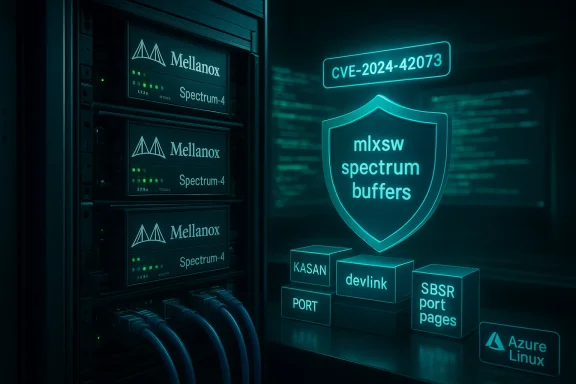
CVE‑2024‑42073 was introduced by a subtle indexing error in the mlxsw driver’s handling of the Shared Buffer Status Register (SBSR) used on Spectrum‑4 switch ASICs. Spectrum‑4 devices can expose more than 256 ports; the SBSR was extended with a concept of port pages, but the driver filled the SBSR masks using absolute port numbers instead of numbers relative to the port page, which allowed out‑of‑bounds writes and produced KASAN‑detected use‑after‑free and memory corruption in live kernels. The two devlink operations implicated are devlink sb occupancy snapshot and devlink sb occupancy clearmax.
The vulnerable driver code built the SBSR payload using absolute port numbers when populating the mask bits, instead of converting those port numbers to the relative index within the current page. The result: when a page’s starting port is not subtracted from the absolute number, the mask writing routine can index outside the intended mask array. In the kernel this manifested as slab use‑after‑free / out‑of‑bounds writes under devlink sb occupancy snapshot/clearmax operations. The kernel sanitizer KASAN reliably caught the misuse during testing and debugging.
Symptom signatures operators should look for:
A. Public attestation (what Microsoft has published)
That said, there are practical limits:
If you operate RDMA or Mellanox/NVIDIA networking gear, treat this as an operational priority: patch Azure Linux first (if you use it), inventory other kernels that may include mlxsw, restrict devlink access, and monitor kernel logs for mlxsw KASAN traces while coordinating with your NIC and OS vendors for any additional Windows‑side driver advisories.
Source: MSRC Security Update Guide - Microsoft Security Response Center
 Background / Overview
CVE‑2024‑42073 was introduced by a subtle indexing error in the mlxsw driver’s handling of the Shared Buffer Status Register (SBSR) used on Spectrum‑4 switch ASICs. Spectrum‑4 devices can expose more than 256 ports; the SBSR was extended with a concept of port pages, but the driver filled the SBSR masks using absolute port numbers instead of numbers relative to the port page, which allowed out‑of‑bounds writes and produced KASAN‑detected use‑after‑free and memory corruption in live kernels. The two devlink operations implicated are devlink sb occupancy snapshot and devlink sb occupancy clearmax.- Affected component: mlxsw (spectrum_buffers) in the Linux kernel.
- Hardware surface: Mellanox Spectrum‑4 switches / NICs with >256 ports.
- Trigger: local devlink operations (netadmin/devlink privileges), snapshot/clear of Shared Buffer occupancy.
- Impact: kernel memory corruption, possible crashes (DoS); theoretical possibility of more serious kernel exploitation in complex attack chains.
What Microsoft actually said — unpacking the MSRC language
Microsoft’s Security Response Center (MSRC) page language that you quoted — effectively: “Azure Linux includes this open‑source library and is therefore potentially affected” — is an inventory attestation: it confirms Microsoft inspected the Azure Linux product, found the referenced upstream source files or compiled module within that product, and therefore treats Azure Linux as a known carrier that needs patching. That is a deliberate, useful statement for customers running Azure Linux because it cuts through ambiguity and lets operators prioritize patching for that specific Microsoft‑distributed image. ([archive.vn](https://archive.vn/2025.12.04-18420...te-guide/vulnerability/CVE-2025-39810?However, this phrase is not a logically equivalent statement of exclusivity. In other words:- Microsoft’s sentence is authoritative for Azure Linux — treat it as the canonical Microsoft signal that Azure Linux images need remediation.
- Microsoft’s wording does not prove that no other Microsoft product, image, or shipping artifact contains the vulnerable mlxsw code; it only means that Azure Linux is the product Microsoft has mapped and publicly attested so far.
Technical anatomy: how the bug works (brief, practical explanation)
On Spectrum‑4, the SBSR register contains two 256‑bit masks that indicate which ports are targeted by shared buffer operations. Because Spectrum‑4 supports more than 256 ports, the hardware uses a port_page field to extend the effective range by addressing ports in groups/pages.The vulnerable driver code built the SBSR payload using absolute port numbers when populating the mask bits, instead of converting those port numbers to the relative index within the current page. The result: when a page’s starting port is not subtracted from the absolute number, the mask writing routine can index outside the intended mask array. In the kernel this manifested as slab use‑after‑free / out‑of‑bounds writes under devlink sb occupancy snapshot/clearmax operations. The kernel sanitizer KASAN reliably caught the misuse during testing and debugging.
Symptom signatures operators should look for:
- KASAN output lines mentioning mlxsw_sp_sb_occ_snapshot or similar function names.
- devlink‑triggered crashes or kernel oopses logged after running devlink sb occupancy snapshot / clearmax.
- Messages referencing "slab‑use‑after‑free" with addresses in kernel space tied to mlxsw driver stacks.
Cross‑checking the claim that Azure Linux is the only Microsoft product implicated
To answer your central operational question — Is Azure Linux the only Microsoft product that includes this open‑source library and is therefore potentially affected? — apply two separate but related tests: (A) what Microsoft has publicly attested, and (B) what is practically plausible given Microsoft’s product artifacts.A. Public attestation (what Microsoft has published)
- Microsoft has explicitly attested Azure Linux as a product that includes the upstream code and is therefore potentially affected; the MSRC CVE pages repeatedly use that same language and Microsoft’s VEX/CSAF rollout started with Azure Linux. That means: Azure Linux is the only Microsoft product Microsoft has publicly listed as affected at the time of that advisory. Treat this as authoritative for Azure Linux customers.
- The presence of the same upstream Linux kernel files in other Microsoft artifacts is technically possible. Microsoft distributes several Linux‑based artifacts that can include upstream drivers rsion/configuration: the WSL2 kernel image, linux‑azure kernels used for some VM SKUs, CBL‑Mariner‑derived builds (the prior name of Azure Linux), AKS node images, marketplace appliance images, and the kernel images used internally by specific Azure services. The existence of those artifacts, combined with the fact that kernel builds vary by configuration and version, means any non‑attested Microsoft artifact that ships a kernel compiled from a vulnerable commit range and that enables/includes the mlxsw modules could be affected until proven otherwise. Microsoft’s published practice is to update the CVE/VEX if additional products are found to be carriers — which implies that other products might exist but await verification.
What defenders should do now — prioritized, practical checklist
This section converts the above into hands‑on steps prioritized for security and operations teams. Follow this checklist exactly in order of priority.- Patch Azure Linux images first
- If you run Microsoft‑published Azure Linux instances, apply the kernel update Microsoft or your image provider published that includes the upstream fix. Azure Linux was explicitly attested as a carrier and is the highest‑priority Microsoft artifact to remediate.
- Inventory all Linux kernels and RDMA hosts
- Find all machines in your estate that run RDMA/NICs from Mellanox/NVIDIA (ConnectX, Spectrum). Include on‑prem and cloud VMs.
- For every host, record kernel package name, version, vendor (Ubuntu linux‑azure, RHEL, SUSE, Oracle, Azure Linux), and whether the mlxsw module is built in or available as a module.
- Verify WSL2 and other Microsoft‑distributed kernels
- If you use WSL2, check the WSL kernel binary and the kernel config shipped with your Windows build or WSL update; WSL kernel trees are published by Microsoft and the module set can be inspected. If mlxsw components are present and the kernel version falls in the vulnerable range, treat those WSL installations as potentially affected and apply a fixed WSL kernel or rebuild with the patched upstream commit. Microsoft has not necessarily attested WSL as affected — absence of attestation is not proof of safety.
- Inspect linux‑azure and marketplace images
- Some Azure VM SKUs use linux‑azure kernels or vendor images; check those kernel versions against the upstream patch. For Marketplace images, verify the distro vendor’s advisory and the specific image publisher version. Do not assume Azure Marketplace images are covered by Microsoft’s Azure Linux attestation unless Microsoft explicitly lists them.
- Harden access to devlink and netadmin interfaces
- The most reliable way to trigger the bug is through privileged devlink operations. Reduce the attack surface by restricting access to administrative nets and by limiting who can run devlink/netlink commands. Use role‑based controls and jump‑hosts for network admin tasks.
- Monitor kernel logs and set detection rules
- Look for KASAN slab‑use‑after‑free messages referencing mlxsw or function names like mlxsw_sp_sb_occ_snapshot. Integrate these signatures into SIEM and kernel‑log monitoring. Capture devlink usage and correlate with kernel oops messages.
- Coordinate vendor driver updates for Windows
- On Windows hosts with Mellanox/NVIDIA NICs, check the NIC vendor’s WinOF‑2 and other Windows driver advisories. The Linux mlxsw CVE does not automatically translate to the Windows driver stack, but vendor drivers are a separate patch track you must monitor and apply.
- Subscribe to MSRC CSAF/VEX feeds and distro advisories
- Microsoft is publishing machine‑readable VEX attestations starting with Azure Linux; subscribe to the feeds and to your Linux vendor advisories to automate detection of impacted artifacts and fixes. Microsoft will update the VEX mapping if new products are found to be affected.
Detection and forensic notes for incident responders
If you suspect exploitation or want to hunt for attempts:- Check for devlink command history (auditd, bash history for root, orchestration logs).
- Search kernel logs for oops messages mentioning mlxsw*sp** symbols, KASAN warnings, or slab use‑after‑free. These messages often include stack traces that identify the exact offending function.
- On systems with crash dump configured, capture kernel crash dumps and examine the stack trace for the mlxsw call path and devlink task context (devlink/<pid>).
- If you see repeated KASAN or oops events, treat as a potential compromise or instability event and isolate affected systems pending patch application.
Why Microsoft’s VEX/CSAF approach matters — and its limits
Microsoft’s decision to publish machine‑readable CSAF/VEX attestations starting with Azure Linux is a meaningful improvement in vendor transparency and reduces triage overhead for enterprise patch programs. By declaring per‑product exploitability status (Known Affected, Under Investigation, Not Affected, Fixed), Microsoft enables automation and more targeted remediation workflows. For Azure Linux customers this is a direct win: the attestation makes the remediation signal machine‑actionable.That said, there are practical limits:
- The rollout is phased; starting with Azure Linux means other Microsoft artifacts will be onboarded later. During the rollout, many customers will still need to perform artifact‑level verification themselves.
- VEX/CSAF attestations reflect Microsoft’s inventory work — they do not automatically scan or certify third‑party images or Marketplace images unless Microsoft has included those artifacts in their mapping.
- The presence of functionally similar drivers in other ecosystems (custom WSL kernels, vendor Windows drivers, appliances) creates a need for per‑artifact verification and vendor coordination.
Critical analysis — strengths, risks, and where defenders should focus attention
Notable strengths- Microsoft’s attestation for Azure Linux is accurate, useful, and actionable for customers of that product. It reduces ambiguity and lets teams prioritize patching where Microsoft has confirmed the component’s presence.
- The upstream Linux community and mainstream distributors responded with patches and advisories; the fix is in the kernel stable trees and across vendor kernels, making remediation feasible for most operators.
- Attestation rollout timing: while Azure Linux is covered, other Microsoft artifacts may not yet be included in VEX; those gaps are operational blind spots and require active customer validation.
- Supply‑chain complexity: Marketplace images, third‑party appliances, and vendor‑supplied kernels live outside Microsoft’s attestation unless explicitly mapped. These artifacts are common in enterprise clouds and can host vulnerable kernel versions.
- WSL and embedded kernels: Microsoft ships Linux kernels in contexts other than Azure Linux (WSL, linux‑azure, appliance kernels). Determining vulnerable presence requires inspecting kernel configs, module lists, and version ranges — a task that cannot be answered by a single line on a CVE page.
- Prioritize patching of attested products (Azure Linux) immediately.
- Systematically inventory all kernel‑bearing artifacts in your environment and verify whether the mlxsw modules are present and whether the kernel version includes the fix.
- Harden access to the administrative interfaces that can trigger the bug and build log‑based detection for the mlxsw/KASAN signatures described above.
Conclusion
CVE‑2024‑42073 is a real kernel memory‑corruption bug affecting the mlxsw spectrum_buffers code on Spectrum‑4 hardware; it was fixed in upstream kernels and should be remediated by applying vendor/kernel updates. Microsoft’s public statement that Azure Linux includes this open‑source library and is therefore potentially affected is an authoritative attestation for Azure Linux and a practical remediation signal for customers of that product — but it is not a categorical guarantee that no other Microsoft product or artifact could contain the same vulnerable code. Customers must therefore combine Microsoft’s VEX/CSAF signals with their own artifact inventory (WSL kernels, linux‑azure, Marketplace images, vendor drivers) and patch or mitigate accordingly.If you operate RDMA or Mellanox/NVIDIA networking gear, treat this as an operational priority: patch Azure Linux first (if you use it), inventory other kernels that may include mlxsw, restrict devlink access, and monitor kernel logs for mlxsw KASAN traces while coordinating with your NIC and OS vendors for any additional Windows‑side driver advisories.
Source: MSRC Security Update Guide - Microsoft Security Response Center
