

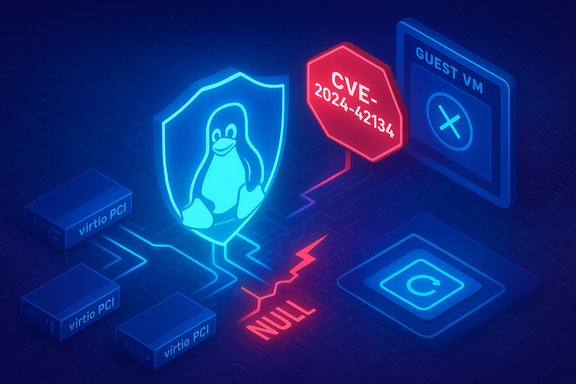
A null-pointer bug in the Linux kernel’s virtio-pci driver — tracked as CVE-2024-42134 — can be triggered when the driver attempts to use an uninitialized pointer (vp_dev->is_avq) while tearing down virtqueues, allowing an attacker with local privileges to crash a guest and produce a denial-of-service condition; distributions and the upstream kernel have issued fixes, and operators must prioritize kernel updates for affected guests and hypervisors to eliminate the risk.
The virtio framework is the standard paravirtual I/O stack used by many hypervisors and guest kernels to deliver efficient virtual network, block, and other devices. Virtqueues are the core data structures used to move descriptors between guest drivers and host device backends; the virtio-pci glue layer in the kernel adapts virtio devices over PCI.
CVE-2024-42134 is a classic null-pointer dereference in the virtio-pci code path: the function that deletes virtqueues (vp_del_vqs in drivers/virtio/virtio_pci_common.c) references vp_dev->is_avq — a function pointer used to identify administrative virtqueues (AVQs) — without first confirming that the pointer is non-NULL. Under certain configurations (notably when the legacy virtio PCI path is in use), that function pointer may never be set. The kernel therefore may call through a NULL function pointer and crash the guest kernel at the moment the code path is exercised (for example, when the management tool attempts to hotplug or attach a device).
Multiple vendor advisories and vulnerability databases classify the bug as a medium-severity availability issue with a CVSS v3.1 base score in the mid-5 range; the technical impact is limited to availability (guest crash / DoS) rather than data disclosure or code execution. Upstream patches were merged into stable kernel trees and the issue has been fixed in vendor kernel releases and distribution packages; however, older kernels and unpatched guests remain vulnerable.
The vulnerability report notes that installations using the legacy PCI path (via virtio_pci_legacy) do not always assign vp_dev->is_avq. Consequently, kernels compiled or running with legacy behavior — or guests interacting with host devices presented in legacy mode — were the primary exposure vector.
Source: MSRC Security Update Guide - Microsoft Security Response Center
 Background / Overview
The virtio framework is the standard paravirtual I/O stack used by many hypervisors and guest kernels to deliver efficient virtual network, block, and other devices. Virtqueues are the core data structures used to move descriptors between guest drivers and host device backends; the virtio-pci glue layer in the kernel adapts virtio devices over PCI.CVE-2024-42134 is a classic null-pointer dereference in the virtio-pci code path: the function that deletes virtqueues (vp_del_vqs in drivers/virtio/virtio_pci_common.c) references vp_dev->is_avq — a function pointer used to identify administrative virtqueues (AVQs) — without first confirming that the pointer is non-NULL. Under certain configurations (notably when the legacy virtio PCI path is in use), that function pointer may never be set. The kernel therefore may call through a NULL function pointer and crash the guest kernel at the moment the code path is exercised (for example, when the management tool attempts to hotplug or attach a device).
Multiple vendor advisories and vulnerability databases classify the bug as a medium-severity availability issue with a CVSS v3.1 base score in the mid-5 range; the technical impact is limited to availability (guest crash / DoS) rather than data disclosure or code execution. Upstream patches were merged into stable kernel trees and the issue has been fixed in vendor kernel releases and distribution packages; however, older kernels and unpatched guests remain vulnerable.
What exactly went wrong: the technical root cause
The code-level fault
At its core, CVE-2024-42134 is a straightforward pointer validation bug:- The virtio PCI code organizes device-specific behavior using function pointers (a common C pattern in kernel device drivers).
- One such pointer, used to determine whether a virtqueue is an administrative virtqueue (is_avq), can be absent (NULL) in configurations that use the legacy virtio PCI driver.
- The function vp_del_vqs, responsible for removing virtqueues during device teardown or reconfiguration, uses vp_dev->is_avq without checking whether the pointer exists.
- If the pointer is NULL, dereferencing or invoking it causes a kernel fault that leads to a guest crash.
Why some builds were affected and others were not
The virtio implementation in the kernel carries both legacy and modern (virtio 1.0) code paths. Historically the kernel maintained a “transitional” convenience mode where the same driver could handle legacy (0.95) and modern devices; in that transitional code, not all function pointers are always set, and some initialization happens only in the modern path.The vulnerability report notes that installations using the legacy PCI path (via virtio_pci_legacy) do not always assign vp_dev->is_avq. Consequently, kernels compiled or running with legacy behavior — or guests interacting with host devices presented in legacy mode — were the primary exposure vector.
Impact and attacker model
Who can exploit this bug?
- The bug is not remotely exploitable across an unauthenticated network by default. The principal attack vector requires local access to the guest or the ability to interact with the hypervisor’s device-management interfaces.
- The most plausible scenarios include:
- A malicious or compromised management-plane user with rights to attach or reconfigure devices for a VM (for example, via libvirt/virsh on the host) triggering the guest-side teardown path.
- Local users on the guest that can trigger operations which lead to the virtio-pci teardown (less likely unless the guest itself provides local device attach functionality).
- Special device hotplug flows that implicitly cause vp_del_vqs to run (e.g., certain live-attach or hot-unplug operations).
- Published advisories uniformly describe the exploitability as local with low attack complexity and no confidentiality/integrity impact — the observable result is a crash (availability loss).
What does a successful exploit achieve?
- A successful trigger results in a guest kernel crash — immediate denial of service for that VM.
- The condition is an availability failure only: there are no public reports that the bug can be escalated to code execution or data leakage from the memory that caused the fault.
- For environments where VMs host critical workloads or stateful services, repeated or automated triggering could cause persistent disruption and potential data loss from unflushed state.
Vendor response and remediation status
- The upstream kernel maintainers merged a straightforward fix: add a defensive check to ensure vp_dev->is_avq is non-NULL before using it. That patch was propagated into the stable kernel trees and release changelogs.
- Distribution vendors issued security advisories and package updates. Major distributions that published advisories and updates include Ubuntu, Debian, SUSE, Amazon Linux, and others; the upstream kernel stable release branch that contains the fix is reflected in distribution backports.
- Kernel-series boundary: publicly available CVE data indicates kernels earlier than a certain stable point (reported as versions prior to 6.9.9 in vulnerability summaries) were vulnerable. Distributions backported the fix to earlier branches where necessary.
- Operators should apply vendor kernel updates for guests and, where the host uses the affected code path, for host kernels and device-backed modules as well.
Practical mitigation guidance
Immediate actions for system administrators
- Prioritize patching:
- Update guest kernels and host kernels to vendor-published packages that include the CVE-2024-42134 fix.
- For managed cloud instances, apply vendor image updates or schedule maintenance windows for kernel updates.
- If you cannot patch immediately:
- Limit who can perform device hotplug or attach operations on the host. Restrict libvirt, cloud control-plane, and hypervisor management interfaces to trusted administrators.
- Avoid manual or automated workflows that hotplug or reconfigure virtio devices while you remain unpatched.
- Inventory and triage:
- Identify VMs and hosts that use virtio devices (virtio-net, virtio-blk, virtio-scsi, etc. and determine whether their kernels are from an affected series.
- Track whether devices are presented in legacy or modern modes in your virtualization platform and whether your configuration uses legacy drivers that may leave the pointer unset.
- Test updates in staging:
- Before large-scale rollouts, test updated kernels in a representative staging environment to catch regressions in device driver behavior or performance.
Recommendations for hypervisors and cloud providers
- Harden management-plane access and audit device-attach operations.
- For multi-tenant platforms, ensure that guest isolation guarantees that tenant operations cannot cause neighbor VM crashes through the management plane.
- Consider scheduling a maintenance window for orchestrated reboots; since the vulnerability affects the guest kernel itself, rebooting into a patched kernel is the correct long-term cure.
Workarounds and temporary controls (when patching is impossible)
- Avoid operations that trigger vp_del_vqs (not always possible to enumerate), especially device attach/detach during live migrations or hotplug workflows.
- Block or limit the use of legacy virtio presentation where practical — migrating to modern virtio device presentation reduces the chance of encountering the specific legacy-path initialization gap. Note: disabling legacy mode can have compatibility consequences; this must be tested.
- If your setup loads virtio_pci as a module rather than building it into the kernel, module-parameter or kernel-configuration options may be available to change behavior, but these are architecture- and distro-dependent and are not a reliable long-term fix compared to installing vendor updates.
How serious is the risk — a balanced assessment
Strengths of the fix and the situation
- The remedy is simple and low-risk: add a null-check before use. A short, targeted kernel patch eliminates the root cause without refactoring major subsystems.
- Because the vulnerability is limited to availability (crash), it does not grant an attacker code execution or data exfiltration capabilities, which reduces the severity relative to privilege-escalation or RCE bugs.
- Vendors have produced fixes and backports for common distribution releases; this makes remediation practicable for most operators.
Remaining risks and caveats
- The exploit requires local or management-plane access to trigger; however, in many real-world clouds and hosting platforms, misconfigurations or insufficiently restricted management access can expose that vector. Multi-tenant providers must be vigilant.
- Not all environments can accept immediate kernel updates due to certification, uptime, or compatibility constraints; hosts and appliances with long lifecycles may stay unpatched for longer.
- There is a non-zero risk of automated or scripted abuse: a malicious tenant, if they can leverage host-side management APIs or have misconfigured privileges, could repeatedly crash other guests — creating an availability attack surface.
- While current evidence indicates the bug leads to a crash only, missing checks reveal a pattern of defensive gaps; other pointer-related oversights in complex kernel subsystems could hide more subtle vulnerabilities. Maintainers and auditors should review similar code paths for analogous issues.
For developers and kernel maintainers: lessons and recommendations
- Defensive initialization: ensure that any function-pointer fields used by common code paths are initialized to safe no-op implementations or explicitly checked before invocation.
- Audit transitional code paths: legacy/modern transitional drivers frequently harbor subtle initialization differences. Code that is intended to be multi-mode should be audited to ensure consistent initialization across all modes.
- Tests for teardown flows: teardown and hotplug code must be tested with legacy and modern device presentations; unit tests and integration tests should simulate hotplug sequences that force vp_del_vqs-like paths.
- Backport discipline: when a fix is trivially defensive (null-check) it is feasible and advisable to backport to stable branches and vendor kernels quickly; maintainers should ensure backports are available across major LTS families to accelerate operator patching.
Q&A-style clarifications (concise)
- Is this a remote code execution vulnerability?
- No. The flaw causes a guest kernel panic (availability loss). There are no public reports that the bug enables memory disclosure or arbitrary code execution.
- Which kernel series are affected?
- Vulnerability summaries identify affected versions as older kernel releases prior to the stable point where the fix merged; distributions map the fix into their stable kernels. Operators should check vendor advisories for the exact patched package for their release.
- Will applying a distribution kernel update fix this for all guests?
- Yes: updating the guest kernel package to a version that contains the upstream patch eliminates the guest-side vulnerability. Hosts presenting devices to guests should also be updated if their kernel/device-backend code could interact with guests via legacy presentation.
- Can I mitigate by changing QEMU or hypervisor settings?
- Some hypervisors allow configuring virtio device presentation modes (legacy vs modern). Where possible and compatible, using modern-only device presentation can avoid legacy code paths that are implicated by this bug; however this is environment-specific and requires testing.
Final recommendations — what operators must do now
- Treat CVE-2024-42134 as a patch-priority availability bug for any systems that rely on virtio devices.
- Update guest kernels and host kernels promptly with vendor-supplied packages that state they fix CVE-2024-42134.
- Immediately restrict and audit management-plane operations that can hotplug or attach devices to VMs if you cannot apply updates quickly.
- Test any workaround (disabling legacy presentation, changing device flags) thoroughly before rolling out in production — compatibility and migration impacts are real.
- Add this class of null-pointer/initialization checks to your security testing program, and consider kernel traffic monitoring for repeated device-attach operations as an operational detection mechanism.
Conclusion
CVE-2024-42134 is a textbook availability defect — a missing null check in the virtio-pci teardown path that can crash a guest and cause denial-of-service. The code fix is small and widely distributed, but the operational work to apply it is not trivial for all environments. The risk is controllable and should be treated as a standard kernel-patch priority: identify affected guests and hosts, apply vendor kernel updates as soon as possible, and harden the management interfaces that can trigger device reconfiguration. Defensive coding and systematic testing across legacy and modern device modes would prevent similar oversights in the future.Source: MSRC Security Update Guide - Microsoft Security Response Center
