

The one-line statement from Microsoft’s CVE page — “Azure Linux includes this open‑source library and is therefore potentially affected” — is factual and actionable for Azure Linux users, but it is not a technical guarantee that no other Microsoft product or artifact could contain the same vulnerable code.
CVE‑2024‑42277 is a medium‑severity Linux kernel defect in the Spreadtrum (sprd) IOMMU driver that fixes a null‑pointer dereference in sprd_iommu_hw_en called from sprd_iommu_cleanup. The vulnerability was reported upstream and is recorded in public vulnerability databases; it carries a CVSS v3 score of 5.5 and has been fixed in the upstream stable kernel trees and in downstream vendor kernels.
Microsoft’s Security Response Center (MSRC) page for the CVE (the standard MSRC FAQ line you quoted) communicates a product‑level inventory result: Microsoft inspected the Azure Linux build outputs and found the implicated upstream component, therefore Azure Linux images are confirmed carriers and should be treated as in‑scope for remediation. Microsoft also states it will update the CVE enional Microsoft products is identified. That phrasing is intentional and procedural — it announces the scope of Microsoft’s current inventory work rather than asserting exclusivity.
This article explains what that MSRC sentence means in practice, why it should not be read as a universal “only Azure Linux,” and what administrators and security teams should do now to find, triage, and remediate any instances of the vulnerable code across their estates.
Conclusion: Microsoft’s MSRC statement correctly identifies Azure Linux as a confirmed carrier for the upstream component implicated in CVE‑2024‑42277 and gives you a clear remediation priority. However, do not stop there — proactively scan and verify other Microsoft‑supplied kernels, images, and artifacts in your environment so you can find and patch any additional copies of the vulnerable code before they become an operational problem.
Source: MSRC Security Update Guide - Microsoft Security Response Center
 Background / Overview
CVE‑2024‑42277 is a medium‑severity Linux kernel defect in the Spreadtrum (sprd) IOMMU driver that fixes a null‑pointer dereference in sprd_iommu_hw_en called from sprd_iommu_cleanup. The vulnerability was reported upstream and is recorded in public vulnerability databases; it carries a CVSS v3 score of 5.5 and has been fixed in the upstream stable kernel trees and in downstream vendor kernels.Microsoft’s Security Response Center (MSRC) page for the CVE (the standard MSRC FAQ line you quoted) communicates a product‑level inventory result: Microsoft inspected the Azure Linux build outputs and found the implicated upstream component, therefore Azure Linux images are confirmed carriers and should be treated as in‑scope for remediation. Microsoft also states it will update the CVE enional Microsoft products is identified. That phrasing is intentional and procedural — it announces the scope of Microsoft’s current inventory work rather than asserting exclusivity.
This article explains what that MSRC sentence means in practice, why it should not be read as a universal “only Azure Linux,” and what administrators and security teams should do now to find, triage, and remediate any instances of the vulnerable code across their estates.
What CVE‑2024‑42277 actually is
The technical fault, in plain language
- The defect is a null‑pointer dereference in the Spreadtrum (sprd) IOMMU driver: when sprd_iommu_cleanup() calls sprd_iommu_hw_en(), the driver may observe dom->sdev as NULL and dereference it, causing a kernel oops/crash. This is a correctness/robustness bug; its real‑world impact is system instability and availability problems (kernel crashes), not data disclosure.
- The attack vector is local (AV:L): an attacker who can run code on the system or interact with device lifecycle paths can trigger the problematic cleanup path. Exploitation for remote code execution or credential theft is not indicated by vendor writeups; instead, the immediate risk is denial‑of‑service or instability for hosts that load the sprd IOMMU driver.
Where the code lives and why that matters
- The sprd driver is a hardware‑vendor driver that appears in kernel source trees under drivers for the specific SoC vendor (Spreadtrum/Unisoc). Such drivers are usually relevant to embedded, mobile, or specific ARM platforms that use Spreadtrum silicon. On general‑purpose x86_64 or mainstream ARM64 cloud VM images, the driver may not be built in or loaded by default. That architecture and configuration context materially reduces the surface area for most cloud workloads, but it does not eliminate risk for images or appliances that target Spreadtrum hardware. Independent vulnerability trackers and vendor advisories list the affected kernel series and fixed versions so operators can map the issue to their kernel package versions.
What Microsoft’s short FAQ line means — and what it doesn’t
Correct interpretation (what Microsoft is saying)
- Microsoft’s statement that “Azure Linux includes this open‑source library and is therefore potentially affected” is a product‑scoped attestation. It confirms Microsoft completed an inventory of the Azure Linux product family and found the upstream component that maps to the CVE. For customers running Azure Linux images, this is an authoritative signal: treat those images as in‑scope and apply Microsoft’s updates.
- Microsoft has also committed to publishing machine‑readable CSAF/VEX attestations (a rollout that began in October 2025) and to update CVE mappings when additional Microsoft products are discovered to include affected components. That program is designed to reduce ambiguityg individual Microsoft artifacts as Known Affected, Not Affected, Under Investigation, or Fixed.
What Microsoft is not saying (and what you should not infer)
- The MSRC line is not an exclusivitynot mean “Azure Linux is the only Microsoft product anywhere that could ever include this upstream code.” Large vendors ship hundreds of artifacts and images; a single upstream file can be copied, rebuilt, or embedded in many different outputs. Absence of a published attestation for a product is absence of attestation, not proof of absence.
- Microsoft’s attestation is valuable and actionable for Azure Linux, but defenders with broad estates (multiple Azure Marketplace images, WSL kernels, AKS node images, device or appliance images, containers published by Microsoft or partners) should run artifact‑level checks rather than rely on a single public sentence as blanket assurance.
Is Azure Linux the only Microsoft product that could be affected? (short answer)
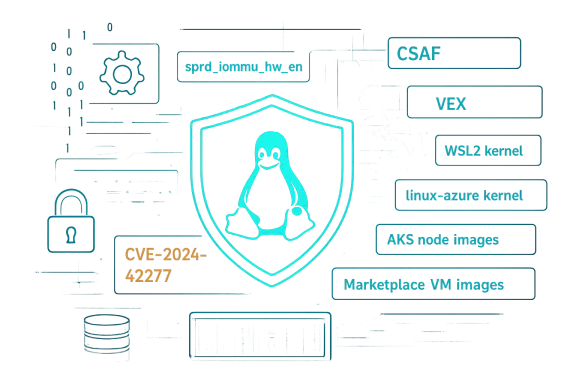
No — Azure Linux is thet Microsoft has publicly attested (so far) to include the implicated upstream sprd IOMMU code for CVE‑2024‑42277, but that attestation is product‑scoped and not an exhaustive, corporation‑wide guarantee. Other Microsoft artifacts — for example, the Microsoft‑supplied WSL2 kernel, linux‑azure kernels used in some VM SKUs, Marketplace VM images, AKS node images, or other published kernel binaries — could include the same upstream source depending on the kernel version and build configuration. Determining whether those artifacts are affected requires either Microsoft‑published VEX/CSAF attestations or direct artifact inspection. ([archive.v/2025.12.04-184202/https%3A/msrc.microsoft.com/update-guide/vulnerability/CVE-2025-39810)Practical detection and triage: how to verify whether a given Microsoft artifact contains the vulnerable sprd code
The single most useful truth is this: the vulnerability only matters if the kernel binary (or modules) actually contains the sprd IOMMU driver and that driver is present and/or loaded at runtime. Here’s a prioritized checklist you can follow.Quick runtio these first)
- Check the running kernel architecture: run uname -m. If the kernel is x86_64 or aarch64 (and you do not run Spreadtrum hardware), the sprd driver is unlikely to be present in tis narrows risk quickly.
- Look for loaded modules: lsmod | grep -i sprd or dmesg | grep -i sprd. If no sprd module is loaded and none of your devices use Spreadtrum IOMMU, immediate runtime exposure is unlikely.
- Inspect the kernel config on the host: zgrep CONFIG_SPRD /proc/config.gz or grep -i sprd /boot/config-$(uname -r). If the sprd driver is built as 'y' or 'm', the code may be present. If CONFIG_SPRD/CONFIG_SPRD_IOMMU (or similar names) is unset, the kernel binary likely does not include the driver.
- Search the kernel image for symbols: strings /boot/vmlinuz-$(uname -r) | grep -i sprd or grep -R "sprd" /lib/modules/$(uname -r). These binary‑level checks are definitive for a given image.
Image and artifact inspection (VM images, Marketplace images, containers, WSL kernels)
- For offline images, mount the image and run the same checks against the contained /boot and /lib/modules directories. Use your image‑scanning tooling or a quick script to look for the driver symbols or the string "sprd_iommu_hw_en."
- For WSL2: Microsoft publishes WSL kernel sources and builds; check the WSL kernel config or the binary shipped with the WSL distribution to confirm whether sprd sources were included in that build.
- For Azure Marketplace/AKS: determine whether the node image uses a Microsoft‑built linux‑azure kernel or a distro‑provided kernel (Ubuntu, Debian). The vendor‑specific kernel may include or exclude vendor drivers differently; consult the image’s SBOM or the vendor advisory if available. Ubuntu’s linux‑azure packages, for example, are a distinct kernel build for Azure VM families and are the subject of separate security notices.
Automated scanning recommendations
- Add signatures to your image scanners to search for the symbol name sprd_iommu_hw_en or the module name (sprd). Scan your container registry, VM image catalog, Marketplace images, WSL kernels, and any archived kernel packages you store.
- If you manage a fleet with centralized telemetry (MDE, collected syslogs, or configuration management databases), query for loaded sprd modules, dmesg lines referencing Spreadtrum or sprd, and the kernel package versions that are known‑to‑be affected by CVE‑2024‑42277 (refer to NVD / vendor advisories for precise kernel version ranges).
Remediation: what to patch and how to prioritize
Immediate priorities
- If you run Azure Linux images: prioritize installing Microsoft’s updates for Azure Linux. Microsoft’s attestation makes Azure Linux a confirmed carrier for the implicated upstream component; apply the kernel/security updates Microsoft provides for the affected Azure Linux images.
- If you find sprd code present in any kernel binary or module in your environment: upgrade that kernel to a fixed upstream or vendor backport that includes the sprd fix. Vendor advisories (Oracle, distribution trackers, and cloud vendors) list fixed kernel versions and backports; use the vendor package that matches your distribution and kernel stream.
When you cannot patch immediately
- If sprd functionality is not required on a host (for example, the host does not use Spreadtrum IOMMU hardware), consider blacklisting the sprd IOMMU module to prevent it from loading: add a blacklist entry in /etc/modprobe.d/ and update initramfs if necessary. This is a practical mitigation for non‑embedded cloud hosts but should be validated carefully — blacklisting a driver can have side effects on hardware that legitimately needs it.
- For appliances or devices where vendor patches are delayed, consider isolating the host, restricting local user access, and applying monitoring for kernel oops/panic events that could indicate attempts to trigger the bug.
Upgrade & test cycle
- Obtain the vendor‑recommended fixed package for your kernel (upstream stable, distro backport, or vendor UEK/LTS build).
- Test the updated kernel in staging for functional regressions (especially on devices that depend on hardware drivers).
- Roll out with a scheduled reboot window (kernel updates require reboots).
- Monitor logs and telemetry for recurring oops/panic messages after patching to confirm remediation.
Risk analysis and operational guidance
Strengths of Microsoft’s approach
- The MSRC product attestation model gives actionable guidance for an important subset of Microsoft customersux, the message is clear — those images contain the upstream code and are in‑scope for remediation. Microsoft’s move to publish machine‑readable CSAF/VEX attestations (rolled out starting October 2025) improves transparency and will reduce manual inventory work once artifact coverage expands. (archive.vn)
- Publishing a simple, repeatable FAQ line across CVE pages reduces confusion for customers who need quick triage instructions for a specific Microsoft product.
Risks and limitations of the messaging
- A one‑line product attestation can be misread as a global exclusivity statement by less technical readers. The practical effect of that misreading is risk: teams may only patch Azure Linux images and negletifacts that also contain the vulnerable component. That blind spot is precisely why Microsoft is rolling out VEX/CSAF attestations to expand coverage; until t comprehensive, artifact‑level verification remains essential.
- Large enterprise estates, third‑party Marketplace images, and developer container images are common places for vulnerable copies of open‑source code to hide. The presence of a vulnerable upstream file in a distro does not automatically imply it is absent elsewhere. The inverse is also true: the attestation confirms presence in the named product il Microsoft confirms them.
Checklist: what your security/ops team should do in the next 72 hours
- Identify all Azure Linux images in your estate and schedule patching for those VMs and nodepools as a priority. Microsoft has attested those images as potentially affected.
- Run the quick runtime checks (uname -m; lsmod | grep sprd; zgrep CONFIG_SPRD /proc/config.gz). If you find sprd symbols, treat the host as in‑scope.
- Add signatures for sprd_iommu_hw_en and related snd container scanners; scan registries, Marketplace images, and archived kernels.
- Consult vendor advisories and the NVD/OpenCVE entries for the CVE to map precise fixed kernel versions for your distribution. Prioritize hosts that load the driver or run on Spreadtrum hardware.
- If immediate patching is impossible, implement mitigation (blacklist the module if safe), tighten local access controls, and increase monitoring for kernel oops/panic patterns.
Final takeaways
- Microsoft’s public sentence is an authoritative, product‑scoped attinux: if you run Azure Linux, assume the images are in‑scope* and apply Microsoft’s updates promptly.
- That attestation does not prove exclusivity. Other Microsoft artifacts (WSL2 kernels, linux‑azure builds, Marketplace images, AKS node images) could include the same upstream sprd IOMMU code depending on build choices, architecture targets, and packaging. You should verify those artifacts directly or wait for Microsoft’s expanded CSAF/VEX attestations if you prefer vendor attestations.
- Operationally: prioritize patching Azure Linux images now, but simultaneously run artifact‑level scans and the quick kernel checks described above across your estate to discover any other carriers. Use vendor advisories and the upstream CVE records to map fixed kernel versions and to validate vendor backports before rollout.
- Finally, treat this as an object‑lesson in supply‑chain hygiene: product‑level attestations are valuable, but they are one tool in a broader set — artifact scanning, SBOMs, image signing, and a reproducible build pipeline are the defenses that close the remaining blind spots.
Conclusion: Microsoft’s MSRC statement correctly identifies Azure Linux as a confirmed carrier for the upstream component implicated in CVE‑2024‑42277 and gives you a clear remediation priority. However, do not stop there — proactively scan and verify other Microsoft‑supplied kernels, images, and artifacts in your environment so you can find and patch any additional copies of the vulnerable code before they become an operational problem.
Source: MSRC Security Update Guide - Microsoft Security Response Center
