

A critical bug in OpenSC’s libopensc — tracked as CVE-2024-45619 — has rippled through multiple Linux distributions and vendor advisories. Microsoft’s security guidance for this CVE names Azure Linux as a confirmed carrier of the vulnerable open-source component, but that product-level attestation does not automatically mean Azure Linux is the only Microsoft artifact that could include the same code. This article explains what CVE-2024-45619 is, why Microsoft’s wording matters (and what it does not mean), how to verify whether your Microsoft-provided images and appliances are affected, and pragmatic remediation and mitigation steps for defenders who run Linux images in Azure or elsewhere.
CVE-2024-45619 is a memory-handling weakness inside the libopensc library — part of the OpenSC project that implements smart-card handling, PKCS#11 modules, and related tooling. The bug arises when buffers are partially filled and code paths later access the buffer’s uninitialized portions; in practice, that can lead to application crashes and information leakage. The most realistic attacker model is a physically proximate adversary who supplies a specially crafted smart card or USB-attached smart-card-like device that returns malformed APDU responses. Several mainstream Linux distributions and vendor advisories treated the issue as medium/low-severity and published fixes in their packaged opensc releases.
Microsoft’s public advisory language for this and related Linux component CVEs has followed a consistent pattern: the MSRC mapping states that Azure Linux includes this open-source library and is therefore potentially affected by this vulnerability. That sentence performs an important inventory function for Azure Linux customers — it confirms Microsoft’s product-level scan found the upstream library in Azure Linux images — but it is not a proof that other Microsoft products cannot also ship the library. Because large vendors publish many distinct artifacts (kernels, VM images, appliance images, containers, SDKs), determining all carriers requires artifact-level inspection and, ideally, machine-readable attestations such as SBOMs or VEX/CSAF records.
Longer explanation:
However, Microsoft’s single-sentence product attestation is an inventory statement — it is not a universal guarantee that other Microsoft artifacts are free of the same upstream code. Defenders should therefore perform artifact-level verification across all Microsoft-supplied images and appliances they use: consume SBOMs and VEX/CSAF records when available, run package and binary scans, and apply patched opensc packages as soon as they are available for the affected artifacts.
Patch promptly where Microsoft has confirmed Azure Linux is affected. For other Microsoft images and third-party distributions, prioritize verification and remediation based on artifact-level findings. The long-term fix for this class of supply-chain blind spots is wider adoption of SBOMs and machine-readable attestations — both of which Microsoft has begun to roll out — combined with diligent image-scanning and reproducible build practices inside operator pipelines.
Source: MSRC Security Update Guide - Microsoft Security Response Center
 Background / Overview
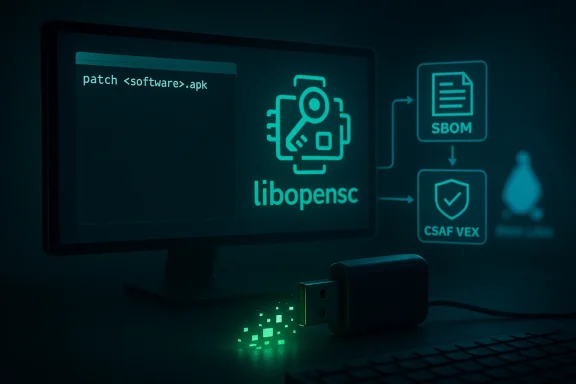
CVE-2024-45619 is a memory-handling weakness inside the libopensc library — part of the OpenSC project that implements smart-card handling, PKCS#11 modules, and related tooling. The bug arises when buffers are partially filled and code paths later access the buffer’s uninitialized portions; in practice, that can lead to application crashes and information leakage. The most realistic attacker model is a physically proximate adversary who supplies a specially crafted smart card or USB-attached smart-card-like device that returns malformed APDU responses. Several mainstream Linux distributions and vendor advisories treated the issue as medium/low-severity and published fixes in their packaged opensc releases.Microsoft’s public advisory language for this and related Linux component CVEs has followed a consistent pattern: the MSRC mapping states that Azure Linux includes this open-source library and is therefore potentially affected by this vulnerability. That sentence performs an important inventory function for Azure Linux customers — it confirms Microsoft’s product-level scan found the upstream library in Azure Linux images — but it is not a proof that other Microsoft products cannot also ship the library. Because large vendors publish many distinct artifacts (kernels, VM images, appliance images, containers, SDKs), determining all carriers requires artifact-level inspection and, ideally, machine-readable attestations such as SBOMs or VEX/CSAF records.
What exactly is CVE-2024-45619?
Technical summary
- The vulnerability is in libopensc, the library portion of the OpenSC project used for smart-card and PKCS#11 functionality.
- The root cause is incorrect handling of buffer or file lengths: when buffers are partially filled, the code can later access uninitialized parts of memory, leading to crashes or information disclosure.
- The practical exploitation vector is physically proximate: a malicious or specially-crafted smart card or USB device that responds to APDUs with crafted payloads.
- The canonical CVSS v3.1 score used by multiple trackers for this CVE is in the medium range (a common published value is 4.3), reflecting limited impact and a physical/adjacent attack vector.
Practical implications
This is not a remote network worm-style vulnerability: it requires either local access to a machine with smart-card interaction enabled or physical access to a device (smart card, USB token) that the victim system will interact with. However, where organizations rely on smart-card workflows (identity enrollment, card-based authentication, hardware token management), the vulnerability can have outsized operational impact: a crafted token can crash card-management tools, leak portions of in-memory card-handling buffers, and interfere with enrollment/administration workflows.Who shipped the vulnerable library — and where was it fixed?
Multiple mainstream Linux distributions cataloged the CVE and released package updates in response. Representative, widely used packaging vendors issued updates quickly:- Debian packaged fixes into their opensc package and released security updates backported to affected stable releases. For example, Debian's bullseye updates show fixed opensc versions made available to users through security channels.
- Ubuntu published a security notice and patched opensc in their supported releases, with fixed package revisions in the Ubuntu security notices for affected versions.
- Amazon Linux (ALAS) and other cloud-vendor Linux images recorded the issue and released advisories that identify opensc as the affected package and supply fixed versions for Amazon Linux 2 and Amazon Linux 2023.
- Upstream OpenSC maintainers and downstream packagers corrected the vulnerable code paths and distributed patched releases; distribution vendors then integrated those updates into their respective repos and images.
Microsoft’s statement: “Azure Linux includes this open-source library …” — what it means
When Microsoft’s Security Response Center (MSRC) states that “Azure Linux includes this open-source library and is therefore potentially affected,” that language should be read precisely and operationally:- It is an inventory attestation for Azure Linux. Microsoft inspected the Azure Linux distribution artifacts and found instances of the implicated upstream library. That assertion makes Azure Linux images an explicit in-scope target for remediation and patching.
- It is not a blanket exclusivity claim. The wording does not assert that no other Microsoft product includes the same code; rather, it reflects Microsoft’s current, documented findings for the product family they evaluated.
- Microsoft has committed to publishing machine-readable CSAF/VEX attestations (a rollout started in October 2025) and to updating the VEX/CVE mapping if additional Microsoft products are later found to ship or include the affected component.
Is Azure Linux the only Microsoft product that could be affected?
Short answer: No — Azure Linux is the only Microsoft product Microsoft has publicly attested (so far) to include the libopensc component for CVE-2024-45619, but that attestation does not prove other Microsoft products are unaffected.Longer explanation:
- Microsoft’s attestation is authoritative for Azure Linux. If you run Azure Linux images, treat Microsoft’s guidance as direct remediation instruction: update the opensc package in those images per Microsoft’s advisory.
- Microsoft ships a broad portfolio of artifacts beyond Azure Linux: WSL kernel binaries, Marketplace VM images and appliances, managed appliance images, container base images, SDK binaries, and more. Any of those artifacts that were built from upstream snapshots containing the vulnerable code could carry the same vulnerable libopensc code.
- Whether another Microsoft image or product contains the vulnerable code depends on artifact-specific details: which upstream snapshot was used, package selection and build-time configuration, whether the opensc package was included, and whether the library was compiled in or installed as a runtime package.
- The only way to eliminate doubt for non-Azure-Linux Microsoft artifacts is via artifact-level signals: SBOMs, VEX/CSAF attestations, package manifests, or direct binary/package inspection.
How to verify whether a Microsoft-supplied image or product in your environment contains libopensc
Perform targeted, artifact-level checks. Use multiple independent methods — don’t rely on a single source of truth.- Check package metadata inside the image or VM:
- For Debian/Ubuntu-based images: run dpkg -l | grep -i opensc or apt-cache policy opensc to see installed version strings.
- For RPM-based images: run rpm -qa | grep -i opensc or dnf repoquery --installed opensc.
- Inspect the filesystem of an image or container:
- Unpack the image and list installed packages in its package manager metadata; for Docker/OCI images, use a local runtime to start an ephemeral container and run the package queries above without running harmful workloads.
- Use SBOMs and VEX/CSAF attestations:
- If Microsoft published machine-readable attestations for the artifact (CSAF or VEX), consume those records and search for the upstream component mapping to “opensc” or “libopensc.”
- If an SBOM is available for the image or appliance, search the SBOM for the package or source component.
- Binary-level checks:
- Search for libopensc library files in /usr/lib/ or /lib/; examine package change logs.
- Use readelf or ldd on relevant binaries to find dynamic links against libopensc.
- Automated image-scanning tools:
- Run scanners such as Trivy, Grype, or your EDR/container-scan tooling against images and artifacts; these tools cross-reference CVE databases and package metadata to flag matches.
- For Windows-hosted or WSL assets:
- WSL distributions are user-land Linux images; apply the same package checks within each WSL distro instance.
- For Microsoft-published kernels or kernel-derived artifacts, check kernel build configs and module lists to determine whether smart-card drivers or crypto modules that depend on OpenSC were included.
Recommended immediate actions for customers
If you run Azure Linux images or any Microsoft-supplied Linux image:- Prioritize Azure Linux updates
- Apply the updates Microsoft recommends for Azure Linux images immediately. Microsoft’s product-level attestation signals a confirmed carrier — that’s a high-priority remediation path.
- Inventory Microsoft artifacts in your environment
- Build a list of all Microsoft-supplied images, WSL distros, Marketplace VMs, container base images, and SDKs running in your environment.
- Scan and verify each artifact
- Use the package and binary inspection steps above, and complement them with automated scanners that match package metadata to CVE lists.
- Apply or backport updates where available
- If updates or patched package versions are available from the vendor or upstream, apply them and rebuild images.
- If you cannot patch immediately, mitigate
- Remove or disable unused smart-card readers and services.
- Limit the set of users who can plug in physical tokens to managed hosts.
- Use network and host-level controls to isolate systems that interact with untrusted physical tokens.
- Track Microsoft’s VEX/CSAF attestations
- As Microsoft rolls out machine-readable attestation coverage, consume those artifacts to reduce manual inspection workload and to get authoritative mappings for additional products.
Longer-term defenses: SBOMs, VEX, and reproducible build hygiene
This CVE and Microsoft’s response illustrate a broader and increasingly critical operational posture: product-level attestation is useful, but defenders still must perform artifact-level verification. The practical toolset to close this gap includes:- SBOMs (Software Bill of Materials): Request and consume SBOMs for vendor-supplied images and appliances. SBOMs permit automated search for specific components (e.g., opensc) and speed up triage.
- VEX/CSAF attestations: These machine-readable attestations tell you whether a specific product version is known to include an upstream component mapped to a CVE, and whether that product version has an available fix or is out-of-scope. They can greatly reduce false negatives and manual effort when widely available.
- Image signing and reproducible builds: Prefer vendor artifacts that are signed and whose provenance is documented. Reproducible build practices and transparent rebuild chains help security teams determine exactly what was included in a shipped image.
- Runtime safety: Adopt runtime detection for anomalous behavior (unexpected process crashes around smart-card daemons, unusual pkcs11 consumers) and use least-privilege controls to limit which processes access smart-card devices.
Risk analysis: how bad is this vulnerability in practice?
- Attack feasibility: Limited. The most realistic path for exploitation requires physical proximity to present a malicious smart card/USB token. That reduces the broad, remote risk profile but leaves specialized scenarios (card issuance stations, kiosks, shared enrollment hardware) exposed.
- Impact scope: Narrow but real. The vulnerability can cause application crashes and could leak fragments of uninitialized memory. That’s not an immediate full-system compromise in the typical case, but in card-management workflows it can disrupt enrollment and could reveal sensitive in-memory data.
- Likelihood of mass exploitation: Low. There is little evidence that in-the-wild remote exploits exist for this specific CVE, and EPSS/KEV-style indicators historically classify similar issues as lower likelihood to be exploited at scale. However, targeted attacks on high-value environments that rely on smart-card workflows remain a plausible concern.
- Operational risk: Moderate for affected workflows. Environments that provision or manage smart cards (government PIV deployment, corporate PKI enrollment, token-based authentication systems) should prioritize remediation because even denial-of-service or enrollment corruption can have downstream availability and operational costs.
Practical remediation checklist (quick reference)
- Confirm: Identify all endpoints and images that run Azure Linux or other Microsoft-supplied Linux artifacts.
- Inspect: Run package queries and image-scanning tools to detect opensc/libopensc in images.
- Patch: Upgrade the opensc package to the patched version provided by your distribution or rebuild images using a patched upstream release.
- Isolate: If patching cannot be immediate, remove or restrict access to smart-card interfaces on sensitive hosts.
- Monitor: Watch for crashes in card-management services and unusual pkcs11 client failures after patching (regressions have appeared in the past; validate functionality post-patch).
- Verify: Re-scan images after patching and incorporate SBOM/VEX attestations into your CI/CD pipeline for ongoing detection.
Special notes and caveats
- Distribution differences: Fixed package version numbers and the patch-placement differ across Debian, Ubuntu, Amazon Linux, and vendor-specific images. Always rely on your distribution’s security advisory and package metadata to identify the exact version you must deploy.
- Regression possibility: Historically, some OpenSC fixes have introduced regressions in certain older release branches; test patches in a staging environment before wide deployment, especially where card provisioning is critical.
- Microsoft’s attestation coverage is growing: Microsoft’s public mapping of CVEs to Azure Linux is an actionable signal, but Microsoft has also committed to expand machine-readable attestations over time; expect updates to CVE mappings if additional Microsoft products are found to carry implicated upstream components.
- Unverifiable negatives: If a vendor does not explicitly state that a product is free of a component, that absence of statement is not a guarantee of absence. Treat non-attested artifacts as “unverified” until you can inspect them or obtain an SBOM/VEX.
Conclusion
CVE-2024-45619 is a classic memory-handling bug in libopensc that presents a physical/adjacent attack vector through specially crafted smart cards or USB tokens. Multiple Linux distributions and vendors have published fixes, and Microsoft’s advisory identifies Azure Linux as a confirmed carrier of the vulnerable library. That attestation should be acted on immediately by Azure Linux customers.However, Microsoft’s single-sentence product attestation is an inventory statement — it is not a universal guarantee that other Microsoft artifacts are free of the same upstream code. Defenders should therefore perform artifact-level verification across all Microsoft-supplied images and appliances they use: consume SBOMs and VEX/CSAF records when available, run package and binary scans, and apply patched opensc packages as soon as they are available for the affected artifacts.
Patch promptly where Microsoft has confirmed Azure Linux is affected. For other Microsoft images and third-party distributions, prioritize verification and remediation based on artifact-level findings. The long-term fix for this class of supply-chain blind spots is wider adoption of SBOMs and machine-readable attestations — both of which Microsoft has begun to roll out — combined with diligent image-scanning and reproducible build practices inside operator pipelines.
Source: MSRC Security Update Guide - Microsoft Security Response Center
