

The Linux kernel CVE-2024-49968 exposes a surprising but practical availability issue in ext4: when the filesystem mount logic is configured to use the DX_HASH_SIPHASH directory-index hash by default, ext4 will refuse to mount filesystems that do not advertise the casefold feature — a mismatch that yields mount failure and an operational Denial‑of‑Service in affected kernels and distributions.
This vulnerability is not a classic memory‑corruption exploit; it’s a logic/compatibility bug in ext4’s mount code that produces a definitive availability impact: certain ext4 filesystems simply cannot be mounted when the kernel’s default hashing mode is set to the SipHash variant but the filesystem lacks casefold support. The issue was assigned CVE‑2024‑49968, fixed upstream in the stable kernels, and tracked by multiple distributors and vulnerability databases with a typical CVSS v3 base score around 5.5 (Medium). At a glance:
High‑priority exposure scenarios:
The remedy is straightforward and low‑risk: install the vendor kernel update that includes the upstream stable commit, reboot into the patched kernel, and validate mounts in a controlled environment. In the short term, operators should restrict mount privileges, avoid mounting untrusted images on critical hosts, and treat mount failures that mention ext4 hash/casefold logic as high priority for forensic capture and patching. For administrators managing large fleets, the practical playbook is: inventory quickly, prioritize multi‑tenant and image‑ingestion hosts, patch and reboot in a phased fashion, and use short‑term policy mitigations where immediate patching is infeasible. These measures restore availability and reduce the risk that a configuration or image mismatch will turn into a disruptive outage.
Source: MSRC Security Update Guide - Microsoft Security Response Center
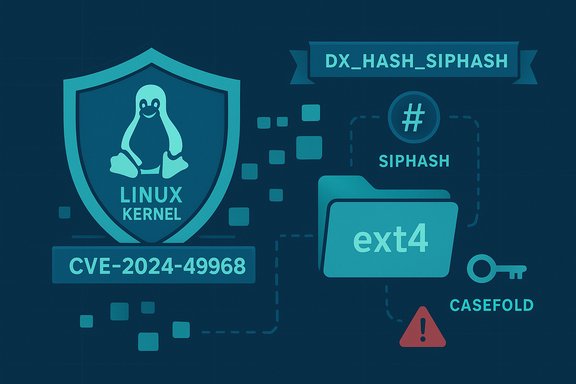 Overview
This vulnerability is not a classic memory‑corruption exploit; it’s a logic/compatibility bug in ext4’s mount code that produces a definitive availability impact: certain ext4 filesystems simply cannot be mounted when the kernel’s default hashing mode is set to the SipHash variant but the filesystem lacks casefold support. The issue was assigned CVE‑2024‑49968, fixed upstream in the stable kernels, and tracked by multiple distributors and vulnerability databases with a typical CVSS v3 base score around 5.5 (Medium). At a glance:- Affected component: Linux kernel — ext4 mount code (fs/ext4/super.c).
- Symptom: mount operation exits/refuses the filesystem when the kernel default hash is DX_HASH_SIPHASH and the underlying ext4 lacks the casefold feature flag.
- Impact: Availability — legitimate filesystems cannot be mounted under the specific configuration, blocking access to data and services that depend on those mounts.
Background: ext4 casefold, directory hashing, and SipHash
What is the ext4 casefold feature?
The casefold ext4 feature enables case‑insensitive filename lookups by changing how directory entries are compared and hashed. Casefolding requires a consistent, secure hashing method to avoid collisions and to ensure identical lookup behavior across case variations. When a filesystem is created with casefold enabled, it sets a metadata flag that informs the kernel and userland to use the compatible hashing behavior during mounts and directory operations.Directory hashing and DX_HASH_SIPHASH
ext4 supports pluggable directory hashing algorithms. The kernel and userland can choose a default directory-index hash; one of the available implementations is DX_HASH_SIPHASH (a SipHash‑based hash). SipHash is favored for its resistance to hash-flooding DoS vectors and for consistent behavior across inputs. However, SipHash is meaningful for ext4 only in the context of casefold-aware name handling; attempting to use a SipHash-based lookup when a filesystem hasn’t declared casefold capability creates an incompatibility the mount logic must handle.How the mismatch affects mounting
If the kernel's configuration or runtime defaults indicate SipHash should be the active hashing method but the target ext4 superblock lacks the casefold flag, the ext4 mount implementation detects the mismatch and aborts the mount. Operationally this is an availability failure: a legitimate filesystem (for example, a loopback image, a disk attached in a VM, or a removable volume) will fail to mount until the kernel or the filesystem is adjusted. The upstream kernel team treated this as a correctness/robustness bug and produced a targeted fix that landed in stable kernels.The technical root cause (in plain language)
At its core, CVE‑2024‑49968 arises from a validation/compatibility check during the ext4 mount sequence:- The kernel determines the directory hashing method to use (based on configuration, mount options, and defaults).
- If the chosen hash is the SipHash variant (DX_HASH_SIPHASH) but the filesystem’s superblock does not advertise the casefold capability, ext4’s mount code exits the mount rather than attempting a best‑effort fallback.
- The condition was considered invalid by the code path, but the operational consequence — failing to mount filesystems that otherwise should be mountable under more permissive behavior — was judged unacceptable for robustness.
Who is affected — realistic exposure and risk model
This vulnerability’s attack vector is local: an attacker must be able to cause or influence mount attempts on a host. That makes it fundamentally different from remote network exploits, but its real-world severity depends on where mounts happen and which actors can trigger them.High‑priority exposure scenarios:
- Cloud hosts and virtualization platforms that frequently attach, mount, or loopback‑mount untrusted guest images or volumes. A tenant or CI job that provides an image lacking casefold but running on a SipHash‑default host could cause service disruption.
- CI/CD runners, build farms, and shared development servers that mount many externally supplied images and may therefore encounter the mismatch frequently.
- Storage appliances or NAS devices that accept user-supplied images or disks and mount them on the host kernel.
- Single‑user desktops or servers with tightly controlled local access that never mount untrusted images. In those cases mounting failure is still inconvenient, but the threat of deliberate exploitation is small.
- This is not a privilege‑escalation vector; public records indicate the bug produces a deterministic mount failure rather than arbitrary code execution or information disclosure.
- The primary threat is denial of availability — a mount refusal that could interrupt applications, backup jobs, or provisioning workflows until the host is patched or configuration is adjusted.
How the kernel and distributions responded
The Linux kernel CVE team recorded CVE‑2024‑49968 and provided upstream fixes. The official announcement and stable patches show two relevant stable‑tree commits (one backport for 6.11.3 and the other for 6.12‑rc1), and the fix was included in subsequent stable kernels. Distributors (Debian, SUSE, Red Hat, Amazon Linux, etc. mapped the upstream commits into their kernel packages and issued advisories or package updates as part of normal security maintenance. Key technical signals:- Fix landed in upstream stable commits referenced by kernel.org; distributors used those commits to produce patched kernel packages.
- Public CVE trackers (NVD, OpenCVE, ALAS) recorded the issue and the CVSS assessment (commonly CVSS v3 = 5.5 / Medium).
Detection: how to tell if a host is affected
- Check running kernel version and map to vendor advisories:
- uname -r and consult your distribution’s security tracker for CVE mappings and whether a particular kernel package includes the upstream commit that fixes CVE‑2024‑49968.
- Identify ext4 mounts that may be impacted:
- mount | grep ext4
- findmnt -t ext4
- Inspect kernel logs for mount failures or ext4-specific error messages:
- journalctl -k | grep -i ext4
- dmesg | grep -i ext4
Practical remediation and short-term mitigations
The definitive fix: install a kernel package from your distribution or vendor that includes the upstream stable commits that resolve the issue, then reboot into the patched kernel. Distributors have mapped the fix into package versions in different timelines; check your vendor change logs to identify the package versions to install. If you cannot immediately apply kernel updates, consider these compensating controls:- Restrict ability to mount filesystems:
- Ensure mount and loop device creation privileges are limited to trusted users.
- Use mount namespaces, capability restrictions (CAP_SYS_ADMIN), or policy modules to restrict who may perform mounts.
- Avoid mounting untrusted images on critical hosts:
- For virtualization hosts, do not automatically attach or mount guest images that originate from untrusted tenants in the host context; prefer isolated helper VMs or user-space tools that avoid host kernel mounts.
- Use sandboxing for image ingestion:
- Process and validate uploaded images in dedicated staging hosts that can be patched quickly or are physically/virtually isolated.
- Blacklist or unload ext4 if the host does not require it (not typically possible on systems with ext4 root):
- modprobe -r ext4 (only where ext4 is a module and safe to unload).
Patch verification and validation steps
After applying a kernel update:- Reboot into the patched kernel and confirm uname -r matches the expected patched package.
- Validate the patch presence:
- Confirm your distribution package changelog or advisory explicitly references CVE‑2024‑49968 or the upstream commit hashes (for example, the commits the kernel CVE announcement listed).
- Reproduce the mount cases in a safe test environment:
- Attempt to mount the previously failing image or filesystem and validate the mount succeeds under the patched kernel.
- Monitor logs for residual errors:
- journalctl -k after attempting mount operations and add detection rules for the specific ext4 mount failure strings observed prior to the patch.
Why this matters operationally — a deeper risk analysis
From a security‑operations perspective, CVE‑2024‑49968 illustrates several broader lessons:- Small compatibility checks can produce outsized operational impacts. A mount-time validation that seems correct from a correctness perspective may still block legitimate workflows if defaults and filesystem features diverge across environments. The fix and the subsequent vendor advisories show maintainers prefer minimal, surgical changes that restore expected behavior without wide‑ranging semantic shifts.
- Local-only vulnerabilities still matter in multi‑tenant and cloud environments. Although a local attack vector limits remote exploitability, in shared infrastructures the blast radius is host-wide: an untrusted tenant or CI job capable of supplying a specially formatted image can deny service to others by forcing repeated mount failures or requiring manual interventions. That justifies a higher operational priority on these fixes for cloud providers and hosting platforms.
- Accurate inventory and policy enforcement are critical. The easiest way to triage exposure is to know which hosts accept or perform mounts of third‑party images and to ensure those hosts are prioritized for kernel updates. Automation that collects uname, mounts, and loaded modules across fleets converts a nebulous exposure into an actionable remediation plan.
A short technical timeline
- Discovery: The incompatibility was identified in ext4’s mount logic and reported into the kernel stable‑tree process. Public listings show the issue was published as a CVE on October 21, 2024.
- Upstream fix: Patches were posted and incorporated into stable kernels (fixed in 6.11.3 and 6.12‑rc1 upstream since the change impacted fs/ext4/super.c). Distributors mapped those commits into vendor kernel packages.
- Distribution advisories: Debian, SUSE, Red Hat, Amazon Linux and other trackers recorded the CVE and published distribution‑specific guidance and package mappings. Administrators were advised to apply vendor kernel updates and to enforce mitigations where immediate patching was not possible.
Recommendations — prioritized remediation checklist
- Inventory and prioritize
- Collect uname -r, findmnt -t ext4, and list loaded modules on all hosts.
- Prioritize patching hosts that mount untrusted images, run CI/automation that mounts images, or host many tenants.
- Patch quickly
- Install vendor-supplied kernel packages that include the fix and reboot into the patched kernel.
- If using vendor images (cloud providers, WSL2, appliances or Android/OEM kernels), check vendor advisories for backports or contact the vendor for clarification.
- Short-term mitigations (if patching delayed)
- Restrict mount/loop privileges and avoid mounting untrusted images.
- Isolate image-processing workloads to patchable staging hosts.
- Validate and monitor
- Confirm the kernel changelog references the CVE or upstream commit.
- Add log detection for ext4 mount failures and ensure telemetry captures kernel oops/warn lines for ext4/super.c paths.
Limitations and caveats
- The issue is not a remote, unauthenticated code‑execution vulnerability; it is a local availability and compatibility bug. Treat claims that this CVE leads directly to privilege escalation as unverified unless corroborated by exploit code or credible analysis. Public trackers and vendor advisories all characterize the impact as Availability first.
- Long‑tail devices and vendor kernels may lag: embedded devices, appliance images, and OEM kernels often require vendor backports. Operators of such devices should request explicit confirmation that the upstream commit was backported or arrange compensating network/privilege mitigations until a vendor release is available.
- Some distribution trackers initially report vulnerability windows differently; always confirm patch presence by comparing your kernel package changelog or the vendor advisory to the upstream commit IDs listed in the kernel CVE announcement.
Conclusion
CVE‑2024‑49968 is a reminder that filesystem feature negotiation — the small flags and defaults that coordinate kernel behavior and on-disk format capabilities — can be the source of real operational pain when they diverge. The bug causes mounts to fail when the kernel expects SipHash-based directory lookups but the filesystem lacks the casefold flag. Although the vulnerability does not permit remote code execution or data theft, its availability impact is material in cloud, CI, and multi‑tenant contexts.The remedy is straightforward and low‑risk: install the vendor kernel update that includes the upstream stable commit, reboot into the patched kernel, and validate mounts in a controlled environment. In the short term, operators should restrict mount privileges, avoid mounting untrusted images on critical hosts, and treat mount failures that mention ext4 hash/casefold logic as high priority for forensic capture and patching. For administrators managing large fleets, the practical playbook is: inventory quickly, prioritize multi‑tenant and image‑ingestion hosts, patch and reboot in a phased fashion, and use short‑term policy mitigations where immediate patching is infeasible. These measures restore availability and reduce the risk that a configuration or image mismatch will turn into a disruptive outage.
Source: MSRC Security Update Guide - Microsoft Security Response Center
