

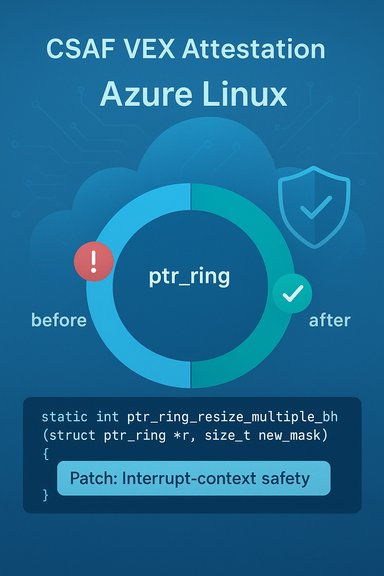
The Linux kernel change that became CVE-2024-57994 fixes a subtle concurrency / interrupt-context bug in the ptr_ring helpers — the short, operational truth is: Microsoft has publicly attested that Azure Linux images include the affected code and are therefore potentially affected, but that attestation is product‑scoped and does not prove Azure Linux is the only Microsoft product that could carry the vulnerable kernel code.
Background / overview
CVE-2024-57994 addresses a kernel change in the networking/page-pool helpers where a function calledptr_ring_resize_multiple (and a sibling skb_array_resize_multiple) was updated so it no longer masks hard IRQs. The upstream maintainers replaced the hard-IRQ masking with a bottom-half (BH) safe variant and renamed the helpers to make their semantics explicit; this was driven by a syzbot-discovered splat where hard interrupts were being blocked and producing an unreliable state. The issue and the patch are recorded in public kernel advisory feeds and standard vulnerability trackers. The practical impact profile for CVE-2024-57994 is availability/stability rather than code-execution: the bug is an improper-locking / interrupt-context correctness issue that can provoke kernel warnings or OOPSes in certain interleavings. The NVD assigns a medium-severity score (CVSS 3.x ~5.5) and classifies the vector as local (an attacker needs local access to trigger the condition). The fix is a small change in locking/interrupt semantics rather than a large redesign, which typically makes vendor backports straightforward. Microsoft’s public advisory language for this CVE states that “Azure Linux includes this open‑source library and is therefore potentially affected,” and it notes Microsoft’s program to publish machine-readable CSAF/VEX attestations (starting with Azure Linux) and to update the CVE record if more Microsoft products are later identified as carriers. That phrasing is an inventory attestation — it tells Azure Linux customers that Microsoft has validated and mapped the vulnerable upstream component into that product family at the time of publication.Technical details — what changed in ptr_ring
The bug in plain terms
- The ptr_ring helpers are generic ring-buffer helpers used by several networking subsystems (and other kernel subsystems) to manage ring-like buffers and queues.
- A test or fuzz run (syzbot) observed a kernel splat tied to hard IRQs being blocked while callers expected only BH (softirq/tasklet) protection.
- Upstream developers adjusted the implementation to remove hard-IRQ masking from the resize path, making the helpers BH-safe only, and renamed the helpers to reflect that contract (for example,
ptr_ring_resize_multiple→ptr_ring_resize_multiple_bh). - The patch adds stronger lockdep assertions and changes the interrupt masking to match real caller expectations, which eliminates the rare hard‑IRQ / context-sensitivity splat.
Why this matters operationally
Interrupt-context correctness bugs tend to be noisy and brittle: they can crash or OOPS kernels in ways that are hard to reproduce and diagnose, and they are especially dangerous on multi-tenant infrastructure (cloud hosts, shared containers, hypervisor hosts) where untrusted workloads may exercise rare code paths. This CVE does not enable arbitrary remote code execution in the usual sense; its operational cost is stability and availability risk.What Microsoft actually said — reading the attestation precisely
Microsoft’s security page and accompanying public messaging state two specific things:- Azure Linux images include the implicated upstream component and are therefore potentially affected.
- Microsoft has started publishing machine-readable CSAF/VEX attestations (a transparency program that creates per-product, automatable vulnerability mappings) and will update the CVE/VEX record if additional Microsoft products are found to ship the same component.
Short direct answer to the user’s question
- No — Azure Linux is not necessarily the only Microsoft product that could include the vulnerable ptr_ring code.
- Yes — Azure Linux is the only Microsoft product Microsoft has publicly attested as including the vulnerable component at the time of the advisory.
Why the attestation does not imply exclusivity — technical and organizational reasons
- Per-artifact build choices
- Kernel features and drivers are selected at build time via
CONFIG_options. One kernel build can include a component while another does not. - The same vendor can ship multiple kernel artifacts (cloud VM images, host OS images, WSL kernels, container base images), each built from different upstream trees or with different config options.
- Kernel features and drivers are selected at build time via
- Static vs. packaged binaries
- Some components are compiled directly into binaries (statically), so package updates to a distro’s user-space package manager may not touch embedded or statically-linked copies.
- Wide vendor footprint and phased inventory
- Large vendors (including Microsoft) publish attestations product-by-product as internal inventories are completed. Publishing a VEX attestation for Azure Linux first is pragmatic but leaves other product families to be scanned later.
- Marketplace and partner images
- Azure Marketplace images, partner appliances, or third-party containers hosted in Azure may be built and maintained by other vendors; their patch or inventory state can diverge. Customers running those artifacts must validate them independently.
Where else to look inside Microsoft’s ecosystem (plausible carriers)
When deciding whether other Microsoft products might include the same vulnerable kernel code, inspect the following artifacts and product families first:- WSL2 kernel — Microsoft publishes and ships a WSL2 kernel; it is built from an upstream tree and its configuration is public. If the WSL kernel version/config includes the relevant net/core code, it could be affected.
- CBL‑Mariner — Microsoft’s internal Linux distro used for some cloud hosts, container bases, and managed infrastructure. CBL‑Mariner kernel builds can carry upstream fixes and have been the subject of CVE mappings in Microsoft’s update channels.
- Azure host / AKS node images — VM host images, AKS node images and host OS images are separate artifacts. The presence of the kernel code depends on the image and kernel package versions.
- Marketplace images and partner appliances — images published by third parties and hosted in Azure Marketplace may bundle kernels containing the code.
- Custom or vendor-supplied kernels — any custom kernels that customers upload or that third-party appliances embed may include vulnerable code.
Practical detection and verification steps (prioritized for operators)
Below are precise, actionable checks administrators and engineers should perform to determine exposure across mixed Windows + Linux estates.Quick inventory (priorities)
- Confirm running kernel versions
- Run
uname -ron each Linux host (VMs, container hosts, WSL distributions). - Cross-check the returned kernel version against the affected ranges identified by public trackers (NVD lists the affected kernel ranges for this CVE; check vendor advisories if you use distro kernels).
- Run
- Identify Microsoft-supplied Linux artifacts in your estate
- Azure VM images: Azure Linux (attested), Marketplace images, custom images.
- Windows hosts: WSL2 instances (check the shipped WSL kernel or whether a custom kernel is in use).
- Container images: base images used for AKS nodes or build pipelines.
- Inspect kernels for the patched commit
- Examine distro changelogs (e.g.,
apt changelog linux-image-$(uname -r)orrpm -q --changelog kernel) for references to the ptr_ring fix or the upstream commit IDs. - If you possess the
vmlinuz/System.mapfor an image, grep forptr_ringorpage_poolsymbols:grep -i ptr_ring System.map(presence of symbol names can be an indicator that the relevant code is compiled in). Be cautious: symbol names and module inclusion vary by config.
- Examine distro changelogs (e.g.,
- WSL-specific checks
- WSL2 users can check the kernel version and the WSL kernel repository (the WSL kernel repo includes the build config and release tags).
- If using the Microsoft-distributed WSL kernel, monitor for WSL kernel updates via Windows Update and the WSL release notes.
Commands and quick checks
- On a running Linux VM or host:
uname -rzgrep CONFIG_PAGE_POOL /proc/config.gz || grep -i page_pool /boot/config-$(uname -r)grep -i ptr_ring /proc/kallsyms(note: kallsyms may be restricted on some distros)apt changelog linux-image-$(uname -r) | sed -n '1,200p'orrpm -q --changelog kernel | head -n 100to search for CVE references
- On Windows running WSL2:
- In a WSL shell:
uname -rand cross-check the kernel tag against WSL kernel releases. - If you run a custom WSL kernel, inspect that custom build’s config and commit history.
- In a WSL shell:
Recommended remediation and mitigation actions (immediate to medium term)
- Patch and reboot (highest priority)
- Apply vendor-supplied kernel updates for the affected images and reboot to ensure the patched kernel is active.
- For Azure Linux VMs, apply the Azure-managed kernel/image updates Microsoft publishes for Azure Linux. Microsoft’s Azure Linux attestation indicates they have mapped the component and will publish fixes where needed.
- WSL hosts
- Install WSL kernel updates via Windows Update / WSL update instructions if Microsoft publishes a WSL kernel advisory for this CVE.
- If you use a custom WSL kernel, rebuild that custom kernel from a patched upstream tree and deploy it.
- AKS / container hosts / Marketplace images
- For AKS node pools, ensure the node image versions are patched or upgrade the node pools.
- For Marketplace or third-party images, consult the image publisher and apply their updates or replace the image with a patched alternative.
- If immediate patching is impossible
- Inventory and restrict untrusted local access on multi-tenant systems (use stricter container isolation, capabilities removal, SELinux/AppArmor profiles).
- For hosts where the vulnerability could be triggered by local untrusted processes, tighten user access and avoid running untrusted workloads.
- Monitor vendor channels and VEX/CSAF outputs
- Use Microsoft’s VEX/CSAF attestations for Azure Linux as a reliable, machine-readable signal for automation. Monitor MSRC advisories for updates and expanded attestations if Microsoft identifies more affected products.
Strengths in Microsoft’s approach — and remaining gaps
Notable strengths
- Product-scoped VEX/CSAF attestations are valuable. They produce machine-readable mappings that make automation and triage faster for customers who run attested artifacts (Azure Linux in this case). That reduces uncertainty for those specific images.
- The upstream fix is small and surgical. Interrupt/masking corrections are typically lower risk to backport, which helps vendors produce safe updates quickly.
Residual risks and caveats
- Attestation ≠ completeness. An attestation for Azure Linux is an authoritative “yes” for that product but is not a “no” for other Microsoft products. Customers must validate each artifact they run.
- Custom kernels, Marketplace images, and static binaries complicate remediation. These can hide vulnerable code behind layers that standard package managers do not touch.
- Local vector but significant availability impact for certain environments. On shared hosts, a local crash or OOPS can disrupt many tenants and has outsized operational impact even when the CVSS is “medium.”
Practical checklist — what to do in the next 72 hours
- Inventory: list all Linux artifacts you run (VM images, containers, AKS nodes, WSL2 instances, Marketplace appliances).
- Identify: run
uname -ron each host and check vendors’ advisories for whether that kernel release is listed as affected. - Patch Azure Linux instances first if you use them (Microsoft has attested those images). Reboot to apply kernels.
- Verify WSL2 hosts and update via Microsoft if a WSL kernel advisory is published.
- For AKS and host fleets, coordinate node upgrades and image replacements; test in staging before mass rollouts.
- If you cannot patch immediately, restrict local untrusted workloads and isolate critical hosts.
- Automate: ingest Microsoft’s CSAF/VEX attestations for Azure Linux into your vulnerability orchestration tooling to reduce triage time where relevant.
Conclusion — a clear, operational interpretation
Microsoft’s public statement that “Azure Linux includes this open‑source library and is therefore potentially affected” is deliberate and useful: it gives Azure Linux customers a machine-readable, authoritative signal to act on immediately. However, that statement should not be misread as an exclusive guarantee that no other Microsoft product contains the vulnerable kernel component. The correct operational posture is to treat Microsoft’s Azure Linux attestation as a confirmed exposure for that product family while verifying other Microsoft-supplied artifacts (WSL2 kernels, CBL‑Mariner-based images, AKS and Marketplace images, custom kernels) individually. Microsoft has committed to expand its VEX/CSAF mapping if additional internal products are found to include the component — customers should monitor those updates and follow the practical verification and remediation checklist outlined above.(Technical note: this analysis is assembled from the public CVE record and vendor attestations; NVD and distribution trackers list the vulnerability details and affected kernel ranges, and Microsoft’s public messaging frames Azure Linux as the first attested product with a commitment to expand VEX/CSAF mappings if additional products are discovered to ship the same upstream component.
Source: MSRC Security Update Guide - Microsoft Security Response Center
