

The Linux kernel vulnerability tracked as CVE‑2024‑58098 is a targeted but important correctness fix in the eBPF verifier: upstream maintainers changed how the verifier computes and propagates the changes_pkt_data property for global (non-inline) subprograms so that packet-pointer invalidation triggered by certain helper calls is not accidentally missed. Microsoft’s public advisory for this CVE names Azure Linux as a product that “includes this open‑source library and is therefore potentially affected,” but that product-level attestation is an inventory statement — it confirms Azure Linux carries the implicated kernel code and deserves immediate attention, yet it is not a categorical guarantee that no other Microsoft product contains the same vulnerable code. This article explains the technical issue, verifies the scope of the fix across vendors, and provides practical guidance for defenders who need to know whether their Microsoft‑managed artifacts could be affected.
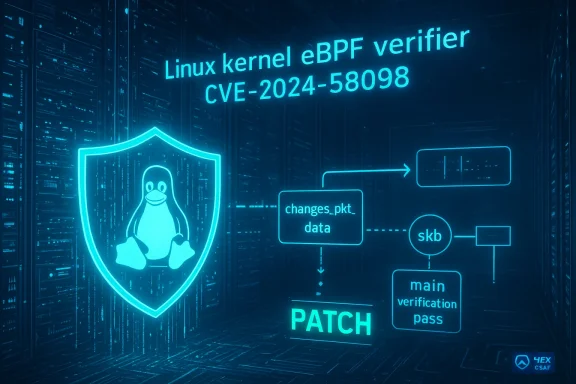
The problem fixed by CVE‑2024‑58098 lives in the BPF (Berkeley Packet Filter) verifier inside the Linux kernel. BPF programs commonly manipulate packet data pointers (for example skb->data and skb->data_end) and the verifier must conservatively ensure those pointers are used safely. Some BPF helper calls — notably helpers that modify or revalidate packet data like bpf_skb_pull_data() — cause the verifier to invalidate packet pointers in the current verification state. The subtlety addressed by this CVE is that the verifier did not correctly propagate “this subprogram invalidates packet pointers” information across calls to global (non-inline) helper-wrapping subprograms. In short, a helper call hidden behind a global function could be missed; the verifier would not mark packet pointers invalid in the caller state and could incorrectly accept BPF programs that later dereference now-unsafe pointers.
This is a correctness/verification fix rather than an obviously remote‑exploitable kernel backdoor. The upstream remediation computes a per‑subprogram flag (bpf_subprog_info->changes_pkt_data) before the main verification pass so that callers correctly inherit pointer-invalidating behavior from callees, including when the invalidation is done indirectly (through additional global subprograms).
Key operational consequences:
When a BPF helper may alter the packet layout or otherwise "pull" or change packet data, the verifier must conservatively mark existing packet pointers as invalid for subsequent operations. If the verifier fails to do that, later pointer dereferences may not be safe and could produce memory corruption at kernel level.
Two things to emphasize:
Why that nuance matters:
Important interpretive points:
Microsoft’s public statement that Azure Linux includes the affected open‑source component and is potentially affected is useful and actionable for Azure Linux customers. That statement reflects Microsoft’s new CSAF/VEX approach: publish what you have verified and promise to expand coverage as inventory checks continue. But that wording should not be read as an exhaustive declaration of risk across all Microsoft products. Microsoft ships kernel artifacts in multiple places (for example, WSL and Azure‑tuned kernels), and each artifact must be verified independently.
Practical defenders should therefore treat Microsoft’s Azure Linux attestation as a clear signal to patch those artifacts, while also performing a wider artifact‑level inventory across WSL, AKS nodes, Marketplace images, and any Microsoft‑published appliances in their environment. Use the upstream commit history and vendor advisories to map affected kernel versions, apply vendor kernel updates, and harden runtime privileges when immediate patching is not possible.
Transparency programs like CSAF/VEX are a meaningful step forward — they reduce ambiguity for defenders — but they are only useful when combined with active artifact verification and patching discipline. Treat Microsoft’s Azure Linux attestation as authoritative for that product, but assume additional Microsoft artifacts may require your attention until Microsoft explicitly attests otherwise or you verify artifact versions yourself.
Source: MSRC Security Update Guide - Microsoft Security Response Center
 Background / Overview
The problem fixed by CVE‑2024‑58098 lives in the BPF (Berkeley Packet Filter) verifier inside the Linux kernel. BPF programs commonly manipulate packet data pointers (for example skb->data and skb->data_end) and the verifier must conservatively ensure those pointers are used safely. Some BPF helper calls — notably helpers that modify or revalidate packet data like bpf_skb_pull_data() — cause the verifier to invalidate packet pointers in the current verification state. The subtlety addressed by this CVE is that the verifier did not correctly propagate “this subprogram invalidates packet pointers” information across calls to global (non-inline) helper-wrapping subprograms. In short, a helper call hidden behind a global function could be missed; the verifier would not mark packet pointers invalid in the caller state and could incorrectly accept BPF programs that later dereference now-unsafe pointers.This is a correctness/verification fix rather than an obviously remote‑exploitable kernel backdoor. The upstream remediation computes a per‑subprogram flag (bpf_subprog_info->changes_pkt_data) before the main verification pass so that callers correctly inherit pointer-invalidating behavior from callees, including when the invalidation is done indirectly (through additional global subprograms).
Key operational consequences:
- The issue is local in nature (BPF programs are typically loaded by local users or privileged workflows), and exploitability requires the ability to load or update BPF programs in the target kernel context.
- The vulnerability can allow unsafe pointer use to pass verifier checks, which in the worst case can enable memory corruption, stability problems, or privilege/escalation vectors depending on how the kernel and callers behave.
- Upstream and distributors have landed fixes in stable kernel branches, and many Linux distributors have released patches or updated kernel packages.
What exactly did the verifier get wrong?
The verifier’s job, in short
The eBPF verifier statically analyzes BPF bytecode before the kernel accepts it for execution. It tracks pointer provenance, bounds, and which state bits are valid; for packet-processing helpers in the networking path, correct tracking of packet pointers (pointers into skb data) is critical.When a BPF helper may alter the packet layout or otherwise "pull" or change packet data, the verifier must conservatively mark existing packet pointers as invalid for subsequent operations. If the verifier fails to do that, later pointer dereferences may not be safe and could produce memory corruption at kernel level.
The specific omission
- BPF programs can call helper functions directly, which the verifier checks and uses to mark packet-pointer invalidation. The verifier knows, for a list of helpers, that they invalidate packet pointers (this comes from code like filter.c:bpf_helper_changes_pkt_data()).
- But the verifier’s earlier logic did not traverse global subprograms when deciding whether a call to a global subprogram should mark the caller’s packet pointers invalid. In other words, if subprogram S calls helper H that invalidates packet pointers, and caller C calls S (where S is a global function), the original verifier pass could miss that chain and not mark packet pointers in C as invalid.
- The fix computes bpf_subprog_info->changes_pkt_data for every subprogram in a pre‑verification pass so the main verification pass can inherit the correct packet-invalidating behavior through call chains.
How serious is this bug?
- Severity: medium (many public trackers and CVE aggregators place the CVSSv3 around 5.5). The classification reflects a substantial correctness risk but not a straightforward remote remote‑code‑execution hole by itself.
- Exploitability: local — to exercise the wrong code paths an attacker typically needs the ability to load or update BPF programs on the host. In many cloud or container environments, that capability is controlled by privileged services; however, on multi‑tenant hosts or developer workstations where untrusted code can become a BPF program, the risk is meaningful.
- Impact profile: incorrect verifier behavior can permit unsafe pointer dereferences that lead to kernel corruption, instability, or more nuanced local elevation scenarios. The exact impact depends on the BPF program’s behavior and the kernel configuration.
Who has published fixes, and where does Microsoft fit in?
Multiple independent sources and major distributors document the CVE and the fix:- The National Vulnerability Database (NVD) and several vulnerability databases list the CVE with the same technical summary describing changes_pkt_data propagation in the BPF verifier.
- Major Linux distributors (for example, SUSE and Amazon Linux/ALAS lists) have published kernel updates that mention the bpf changes and include this fix among other BPF-related corrections.
- The upstream kernel git history contains the commits that compute bpf_subprog_info->changes_pkt_data earlier and adjust check_cfg() traversal — that is the authoritative technical change.
- Scanning and security tooling vendors (Tenable/Nessus, Wiz and others) have produced advisories and detection plugins that identify affected kernel versions and the presence of unpatched images.
Two things to emphasize:
- Microsoft’s attestation that “Azure Linux includes this open‑source library and is therefore potentially affected” is authoritative for Azure Linux, and customers using Azure Linux must apply the vendor’s updates.
- That attestation is product scoped — it does not automatically mean other Microsoft offerings (for example, WSL kernel builds, Azure Marketplace images, AKS node images, or other Microsoft‑curated kernel binaries) are clean. The absence of a public attestation for another product is not proof that the product is unaffected.
Is Azure Linux the only Microsoft product that could be affected?
Short answer: No — Azure Linux is the only Microsoft product Microsoft has publicly attested (via CSAF/VEX outputs) to include the vulnerable code so far, but other Microsoft‑distributed Linux kernels or images may also carry the same source code and require per‑artifact verification.Why that nuance matters:
- Microsoft builds and ships kernels in multiple places. The Windows Subsystem for Linux (WSL/WSL2) uses a Microsoft‑maintained kernel source tree and binary artifacts; the WSL kernel source is openly available and Microsoft uses its own build and update channels for WSL kernels. Microsoft also publishes and maintains Azure‑tuned kernels and provides kernel images for various Azure artifacts.
- Whether a Microsoft product is actually affected depends on two things: (1) whether that product’s delivered kernel binary contains the vulnerable commit range, and (2) the build/configuration choices used (e.g., is the relevant BPF verifier and the affected helper code enabled?).
- Microsoft’s VEX/CSAF program started with Azure Linux as the first product family to receive structured attestations. That early focus was intentional; it does not imply exhaustive coverage of every Microsoft kernel artifact yet.
- Azure Linux images and packages (attested).
- WSL2 kernels distributed and maintained by Microsoft (open-source repo and Microsoft update mechanisms).
- Any Azure Marketplace or platform image where Microsoft supplies or curates the kernel (AKS node images, platform appliance kernels).
- Microsoft‑published virtual appliance images that include a Linux kernel.
What to check right now — a practical checklist for operators
- Inventory all host kernels in your environment.
- Identify hosts running Azure Linux and apply the vendor‑published kernel update immediately.
- Identify Windows hosts running WSL/WSL2; confirm the installed WSL kernel version and update via Microsoft’s WSL update mechanism if necessary.
- For Azure VMs and AKS nodes, check the kernel package and image provenance: is the kernel vendor-supplied (Ubuntu, RHEL, etc.) or Microsoft‑curated? If the latter, verify the image’s kernel version and patch level.
- Identify kernel versions and commit ranges.
- Use uname -r and distribution package metadata to determine kernel builds. Compare against public advisories that list fixed kernel versions or the upstream commit that addresses the issue.
- If vendors supply a kernel package with a vendor‑specific version string, consult the vendor advisory to map to upstream fixes.
- Apply available patches.
- Update Azure Linux instances using the update guidance from Microsoft for Azure Linux.
- For distributions patched by their vendors (SUSE, Amazon Linux, etc.), deploy the distributor-provided kernel updates.
- Update WSL by applying the latest Microsoft WSL release (the WSL kernel is serviced independently of Windows in many channels).
- For environments where kernel updates are slow to roll out:
- Consider reducing local attack surface: deny untrusted users the ability to load BPF programs, restrict CAP_BPF/CAP_NET_RAW where possible, and apply container runtime controls to minimize exposure.
- On shared hosts (multi‑tenant), evaluate host hardening and stricter controls around eBPF program loading.
- Validate with scanners and runtime checks.
- Use vendor advisories, security scanners (Nessus, Qualys, etc.), and vendor-supplied detection scripts to identify unpatched kernels.
- Test BPF load paths in a safe staging environment after updates; some patches change verifier behavior and could reveal previously accepted, but unsafe, user programs.
How to interpret Microsoft’s VEX/CSAF attestation language
Microsoft’s move to publish machine‑readable VEX/CSAF attestations is a positive step for supply‑chain transparency: when Microsoft says “Azure Linux includes this open‑source library and is therefore potentially affected,” that is a direct product‑level inventory statement derived from Microsoft’s internal artifact checks. It is intended to help customers quickly decide where patching is needed.Important interpretive points:
- “Potentially affected” signals that the product includes the implicated upstream component; remediation or a confirmed “not affected” status requires further product‑level verification.
- Microsoft’s published VEX/CSAF output is incremental; the program began with Azure Linux and plans to expand to more Microsoft products over time. Customers should check the VEX/CSAF feed for updates and watch Microsoft’s product mapping for changes.
- If you operate other Microsoft artifacts (WSL kernels, platform images, Marketplace appliances), do not assume you are covered until you see an explicit attestation or you perform your own artifact verification.
Cross‑vendor verification (where the fix landed)
Multiple independent sources corroborate the technical fix and the distribution of patches:- The upstream Linux kernel commits implementing the changes to compute and propagate changes_pkt_data are available in kernel git history; these are the technical source-of-truth for the change.
- The NVD and independent vulnerability databases describe the same technical issue and the same mitigation approach: compute per‑subprogram flags and propagate them during verification.
- Several Linux distributors and cloud OS teams — for example SUSE and Amazon Linux advisories — explicitly mention the BPF changes in their kernel update notes and include the fix in vendor kernel updates.
- Security scanners and advisories (Nessus, Tenable, Wiz and others) provide detection logic and classify Azure Linux images as carrying the vulnerable kernels until patched.
Risk assessment and operational advice for Microsoft customers
- If you run Azure Linux: this is a confirmed in‑scope product — apply Microsoft’s updates for the Azure Linux kernel as soon as they are available in your environment.
- If you run WSL/WSL2: treat WSL kernels as Microsoft‑supplied kernel artifacts; check the WSL kernel version and update the WSL kernel image where updates are available. Microsoft publishes the WSL kernel source and ships binaries via its update mechanisms.
- If you run Azure VMs, AKS, or Marketplace images: inventory the kernel in each image. Many Azure Marketplace images use vendor kernels, but some Azure‑tuned or Microsoft‑curated kernels are distributed by Microsoft and deserve verification.
- For on‑prem or other cloud hosts running Microsoft‑published images or appliances, coordinate with your Microsoft support contacts or the VEX/CSAF feed to confirm whether the appliance uses an affected kernel.
- Inventory (which products use which kernels).
- Patch on a staged schedule (test, then rollout).
- Harden host capabilities to limit arbitrary BPF program loading where you cannot immediately patch.
- Monitor vendor VEX/CSAF attestation feeds and vendor advisories for updates expanding product mappings beyond Azure Linux.
Caveats and unverifiable items
- Public attestations are evolving: Microsoft explicitly committed to expand VEX/CSAF attestations to more products over time. Until Microsoft updates the CVE mappings, other Microsoft artifacts remain potentially in scope and require per‑artifact checks.
- Whether any specific Microsoft product beyond Azure Linux carries the vulnerable kernel in your environment depends on the exact kernel version and configuration shipped in that product image — this is a fact that only per‑artifact inspection can confirm.
- The vulnerability is not a remotely exploitable network worm‑type issue by itself; exploitability requires loading or having access to BPF program load paths. However, in multi‑tenant or developer‑heavy environments, BPF load‑capable users or services can raise risk.
Recommended immediate actions (summary)
- Apply patches to Azure Linux systems without delay.
- Check and update WSL2 kernels on Windows hosts through Microsoft’s WSL update channels.
- For Azure virtual machines and AKS nodes, verify kernel package provenance and update node images or kernels where vendors have published patches.
- Restrict BPF program load privileges where practical while you patch.
- Use vulnerability scanners tuned to CVE‑2024‑58098 to find unpatched kernels in your fleet.
- Subscribe to the vendor VEX/CSAF output and MSRC advisories; Microsoft’s product mapping may be expanded and updated as additional artifacts are inventoried.
Final analysis: transparency is necessary, but inventory is the key
CVE‑2024‑58098 is a classic example of a correctness bug in a complex kernel subsystem — the kind of flaw that matters in real deployments, particularly where untrusted or less‑restricted users can register or load BPF programs. The kernel fix is surgical: it makes the eBPF verifier correctly propagate changes_pkt_data for global functions and closes a gap where indirect helper calls could invalidate packet-pointer safety checks.Microsoft’s public statement that Azure Linux includes the affected open‑source component and is potentially affected is useful and actionable for Azure Linux customers. That statement reflects Microsoft’s new CSAF/VEX approach: publish what you have verified and promise to expand coverage as inventory checks continue. But that wording should not be read as an exhaustive declaration of risk across all Microsoft products. Microsoft ships kernel artifacts in multiple places (for example, WSL and Azure‑tuned kernels), and each artifact must be verified independently.
Practical defenders should therefore treat Microsoft’s Azure Linux attestation as a clear signal to patch those artifacts, while also performing a wider artifact‑level inventory across WSL, AKS nodes, Marketplace images, and any Microsoft‑published appliances in their environment. Use the upstream commit history and vendor advisories to map affected kernel versions, apply vendor kernel updates, and harden runtime privileges when immediate patching is not possible.
Transparency programs like CSAF/VEX are a meaningful step forward — they reduce ambiguity for defenders — but they are only useful when combined with active artifact verification and patching discipline. Treat Microsoft’s Azure Linux attestation as authoritative for that product, but assume additional Microsoft artifacts may require your attention until Microsoft explicitly attests otherwise or you verify artifact versions yourself.
Source: MSRC Security Update Guide - Microsoft Security Response Center
