

The recently assigned CVE-2025-10148 — a predictable WebSocket mask bug in curl/libcurl — is real, it is patched upstream, and Microsoft’s short public attestation that “Azure Linux includes this open‑source library and is therefore potentially affected” is accurate for the product it covers. However, that attestation is a product‑scoped inventory statement, not a categorical guarantee that no other Microsoft product or image could contain the same vulnerable code. In practical terms: Azure Linux is the one Microsoft product Microsoft has publicly inventory‑checked and declared as potentially affected so far, but you must not treat that as proof that other Microsoft artifacts are safe. Operators and security teams should assume a need for verification across their Microsoft‑supplied images, endpoints, and services until Microsoft expands its VEX/CSAF attestations or you confirm otherwise in your environment.
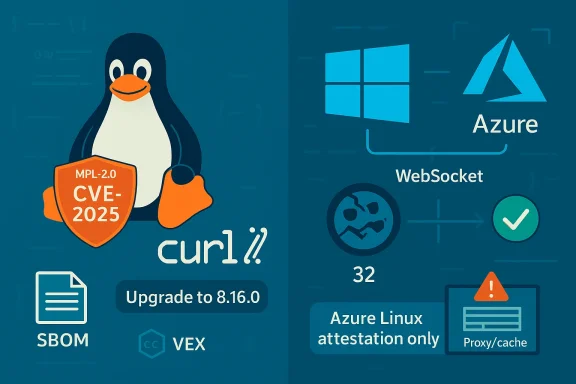
CVE-2025-10148 is a vulnerability in curl’s WebSocket implementation where the library failed to generate a fresh 32‑bit mask for every outgoing WebSocket frame, instead reusing a fixed mask across a connection. According to the upstream curl security advisory, this deviates from RFC 6455 and produces a predictable mask pattern that a malicious server can exploit under narrow conditions to induce traffic that an intermediary proxy might treat as ordinary HTTP. The concrete attack scenario the advisory warns about is proxy cache poisoning: a malicious WebSocket server crafts frames that confuse a proxy into caching attacker‑controlled content, which the proxy can subsequently serve to unrelated clients.
Key technical facts you should keep front of mind:
Crucial interpretation points:
Why the risk is tempered
Source: MSRC Security Update Guide - Microsoft Security Response Center
 Background / Overview
CVE-2025-10148 is a vulnerability in curl’s WebSocket implementation where the library failed to generate a fresh 32‑bit mask for every outgoing WebSocket frame, instead reusing a fixed mask across a connection. According to the upstream curl security advisory, this deviates from RFC 6455 and produces a predictable mask pattern that a malicious server can exploit under narrow conditions to induce traffic that an intermediary proxy might treat as ordinary HTTP. The concrete attack scenario the advisory warns about is proxy cache poisoning: a malicious WebSocket server crafts frames that confuse a proxy into caching attacker‑controlled content, which the proxy can subsequently serve to unrelated clients.Key technical facts you should keep front of mind:
- The vulnerability affects curl/libcurl versions 8.11.0 through 8.15.0 inclusive.
- The bug was fixed in curl 8.16.0; operators are advised to upgrade to that version or later.
- Exploitation requires cleartext WebSocket (ws://), not TLS‑protected WebSocket (wss://), and a proxy that (incorrectly) interprets WebSocket frames as HTTP traffic.
- The practical severity is low-to-medium for most environments because the exploitable network conditions (defective or misconfigured intermediary proxy + ws:// usage) are not common in modern deployments that use TLS end-to-end.
What Microsoft actually said — and what that wording means
Microsoft’s public vulnerability mapping for this CVE contains a short FAQ answer: that Azure Linux includes the open‑source library and is therefore potentially affected. Microsoft has also publicly explained its rollout of machine‑readable attestations (CSAF/VEX) — a welcome transparency move that began with Azure Linux and is intended to be expanded to other Microsoft products over time.Crucial interpretation points:
- That Microsoft statement is an attestation about a specific product (Azure Linux). It confirms Microsoft has completed an inventory check for Azure Linux and found the upstream component present there.
- It is not a global scan of all Microsoft products. The absence of a similar attestation for other Microsoft products is not evidence those products are unaffected. It is simply an indication Microsoft has not yet published attestations for them.
- Microsoft has committed to updating CVE records when additional product impact is identified; that is standard practice and helpful — but it is forward‑looking and relies on ongoing discovery and mapping.
Why Azure Linux was named first — the practical reasoning
Microsoft’s early VEX/CSAF rollout focused on Azure Linux for reasonable operational reasons:- Azure Linux is Microsoft’s own, curated Linux distribution used to build and publish many Azure VM images and container base images. That makes it a sensible starting place for attestations because the company controls and tests those artifacts end‑to‑end.
- Publishing machine‑readable VEX information for a single, internally managed product lets Microsoft validate tooling, partner integrations, and feedback loops before scaling the program to the many other places Microsoft ships third‑party code.
- Customers running Azure VM images, Azure Kubernetes Service (AKS) node images, and other services that directly consume the Azure Linux images receive immediate, actionable clarity from those attestations.
How libcurl lands inside Microsoft products — why other Microsoft artifacts could be affected
libcurl is an extremely widely reused C library. It appears in three common packaging patterns that matter when reasoning about Microsoft product exposure:- Standalone system packages and CLI binaries (curl.exe / libcurl.dll): Microsoft ships curl as a system component in Windows. Historically Microsoft builds curl for Windows and includes it in Windows 10/11 images; the shipped curl binary is a separate build of upstream curl and can lag upstream release timelines. That makes the Windows curl executable a candidate for containing a vulnerable version if Microsoft’s shipped build used an affected upstream version.
- Distribution packages inside Linux images and containers: any Microsoft‑produced Linux image (Azure Linux, older CBL‑Mariner images, custom Azure Marketplace images) or container base image may include a packaged curl or libcurl. Those images are specifically in scope for Microsoft’s VEX program when they are attested, and Azure Linux is the first such artifact to be publicly mapped.
- Embedded uses inside other software artifacts: third‑party vendors, open‑source components, or internal Microsoft services sometimes link libcurl directly into server or agent binaries. These usages are harder to inventory because they are embedded into disparate binaries or shipped as part of product-specific installers.
Practical examples: where to check in a Microsoft environment
If you run Microsoft products or consume Microsoft‑supplied images, start by checking these places:- Windows endpoints and servers: check the system curl executable versions at %WINDIR%\System32\curl.exe and %WINDIR%\SysWOW64\curl.exe. If those binaries are in the range 8.11.0–8.15.0, they match the upstream affected versions and should be updated or mitigated.
- Azure VM images and Marketplace images: examine the specific image version and package manifests used by your VMs. For Azure Linux images, Microsoft’s attestation is explicit; for other images, confirm package versions inside the image.
- Containers and Kubernetes node images (AKS): base images and node images often include curl; rebuild images or apply package updates so libcurl is 8.16.0 or newer.
- Developer tooling and CI/CD agents: build agents, self‑hosted runners, and provisioning images frequently carry curl; scan those images and the tools they install.
- Embedded/third‑party components: vendor appliances, SDKs, or runtimes that bundle libcurl need per‑artifact verification. Contact vendors or inspect SBOMs where available.
- WSL distributions and developer VMs: WSL uses upstream distro packages; if a WSL distro package includes a vulnerable curl, developer systems could be affected (though exploitation conditions are network‑centric).
Risk analysis: how worried should you be?
Short answer: the direct exploitation conditions are constrained, so urgency is moderate — but remediation remains recommended.Why the risk is tempered
- Exploitation requires cleartext WebSocket (ws://). Most services and clients use TLS (wss://) for WebSocket connections today, which eliminates the attack vector described for this CVE.
- The attack additionally requires a proxy that misinterprets WebSocket frames as HTTP and will cache poisoned content — that is an uncommon, non‑default proxy behavior in properly configured intermediaries.
- The curl advisory explicitly warns this is an edge case: the attacker must control the WebSocket server and operate in a network path where the proxy both sees and errs on WebSocket frames. That chain of conditions reduces likely exploitability in most modern deployments.
- Proxy cache poisoning can be impactful when it works. If a common proxy in your enterprise or ISP provider misbehaves in the required way, many downstream clients could receive attacker‑controlled content.
- Windows ship‑state: if your Windows fleet (or other Microsoft images you use) contains an affected curl binary, an attacker controlling an on‑path or hosting WebSocket endpoint could attempt abuse against internal clients.
- Proper security hygiene — upgrading to the patched curl or enforcing wss:// — removes the risk entirely and is low cost relative to the possible downstream consequences.
Recommended immediate actions for operators
- Inventory quickly and precisely.
- Scan endpoints, servers, container images, and VM images for curl/libcurl versions. Focus on Windows system paths, your Azure VM image catalog, AKS node images, and build agent images.
- Patch where practical.
- Upgrade to curl/libcurl 8.16.0 or later wherever you control the package or image. For system‑packaged distributions, apply vendor updates; for custom images, rebuild and redeploy.
- Apply short‑term mitigations if you cannot patch immediately.
- Prefer TLS: enforce or require wss:// for WebSocket traffic. If possible, block outbound ws:// connections in network controls until images are updated.
- Harden proxies: ensure proxies correctly identify and refuse to cache or interpret WebSocket traffic; confirm your caching layer strictly differentiates HTTP and WebSocket framing.
- Watch Microsoft’s VEX/CSAF feed and product mappings.
- Microsoft has pledged to expand attestations; monitor MSRC feeds for updates indicating additional product impact mappings. If you rely on a Microsoft product not yet attested, proactively verify the artifact.
- Use SBOM/SCA and image scanning.
- Where available, check SBOMs for the presence of curl. Use static scanning and package managers to detect vulnerable package versions inside images and deployed artifacts.
- Communicate with stakeholders.
- Inform developers, platform teams, and security ops about the low‑probability but concrete vector and the need to patch or apply mitigations.
For Microsoft customers: how to interpret Microsoft’s attestation and what to ask for
Microsoft’s move to machine‑readable VEX/CSAF is positive and should be encouraged — it reduces guesswork. But customers should understand the program’s current scope and what to request:- Treat VEX attestations as authoritative for the listed products only. If your environment uses Microsoft artifacts not listed as “affected” or “not affected” in the VEX file, assume “unknown until verified.”
- Ask Microsoft for expanded coverage of high‑impact product families you rely on (Windows system components, Azure Marketplace images, AKS node images, Visual Studio build agents, Microsoft‑supplied SDKs).
- Request or extract SBOMs and per‑artifact package manifests when consuming Marketplace images or official Microsoft images. That will allow you to triage your exposure without waiting for Microsoft to publish explicit VEX entries for every artifact.
- Where possible, automate verification by integrating Microsoft’s CSAF feed into your vulnerability management pipeline so attestations and changes are reflected automatically.
Incident response and detection suggestions
If you discover a vulnerable curl in your environment:- Treat the finding as a low‑immediacy vulnerability to remediate, but prioritize images and endpoints that are known to connect to untrusted WebSocket servers over cleartext networks.
- Look for suspicious inbound/outbound ws:// connections in network logs and proxy logs. An attacker would likely require a WebSocket session to have been established to deliver crafted frames.
- Inspect proxy cache entries and validate content integrity if you run or depend on caching proxies in the path.
- If you have a proxy that performs non‑standard processing of WebSocket frames, treat that proxy as high risk and accelerate configuration fixes or replacement.
- Update your image and package scanners with a rule to flag curl versions between 8.11.0 and 8.15.0.
- Add signatures or heuristics to your IDS/IPS for abnormal WebSocket frame sequences that could indicate probe activity. Bear in mind that such detection will yield false positives, so tune carefully.
Broader supply‑chain takeaways
This CVE and Microsoft’s response illustrate several broader trends and best practices for enterprise security teams:- Product‑scoped attestations are useful, but they are insufficient alone. Attestations must be broad, frequent, and accompanied by easy‑to‑consume SBOMs for real operational value. Microsoft’s VEX/CSAF rollout is an important step, but customers must retain active, automated inventory and scanning capabilities.
- Ubiquitous libraries (like libcurl) create repeated downstream exposure patterns. Even when a vendor does a good job of mapping impact to one product (Azure Linux), the same upstream code can exist in many other artifacts, third‑party tools, and custom images. Don’t rely on a single vendor’s attestation to clear your estate.
- Operational mitigations (use TLS, tighten proxy behavior, and enforce network egress rules) provide immediate ROI and reduce the attack surface while patches roll out.
Conclusion — direct answer to the user’s question
Is Azure Linux the only Microsoft product that includes this open‑source library and is therefore potentially affected by CVE‑2025‑10148?- From a strictly public‑attestation perspective: yes — Azure Linux is the Microsoft product Microsoft has publicly attested includes the vulnerable library at the time of the advisory. That attestation is authoritative for Azure Linux consumers.
- From a practical, security‑engineering perspective: no — Azure Linux is not necessarily the only Microsoft product that could include the vulnerable curl/libcurl code. Microsoft ships curl in Windows and distributes many images and artifacts that may include libcurl, and other Microsoft products or images could still contain an affected version until they are inventory‑checked and attested. Absence of a Microsoft VEX entry for another product is not proof of absence of the vulnerable library.
- Immediately scan your estate (Windows servers, Azure images, container images, build agents) for curl/libcurl versions and upgrade to curl 8.16.0 or later where you control the artifact.
- Enforce wss:// and tighten proxy caching behavior as interim mitigations.
- If you rely on Microsoft artifacts not yet covered by VEX/CSAF, request SBOMs or version manifests and monitor Microsoft’s VEX feed for updates.
Source: MSRC Security Update Guide - Microsoft Security Response Center
