

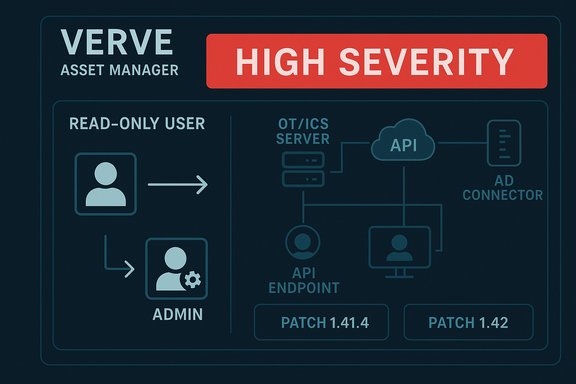
Rockwell Automation has released a security advisory confirming a serious access-control vulnerability in Verve Asset Manager that lets read-only API users perform administrative actions on user accounts — including reading, updating, and deleting users. Tracked as CVE-2025-11862, the bug is scored extremely high by the vendor and industry databases (CVSS v3.1 9.9 / CVSS v4 8.4) and affects a wide range of Verve releases. Rockwell says the flaw was discovered internally and fixed in Verve Asset Manager 1.41.4 and 1.42; organizations running any affected builds should treat this as urgent and follow a prioritized mitigation and remediation plan immediately.
Verve Asset Manager is a vendor-neutral OT cybersecurity platform used for asset visibility, vulnerability management, and automated security operations across industrial control systems. Because Verve often sits at the intersection of IT and OT environments and may be trusted with identity and asset information, a compromise of its access controls can have outsized consequences in industrial networks.
This vulnerability is an incorrect authorization issue (CWE-863): authorization checks in the Verve API incorrectly allow actors with limited (read-only) privileges to perform higher-privilege operations on user objects. The practical effect is privilege escalation and user-account manipulation via API calls.
Key technical facts verified from vendor and public vulnerability records:
Immediate IR steps:
Treat CVE-2025-11862 as a high-priority operational risk: patch with validated procedures; implement compensating network and identity controls immediately where patching is delayed; audit and monitor aggressively for signs of misuse. The vendor-supplied fixes resolve the immediate coding flaw, but the broader work — strengthening RBAC, API governance, and secure lifecycle practices — is still necessary to reduce the chance of similar issues recurring.
Remain vigilant: an advisory’s “no known exploitation” status does not remove urgency. Patch, isolate, monitor, and harden.
Source: CISA Rockwell Automation Verve Asset Manager | CISA
 Background
Verve Asset Manager is a vendor-neutral OT cybersecurity platform used for asset visibility, vulnerability management, and automated security operations across industrial control systems. Because Verve often sits at the intersection of IT and OT environments and may be trusted with identity and asset information, a compromise of its access controls can have outsized consequences in industrial networks.This vulnerability is an incorrect authorization issue (CWE-863): authorization checks in the Verve API incorrectly allow actors with limited (read-only) privileges to perform higher-privilege operations on user objects. The practical effect is privilege escalation and user-account manipulation via API calls.
Key technical facts verified from vendor and public vulnerability records:
- Vulnerability identifier: CVE-2025-11862.
- Vendor-assigned CVSS v3.1 base score: 9.9 / 10.
- Vendor-assigned CVSS v4 base score: 8.4 / 10.
- Affected Verve builds: 1.33 → 1.41.3 (inclusive) according to the vendor advisory.
- Corrected in: 1.41.4 and 1.42.
- Vulnerability category: Incorrect Authorization (CWE-863).
- Discovery: internal vendor testing (reported by the vendor to national vulnerability authorities).
- At the time of public advisories the vendor and national authorities reported no known public exploitation, but this is a snapshot — the operational risk continues until systems are patched or otherwise mitigated.
Why this matters: OT context and practical impact
The problem in one line
A user account that should only have read-only access can call the Verve API and perform administrative user-management operations, effectively bypassing role-based access restrictions.Why that’s critical in OT environments
Industrial and manufacturing environments rely on layered trust assumptions and controlled change windows. Verve often integrates with identity sources, inventories, vulnerability scanners, and orchestration tools. If a low-privileged actor can alter user accounts, they can:- Create or elevate accounts to persist access.
- Delete or modify privileged user accounts to cause denial of access or evade detection.
- Exfiltrate account metadata and configuration that helps map the network and identify targets.
- Forge or remove audit trails by manipulating the system’s user and permission model.
- Combine with other flaws or misconfigurations to pivot deeper into OT networks.
Attack surface and threat model
- Attack vector: network-reachable API (the vulnerability is exploitable remotely if the API is accessible).
- Privileges required to exploit: low-privilege user account (the advisory specifies read-only users can abuse the API).
- Attack complexity: low — the issue arises from improper checks rather than a multi-step chain.
- Likely impacts: confidentiality loss (user data), integrity compromise (modify/delete accounts), availability issues (removal of accounts, administrative lockout).
Technical breakdown (what appears to be happening)
What the flaw allows
- Unauthorized reads: read-only principals can retrieve user details that should be restricted.
- Unauthorized updates: read-only principals can submit API updates to modify other users’ attributes, potentially changing roles, credentials, or linked authentication methods.
- Unauthorized deletes: read-only principals can remove user accounts via the API, which can be used to disrupt operations or remove defenders’ access.
Why standard protections may not have helped
- Role-based access control (RBAC) logic appears to be bypassed at the API layer; so client-side or UI-based restrictions would not stop API consumers.
- Network isolation helps only if the API is not reachable by a malicious actor. If an attacker gains any foothold with a read-only credential (phishing, stolen creds, prior compromise), they can exploit this without needing additional privilege escalation.
- Multi-factor authentication and strong passwords do not directly prevent this when the attacker already holds valid read-only credentials.
Likely root causes (based on CWE-863 classification)
- Missing or incorrect server-side authorization checks in the REST API endpoints that manage user resources.
- Role or permission flags being ignored, incorrectly mapped, or validated against an incomplete authorization policy.
- Possible regression or logic flaw introduced in handling API requests for older APIs or compatibility paths (common in systems that support legacy integrations).
Immediate actions (first 24–72 hours)
These are priority actions every operator should treat as urgent. Implement them in the order listed where practical.- Identify affected systems
- Inventory all Verve Asset Manager installations and record versions. If your installed version is within 1.33 – 1.41.3, treat it as vulnerable until proven otherwise.
- Isolate and reduce exposure
- Immediately ensure that Verve management interfaces and APIs are not accessible from the public Internet. If connections exist, block them at network perimeter devices or apply access control lists (ACLs).
- Place Verve systems behind a management-only VLAN or segmented network zone if not already segregated.
- Restrict read-only accounts
- As a temporary mitigation, remove or disable unnecessary read-only accounts and service accounts that are not essential.
- Apply the rule of least privilege for all users who have any API access.
- Apply available patches
- Schedule and deploy Verve Asset Manager 1.41.4 or 1.42 as soon as possible following vendor upgrade guidance and local change control processes.
- If a quick vendor patch deployment is not possible, implement compensating controls (see below).
- Monitor and investigate
- Increase logging and monitoring of Verve API endpoints and user-management related events.
- Perform an immediate audit of user creation, modification, and deletion events over the last 90 days to detect possible unauthorized changes.
- Alert operations and incident response teams
- Notify internal SOC/IR teams and relevant OT/plant operations stakeholders so they can be on heightened alert for suspicious activity.
Compensating controls (if immediate patching is delayed)
- Remove or disable read-only accounts that can interact with the API.
- Enforce network segmentation: keep Verve systems on isolated management networks with strict ACLs limiting which hosts and subnets can access APIs.
- Use a jump-host bastion with restricted administrative access rather than exposing direct API endpoints.
- Apply web application firewall (WAF) or API gateways with request inspection rules that can block suspicious user-management API patterns; however, do not rely solely on WAFs to fix authorization logic.
- Review and tighten identity provider mappings and connector privileges (for example, connectors that sync users from Active Directory).
- Enforce MFA for all administrative and service accounts that can access management interfaces.
- Enable and retain comprehensive audit logging; forward logs to an immutable or external collector to prevent local tampering.
Patch guidance and testing considerations
Upgrading OT systems requires careful planning. Follow this checklist before and during patching:- Pre-upgrade validation
- Read the vendor advisory and release notes for 1.41.4 and 1.42 to confirm fixed functionality and any changed configuration parameters.
- Confirm compatibility with downstream integrations (AD connectors, SIEM agents, scanners).
- Backup current Verve data and configuration, and capture system snapshots where possible.
- Test upgrade in staging
- Deploy the update to a staging system that mirrors production. Run through user management, API scripts, connectors, and automation flows to detect regressions.
- Validate that RBAC behaviors behave as expected post-upgrade; test a read-only account cannot perform write/delete actions.
- Rollout plan
- Use a phased approach: update non-critical instances first, then core production after confirming stability.
- Maintain a documented rollback plan and ensure backups are validated.
- Post-upgrade validation
- Re-run the audit checks used during detection step to ensure no unauthorized changes happened during the upgrade window.
- Re-enable any accounts or integrations that were temporarily disabled only after confirming the fix.
Incident response: if you suspect exploitation
If you find evidence of unauthorized user updates or deletions, treat this as a potential compromise with possible lateral movement.Immediate IR steps:
- Contain the system — isolate affected Verve servers from the network but avoid powering off without preserving forensic evidence.
- Preserve logs and backups — collect Verve logs, API access logs, SIEM data, and any host-level logging before they can be altered.
- Reset and reissue credentials — rotate keys, service account credentials, and privileged user passwords after following containment guidance.
- Restore from known-good backup if user data or configuration integrity cannot be re-established.
- Conduct forensic triage — look for indicators of earlier access, persistence mechanisms, or evidence of lateral movement into AD, SCADA, or orchestration systems.
- Engage vendors and authorities as required under your policy — Rockwell Automation TechConnect and national CERT/CSIRT organizations should be engaged per contract and regulatory requirements.
- Report to regulators or critical infrastructure authorities if your environment or sector requires notification of ICS incidents.
Longer-term mitigations and strategic recommendations
This vulnerability highlights persistent systemic concerns for OT cybersecurity. Beyond the immediate patch, organizations should adopt or reinforce these strategic measures:- Enforce strong RBAC design and independent verification: implement policy-driven authorization tests that are executed as part of CI/CD and change control.
- Implement an allow-list approach for APIs: limit which API methods are available to which roles and clients; prefer explicit allow-lists rather than deny-lists.
- Maintain up-to-date asset and software inventories: know where Verve and other management systems are installed and which versions are active.
- Segregate OT management-plane services from production control-plane systems: management tools should reside in a dedicated, tightly controlled zone.
- Shorten maintenance windows and automate patching where feasible: automation reduces window-of-exposure, but must be combined with robust testing.
- Harden service accounts and connectors: minimize privileges assigned to service accounts that integrate third-party tools.
- Continuous verification and red-team testing: simulate low-privileged API usage to confirm that privilege boundaries remain effective.
- Contract and supply-chain security: demand secure development and disclosure practices from vendors, including clear advisory timelines and CVE assignments.
What organizations should say to leadership
When briefing executives and plant managers, use blunt, concise language:- This is a high-severity authorization flaw in a central OT cybersecurity product that could allow attackers with low privileges to perform privileged user-management actions.
- The vendor issued hotfixes (1.41.4 / 1.42). The recommended path is to patch quickly but safely — test in a staging environment, then deploy.
- If rapid patching isn’t possible, immediate compensations are network isolation, removal of unnecessary read-only accounts, and increased monitoring.
- This is not just a software bug; it is a posture and process issue. Expect follow-up work to review RBAC, API usage, and third-party integrations.
Strengths and limitations of the vendor response
Strengths:- The vendor identified the issue internally and released an advisory and fixes promptly.
- The problem is assigned a CVE and scored using modern CVSS frameworks, enabling prioritized risk assessment.
- Fixed builds were released for a broad set of affected versions, and vendor guidance includes practical mitigations such as removing read-only accounts.
- Many OT environments are conservative about upgrades; operators may be slow to adopt fixes due to integration concerns.
- Compensation instructions — e.g., "remove read-only accounts" — can be operationally disruptive if read-only accounts are used by monitoring and reporting tools.
- The advisory’s statement of “no known public exploitation” is a snapshot; lack of observed exploitation is not a guarantee of safety. Organizations should treat the window between disclosure and patching as high risk.
- API-level authorization flaws can be difficult to detect until they are exploited; unless logging and external monitoring are in place, unauthorized account changes may go unnoticed.
Quick checklist for administrators (actionable summary)
- Inventory: confirm all Verve instances and versions.
- If running 1.33 → 1.41.3, schedule upgrade to 1.41.4 or 1.42 immediately after testing.
- If patching is delayed:
- Remove or disable non-essential read-only accounts.
- Block external access to Verve APIs; restrict to management subnets.
- Enable/forward immutable audit logs to external collectors.
- Enforce MFA and rotate privileged credentials.
- Monitor: watch for account creation, updates, or deletes and investigate anomalies.
- Plan: validate upgrade process in staging, prepare backups, and create rollback plans.
Final assessment and risk posture
This Verve Asset Manager vulnerability is a classic example of how authorization failures at the API level can have cascading effects in industrial contexts. Even though the flaw was discovered internally and fixed, the nature of OT operations — long lifecycles, multiple integrations, and high change costs — means many deployments will remain exposed for weeks or months.Treat CVE-2025-11862 as a high-priority operational risk: patch with validated procedures; implement compensating network and identity controls immediately where patching is delayed; audit and monitor aggressively for signs of misuse. The vendor-supplied fixes resolve the immediate coding flaw, but the broader work — strengthening RBAC, API governance, and secure lifecycle practices — is still necessary to reduce the chance of similar issues recurring.
Remain vigilant: an advisory’s “no known exploitation” status does not remove urgency. Patch, isolate, monitor, and harden.
Source: CISA Rockwell Automation Verve Asset Manager | CISA
