

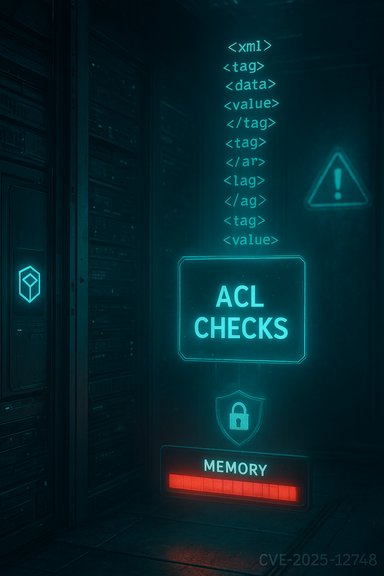
A newly cataloged libvirt vulnerability, tracked as CVE‑2025‑12748, lets a low‑privileged user submit specially crafted XML that is parsed before access controls are applied — triggering uncontrolled memory allocations and crashing the libvirt process on the host, producing a denial‑of‑service (DoS) condition that can affect VM management availability across affected systems.
Background
Libvirt is the de facto virtualization management layer used by QEMU/KVM, Xen and other hypervisors to define and control virtual machines, networks and storage via a unified API. Its configuration model is XML‑based: domains, networks and storage objects are represented as XML documents that libvirt parses and validates before using to configure guests and host resources. That XML workflow is central to libvirt’s flexibility, but it has also been the source of recurring security problems when untrusted input is parsed or entity expansion is enabled without adequate checks. CVE‑2025‑12748 was published in November 2025 after coordinated upstream and vendor triage. The central flaw is not a traditional buffer overflow or pointer corruption; instead, the vulnerability results from the order of operations in libvirt’s handling of user‑supplied XML: parsing occurs before ACL (access‑control) checks. Because the parser processes potentially attacker‑controlled data prior to verifying whether the caller has permission to submit that XML, an attacker with limited privileges can craft XML that forces libvirt to allocate very large amounts of memory, exhausting host resources and causing the libvirt daemon to fail. Public CVE records and multiple vendor advisories classify this as an Allocation of Resources Without Limits or Throttling issue (CWE‑770).What exactly is wrong (technical overview)
The defect in plain terms
At a high level, the bug arises because libvirt attempts to parse and build an internal representation of user‑provided XML before it verifies the caller’s privileges. That parsing step can cause the underlying XML library (libxml2) to construct data structures and allocate memory proportional to the structure and content of the input document. If an attacker supplies XML deliberately crafted to produce extremely large allocations (or pathological structures that force quadratic or otherwise amplified memory usage), those allocations can exhaust the process’s memory budget and crash libvirt or drive it into an unrecoverable state. The vulnerability description provided by vendors repeatedly notes “parsing before ACL checks” as the key logic error.Attack class and impact mechanics
- CWE: Allocation of Resources Without Limits or Throttling (CWE‑770).
- Primary consequence: Availability loss — immediate crash of libvirt processes, potentially triggering VM management outages across host machines.
- Exploit prerequisites: the attacker needs an account or interface that can submit XML to libvirt (the vulnerability is generally modeled as local or low‑privilege in CVSS terms, but many server deployments expose libvirt management interfaces over the network or use management planes where authenticated users can reach XML APIs).
Who and what is affected
This is a library/service‑level vulnerability in libvirt itself; the practical exposure depends on how libvirt is deployed and what management surfaces are exposed.- Linux distributions that ship libvirt packages (Debian, Red Hat, SUSE, Ubuntu and others) have been tracking and labeling affected package versions; Debian’s security tracker lists multiple branches with vulnerable libvirt packages until patched builds are released for each distribution.
- Enterprise vendors (Red Hat, SUSE) have published advisories or entries acknowledging the flaw and assigning the medium severity rating; Red Hat’s disclosure lists reporter names and the root cause summary.
- Appliances, hosted images, marketplace VM images and custom tooling that bundle or expose libvirt to tenant or non‑admin users inherit the same exposure unless the vendor or image publisher ships a patched libvirt. This includes cloud images, self‑hosted virtualization management stacks, and platforms that expose libvirt‑backed APIs to authenticated users.
Exploitability and real‑world status
Vendor and CVE trackers indicate the attack vector is generally local or requires low privileges (an authenticated user who can send XML to libvirt). However, in deployments where libvirt is reachable via networked management APIs (for example, when libvirt‑based control endpoints are exposed to administrative users or integrated into upper‑layer orchestration systems), the vulnerability is practically reachable over the network by an authenticated user. Multiple vulnerability databases model attack complexity as low and confirm the availability impact is high. As of the latest vendor advisories and tracker entries, there are no public, reliable reports of wide‑scale exploitation or weaponized PoCs published in the wild. EPSS/automation probability metrics reported by tracking services show a very low likelihood for immediate mass exploitation, reflecting the requirement for authenticated access and the presence of mitigations in many managed environments. Nevertheless, absence of proof is not proof of absence — the attack primitive is straightforward wherever untrusted XML is accepted.Why this matters operationally
- Availability over integrity/confidentiality: Unlike an RCE or data disclosure bug, this vulnerability’s direct impact is availability — crashing the libvirt daemon can halt VM lifecycle operations, interfere with automation and orchestration flows, and in some cases cause unclean VM shutdowns that lead to data loss for stateful workloads.
- Scaleable disruption: Attackers who can repeatedly submit crafted XML to multiple hosts (for example, across a multi‑host cluster or cloud control plane) can create sustained outages across a fleet.
- Supply‑chain persistence: Many third‑party tools, appliances and cloud images bundle a specific libvirt binary. Even after vendors patch libvirt upstream, many images and installers remain vulnerable until those vendors rebuild and reissue images.
- Administrative blast radius: Because libvirt runs with elevated privileges to manage VMs, a crashing libvirt service may disrupt many VMs and dependent services, increasing the operational urgency beyond the numeric CVSS score.
What vendors and maintainers have done so far
Upstream and packaging maintainers responded by auditing the parsing path and addressing the order of operations so that ACL checks are applied before any heavy parsing, and by adding defensive resource‑use limits during XML handling where appropriate. Distributions have begun to map patches into their release branches and prepare updated packages; Debian, Red Hat and SUSE trackers list the vulnerability and reference vendor bug reports or package fix status. Administrators should monitor their vendor channel for the exact patched package for their release.Immediate mitigations — what to do now
The following list is ordered by immediacy and impact. Apply the first items as urgent stopgaps while you test and deploy vendor patches:- Patch first: Obtain and install vendor/OS packages that include the libvirt fix as they become available. This is the only reliable, long‑term cure.
- Restrict management access: Ensure libvirt control interfaces (unix sockets, TCP endpoints or management proxies) are reachable only by trusted administrators. If libvirt is exposed over the network to authenticated users, consider temporarily disabling remote access or limiting it to a safe maintenance window.
- Harden who can submit XML: Audit and tighten policies so only fully trusted accounts or service principals can define/modify domain XML. Where possible, block user‑supplied arbitrary XML submissions from lower‑privilege accounts.
- Validate input early: If your orchestration layer accepts user templates prior to handing them to libvirt, add a sanitizer/validator and reject unusually large or deeply nested XML inputs. Use pre‑validation tools (for example, virt‑xml‑validate) in a front‑end to reject risky documents before they reach libvirt.
- Sandbox parsing: Run any process that parses untrusted XML in an isolated helper process or container with strict resource limits (cgroups, namespaces). If parsing fails or OOMs occur, the helper can exit and be restarted without taking down the primary libvirt daemon.
- Rate limits and quotas: Rate‑limit the number of XML submissions accepted per user or per time window, and enforce per‑request size limits on XML payloads.
- Monitoring and alerting: Configure alerts for rapid, repeated libvirt crashes, core dumps, sudden memory spikes in libvirtd or frequent process restarts — these are high‑signal indicators. Preserve any offending XML samples for analysis.
Detection — what to look for and how to hunt
- Service behavior: repeated libvirtd crashes, OOM killer activity targeting libvirt processes, or prolonged unresponsiveness in management UI/API endpoints are top indicators. Log aggregators should flag sudden surge of core dumps or restarts.
- Logs: check systemd/journal entries for libvirtd and qemu processes. Look for stack traces that mention XML parsing functions in libxml2 or messages that indicate memory exhaustion or failed allocations.
- Input correlation: correlate crashes with recent XML submissions. Preserve the submitted XML file for test reproduction.
- Audit trails: collect and review who performed XML define/edit operations (virsh edits, API calls) in the minutes prior to a crash to identify the responsible account or service.
- Canary parsing: in higher‑risk environments, run an offline fuzzer or a set of canonical bad inputs against a staging libvirt instance to confirm that your deployed version has the fix applied. Vendor advisories and CVE trackers often include minimal reproduction guidance in private bug reports — treat those samples carefully in isolated test beds.
Longer‑term remediation and platform hardening
- Move parsing of any user‑supplied templates into an explicit, auditable service that applies ACLs and structural validation before attempting resource‑heavy parsing.
- Adopt a “minimize privilege” model for management interfaces: separate read and write roles, and require higher privileges for operations that accept raw XML definitions.
- Require signed images or SBOMs for appliances and published images; track which images include libvirt and the exact shipped version to speed patching when upstream fixes are released.
- Extend continuous integration to include native library dependency scanning (not only OS packages but bundled native binaries inside installers and language wheels).
- Consider runtime protections (e.g., address‑space randomization, hardened allocators) as complementary measures — they do not prevent a resource‑exhaustion DoS but raise the bar for exploitation of memory corruption bugs that might exist in other components. File‑system and orchestration hardening (restricting who can mount or edit images, RBAC for volume content) also reduces exposure in modern cloud‑native virtualization stacks.
Practical checklist for administrators (quick‑reference)
- Inventory all hosts and images that run libvirt (kernel packages, qemu/libvirt packages and any vendors’ appliance images).
- Confirm whether your distribution vendor has published a patched libvirt package and obtain the exact package name/version for your release.
- Apply vendor patches to staging first, test VM lifecycle and orchestration integration, then deploy to production.
- Until patched: block remote submission of XML by non‑admin accounts; enforce strict RBAC; sandbox parsing; and set upload/size limits.
- Monitor libvirt logs and alert on core dumps, OOMs and repeated restarts; retain offending XML samples for analysis.
Strengths and limits of the vendor fixes — critical appraisal
Vendor responses have been timely in documenting the issue and mapping fixes into distribution packages, but two operational realities reduce the speed at which environments become safe:- Bundled binaries: Many third‑party appliances and curated images embed libvirt. Even after upstream fixes are merged, those images must be rebuilt and redistributed. That process is slow in vendor ecosystems and leaves a long tail of vulnerable systems.
- Attack surface nuance: While many advisories model the vector as local or low‑privilege, real‑world managed environments expose management APIs that blur the local/remote distinction — operators may underestimate risk if they assume “local only.” The practical exposure assessment must account for management-plane reachability and multi‑tenant control surfaces.
Unverifiable claims and cautionary notes
- Public exploit code: there are no confirmed public exploits or weaponized PoCs documented in authoritative trackers at the time of writing; EPSS/automation metrics remain very low. That does not mean exploitation is impossible in targeted environments where authenticated users can submit XML — organizations should not assume safety because a public PoC is absent.
- Exact patch details: while vendors report fixes, the exact patch locations and the internal code changes (for example, whether parsing order was swapped or resource checks were added) vary by upstream change and downstream backport. Administrators must rely on their vendor changelogs and package metadata to confirm correct fix application rather than assuming all upstream commits are present in a given distro release.
- Scope for chaining: a resource‑exhaustion DoS can be combined with other flaws or operational misconfigurations to create larger attack effects (for example, automated orchestration that repeatedly restarts crashed services without proper throttling). Such chaining is environment‑specific and cannot be universally characterized; treat chaining as a plausible risk and validate orchestration behavior post‑patch.
Final verdict — risk, urgency and recommended next steps
CVE‑2025‑12748 is a pragmatic but serious availability vulnerability for organizations that run libvirt in environments that accept XML input from non‑administrator accounts or that expose libvirt management to authenticated users across networks. The technical root cause (parsing before ACL checks) is a straightforward logic/flow error with very real operational consequences: memory exhaustion and process crashes. Multiple vendors and CVE trackers have cataloged the issue, assigned a medium severity rating (CVSS 3.1 ≈ 5.5) and begun packaging fixes. Priority actions:- Treat this as an operational priority for virtualization management hosts and any appliance or orchestration component that accepts user XML. Patch libvirt packages as soon as vendor fixes are available.
- If immediate patching is not possible, apply the mitigations listed above: lockdown management interfaces, sandbox parsing, enforce input validation and rate limits, and monitor vigorously for repeated crashes or memory spikes.
- For cloud providers and multi‑tenant platforms: inventory which images and customer‑facing services embed libvirt and coordinate image rebuilds or controlled mitigations with affected customers.
Conclusion
CVE‑2025‑12748 is a clear reminder that parsing logic and the order of security checks matter as much as the parsing code itself. XML remains a convenient but sensitive surface for virtualization configuration; unless parsing and access control are applied in the right sequence and with resource safeguards, low‑privilege users can weaponize well‑formed documents to produce outsized operational damage. Administrators must prioritize vendor updates, restrict management interfaces, validate inputs early and make parsing of untrusted documents a first‑class security concern in any virtualization control plane.
Source: MSRC Security Update Guide - Microsoft Security Response Center
