

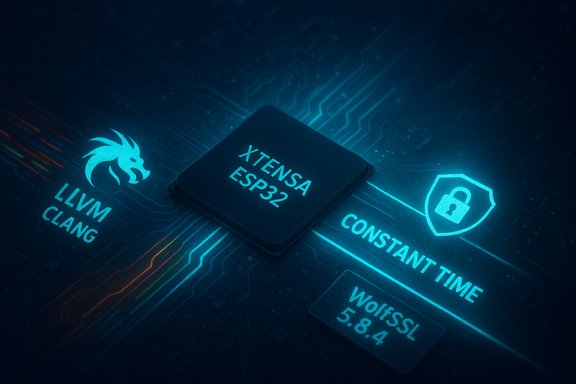
CVE-2025-13912 is a timing‑side‑channel concern in wolfSSL where compiler optimizations (notably from Clang/LLVM toolchains) can transform carefully written constant‑time C code into binaries whose runtime varies with secret data — a behavior that undermines cryptographic assumptions and was addressed in wolfSSL 5.8.4 after vendor patches and pragmatic mitigations were merged upstream.
Cryptographic code frequently relies on the constant‑time property: operations that handle secret material must execute in a way that does not change timing based on secret bits. This prevents remote or local attackers from using timing measurements to infer keys, MACs, or other secret values. Constant‑time guarantees depend on the full toolchain — source code, compiler optimizations, instruction scheduling, and the microarchitecture — not only on the programmer’s intent. Multiple public trackers and vendor notes describe situations where optimizers produce instruction sequences that leak timing, especially on constrained or unusual targets. wolfSSL is a lightweight TLS/crypto library widely used in embedded devices and appliance firmware. Because wolfSSL is often statically linked into firmware, the library’s behavior and compiler choices are a primary attack surface for many IoT and edge devices. In late 2025, a set of issues was consolidated into public CVE records that call attention to constant‑time assumptions being broken by compiler output — captured in CVE‑2025‑13912 among related advisories. The vendor fixed these issues in the 5.8.4 release by adjusting implementation choices and adding defensive code and tests.
Source: MSRC Security Update Guide - Microsoft Security Response Center
 Background
Cryptographic code frequently relies on the constant‑time property: operations that handle secret material must execute in a way that does not change timing based on secret bits. This prevents remote or local attackers from using timing measurements to infer keys, MACs, or other secret values. Constant‑time guarantees depend on the full toolchain — source code, compiler optimizations, instruction scheduling, and the microarchitecture — not only on the programmer’s intent. Multiple public trackers and vendor notes describe situations where optimizers produce instruction sequences that leak timing, especially on constrained or unusual targets. wolfSSL is a lightweight TLS/crypto library widely used in embedded devices and appliance firmware. Because wolfSSL is often statically linked into firmware, the library’s behavior and compiler choices are a primary attack surface for many IoT and edge devices. In late 2025, a set of issues was consolidated into public CVE records that call attention to constant‑time assumptions being broken by compiler output — captured in CVE‑2025‑13912 among related advisories. The vendor fixed these issues in the 5.8.4 release by adjusting implementation choices and adding defensive code and tests. What CVE‑2025‑13912 actually is
Short, precise description
CVE‑2025‑13912 describes cases where constant‑time implementations in wolfSSL prior to v5.8.4 can be transformed by LLVM/Clang optimizations into binaries that are not constant‑time, opening the possibility for observable timing discrepancies and information disclosure through timing side channels. The record lists the affected range as wolfSSL versions earlier than 5.8.4 and credits the vendor for mapping and fixing the behavior.How the compiler breaks constant time
Compilers perform many correctness‑preserving transformations: register allocation, instruction selection, instruction scheduling, and peephole optimizations. On some targets and toolchains (notably certain Xtensa/ESP32 backends and various LLVM optimizers), these transformations can generate instruction streams with:- secret‑dependent microarchitectural effects (variable‑latency instructions or differing memory access patterns),
- implicit branches via conditional instructions or predicate moves,
- reordered memory operations or cached data footprints that vary with data values.
Specific places in wolfSSL affected
Public analyses and the vendor changelog point to several sensitive code paths:- binder verification logic used in TLS PSK/session resumption paths, where early‑exit comparisons were replaced by constant‑time comparisons to remove timing dependence; and
- fast X25519/X448 and Ed25519 implementations that, when compiled with certain Xtensa toolchains, produced non‑constant‑time assembly and thus were replaced by safer “small” implementations for affected targets by default.
Timeline and verification
- Upstream fix merged: the upstream wolfSSL repository shows a pull request that marks variables as volatile (to prevent the optimizer from removing or changing timing‑sensitive operations) and merges other constant‑time hardenings; the PR was merged into master in October 2025.
- Fixed release: wolfSSL published the 5.8.4 release (release date listed in wolfSSL release notes) that bundles the timing‑hardening changes. Distributions and trackers (Debian, Ubuntu, NVD) ingested the CVE and mapped it to the fixed release.
- NVD entry: NVD recorded CVE‑2025‑13912 with the description referencing LLVM optimizations transforming constant‑time code into non‑constant‑time binaries and listed the vendor as the CNA.
Affected environments and practical risk
Where the risk is highest
- Embedded devices using Xtensa/ESP32 toolchains — wolfSSL’s maintainers observed Xtensa compilers producing non‑constant time code for fast cryptographic implementations. The vendor therefore set the small implementations as default for Xtensa builds, since they produced more predictable instruction streams. Devices that ship firmware built with older wolfSSL versions are the primary exposure point.
- Statically linked firmware — many appliances include wolfSSL statically; distributors must rebuild firmware images or push updates to remediate. Distribution lag is the dominant operational risk.
- Low‑noise environments — when attackers can obtain low‑jitter timing (co‑located networks, lab access, or physical proximity), timing side‑channels become easier to exploit. The vulnerability is less useful on high‑noise public internet paths but remains worrying in targeted contexts.
Severity and exploitability
- Public CVSS assessments vary across feeds; many listed CVSS v4 base as low (1.0) in vendor submissions, but some third‑party feeds present higher legacy scoring values. The consensus view frames this as an information‑disclosure/timing issue with local/attacker‑adjacent requirements and limited immediate impact on confidentiality for most internet‑scale services. That said, severity is context dependent: for high‑value targets where timing can be measured precisely, the vulnerability is materially more serious.
Remediation and incident response
Immediate steps (first 24–72 hours)
- Inventory: Identify all firmware, appliances, containers, and binaries that include wolfSSL or vendor builds that depend on it. Static linking is a key indicator of risk.
- Patch where you control builds: Upgrade to wolfSSL 5.8.4 or later and rebuild artifacts. Confirm that the patched build contains the upstream commit or release tag.
- Contact vendors: For third‑party appliances, open support tickets and request a firmware image that includes wolfSSL 5.8.4 or the equivalent backport. Track vendor timelines and regression test plans.
Short‑term compensations where patching is delayed
- Move TLS termination to a patched reverse proxy or load balancer (OpenSSL/BoringSSL/Schannel) so vulnerable wolfSSL components are not exposed directly to untrusted clients.
- Implement rate limits and handshake throttles at the network edge. This reduces the blast radius of automated handshake floods or probing.
- Restrict access with network ACLs or VPNs for high‑value services that rely on affected devices.
Verification and validation after patch
- Rebuild firmware or packages and confirm the wolfSSL version and commit are present in artifacts before deployment.
- Run constant‑time and timing variance tests on representative hardware (especially Xtensa/ESP32) to ensure the fix produces stable timing distributions.
Detection and hunting guidance
- Monitor for abnormal spikes in short‑lived TLS handshakes, handshake failure patterns, and elevated CPU/memory use in TLS processes — these are hallmark signals of probing or DoS attempts targeting the parsing/handshake code path.
- Capture PCAPs and inspect ClientHello messages for malformed or duplicate KeyShare entries (an associated class of issues was exploited to trigger DoS via duplicate KeyShareEntry handling in related wolfSSL fixes). While CVE‑2025‑13912 concerns timing, related parsing issues were also fixed in 5.8.4 and may be visible in handshake captures.
- Add SIEM rules to flag repeated TLS ClientHello messages from single sources or bursts of ClientHello without subsequent progress to completion.
Technical mitigation choices: what wolfSSL did and why it matters
- The vendor’s fixes are conservative and pragmatic: rather than rewriting algorithms or dropping features, wolfSSL forced more conservative implementation choices for affected targets (for example, switching to small low‑memory curve implementations on Xtensa) and applied constant‑time comparisons where needed. The upstream PRs show explicit changes (e.g., marking variables volatile to reduce optimizer‑driven transformations and replacing early‑exit comparisons with constant‑time logic).
- This approach reduces regression risk and is low impact for many deployments, but it does not address the larger toolchain problem: other libraries or in‑house code can still be compiled into non‑CT binaries by aggressive optimizations. The fix is targeted and correct for the immediate problem but not a global cure.
Recommendations for developers and build engineers
- Treat constant‑time as a property of the entire build pipeline. Document compiler versions, flags, and microarchitecture assumptions. Store these in SBOMs and CI metadata to reproduce problematic builds if needed.
- Use defensive coding and test suites that exercise timing properties on representative hardware and toolchains (especially on Xtensa/ESP32 and other embedded targets). Add micro‑benchmarking to CI where feasible.
- For critical verification paths (e.g., MAC or binder comparisons), use vetted constant‑time primitives and avoid early‑exit comparisons. When compilers are known to optimize away timing controls, consider explicit constructs (memory/volatile markings, or assembly‑level fences) but apply them carefully and document why they are needed.
- When shipping to constrained devices, prefer conservative algorithm variants when the toolchain is untrusted or when you cannot control the compiler behavior across the vendor chain. The trade‑off of slightly higher memory or CPU for stronger constant‑time guarantees is often worth it in embedded contexts.
Critical analysis — strengths, caveats, and residual risks
Strengths
- The vendor response was timely and transparent: fixes were merged upstream, release notes documented changes, and distribution trackers updated entries. That makes remediation straightforward in controlled build environments.
- The mitigation strategy (force safer implementations on affected targets + constant‑time replacements) is low risk and fast to deploy for maintainers with build control. This is a pragmatic engineering trade‑off that reduces attack surface without large rewrites.
Caveats and residual risks
- Supply chain lag: many embedded devices never receive timely firmware updates. Even with an upstream fix, the long tail of third‑party appliances and OEM firmware means exploitable devices may persist in the wild for months or years. This is the primary operational risk.
- Toolchain variability remains unaddressed: while wolfSSL’s changes mitigate the library’s own fast implementations, other libraries — or even future wolfSSL code that reintroduces performance variants — can be compiled into non‑CT binaries if compilers evolve. Long‑term mitigation requires toolchain‑aware testing, hardened CI, and conservative defaults across ecosystems.
- Real‑world exploitability: public telemetry does not show broad exploitation at the time of disclosure, and scoring often marks the CVE as low. However, targeted attackers with proximity and control of timing can turn even low‑severity timing leaks into practical attacks. Treat the numeric CVSS as one input among many: asset value and attacker capability matter most.
Practical checklist (actionable)
- Inventory: locate wolfSSL usage and identify devices built for Xtensa/ESP32 toolchains.
- Patch: upgrade to wolfSSL 5.8.4 or later where you control builds; confirm the patched commit is present in distributed packages.
- Rebuild firmware: for statically linked devices, coordinate firmware rebuilds and staged rollouts.
- Compensate: move TLS termination to a patched proxy, rate‑limit handshakes, and restrict access for unpatched devices.
- Validate: run timing variance checks on representative hardware and add regression tests to CI.
Conclusion
CVE‑2025‑13912 is a clear reminder that constant‑time is a systemic property of code, compiler, and platform — not merely a function of an algorithm’s source code. wolfSSL’s upstream patch and the 5.8.4 release address the immediate risk by hardening binder comparisons and defaulting safer implementations on problematic targets, but the long tail of embedded devices and the mutable behavior of compilers mean defenders must act beyond the patch: inventory systems, rebuild firmware where possible, apply compensating controls for unpatched devices, and bake toolchain‑aware constant‑time testing into their development processes. The vulnerability’s public scoring may downplay urgency for many environments, yet the combination of supply‑chain inertia and the possibility of low‑noise, targeted timing attacks argues for timely remediation wherever wolfSSL is in use.Source: MSRC Security Update Guide - Microsoft Security Response Center
