

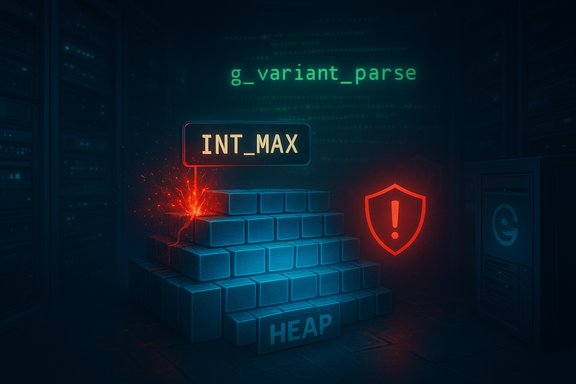
A newly assigned vulnerability, CVE‑2025‑14087, affects GLib’s GVariant text parser and can lead to heap corruption when processing specially crafted strings; the flaw stems from signed‑integer counters that can overflow and cause writes before the start of an allocated buffer, yielding crashes and—under particular conditions—possible code‑execution primitives.
Background
GLib is the low‑level utility library used across GNOME, GTK and a very large body of Linux userland software. Its GVariant subsystem provides both a binary and a text format for serializing structured values; the text form is primarily intended for debugging and manual editing but is nonetheless widely supported by tools and daemons because it’s human‑readable and convenient for configuration or IPC. The vulnerability reported as CVE‑2025‑14087 is specific to the GVariant text parsing code (functions such as those implemented in glib/gvariant‑parser.c) and affects callers that accept untrusted text input for g_variant_parse or related helpers. This is not the first time GVariant parsing has required careful hardening: earlier rounds of fixes (and regressions) in the GVariant codebase have shown how brittle string and offset handling can become when fixes are backported or tokenization logic is adjusted. The current CVE is the result of an integer‑width / counting assumption that breaks when input lengths exceed the range of a signed 32‑bit loop counter.What the bug is (technical summary)
- The defect lives in the GVariant text parser’s handling of string and bytestring literals. The parser used signed 32‑bit integers (gint) as loop counters for tokenization and termination checks.
- When a caller feeds the parser extremely large string or bytestring literals — for example, lengths equal to or larger than INT_MAX — these signed counters can overflow and flip negative.
- The negative counter values then index backwards, causing writes to memory before the allocated buffer (the code increments and writes to str[j++]), creating a classic out‑of‑bounds write (buffer underflow) that corrupts heap metadata.
Why the counting choice matters
Using signed 32‑bit integers for a character count is unsafe if the code must accept arbitrarily large inputs. A signed integer overflow changes the control logic of loops and can invert comparison outcomes. The safe pattern is to:- use unsigned or sufficiently wide counters (e.g., size_t) for buffer lengths and indices, and
- bound‑check every index against the actual allocation length before any write.
Scope: what’s affected and how serious it is
Affected component:- GLib’s GVariant text parser (the functions exposed through g_variant_parse and friends). Any application that calls g_variant_parse (or similar parse helpers) on untrusted or poorly‑bounded textual GVariant input is potentially in scope.
- Services and daemons that accept textual GVariant values across network or IPC boundaries (for instance, configuration APIs, D‑Bus endpoints that accept text values, or file importers that parse text‑form GVariant).
- Tools or scripts that call into GLib and parse user‑supplied .conf or .gvariant files without size limits.
- Any runtime that lets untrusted users submit text that eventually reaches g_variant_parse.
- Multiple vulnerability trackers show a mid‑range severity for CVE‑2025‑14087; Red Hat’s reported CVSS v3.1 base score is 5.6 (Medium) with vector AV:N/AC:H/PR:N/UI:N/S:U/C:L/I:L/A:L. NVD lists the CVE and references the vendor material. SUSE’s tracker reports a different internal assessment (higher in some metrics), which reflects that vendors may disagree on exploitability in particular environments. These scoring differences are worth noting because they change prioritization in enterprise workflows.
- The underlying primitive is an out‑of‑bounds write caused by integer wraparound and a write before buffer start. In many cases that outcome will cause application crashes and denial‑of‑service; with careful heap grooming and favorable allocator behavior, an attacker can sometimes convert heap corruption into an arbitrary write primitive and then into code execution. The reliability of such escalation depends heavily on the target’s runtime mitigations (ASLR, hardened allocators, full RELRO, etc. and whether the vulnerable process performs operations that allow allocating and freeing memory in predictable ways. Red Hat’s public entry treats the primary risk as heap corruption with DoS and potential code execution as a theoretical escalation.
- Many desktop and server applications use GLib indirectly via higher‑level toolkits; the direct exposure is highest where the text format is used in a network‑facing or IPC path. Note that the GVariant binary format is not implicated by this specific CVE; the problem is the text parser. That reduces some remote exposure in deployments that prefer the binary format for untrusted data, but should not be relied on as a systemic defense everywhere.
How the upstream and distributions fixed it
Upstream change:- The GLib maintainers fixed the parsing logic by changing the counter types and termination checks so they cannot become negative and by ensuring the parser bounds are respected (examples: counting as size_t, searching for the NUL terminator when endptr is omitted). The upstream commit referenced in Debian and other distros is identified as part of the GLib 2.86.3 / 2.84.4 patchsets (commit id noted in distro changelogs).
- Debian’s glib2.0 package changelog lists the fix explicitly (glib2.0 2.86.3‑1 contains a patch titled “Fix possible buffer underflow parsing GVariant strings/bytestrings (CVE‑2025‑14087, glib#3834 upstream)”), marking the issue as handled in their builds.
- OpenSUSE and other distros have backported the fix into their glib packages and have release notes describing the same change set (search for gvariant‑parser fixes and glib#3834).
- Red Hat’s bug tracker documents the vulnerability and references the upstream patch; at time of disclosure some vendor packaging work is still in progress or staged. Administrators should check vendor advisories for precise package numbers mapped to their platform versions.
- The upstream fix is small and surgical (counter type and bounds checks). That means a straightforward upgrade to a fixed upstream release (or applying the equivalent distro patch) eliminates the root cause. Always verify the exact package version your distro publishes because backporting decisions can vary across vendors and releases.
Practical risk assessment for operators
- Exposure ranking (who should care most)
- High: services that parse user‑supplied GVariant text over the network or IPC (daemon configuration endpoints, D‑Bus services, file processing and conversion services).
- Medium: workstations and tools that may load text GVariant files from untrusted sources (e.g., build agents, developer tools).
- Low: systems that never parse textual GVariant content from untrusted actors or that use the binary GVariant format exclusively.
- Likelihood of reliable code execution
- Low to moderate in general deployments. Heap metadata corruption can be escalated but requires environment‑specific allocator behavior and exploitation skill.
- Denial‑of‑service via crash is high probability where the parser will be exercised on malformed inputs.
- Scoring divergence and why it matters
- Different trackers and vendors may assign different CVSS vectors (network vs local, complexity, privileges). These differences reflect how each assessor models the realistic delivery path for textual GVariant input in typical deployments. Use your inventory and threat model to translate vendor scores into your prioritization.
Immediate actions and mitigations
If you administer systems or packages that use GLib, follow this prioritized checklist:- Map and inventory
- Identify applications and services that call g_variant_parse, g_variant_new_from_data(text‑form), or otherwise accept textual GVariant input.
- Hunt for daemons that expose text‑form parsing via network endpoints or IPC (D‑Bus). Use code search in your repos for g_variant_parse, g_variant_print-based round trips, or explicit parsing of textual GVariant.
- Patch
- Upgrade GLib to a release containing the upstream fix (for example: versions referenced in distro advisories such as GLib 2.86.3 on Debian or equivalent backport packages from your vendor). If you manage compiled packages, ensure the distribution’s security package for glib2 has been applied.
- Short‑term mitigations if immediate patching is delayed
- Refuse or sanitize textual GVariant inputs at the network boundary; prefer the binary GVariant format when receiving untrusted data.
- If you control the application source, pass an explicit endptr to g_variant_parse to bound parsing, or pre‑validate input length before calling the parser.
- Add input size limits and early rejection policies for any user‑supplied configuration strings.
- Hardening: run vulnerable processes inside sandboxes, with reduced privileges and with memory‑safety mitigations where available.
- Detection and forensic steps
- Monitor applications for crashes (segfaults, core dumps) correlated to calls to GLib components, especially around D‑Bus services or configuration parsing routines.
- Examine process logs and systemd/journald messages for rate increases in parser failures, and collect core dumps for offline analysis.
- If a service handles untrusted uploads, review recent uploads for suspiciously large string or bytestring tokens in textual GVariant payloads.
- Verification after patching
- Reproduce regression tests that exercise g_variant_parse with edge inputs (including very large textual tokens) to confirm the fix removes the overflow without introducing regressions.
- If you deploy vendor appliances or vendor‑shipped images, confirm their vendor‑specific glib packaging and changelogs include the upstream commit or the equivalent backport.
Why this class of defect is easy to miss and why careful patch hygiene matters
Buffer underflow triggered by signed integer wraparound is a subtle variant of memory‑safety bugs. It often appears when:- code uses a signed int for a counter that semantically should be unsigned,
- input sizes can be controlled by attackers, and
- parsing logic assumes an upper bound that is not enforced at call sites.
Cross‑checks and verification of key claims
- The underlying vulnerability description (signed counter overflow → write before buffer → heap corruption) is documented in Red Hat’s bugzilla entry for bug 2419093. That report includes a line‑level explanation of the offending code and confirms an upstream patch.
- Debian’s glib2.0 changelog explicitly records the fix and the upstream issue number (glib#3834), plus the relevant package version mapping (glib2.0 2.86.3‑1 includes the fix). That provides independent confirmation of the upstream commit and distribution remediation.
- The NVD catalog entry reflects the CVE registration and summarizes the same root cause (buffer underflow in GVariant parser leading to heap corruption); several public CVE aggregators report a CVSS v3.1 score roughly 5.6 as provided by a distributor entry. These independent data points corroborate the technical description and severity assessment.
Caveats and unverifiable items (flagged)
- Claims about remote, unauthenticated code execution depend on deployment specifics (whether an internet‑facing service parses textual GVariant without size limits or sandboxing). Public trackers list possible code execution but do not show a widely verified remote RCE PoC at disclosure time. Treat the RCE outcome as feasible in theory but environment‑dependent in practice.
- Microsoft’s Security Update Guide page for this CVE is not user‑friendly to automated scraping (it requires client‑side rendering and JavaScript); the MSRC entry may therefore appear empty or “not found” when accessed by tooling that does not execute JS. Administrators relying on MSRC should open it in a modern browser to map the CVE to product updates. (A simple check shows the MSRC page uses a JavaScript app.
Recommendations (concise checklist)
- Patch: install the GLib update provided by your vendor (packages noted in Debian/OS releases as containing the fix, or upstream GLib 2.86.3 or later where applicable).
- Inventory: identify all services that call g_variant_parse on untrusted input and prioritize them for patching or isolation.
- Harden: prefer binary GVariant for untrusted data, apply sandboxing and privilege reductions, and set input size limits at the network boundary.
- Detect: enable crash monitoring, collect cores from processes that use GLib parsing paths, and look for unexplained crashes tied to GVariant code paths.
- Verify: after patching, run fuzz tests and unit tests that exercise large and malformed textual GVariant inputs to confirm the issue is resolved and no regressions were introduced.
Conclusion
CVE‑2025‑14087 is a classically subtle but important memory‑safety bug: a signed integer counting assumption in GLib’s GVariant text parser allows an attacker to craft inputs that underflow the parser counters and write before the start of buffers. The immediate operational impact is denial‑of‑service through crashes and heap corruption; with favorable conditions the corruption could be escalated into a remote code‑execution primitive. The vulnerability has been fixed upstream and backported by several distributions — administrators should prioritize inventory, patching and short‑term mitigations for services that parse text‑form GVariant input from untrusted sources. The remediation is small but important: update GLib packages, adopt size/bound checks where possible, and treat textual GVariant parsing as a potentially risky public surface until systems are patched.Source: MSRC Security Update Guide - Microsoft Security Response Center
