

The Dangerous Server Is the One Your Client Voluntarily Calls
The shorthand description of CVE-2025-15661 — a heap buffer over-read in sftp_symlink() inside sftp.c — sounds like the kind of C memory bug that security teams have learned to triage by reflex. It is not remote code execution, it is not a Windows kernel flaw, and it does not hand an attacker domain admin privileges. On paper, that makes it tempting to file under “important, patch when convenient.”
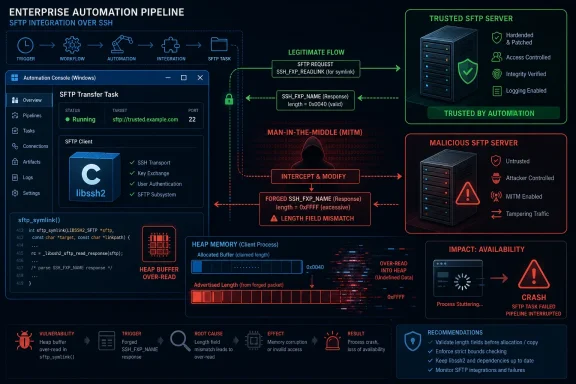
That would be a mistake. VulnCheck’s advisory describes the vulnerable path as reachable when a libssh2-based client processes a crafted SSH_FXP_NAME response during SFTP READLINK and REALPATH operations. In plain English, the client asks an SSH/SFTP server about a path, and a malicious or intercepted server lies about the size of data it is returning.
The vulnerable code then reads beyond the expected heap buffer because it trusts a length field more than the actual available packet data. Depending on what sits next to that buffer in memory, the result can be a crash or a limited disclosure of heap contents. Microsoft’s own severity language emphasizes availability impact, warning that exploitation can produce a serious denial of service against the impacted component.
This is the inversion that matters. Most admins instinctively think of SSH exposure as “who can reach my server?” CVE-2025-15661 is about what happens when your client reaches a server that is hostile, compromised, spoofed, or sitting behind a man-in-the-middle position.
libssh2 Is Small Enough to Hide and Common Enough to Matter
libssh2 occupies an awkward place in infrastructure. It is not OpenSSH, the user-facing command-line tool most admins recognize. It is a C library that applications embed when they need SSH2, SCP, or SFTP functionality without shelling out to external binaries.
That distinction is why this bug can be easy to miss. A system may not advertise itself as “using libssh2,” yet still depend on it through a backup client, monitoring agent, deployment tool, firmware updater, file-transfer utility, Git-adjacent workflow, language binding, or vendor appliance. The official libssh2 project describes it as a client-side C implementation of SSH2 with SFTP support and multiple cryptographic backends, including OpenSSL, mbedTLS, wolfSSL, libgcrypt, and Windows CNG.
That portability is a feature for developers and a headache for defenders. The same library can appear in Linux distributions, Windows software bundles, embedded products, statically linked commercial tools, and in-house automation. Package managers may catch some deployments, but they will not catch every copy embedded inside an executable or vendor-supplied application directory.
The affected range also matters. Public vulnerability records list libssh2 through 1.11.1 as affected, with a fix identified in upstream commit 2dae302. The project’s public site has long listed 1.11.1 as the latest release from October 2024, which means many environments may be sitting on a nominally current released tarball while still needing a downstream backport or vendor patch for this specific flaw.
That is the kind of versioning wrinkle that makes open-source component response feel irrational to non-specialists. “Latest release” and “contains the fix” are not always the same thing, particularly when a vulnerability is fixed in source control before the next formal release is cut.
The Bug Is a Length-Field Trust Failure, Not a Fancy Crypto Break
The technical core of CVE-2025-15661 is familiar: attacker-controlled length metadata is accepted without enough validation against the actual packet buffer. According to VulnCheck and mirrored CVE records, an attacker can supply a link_len value larger than the real packet data in an SSH_FXP_NAME response. The vulnerable path can then perform a memcpy based on a size assumption that does not match what was actually received.
That places this bug in the well-worn family of out-of-bounds reads, categorized as CWE-125 in several vulnerability databases. These bugs are not glamorous, but they are durable because they arise from the gap between protocol parsing and memory safety. In C, that gap is often one unchecked integer away from a process crash.
For administrators, the useful part is not the function name. The useful part is the trigger condition: SFTP operations involving symlink or path-resolution behavior against an untrusted or malicious server. Any system that uses libssh2 to resolve remote paths, follow symlinks, inspect SFTP metadata, or perform automated file operations deserves attention.
The exploit shape also limits and clarifies the risk. This is not a vulnerability where an internet scanner can simply hit your SSH daemon and compromise it. The attacker needs the vulnerable client to connect to, or be redirected through, a server under attacker control or a man-in-the-middle position capable of manipulating the SSH/SFTP exchange.
That does not make the bug theoretical. Enterprise automation often connects outward on schedules, trusts internal DNS, pulls from partner servers, uploads logs, fetches firmware, rotates files, and runs unattended transfer jobs. If one of those destinations is compromised, or if traffic is intercepted in a weakened trust environment, the client becomes the target.
Availability Is the Business Impact, But Memory Disclosure Is the Security Smell
The user-supplied impact language focuses on total or serious loss of availability, and that is the cleanest operational framing. A vulnerable client process can crash when it parses the crafted response. If that client is part of a service loop, file-transfer daemon, backup process, update workflow, or orchestration pipeline, repeated exploitation can deny access to the function that depends on it.
This is how “only a client crash” becomes a production incident. A scheduled SFTP pull fails every five minutes. A deployment worker crashes while resolving remote paths. A backup collector stops ingesting data from a remote host. A managed device cannot complete its firmware retrieval workflow. The denial of service is not necessarily against the entire operating system; it is against the business process that embedded the vulnerable component.
The memory disclosure angle is subtler but should not be dismissed. Heap over-reads can expose fragments of process memory, and the value of that memory depends entirely on the application. In one process it may be uninteresting padding; in another it may include file paths, usernames, tokens, transient secrets, protocol metadata, or data from adjacent operations.
Security teams should avoid overstating that part. Public records for CVE-2025-15661 do not describe a turnkey secret-extraction exploit, and NVD-associated enrichment has characterized exploitation as not observed and automatable exploitation as limited. Still, the presence of any memory disclosure path in a network-facing parser is a red flag because it expands the bug beyond a pure crash condition.
The availability score is also a reminder that CVSS is a lens, not a story. CVSS 3.1 records commonly show a 6.5 high-adjacent severity for this issue, while CVSS 4.0 records have appeared with an 8.3 high score. That gap reflects how scoring systems weigh attack requirements, availability impact, and technical consequence differently.
Microsoft’s Listing Is a Supply-Chain Signal, Not a Windows Panic Button
The Microsoft Security Response Center entry matters because it puts the CVE in front of Windows administrators who may otherwise ignore a libssh2 advisory as “Linux library noise.” Microsoft’s Security Update Guide increasingly functions as a clearinghouse for vulnerabilities that affect Microsoft products, dependencies, or ecosystems, not merely flaws in Windows itself. For WindowsForum readers, that is the right framing.
There is no evidence here that Windows itself becomes remotely exploitable because of this CVE. The risk comes from software running on Windows, managed by Windows admins, or deployed into Windows-heavy estates that includes libssh2. That includes developer tooling, third-party agents, cross-platform utilities, and internal applications compiled with SSH/SFTP support.
This is where Windows shops can get caught flat-footed. Traditional Windows patching is good at MSI updates, Windows Update, WSUS, Intune, Configuration Manager, and vendor patch catalogs. It is less good at discovering that a line-of-business executable contains a statically linked open-source SSH library last refreshed two years ago.
The practical question is not “Did Microsoft patch my PC?” The practical question is “Which products in my environment ship libssh2, and do their maintainers incorporate the fixed upstream code?” That is a software composition inventory problem, and many organizations still do not have a satisfying answer.
The Man-in-the-Middle Clause Is Where the Enterprise Threat Model Gets Real
The advisory language includes both malicious SSH servers and man-in-the-middle attackers. The first scenario is simple: the vulnerable client connects directly to a hostile server. The second is messier and more relevant to real estates.
SSH is designed to resist interception when host keys are verified correctly. But enterprise environments are full of exceptions: first-connection trust prompts, stale known-hosts files, disabled strict checking, internal jump hosts, appliances with recycled keys, scripted transfers that suppress prompts, and operational shortcuts that prioritize job completion over cryptographic hygiene. Every one of those practices makes “man in the middle” less theoretical.
SFTP automation is especially prone to these compromises because it often runs unattended. A human user may notice a scary host-key warning. A script may not. Worse, some automation intentionally disables strict host-key checks because key rotation once broke a nightly job and nobody wants to be paged again.
That is why CVE-2025-15661 should prompt more than a version check. It should prompt a review of SSH trust posture around automated clients. If a client can be tricked into accepting an impostor server, the heap over-read is only one of many things that can go wrong.
The bug also reinforces a broader point: client-side vulnerabilities become server-side problems when clients are infrastructure. In a modern estate, the “client” may be the thing that moves backups, retrieves updates, synchronizes configuration, or pulls production data. Crash the client often enough, and you have denied service to the system that depended on it.
Patch Management Will Be Uneven Because libssh2 Travels Under Other Names
The cleanest remediation is to move to a version of libssh2 that includes the fix for commit 2dae302, or to consume a vendor update that backports the equivalent validation. That sentence is simple; doing it across a real estate is not.
Linux distributions will handle this through security updates in their normal packaging channels. Debian and Ubuntu have already published tracking pages for the CVE, which means distribution maintainers are at least accounting for the issue in their security workflows. The timing and patch state can still vary by distribution release, package branch, and support channel.
Windows software is less uniform. Some vendors dynamically link against a system or bundled DLL that can be updated independently. Others statically link libssh2 into the application binary, which means the only realistic fix is a full application update from the vendor. Some products expose no obvious clue that libssh2 is present at all.
Developers also need to check their build chains. Language bindings, cross-platform SDKs, custom file-transfer features, and internal tools may vendor libssh2 source or binaries directly. A dependency scanner that only reads package manifests may miss a copied source tree, a prebuilt native library, or an old binary checked into a repository.
This is where SBOMs move from compliance theater to operational utility. If your software bill of materials can tell you where libssh2 appears and which version is present, CVE-2025-15661 is a bounded response. If it cannot, the response becomes archaeology.
The Real Exposure Is in Automation, Appliances, and Forgotten Transfer Jobs
Most desktop users will never knowingly call sftp_symlink() or care what an SSH_FXP_NAME response looks like. That does not mean the vulnerability is irrelevant to them. It means the risk is mediated through the software they run.
The highest-value hunting ground is automated SFTP. Backup tools, managed file-transfer systems, ETL jobs, log shippers, CI/CD workers, configuration pullers, and update clients all make recurring outbound connections. If any of them use libssh2 and contact a server that can be controlled or impersonated by an attacker, they sit in the plausible risk zone.
Appliances deserve special scrutiny. Network devices, industrial gateways, security cameras, storage systems, and management appliances often embed open-source libraries and update them slowly. The public internet has been teaching the same lesson for years: a vulnerability in a small library can outlive the upstream fix by half a decade inside firmware.
Developer machines are another quiet exposure point. Build tools and package workflows frequently fetch over SSH, interact with private repositories, or use SFTP-like transfer paths during deployment. If a developer tool bundles libssh2, the target may not be a server outage but the compromise or disruption of the development workflow itself.
For Windows administrators, this is a good moment to ask vendors direct questions. Not “Are you affected by CVE-2025-15661?” in the abstract, but “Do your Windows agents, transfer components, appliances, or SDKs include libssh2 through 1.11.1, and if so, when will you ship the upstream fix or backport?” Specific questions get specific answers.
Mitigation Is About Reducing Trust, Not Just Updating Code
Patching remains the priority, but mitigation can narrow the blast radius while vendors catch up. The most important step is to prevent vulnerable clients from talking to untrusted SSH/SFTP endpoints. That sounds obvious until you look at how many automation jobs can reach broad internal networks or arbitrary partner hosts.
Outbound allow-listing is underrated here. If a service account only needs to connect to a known SFTP server, it should not be able to initiate SSH sessions to the rest of the network. If a transfer worker only talks to a vendor endpoint, egress controls should reflect that.
Host-key verification is the other big lever. Strict verification will not save you from a legitimately compromised server, but it does make impersonation harder. Administrators should hunt for disabled host-key checks, auto-accept behavior, and scripts that redirect errors away from operators.
Service supervision also matters because denial of service is one of the headline impacts. If a vulnerable component crashes, supervisors may restart it indefinitely, producing a loop that hides the root cause while repeatedly attempting the same malicious connection. Logging, alerting, and backoff behavior can turn an invisible crash loop into an incident someone can actually investigate.
Memory disclosure risk calls for process hygiene. Avoid running SFTP automation in long-lived, overprivileged processes that hold unrelated secrets in memory. Segmentation, least privilege, and short-lived workers do not erase the bug, but they reduce the value of whatever a heap over-read might expose.
The Windows Lesson Is That Open Source Risk No Longer Respects Platform Boundaries
Windows administrators have spent years absorbing the idea that open-source security is their problem too. OpenSSL, zlib, curl, libarchive, SQLite, Chromium, and SSH libraries have all crossed the old boundary between “Linux stack” and “Windows estate.” libssh2 belongs in that same category.
This is not an argument against open source. The visibility of the fix, the public CVE record, and the distribution tracking pages are strengths of the ecosystem. The problem is not that libssh2 is open; the problem is that modern software composition is deep, transitive, and frequently invisible to the people accountable for running it.
Microsoft’s presence in the disclosure path underscores that reality. A Windows admin reading the MSRC page may not know whether any local software uses libssh2, but the mere appearance of the CVE in Microsoft’s guide is a nudge to look beyond OS patch status. The Windows security perimeter now includes whatever libraries your vendors, developers, and automation tools quietly carry inside their binaries.
There is also a cultural trap here. Organizations often treat client-side network libraries as lower priority than exposed servers because exploitation requires an outbound connection. But enterprises are made of outbound connections: update checks, repository fetches, partner transfers, backup pushes, telemetry uploads, and maintenance tunnels.
The more automated those connections become, the less comfort we should take from the word “client.” A client with privileged access, scheduled execution, and network reach is infrastructure.
This CVE Rewards Teams That Know What They Ship
The practical response to CVE-2025-15661 is not dramatic, but it is disciplined. Teams that know their components can patch quickly. Teams that do not will spend the next few weeks asking vendors, grepping binaries, searching file systems, and hoping their scanners understand native libraries.
- Inventory applications, agents, appliances, containers, and internal tools that include libssh2, especially versions through 1.11.1.
- Prioritize systems that initiate automated SFTP, SCP, or SSH file-transfer sessions to third-party, partner, or less-trusted servers.
- Apply vendor updates or upstream/backported fixes that include the validation change associated with the libssh2 fix for this issue.
- Review automation for disabled SSH host-key verification, broad outbound SSH access, and scripts that silently accept changed server identities.
- Monitor vulnerable transfer workflows for repeated crashes, failed path-resolution operations, or restart loops after connecting to SFTP servers.
- Ask software suppliers whether libssh2 is dynamically linked, statically linked, or otherwise bundled, because the remediation path depends on that packaging choice.
The organizations that come out ahead will be the ones that treat this as a component-governance exercise rather than a one-off library scare. CVE-2025-15661 is specific, but the pattern is general: an old C parsing mistake in a small dependency becomes an enterprise concern because that dependency is embedded everywhere.
The forward-looking conclusion is not that every heap over-read deserves panic. It is that Windows estates now depend on a web of cross-platform libraries whose failure modes do not map cleanly to Windows Update, and the next serious incident may begin not with an inbound exploit against a server but with a trusted automation client connecting to the wrong place and believing the wrong length field.