

A kernel flaw in the Sound Open Firmware (SOF) IPC4 topology code — tracked as CVE-2025-21870 — can cause NULL-pointer dereferences and broken audio pipelines on affected Linux kernels, and Microsoft’s public attestation that “Azure Linux includes this open‑source library and is therefore potentially affected” should be read as an authoritative, product‑scoped inventory statement rather than a guarantee that no other Microsoft artifact can contain the same vulnerable code.
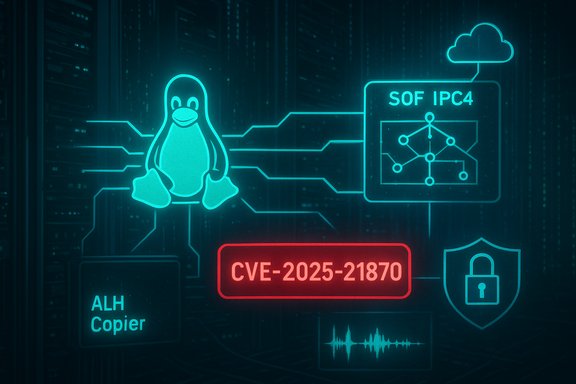
The vulnerability lives in the Linux kernel’s ASoC (ALSA System on Chip) SOF IPC4 topology implementation. In short, topology parsing and copier lookup code paths could assume that a found copier widget belonged to an ALH (Audio Link Hub) DAI (Digital Audio Interface) when in some cases a non‑DAI widget with the same stream name could be present. That mismatch leaves certain pointers uninitialized (copier->data becomes NULL), which in turn can lead to a kernel NULL‑pointer dereference in sof_ipc4_prepare_copier_module and related functions. The code path also contains a second loop that may miscount ALH devices, producing incorrect topology state and broken audio even when a crash does not occur.
This is an availability and stability bug — the practical impact is kernel crashes, audio subsystem failure, or broken pipelines on platforms that use SOF/IPC4 topology code paths. Multiple mainstream vulnerability trackers and several Linux distribution security advisories treat the issue as a legitimate kernel defect and have mapped fixes or backports into vendor kernels.
The fix applied upstream hardens the matching logic: before trusting a widget as an ALH copier, the code now validates that the widget is a DAI widget (so dai = w->private is valid) and then verifies that the DAI in question is actually an ALH copier. This eliminates the unsafe assumptions that previously allowed NULL copier data to be followed.
However, Microsoft produces and publishes multiple distinct Linux artifacts and kernel builds — and whether any given artifact includes a particular upstream component is a build‑time and packaging decision. Other Microsoft artifacts that are plausible carriers include:
The correct operational path for defenders is straightforward: treat Azure Linux as in‑scope and apply vendor patches promptly; perform artifact‑level verification for other Microsoft images you run (WSL kernels, linux‑azure kernels, Marketplace images); and apply containment mitigations where patching is delayed. Microsoft has committed to publishing machine‑readable VEX/CSAF attestations and to update the CVE mapping if additional products are identified, but until those mappings arrive, per‑artifact inspection is the only definitive way to know whether a particular Microsoft product is affected.
Source: MSRC Security Update Guide - Microsoft Security Response Center
 Background / Overview
The vulnerability lives in the Linux kernel’s ASoC (ALSA System on Chip) SOF IPC4 topology implementation. In short, topology parsing and copier lookup code paths could assume that a found copier widget belonged to an ALH (Audio Link Hub) DAI (Digital Audio Interface) when in some cases a non‑DAI widget with the same stream name could be present. That mismatch leaves certain pointers uninitialized (copier->data becomes NULL), which in turn can lead to a kernel NULL‑pointer dereference in sof_ipc4_prepare_copier_module and related functions. The code path also contains a second loop that may miscount ALH devices, producing incorrect topology state and broken audio even when a crash does not occur.This is an availability and stability bug — the practical impact is kernel crashes, audio subsystem failure, or broken pipelines on platforms that use SOF/IPC4 topology code paths. Multiple mainstream vulnerability trackers and several Linux distribution security advisories treat the issue as a legitimate kernel defect and have mapped fixes or backports into vendor kernels.
The fix applied upstream hardens the matching logic: before trusting a widget as an ALH copier, the code now validates that the widget is a DAI widget (so dai = w->private is valid) and then verifies that the DAI in question is actually an ALH copier. This eliminates the unsafe assumptions that previously allowed NULL copier data to be followed.
Why Microsoft’s wording matters — attestation vs. exclusivity
Microsoft’s public advisory language — stating that “Azure Linux includes this open‑source library and is therefore potentially affected by this vulnerability” — is precise and deliberate. It communicates three things:- Microsoft has completed an inventory for the Azure Linux product family and found the upstream open‑source component in the artifacts that make up that product.
- Microsoft is therefore treating Azure Linux as a confirmed product to triage and remediate, and it will publish updates and fixes accordingly for customers using those images.
- The statement does not assert exclusivity; it does not say that only Azure Linux could include the component. It is a product‑level attestation, not a universal negative for all Microsoft artifacts.
Technical context: SOF, IPC4, ALH, and the local attack surface
To put the bug in technical perspective:- SOF (Sound Open Firmware) is an open‑source audio DSP firmware and associated kernel glue used on a variety of Intel and other platforms. SOF implementations include topology parsing code that maps logical audio widgets to hardware endpoints.
- IPC4 is an inter-processor communication format used by SOF implementations and topologies in recent kernels. The topology code for IPC4 is responsible for matching “copier” widgets (which copy streams between endpoints) to the underlying hardware representation.
- ALH (Audio Link Hub) copiers are a specific kind of DAI used on certain Intel platforms. The vulnerable code assumed that a copier name match meant an ALH copier; that assumption is unsafe if a non‑DAI widget reuses a stream name.
- The vulnerability is local in scope: exploiting it requires technical access to the machine (local user or privileged local process) and the ability to direct audio topology operations that exercise the vulnerable parsing routines. In practical enterprise terms the risk is most significant where untrusted local users, containerized workloads, or automated workloads can interact with device nodes or load modules that trigger SOF topology parsing.
Cross‑checks and verification of the flaw and remediation
Independent, authoritative sources confirm the upstream description and the nature of the fix:- National and distributor vulnerability databases and multiple Linux distribution security advisories reproduce the upstream description of the APC4/ALH matching logic error and the NULL pointer risk. Those advisories indicate the fix hardens the matching loops and corrects ALH device counting.
- At least two mainstream distro advisories and multiple vulnerability trackers show the issue was recorded as resolved upstream and have included the appropriate kernel commits or backport references into vendor kernels.
Is Azure Linux the only Microsoft product that includes the library?
Short, operationally useful answer: No — not necessarily. Azure Linux is the only Microsoft product the company has publicly attested, through its CSAF/VEX attestations and Security Update Guide, as including the implicated open‑source kernel component at the time of the advisory. That attestation is authoritative for Azure Linux and means Azure Linux customers should treat the product as in‑scope and patch accordingly.However, Microsoft produces and publishes multiple distinct Linux artifacts and kernel builds — and whether any given artifact includes a particular upstream component is a build‑time and packaging decision. Other Microsoft artifacts that are plausible carriers include:
- The WSL2 kernel builds Microsoft ships for Windows Subsystem for Linux.
- linux‑azure kernel packages or kernel images used for some Azure VMs.
- CBL‑Mariner‑derived images or other Microsoft base images that Microsoft builds for container hosts or managed services.
- Marketplace VM images or partner appliances that include kernels Microsoft builds or maintains.
Practical verification checklist for operators
To remove doubt in environments that run Microsoft-supplied artifacts, perform per‑artifact verification. The steps below are practical, reproducible checks that administrators can run:- For Linux VMs and physical hosts (including Azure Linux images):
- Check the kernel version and vendor package: uname -a; /usr/lib/os-release; check package manager for kernel package names and versions.
- Inspect runtime kernel config (if present): zcat /proc/config.gz or grep CONFIG_SND /boot/config-$(uname -r).
- Search installed modules for SOF or IPC4: lsmod | egrep 'sndsof|sof|ipc4' and check /lib/modules/$(uname -r)/kernel/drivers/sound/soc/ for sof or ipc4 topology files.
- Look for matching source or module names: find /lib/modules/$(uname -r) -type f -name 'sof' -or -name 'ipc4'.
- If modules are present, inspect module versions and changelogs in distribution package metadata (rpm -qi package; apt changelog or dpkg -l and apt changelog).
- For WSL2 (Windows Subsystem for Linux):
- Query the WSL kernel version with uname -r inside a WSL shell and compare to the public microsoft/WSL2‑Linux‑Kernel releases and tags.
- If using the default Microsoft kernel, examine the module tree (if modules are enabled) or check whether drivers are built in by inspecting the WSL kernel config from the public Microsoft kernel repo or from the build tag — examine the Kconfig flags for sound drivers or SOF.
- If running a custom WSL kernel, rebuilds must include or exclude the SOF/IPC4 files explicitly — treat custom kernels as in‑scope if built from upstream commits that predate the patch.
- For Azure Marketplace images and other Microsoft-supplied ISOs:
- When possible, extract kernel package metadata from the image or boot an ephemeral instance to inspect uname -r, installed modules, and kernel config.
- Contact Microsoft support or consult VEX/CSAF output for that product SKU if available; if Microsoft has not attested, request a VEX attestation or SBOM for the artifact.
Mitigation and remediation guidance
Given the vulnerability characteristics (local DoS / availability impact in audio subsystems), the following actions reduce risk while vendors and distributions publish fixes:- Prioritize kernel updates for affected images: apply the vendor‑provided kernel or distribution patch as soon as vendors publish a backport or fixed kernel package for your distribution and image type.
- If patching is delayed, implement least privilege controls around audio and device nodes:
- Restrict unprivileged users from accessing sound device nodes (/dev/snd/*, or /dev/dri if the topology path relies on DRM devices in your environment).
- Avoid mapping host sound devices into untrusted containers. For containerized workloads, do not pass through /dev/snd or /dev/dri to containers unless necessary.
- Restrict module loading for untrusted users and processes: set module loading policies, use kernel lockdown/MODPROBE settings to prevent on-the-fly insertion of possibly vulnerable modules by non‑privileged actors.
- For WSL2 hosts: keep Windows updated (WSL kernel updates distributed through Windows Update) and track the Microsoft/WSL2‑Linux‑Kernel release notes for kernel updates that include the SOF/IPC4 hardening commits.
- Audit automation and orchestration tooling that might deploy Microsoft images en masse; ensure image pipelines pull the patched kernel images once distributed.
Operational risk model: how to prioritize
Risk prioritization for this CVE should consider the following factors:- Presence of SOF/IPC4 code in the artifact: if inspection shows the driver or module is absent, the artifact is not vulnerable.
- Exposure of audio device nodes to untrusted users/containers: multi-tenant hosts that expose device nodes to lower‑privilege processes raise operational risk.
- Use of Microsoft artifacts that may include kernels built from upstream commits where the fix is not yet backported (for example, some Marketplace or custom images): those need artifact‑level verification.
- The potential impact of availability/stability failures on your workload: if your environment uses audio pipelines as part of critical workflow (media processing hosts, telephony appliances), treat the priority as higher.
Why this question is more about inventory than a new zero‑day
The core of the user’s query — “Is Azure Linux the only Microsoft product that includes this open‑source library and is therefore potentially affected?” — exposes a supply‑chain and inventory challenge rather than a binary vulnerability judgment.- Large vendors ship thousands of artifacts. Identifying whether a given product contains a specific upstream file or module is a build‑time and packaging question. Microsoft’s VEX/CSAF attestations aim to reduce this uncertainty by publishing machine‑readable mappings for a product family once inventory for that family is complete.
- Starting the VEX rollout with Azure Linux is an operationally sensible first step: it gives cloud customers an authoritative signal for one product family. But an attestation for one product does not logically imply the absence of the upstream component in other Microsoft artifacts.
- Consequently, the defensible operational posture is: treat Azure Linux as confirmed in‑scope (and patch accordingly), and verify other Microsoft artifacts you depend on by inspection or by awaiting explicit vendor attestations.
Recommended runbook (concise, repeatable)
- Inventory phase
- List all Microsoft-supplied artifacts in your estate (Azure images, WSL2 instances, Marketplace images, appliance/partner images).
- Group artifacts by how they are consumed and whether they run kernel code (VMs, containers, WSL).
- Verification phase
- For each artifact, run the verification checklist: uname, module lookup, kernel config, and package changelog.
- If you cannot inspect an artifact (managed service), request VEX/CSAF attestation or an SBOM from the vendor or vendor support channel.
- Mitigation phase
- Patch Azure Linux instances immediately when Microsoft publishes a fixed kernel image or package.
- For other artifacts that are verified to include SOF/IPC4 and are unpatched, apply containment mitigations (restrict device node access, limit module loading, avoid host device pass‑through).
- Remediation phase
- Deploy fixed kernels and verify via reboot and functional validation that the audio stack no longer produces topology errors or crashes.
- Monitor vendor advisories and the vendor’s VEX feed for scope expansion or updated attestations.
Unverifiable claims and caveats
- It is not possible to state, from the public record alone, whether every Microsoft product other than Azure Linux includes the specific SOF/IPC4 topology code implicated by CVE‑2025‑21870. That is an artifact‑level fact that requires either Microsoft’s published VEX/CSAF attestation for that product or direct binary/source inspection of the product’s kernel artifacts.
- Assertions that all Microsoft WSL kernels or all marketplace images are affected would be speculative without per‑artifact confirmation. In many cases Microsoft’s WSL kernel repo and Microsoft’s kernel release tags are public and can be inspected; for closed or marketplace artifacts, operator inspection or vendor attestation is required.
- The CVE’s practical impact differs by kernel configuration. Some kernels built without SOF/IPC4 support or with vendor backports applied are not vulnerable. Always validate via the steps in the verification checklist.
Conclusion
CVE‑2025‑21870 is a real kernel instability bug in the SOF IPC4 topology code that can cause NULL pointer dereferences and broken audio pipelines. Microsoft’s statement that Azure Linux includes the implicated open‑source library and is therefore potentially affected is an authoritative attestation for Azure Linux but does not prove that no other Microsoft artifact can include the vulnerable code.The correct operational path for defenders is straightforward: treat Azure Linux as in‑scope and apply vendor patches promptly; perform artifact‑level verification for other Microsoft images you run (WSL kernels, linux‑azure kernels, Marketplace images); and apply containment mitigations where patching is delayed. Microsoft has committed to publishing machine‑readable VEX/CSAF attestations and to update the CVE mapping if additional products are identified, but until those mappings arrive, per‑artifact inspection is the only definitive way to know whether a particular Microsoft product is affected.
Source: MSRC Security Update Guide - Microsoft Security Response Center
