

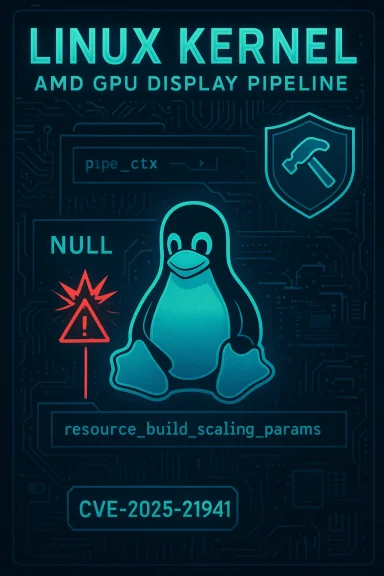
A subtle null‑check omission in the Linux kernel’s AMD display driver has been cataloged as CVE‑2025‑21941 and patched upstream; the bug is a local null‑pointer dereference in drm/amd/display’s resource_build_scaling_params that can crash the kernel and produce a denial‑of‑service condition on affected systems.
The Linux Direct Rendering Manager (DRM) stack mediates how user space and the kernel interact with GPU hardware for display, mode setting, and buffer management. The AMD-specific portion of that stack—the amdgpu driver and the files under drm/amd/display—contains a substantial body of code that prepares and programs display pipelines, timing, and scalers for attached panels and external monitors. One of the internal routines responsible for preparing scaling parameters for a plane is named resource_build_scaling_params; it expects a valid per‑plane state pointer (plane_state) to be present when the pipe context (pipe_ctx) refers to an active plane. When that pointer is unexpectedly NULL and the code dereferences it, the kernel can hit an oops / BUG and stop servicing the system’s display stack, which can escalate to a complete host crash or sustained unavailability until reboot or remediation.
This CVE was identified through a code review and fixed by adding an explicit guard to ensure that pipe_ctx->plane_state is validated before its fields are accessed. The upstream kernel commit that provided the fix was later propagated into stable trees and distribution updates. Multiple vulnerability trackers and distribution advisories record the same root cause and the same remediation.
Key technical points about the fix:
High‑priority recommendations:
Source: MSRC Security Update Guide - Microsoft Security Response Center
 Background / Overview
The Linux Direct Rendering Manager (DRM) stack mediates how user space and the kernel interact with GPU hardware for display, mode setting, and buffer management. The AMD-specific portion of that stack—the amdgpu driver and the files under drm/amd/display—contains a substantial body of code that prepares and programs display pipelines, timing, and scalers for attached panels and external monitors. One of the internal routines responsible for preparing scaling parameters for a plane is named resource_build_scaling_params; it expects a valid per‑plane state pointer (plane_state) to be present when the pipe context (pipe_ctx) refers to an active plane. When that pointer is unexpectedly NULL and the code dereferences it, the kernel can hit an oops / BUG and stop servicing the system’s display stack, which can escalate to a complete host crash or sustained unavailability until reboot or remediation.This CVE was identified through a code review and fixed by adding an explicit guard to ensure that pipe_ctx->plane_state is validated before its fields are accessed. The upstream kernel commit that provided the fix was later propagated into stable trees and distribution updates. Multiple vulnerability trackers and distribution advisories record the same root cause and the same remediation.
What the bug is (technical summary)
The weak link: pipe_ctx and plane_state
Within AMD’s display code, a structure called struct pipe_ctx represents a display pipeline context and contains pointers to current plane state, stream metadata, and assorted per‑pipe resources (such as HUBP/DPP/transform structures). The driver’s functions frequently inspect pipe_ctx->plane_state to decide whether scaling or front‑end programming is needed. In several code paths, code previously assumed pipe_ctx->plane_state was non‑NULL when calling resource_build_scaling_params or when combining conditions involving plane_state flags. The missing check allowed the driver to dereference a NULL pointer under particular timing or configuration circumstances, producing an immediate kernel oops.How a NULL pointer dereference manifests
A NULL pointer dereference in kernel space is not a silent error: it typically triggers a kernel oops or BUG trace that either terminates the faulty task or, in severe cases, panics the entire system. For a display driver this is especially disruptive because the GPU driver is invoked during common operations (mode set, pageflip, hotplug, or even background display updates). The practical result for administrators and end users can be one of the following:- Immediate kernel oops and loss of the display stack, requiring a reboot.
- Persistent instability if the offending code path is exercised repeatedly (for example, by a local process that repeatedly attempts a particular display configuration).
- In multi‑tenant/shared environments, the ability for a local user to repeatedly trigger the condition and thereby deny availability to other users on the same host.
Patch and provenance: how it was fixed
The upstream remedy is small and surgical: maintainers added the missing null check(s) so that calls to resource_build_scaling_params and subsequent uses of plane_state only proceed when pipe_ctx->plane_state is non‑NULL. The patch was authored and merged into the relevant drm/amd/display code paths and then backported into stable kernels and vendor distributions where applicable. The kernel mailing‑list patch notes and stable‑tree cherry‑picks record the exact changes and commit IDs used to track and propagate the correction.Key technical points about the fix:
- The change is defensive and limited in scope: it avoids dereferencing a NULL pointer rather than re‑architecting logic.
- The fix was cherry‑picked into stable release branches to accelerate distribution rollouts.
- Multiple stable‑kernel and distribution advisories reference the same commit series, indicating consistent upstream maintenance.
Exposure and affected systems
Where the code lives
Because the vulnerability is in the upstream Linux kernel’s AMD DRM/display code, any product or distribution that ships an affected kernel that includes the drm/amd/display components and amdgpu driver could be impacted. That includes:- Desktop and laptop installations running a kernel that includes the amdgpu DRM code.
- Cloud images or appliances that intentionally expose GPU resources to guests (for example, GPU‑enabled VMs).
- Embedded devices and appliances using upstream amdgpu code for display controllers.
Attack surface and prerequisites
This vulnerability requires local access to trigger. The typical attacker model is:- A local, unprivileged process that can interact with DRM device nodes (for example, /dev/dri/*) or a local user who can prompt the driver to take the code path that exercises resource_build_scaling_params.
- Low privileges are sufficient in many cases because the driver’s interfaces are user‑accessible for legitimate display operations.
- Remote exploitation is not the primary vector: the vulnerability is not network‑accessible by itself unless combined with other flaws that expose local command execution to a remote actor.
Operational impact: what administrators should expect
- For desktop users: If the bug is triggered, the system may show a GPU driver oops and require a reboot to recover display functionality.
- For servers with GPU passthrough or accelerator sharing: a local user may be able to disable or destabilize the display subsystem, which in virtualized deployments can cause guest or host instability and affect other tenants.
- For cloud providers: the vulnerability’s local requirement reduces remote exposure, but misconfigured GPU access or privileged guest features could enlarge the attack surface.
Mitigation and remediation guidance
Immediate mitigation and recovery options prioritize safety and availability while operators apply vendor patches.High‑priority recommendations:
- Apply vendor kernel updates as soon as they are available for your distribution or appliance. Distribution advisories and OSV entries list patched kernel versions and USN/errata numbers. Rolling updates into production is the recommended route.
- If a quick patch is not possible, remove or restrict access to the amdgpu DRM device nodes for untrusted users. Practical options include:
- Restricting file permissions on device nodes under /dev/dri so only trusted accounts can access the DRM devices.
- Unloading or blacklisting the amdgpu kernel module (understanding that doing so will disable GPU acceleration and displays driven by that driver).
- For virtualized or containerized platforms:
- Ensure that containers do not give untrusted processes direct access to host DRM devices.
- For GPU passthrough setups, verify that device isolation and guest privilege boundaries are configured to the minimum necessary.
- Monitor for driver oops messages in kernel logs (journalctl, dmesg) that reference amdgpu, drm, pipe_ctx, or resource_build_scaling_params; these will be indicators that the code path was exercised and that a system may need remediation or patching.
- Treat systems that are shared between users (multi‑user desktops, shared build servers, CI systems) as high‑priority for patching because local user access is an enabling factor.
- Identify kernels in use and map to distribution advisories (use your vendor’s security guidance).
- Schedule and deploy kernel updates for affected hosts.
- If you cannot patch immediately, restrict DRM device access or remove the amdgpu module temporarily.
- Validate remediation by checking that kernel packages reflect the patched stable commit and by verifying there are no new oopses after the update.
- If you operate a fleet, automate verification via configuration management and remote log monitoring.
Why this matters beyond a single oops
A few important, broader points explain why an apparently small defensive fix merits attention:- The bug’s presence in a widely used kernel subsystem (DRM / amdgpu) means it reaches many device classes: desktops, laptops, embedded systems, and cloud images. Vulnerabilities in kernel drivers frequently have out‑sized operational impact because they execute with kernel privileges and can affect fundamental host availability.
- The attacker model is realistic. Many modern systems expose GPU devices to non‑root users for legitimate reasons (compute APIs, local rendering, virtualized GPU sharing). That exposure makes local denial‑of‑service trivially attainable if the underlying code allows NULL dereferences.
- The fix is defensive and demonstrates good kernel hygiene: missing NULL checks are a recurring pattern class in device drivers, and addressing them in a targeted way reduces the attack surface and prevents simple crash primitives that can be weaponized in other exploit chains.
Cross‑verification and evidence
Multiple independent sources corroborate the vulnerability description, impact, and remediation:- National Vulnerability Database (NVD) records the CVE and summarizes the fix and affected code path.
- The upstream kernel patch and related stable‑tree cherry‑picks show the actual code diff where additional null checks were added; these appear in kernel commit logs and mailing‑list posts documenting the change.
- Open Source Vulnerability (OSV) and distribution security trackers list the CVE and map it to vendor advisories and patched package numbers, enabling operators to find the correct package updates for their systems.
Practical examples: who should patch first
- Multi‑user servers and shared workstations: patch immediately. These systems are most exposed to local, unprivileged actors who might accidentally or deliberately trigger the condition.
- Developer workstations used to build or test GPU‑driven stacks: patch quickly to avoid CI interruptions.
- GPU‑attached cloud hosts or VMs used for GPU workloads: coordinate with your cloud provider and apply vendor patches as they become available; consider restricting device access if immediate patching is not possible.
- Home desktops with one trusted user: patch on your normal maintenance cadence, keeping in mind that the risk model is lower if the system has a single trusted user and limited third‑party code running.
What we do not know (and what to watch for)
- Public exploit code: at the time of publication there is no confirmed public proof‑of‑concept demonstrating remote or ralation stemming from this defect; the primary impact remains denial of service. Track vulnerability feeds and distribution advisories for any sudden changes in exploitation reports.
- Secondary impacts: while this CVE itself is availability‑centred, kernel oops primitives are often useful building blocks for more complex exploitation. Security teams should remain vigilant for correlated vulnerabilities that could widen the impact surface.
- Product mappings: vendors’ scope‑attestations (for example, when a vendor says “this product includes this open‑source component and is therefore potentially affected”) are useful but are product‑scoped by definition; administrators must verify whether their specific kernel builds include the affected code path. Microsoft’s public attestation model for Azure Linux historically has been conservative and product‑scoped; operators running other Microsoft‑distributed kernels (WSL, OEM kernels, etc.) should confirm their own inventory.
A cautionary note on workarounds
Blacklisting the amdgpu module or restricting /dev/dri access are practical short‑term mitigations but come with tradeoffs:- Blacklisting amdgpu will remove GPU acceleration and may render some displays unusable on systems that rely on the amdgpu driver. For servers that depend on GPU acceleration, blacklisting is often unacceptable.
- Restricting device node permissions reduces attack surface but requires careful operational management to avoid disrupting legitimate workflows.
Takeaways for IT teams and enthusiasts
- CVE‑2025‑21941 is a medium‑severity, availability‑focused CVE in the AMD DRM display stack that allows a local actor to trigger a kernel NULL pointer dereference by exercising resource_build_scaling_params when pipe_ctx->plane_state is NULL.
- Upstream fixes have been merged and cherry‑picked into stable kernels; distribution advisories and patched kernel packages are available from major vendors. Prioritize updates on multi‑user and GPU‑exposed systems.
- The recommended mitigation path is to apply vendor updates. If immediate patching is impossible, reduce the attack surface by restricting access to DRM devices or temporarily disabling the amdgpu module, with a clear plan to restore functionality after applying patches.
- Continue monitoring official advisories and kernel logs for signs of attempted exploitation or recurring oops traces that reference the affected code paths.
Conclusion
CVE‑2025‑21941 is a textbook example of how a tiny omission—a missing NULL check—can translate into a measurable operational risk when it lives in kernel space and touches a widely used driver. The fix itself is straightforward and has been distributed through upstream and downstream channels, but the lesson remains: kernel device drivers must be defended with defensive checks because the consequences of a crash are system‑wide. Administrators should treat the CVE as a patch‑now issue for shared and GPU‑exposed systems, and as a medium‑priority update for single‑user desktop systems. Keep an eye on distribution advisories, apply the published kernel updates, and use access control to reduce exposure until patches are deployed.Source: MSRC Security Update Guide - Microsoft Security Response Center
